VIFF 2012: A Mere Life

The Vancouver International Film Festival’s annual Dragons & Tigers competition has an impressive pedigree, honoring young filmmakers over the years such as Jia Zhangke, Hong Sangsoo, Koreeda Hirokazu, Lee Changdong, Wisit Sasanatieng and Liu Jiayin.  I think I’m going to make it to about half the competition films this year, and this film by Park Sanghun is the first.  It’s an unrelentingly grim movie that I’m surprised to find I actually liked quite a bit, given that I don’t normally warm to dark or depressing movies.

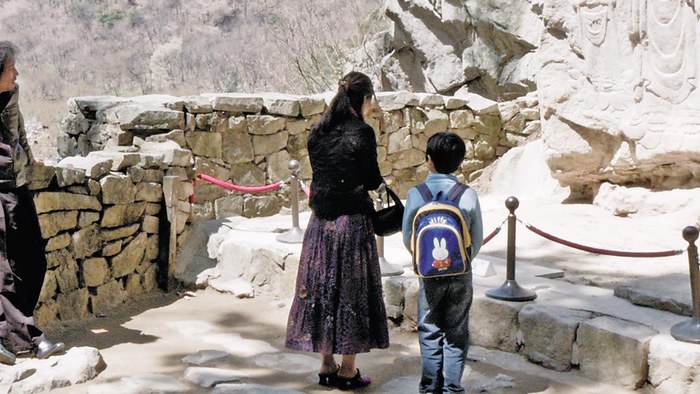
It starts off with a family visiting a Buddhist shrine.  The mother encourages her son to help her place a stone on top of a rock pile (the act has a religious significance of which I’m wholly ignorant).  When the precariously balanced pile collapses, the mother does a comical double take and runs away, leaving her exasperated husband (named Park Il-rae) to rebuild the pile (or face karmic wrath?, again, I’m ignorant).  That’s about the last bit of light comedy the film has to offer.  From there, it becomes a grunge-realist story of poverty and the husband’s drunken incompetence that comes to a head when he is scammed out of their savings and brings some poison home.

It’s here that the film takes an unexpected turn.  It certainly is a bold choice to have your main character murder his wife and child halfway through your movie, and Park doesn’t shy away from the horror or detestability of that act.  But that’s not the end of the story either.  Instead of making a film about how simply awful it is to be poor and married to a drunk, Park gives us something I haven’t quite seen before, a story about an irredeemable man that asks us not only to understand but to try to forgive him.  It asks the rare question, what do you do after you’ve committed an unforgivable act?  Park Il-rae sentences himself to walking the earth as a destitute wretch, while he keeps trying and failing to kill himself.  His father tracks him down (a striking fire-lit scene as the father burns all of Park’s meager possessions in his troll-like under-the-bridge home) and tries to kill him but dies of a heart attack instead.  He tries to hang himself, but the rope breaks.  We leave him wandering aimlessly alone in a desolate grey mudflat, shot with a nauseatingly unstable shaky cam.  Death would be too good for him, so karma (or whatever) simply won’t let him die.  It’s not simply that life is his punishment, I get the feeling he’ll be left to wander until he finds forgiveness, from the people he’s killed, from himself, and from us.
VIFF Day Two: 10 + 10

20 directors were commissioned by the Golden Horse Film Festival to each make a five minute film about something Taiwanese and the result is this collection, an unusually successful entry in the portmanteau film genre.  Ten of the directors are veterans, ten are relative newcomers (hence the title), but aside from a couple names I recognized (Wu Nien-jen and Hou Hsiao-hsein, of course), I couldn’t tell you which was which, I guess that bodes well for the Taiwanese film industry.  Seen as a whole, the film presents a compelling vision of Taiwan in all its diversity and weirdness, with some glances at serious issues thrown in.

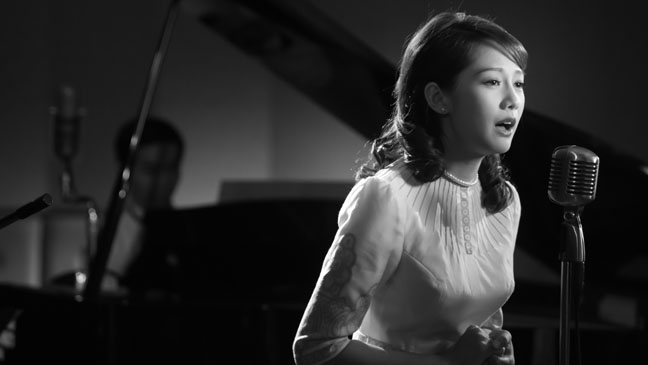
My favorites: Wang Toon’s opener Ritual about a couple of guys hiking to a remote shrine to give thanks for a lottery win (they’ve brought the gods a DVD of Avatar, which they watch together on a sheet strung across the hillside); Shen Ko Shung’s Bus Odyssey, a grim black and white film notable mostly for its sound design (especially given that direct sound was practically unheard of in Taiwanese cinema only 20 years ago); Wei Te-sheng’s Debut a pretty cheesy but heartfelt prayer for success in spreading knowledge about indigenous Taiwanese at a film festival; Hippocamp Hair Salon, a kind of Eternal Sunshine with a Wong Kar-wai look and a darkly funny twist  by Chen Yu-hsun; Sylvia Chang’s Dusk of the Gods, a moving meditation on religion and capital punishment (“Will a bad person like me get my good soul back when I’m executed?”); The Debut, by Chen Ko-fu, about a singer getting a True Romance-style pep talk from a glamorous phantom in 1968; Hou Chi-jan’s Green Island Serenade, another singer, this time singing for the radio in the black and white past, panning to the full color present, music as time travel; Leon Dai’s Key about the urban loneliness of a woman who pretends to have forgotten her key in the hopes of getting to talk to someone, erupting into a flash-cut ballet sequence; Unwritten Rules, a clever and hilarious indie film set comedy about trying to coverup the Nationalist flag a crew finds on location (line of the night: “Thank you for saving Taiwanese cinema.”); and finally Hou Hsiao-hsien’s La Belle Epoque, with Shu Qi hearing the story of her family’s golden heirlooms and posing for a portrait, which finds Hou for the first time (as far as I know) intercutting what appears to be archival or at least black and white footage into one of his films.

Romance Joe (Lee Kwangkuk, 2012)

My two favorite discoveries in four years of festival going are the films of Hong Sangsoo and the team of Johnnie To and Wai Ka-fai.  I surely would have encountered these guys eventually in the regular world, but it was in seeing their films here at VIFF (Like You Know it All and Sparrow, in 2009 and 2008, respectively) that I fell in love with them.  Subsequently, with each new festival I’ve looked forward to another trip into their worlds and this year is no exception.  While I’ll be seeing the latest Hong film, In Another Country, this evening, I was a bit disappointed to find there would be no new To and/or Wai film here this year.  Fortunately, the gap of narrative playfulness that so joyously marks their work (Wai’s especially, see for example, Written By, from VIFF 2009) I found in abundance in Romance Joe, by first-time director Lee Kwangkuk.

Lee is a former assistant director for Hong Sangsoo, and the film begins very much as a kind of mishmash of various Hong situations (a director has writer’s block, gets drunk, goes to a hotel in the countryside).  However, Lee takes Hong’s narrational games, usually limited to a bifurcated story structure with later parts serving as variations on earlier ones, in a wholly original direction, piling story upon story in a complicated flashback structure.  I counted at least six different time levels in the narration (topping Passage to Marseille‘s mere four), with “real” memories and made-up stories featuring the same characters and actors colliding in unpredictable ways.  I’m going to attempt to roughly chart it out.

The film starts with the parents of a director talking to his friend about how the director has gone missing (1).  The friend tells them he was just drinking with the director, and he was sad because he had writer’s block (2).  We then see the director being abandoned by his agent in a rural hotel in an attempt to force him to get to work (3).  The director in his hotel calls a local prostitute, who tells him the story of the time she met another director, who she calls Romance Joe (4).  When she met him, Joe was thinking about killing himself, remembering a time when he was a teenager that he saved a girl, Cho-hee, from killing herself. (5)  Then, we cut back to the first story, and the friend starts telling the parents about his idea for a new screenplay, about a boy who tries to track down his mother, a prostitute, but instead ends up hanging around another call girl instead (6).

At this point, Lee begins to intercut between the various narrative layers, with fictional and real characters showing up in the “wrong” stories, and no one ever quite remembering if they’ve known each other before (there’s more than half a dozen stories, but apparently(?) only one woman), all governed by an explicit Alice in Wonderland reference.  But that’s not to say there isn’t an emotional core to the film.  In particular the budding romance between Joe and Cho-hee is lovely and touching, though it ends drenched in the neon sadness of Seoul.  As the director’s mother sighs “All these fine young lives wasted on film and whatnot.”