Running Out of Karma: King Hu’s Painted Skin

Running Out of Karma is my on-going series on Johnnie To and Hong Kong cinema. Here is an index.

King Hu’s final film, it is, like his greatest work (A Touch of Zen) and his first film as an assistant director (The Enchanting Shadow), an adaptation of a story from the 18th Century collection of folk and supernatural tales Strange Stories from a  Chinese Studio by Pu Songling. Hu’s previous film had been a failed collaboration with Tsui Hark and Ching Siu-tung on the first Swordsman film, and I wonder if there wasn’t a bit of “I’ll show you” at work in Hu’s decision to make a film so closely related to Tsui and Ching’s A Chinese Ghost Story, going so far as to include that film’s female star, Joey Wong, in his cast.

Like Zen and Come Drink with Me, Painted Skin features a shifting protagonist. We begin with Adam Cheng’s bourgeois nobody. He meets the ghost of Joey Wang and learns she’s being trapped in-between the afterlife and reincarnation by a demon called “The King of Yin/Yang” and seeks out two Taoist priests to help her out. Then Cheng disappears from the narrative and we follow the priests (played by veteran supporting performers Wu Ma and Shun Lau) for awhile as they seek out an even better priest to fight the demon. Then we follow the super-priest (Sammo Hung) through the final third of the story.
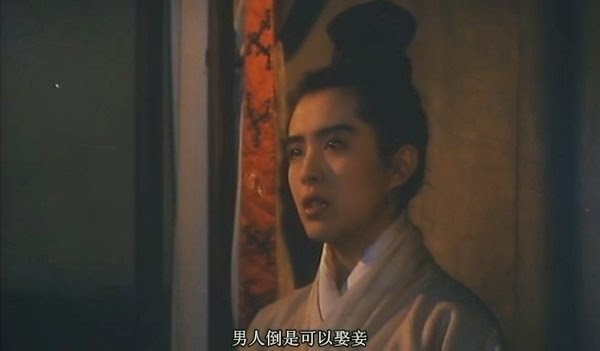
In Zen, the similar progression from everyman to super-priest is tied up with  every other element of the film, as the heroes become less worldly and more divine, Hu’s filmmaking becomes more abstract, more purely visual, more inexplicable. Painted Skin though remains grounded in the same kind of swathed in pale blue light early 90s wuxia world from beginning to end. The villains, whether through poor subtitling or lack of budget or both, always seem slightly comical and ridiculous, even when they’re committing horrible acts (a far cry from the baby-killing demons in Ching Siu-tung and Johnnie To’s The Heroic Trio, which also was released in 1993 and involves the netherworld creeping into the everyday and a journey into darkness to defeat it). Hu doesn’t cut his wire-work stunts at the dizzying pace Ching does, but neither does he find time or space for more realistic fighting. The result is just a slower version of silly fights. If Hu didn’t have such a brilliant eye for composition, light and space, the film would be intolerable.
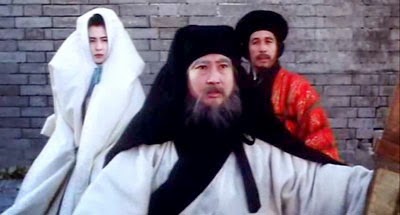
It’s fitting that Hu’s final film would star Sammo Hung. The two had a long and fruitful collaboration, with Hung reportedly serving as an assistant action director on Come Drink with Me, though he was only 14 years old. He had small supporting roles in Dragon Gate Inn, A Touch of Zen and The Valiant Ones, and served as action director on the latter two as well as The Fate of Lee Khan. He looks old here, made up with a gray beard and wizard robes, aside from his introductory scenes, he doesn’t really get time or space to develop his Taoist Gandalf character, nor does he have much opportunity to show off his fighting skills, given the supernatural nature of the action (Lam Ching-ying gets such a chance in a too-small cameo role as “The Purple Taoist”).

Sammo appears to have peaked with 1989’s Pedicab Driver. His 1990s directorial efforts are of low reputation (the only one I’ve seen is his final film, Once Upon a Time in China in America, the idea for which he either stole from Jackie Chan (Shanghai Noon) or vice versa) and he hasn’t directed anything at all since 1997. That year he left Hong Kong for the US (oh how I long for a DVD set of his cop show with Arsenio Hall, Martial Law) and since his return to Hong Kong, has worked exclusively as choreographer, producer and supporting actor. All lot of small roles like his performance in Painted Skin, tantalizing with memories of past greatness but almost never reaching the heights of his previous work.
Running Out of Karma: Samson Chiu’s Golden Chicken 2

Running Out of Karma is my on-going series on Johnnie To and Hong Kong cinema. Here is an index.

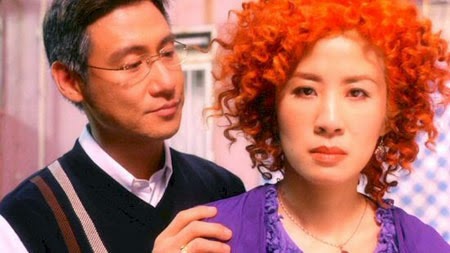
The first Golden Chicken filtered 30 years of Hong Kong history through the life of one ridiculous prostitute and dared you not to be moved by her. Samson Chiu’s sequel, released one year later tries the same trick, but with 30 years of Hong Kong cinema instead, most specifically the work of Wong Kar-wai.

Beginning in the year 2046 (the year Hong Kong finally will be fully incorporated into the People’s Republic, and also of course the title of Wong’s career-summarizing masterpiece, the editing for which was still in progress when this film was released), we meet Sandra Ng’s Kum, the eponymous hooker. Now an old lady (she’s had some work done), she meets a despondent young man and tries to talk him out of erasing his memory (as Hong Kongers of the future will do to deal with their romantic traumas). She tells him stories of a very bad year she had, 2003, with the message that as bad as it was, she wouldn’t give up the memory for anything. The bulk of the film then is three stories of Kum’s year. The first is her comical involvement with a couple of terrible johns: Ronald Cheng plays a man who is weirdly obsessed with her body hair (he has a memory problem: keeps forgetting his wife, Angelica Lee) and Anthony Wong as a client who’s apparent goofy kinkiness is actually suicidal. Next is a section devoted to the SARS epidemic and the medical workers who work tirelessly to fight it, epitomized by a masked doctor played by Leon Lai. The third and by far longest story is Kum’s lifelong relationship with her cousin (think As Tears Go By) Quincy, played by Jacky Cheung.

This story weaves Quincy into the margins of Kum’s life as told in the first film. He’s an inveterate schemer, an amoral capitalist who shows up every few years to charm Kum out of some money and break her heart. He’s an ideal of a kind of Hong Kong ideology: one Christmas his big romantic gesture is a massive set of Christmas lights covering a skyscraper, drawing a giant $ on the HK skyline. Cheung matches Ng’s manic performance, and both wring surprising pathos out of a film where the main character is named “Kum”.

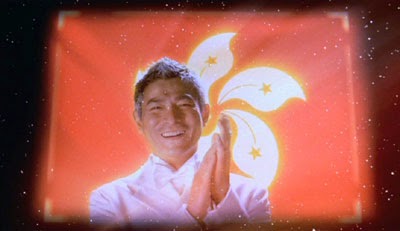
As in the first film, the high point comes with an Andy Lau cameo at the end. He leaves us, and Kum, with the promise that when we close our eyes and open them, we’ll see our Hong Kong, the one we love most. Kum sees the 1980s skyline at night, blue and red and yellow and black, bright and in constant motion, a shot that could have come from any number of John Woo or Tsui Hark or Ringo Lam classics. I’m going to say it’s from A Better Tomorrow.

Running Out of Karma: Notes on Alex Law’s Painted Faces

Running Out of Karma is my on-going series on Johnnie To and Hong Kong cinema. Here is an index.

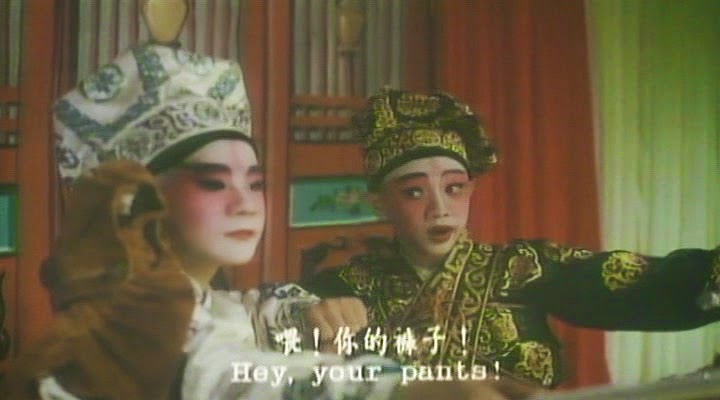
A lovely account of youth spent in the China Drama Academy Peking Opera school, based on the experiences of Sammo Hung, Jackie Chan, Yuen Biao, Corey Yuen and the other members of the Seven Little Fortunes performing troupe that grew up to dominate Hong Kong Cinema from the late 70s through the mid-90s (and beyond). Sammo himself plays their teacher, Yu Jim-yuen (“Yu Ho” in the film) tough (hitting the kids with a stick is his preferred method of punishment) but sentimental and adorably awkward at times. In a sweetly romantic subplot, Sammo walks all over the island looking for a birthday cake for Cheng Pei-pei, a fellow teacher he’s sweet on. Each of the interactions between these two kung fu movie icons is gold, and with nary a punch or kick between them.

The film is somewhat unexpectedly effective at conveying the double outsider status of the students: not only are many of them immigrants to Hong Kong (the master himself is from Peking) but their devotion to a dying artform, and the anti-modern schooling methods that make them great at it (most of the kids are essentially illiterate) doubly separate them from the quickly Westernizing world around them.

The film even takes the time to explore the world of Shaw Brothers stunt men, with Lam Ching-ying as Sammo’s old friend, trying to get by, who takes one blow to the head too many. We and the young students witness his on-set breakdown, a scene made horrifying as much by the fact that we know what these kids are going to spend their lives doing as it is by Lam’s harrowing performance.

I like to think that the scene of Jackie Chan (known throughout as “Big Nose”) standing on a railing serenading his teacher on the eve of the school’s closure served as an inspiration for the end of Dead Poets Society.

There’s an odd Mobius effect whenever Sammo the actor is talking to Sammo the character, we’re watching an older man constantly in the presence of his younger self, knowing that this kid will grow up to be this actor, making this movie about this kid who will grow up to be this actor. Sammo’s performance is brilliant regardless (he won the Hong Kong Film Award for Best Actor), but that extra element makes the movie all the more poignant. Also he uses a turtle to prop up his bed, a position which said turtle appears perfectly happy to occupy for years and years.

This is the first of only three movies directed by Alex Law, who previously co-wrote the very solid Chow Yun-fat-Cherie Chung melodrama An Autumn’s Tale, which was directed by Mabel Cheung, who co-wrote Painted Faces with Alex Law.

Running Out of Karma: Edmund Pang Ho-cheung’s Isabella

Running Out of Karma is my on-going series on Johnnie To and Hong Kong cinema. Here is an index.

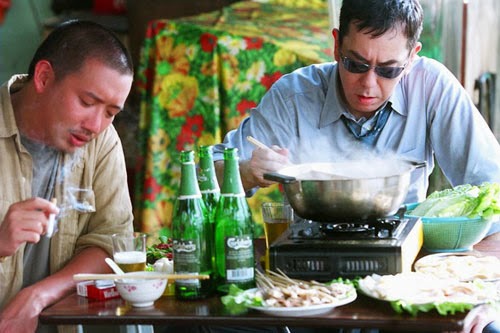
First things first: Anthony Wong is in this movie. He is in three scenes and he is eating in every one of them. It’s set in Macao and was released in 2006. I’m pretty sure he filmed his scenes on his lunch breaks during the making of Exiled. Anthony Wong is the best.

Set in the months leading up to the handover of Macao to the People’s Republic in 1999, it’s an off-beat father-daughter story. Literally off-beat, as the film has a rhythm I’ve never seen before. A seemingly inexplicable event will be shown, followed by the scenes which explain what happened. For the first half hour or so this weird push-pull structure slowly draws you into the story of a corrupt cop who meets his 16 year old daughter and tries to help her find her lost dog.

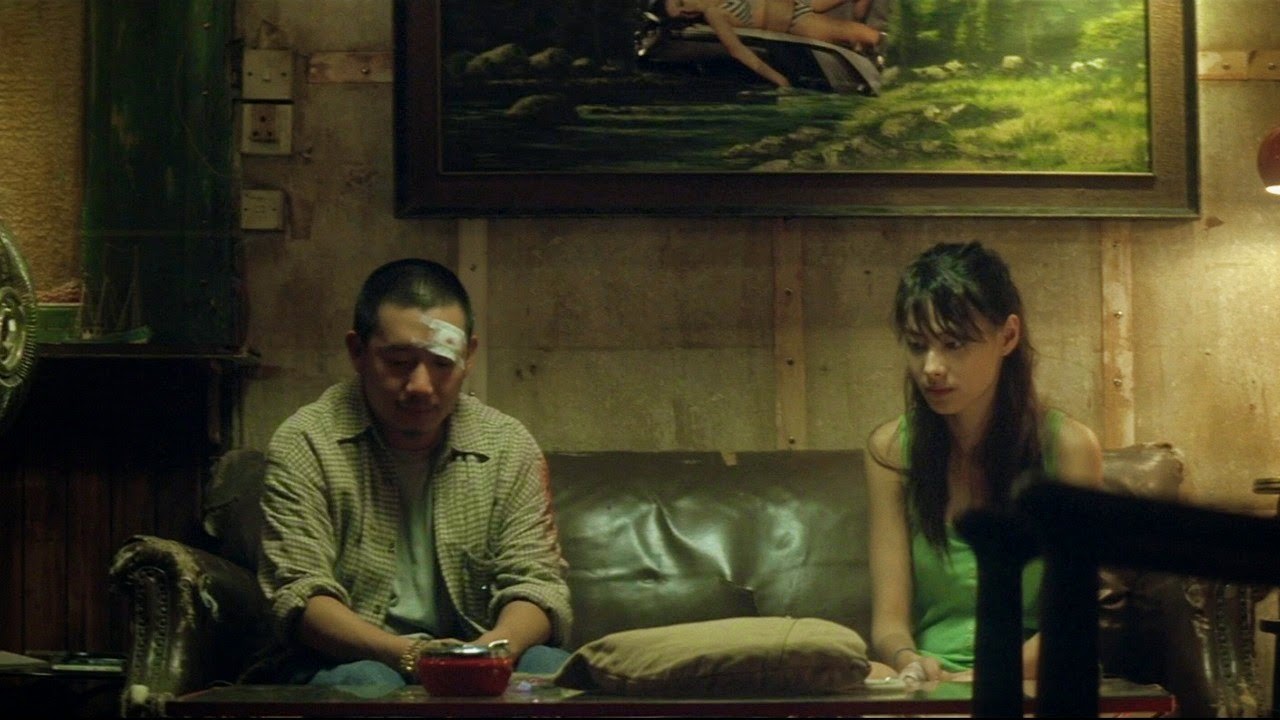
The dog is named Isabella, and so is the lead actress. A Portuguese name for a movie about a city moving on from its Portuguese past. Isabella Leong plays the daughter. 18 years old at the film’s release, she was already a pop star and from her performance her, well on her way to a great film career. Spindle-limbed, all elbows and knees bursting across the screen with a manic energy that blows apart her father’s sad decadent life. Their scenes in her father’s languid, dilapidated apartment recall the middle section of Pen-Ek Ratanaruang’s masterpiece Last Life in the Universe, a joyless space revivified. Leong is strikingly pretty, with sharp eyebrows and melancholy eyes. She appears to have retired from music and film in 2009 (after her only American film, the dreadful The Mummy: Tomb of the Dragon Emperor, a film mostly notable for wasting both Jet Li and Michelle Yeoh). That year, she married Richard Li, the son of Li Ka-shing, a Hong Kong legend and one of the richest men in Asia (he appears as a character in Peter Chan’s He Ain’t Heavy, He’s My Father, played by Waise Lee), though they’ve since split up.

Anyway, as father and daughter get to know each other, bits of their pasts flash back. The dad’s relationship with her mother, as well as the police corruption scandals he is somehow involved in (the passage of time is marked by intertitles informing us of various uncovered criminal conspiracies involving the Macao police force). Also the girl’s relationship with a boy at school, one who loves her but whom she keeps at a distance, telling wild stories that don’t quite fit the truth of who her father is and what he represents. Chapman To as the father has the more difficult role, making a guy who in most respects is a lout, boorish, womanizing, drunk, violent and corrupt, not only lovable, but admirable. It’s a remarkable performance.

Set amid the crumbling colonial concrete of the city (so different from the shimmering skyscrapers of Hong Kong – there is an alien quality to Macao that is a world apart from the other colony, see it as well in João Pedro Rodrigues and João Rui Guerra da Mata’s eerie 2012 film The Last Time I Saw Macao) and scored with a wistful Iberian guitar (the score, by veteran Hong Kong composer Peter Kam, won an award at the Berlin Film Festival. Kam also did the music for Johnnie To’s Throw Down, Peter Chan’s meta-musical Perhaps Love and the first two Golden Chicken movies), director Edmund Pang Ho-cheung conjures something truly unusual: a lament for a lost world that probably wasn’t so great, and hope for an unknown future that might be even worse.