This Week in Rankings

Over the past couple of weeks, leading up to that annual celebration of movies and movie culture that is Oscar night, I handed out a bunch of Endy Awards for the years 1934 and 2007-2013. I enjoy putting those things together, probably too much. I also wrote long reviews of a number of films: 2013’s Cannes sensation Blue is the Warmest Color, Tsui Hark’s Young Detective Dee and the Rise of the Sea Dragon and Shanghai Blues (part of my on-going Running Out of Karma series), Hayao Miyazaki’s The Castle of Cagliostro (a warm-up to our epic They Shot Pictures episode on Miyazaki, Isao Takahata and Studio Ghibli) and my favorite movie of 2013, Raya Martin and Mark Peranson’s La última película (part of my on-going I swear coverage of the 2013 Vancouver Film Festival). On The George Sanders Show, we talked Oscars with Best Picture winners The Great Ziegfeld and Chicago.

Over at Letterboxd I have a few lists, new and updated: Running Out of Karma Movies, Tsui Hark Movies, Best Picture Oscar Winners, Alain Resnais Movies, Studio Ghibli MoviesMovies Discussed on The George Sanders Show, Movies Where People Fall Asleep On Screen and The Best Movies of Every Year.

These are the movies I’ve watched and rewatched over the last few weeks, and where they place on my year-by-year rankings. Links are to my comments at letterboxd.

The Great Ziegfeld (Robert Z. Leonard) – 16, 1936
The Life of Emile Zola (William Dieterle) – 30, 1937
Mrs. Miniver (William Wyler) – 17, 1942
Kiss of Death (Henry Hathaway) – 12, 1947
The Greatest Show on Earth (Cecil B. DeMille) – 30, 1952

Tom Jones (Tony Richardson) – 11, 1963
The Castle of Cagliostro (Hayao Miyazaki) – 17, 1979
Shanghai Blues (Tsui Hark) – 8, 1984
Grave of the Fireflies (Isao Takahata) – 11, 1988
Mystic Pizza (Donald Petrie) – 48, 1988

Kiki’s Delivery Service (Hayao Miyazaki) – 6, 1989
Only Yesterday (Isao Takahata) – 4, 1991
My Neighbors the Yamadas (Isao Takahata) – 3, 1999
Spirited Away (Hayao Miyazaki) – 6, 2001
Chicago (Rob Marshall) – 44, 2002

Howl’s Moving Castle (Hayao Miyazaki) – 23, 2004
Ponyo on the Cliff by the Sea (Hayao Miyazaki) – 15, 2008
The Secret World of Arrietty (Hiromasa Yonebayashi) – 36, 2010
The Master (Paul Thomas Anderson) – 4, 2012
Wolf Children (Mamoru Hosada) – 7, 2012

The Act of Killing (Joshua Oppenheimer) – 30, 2012
Museum Hours (Jem Cohen) – 34, 2012
La última película (Raya Martin & Mark Peranson) – 1, 2013
The Wind Rises (Hayao Miyazaki) – 10, 2013
12 Years a Slave (Steve McQueen) – 20, 2013
Young Detective Dee and the Rise of the Sea Dragon (Tsui Hark) – 21, 2013

All is Lost (JC Chandor) – 23, 2013
Blue is the Warmest Color (Abdellatif Kechiche) – 27, 2013
Blue Jasmine (Woody Allen) – 30, 2013
The Great Beauty (Paolo Sorrentino) – 37, 2013
Pompeii (Paul WS Anderson) – 1, 2014
And the Oscar Goes To… (Rob Epstein & Jeffrey Friedman) – 2, 2014

Running Out of Karma: Tsui Hark’s Shanghai Blues

Running Out of Karma is my on-going series on Johnnie To and Hong Kong cinema. Here is an index.

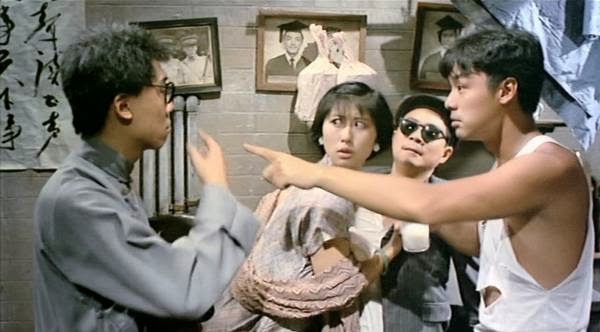
In his essential book Planet Hong Kong, David Bordwell examines a sequence in Peking Opera Blues where Tsui Hark deftly coordinates the movements of his actors as they try to remain hidden from an inquisitive father (three of them are in his daughter’s bed and two of them shouldn’t be, if I remember correctly). It’s a short little scene, and Bordwell uses it as an example of the creativity of Hong Kong artists, how they’re able to make an exciting and fun sequence out of almost nothing, budget-wise, and how Tsui’s mastery of cutting and framing keeps the whole sequence light and airy. Shanghai Blues is essentially a feature length version of that scene.

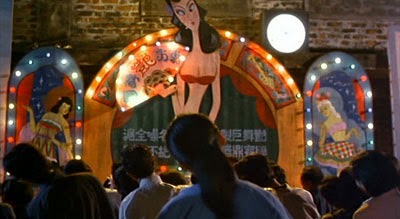
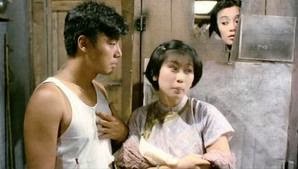
Set in the chaotic interregnum between the end of World War II and the end of the Civil War that would bring the Communists to power, Kenny Bee plays a veteran trying to make a living as a songwriter while searching for a girl he met only briefly, in the dark and under a bridge, ten years earlier during an air raid. He becomes entangled with his downstairs neighbors, Sally Yeh, a recent arrival who promptly has her pocket picked, and Sylvia Chang, a showgirl (who we know is the girl from the bridge). An early scene of Yeh and Bee just missing seeing each other as they do their roof-top laundry is compounded in the film’s central, and most extraordinary segment, when Chang, to get out of the rain, goes into Bee’s apartment to change clothes, but mid-change, Yeh arrives (she now has a crush on Bee) and so Chang hides in a closet. At the same time, the same pickpocket from early in the film is trying to rob the apartment and hiding from everyone else. Finally, one of Bee’s pals shows up, so Yeh goes into hiding as well. Bee attempting to hide the two girls from the friend and from each other while the thief tries to hide from everyone. All in the confines of a tiny, cunningly laid out apartment to which Tsui has spent the first half of the film slyly orienting us. It’s as remarkable a tour de force of choreography as you’ll find in any kung fu film.

This kind of romance, where the two heroes can’t see each other, though they occupy the same space (same frame) dates back at least as far as Paul Fejos’s 1928 Lonesome, and Tsui appears to be specifically riffing on it. The early shot of Bee and Chang’s separation in the crowd in particular recalls that film. Johnnie To’s Turn Left, Turn Right, what I’d consider one of his most underrated films (even among his romantic comedies: I think it has a lower profile because it lacks any of his signature stars, with Takeshi Kaneshiro and Gigi Leung instead of Sammi Cheng or Andy Lau or Louis Koo), follows that tradition as well, even adopting Lonesome‘s conceit that the two destined lovers are unwitting neighbors. But I wonder if Shanghai Blues isn’t the more proximate influence. In Lonesome, the heroes just miss each other through their parallel stories, but they rarely share the same filmic space. In Shanghai Blues, they’re often in the same space, looking right at and not recognizing each other, while everyone else in the film seems to be actively attempting to avoid being seen by someone (a girl at the nightclub hides from a lecherous gangster, Yeh mistakenly joins a modeling audition and is appalled by people looking at her (when she later gets the job, she’s mobbed by men everywhere she goes)). In the To film, no one is hiding, it is instead apparently chance and fate that prevents them from meeting, though through much of the film we see them together in the same frame. Tsui sets his avoidance dances in confined spaces (tiny apartments, dressing rooms), but To’s is set out in the open: a fountain in a public park, a street corner, a sidewalk (a similar scene plays out early in Romancing in Thin Air, itself a kind of compendium of all of To’s romantic comedies, where Sammi Cheng and Louis Koo wander outside the grounds of the hotel, oblivious to each others’ presence).

The three films are somewhat different in their thematic ends as well. Lonesome as all about the city, growing out of the city symphony subgenre of films in the late 20s, a time of rapid urbanization throughout the Western world, as people flocked from the farms and the countryside to new, anonymous urban centers, cut off from the family and communal structures that had supported their lives for generations. Turn Left, Turn Right is about chance and fate, the interplay of which forms one of the thematic cores of To’s work, expressed across genres in romantic comedies and gangster epics alike (exploring the development of this theme is one of the ultimate goals of Running Out of Karma). Shanghai Blues seems to me to be about in-betweenness, about a world that’s lost all its moorings, and the fear that what’s to come may be even worse. It’s about trying to keep your head down and get by, while dreaming of being a star. There doesn’t seem to be any metaphysical element to Tsui’s work; To and Wai Ka-fai have a spiritual preoccupation I’ve yet to identify in any of Tsui’s films. Peking Opera Blues ends with its heroes, having saved the day, riding off saying they’ll meet again soon, though we know the contingencies of the wars make that extremely unlikely. Similarly, as two of the heroes here leave Shanghai for Hong Kong, while the others stay behind, we know they too will never meet again. Just another pair of couples lost in the churn of history.

Predictions for the 86th Academy Awards

These are my predictions for the winners of this year’s Academy Awards. Alongside the winner, I’m including the winner of the 2013 Endy Award in that category.

Best Picture:
Endy: La última película
Oscar: 12 Years a Slave
Best Director:
Endy: Jia Zhangke, A Touch of Sin
Oscar: Steve McQueen, 12 Years a Slave
Actor:
Endy: Leonardo DiCaprio, The Great Gatsby & The Wolf of Wall Street
Oscar: Matthew McConaughey, Dallas Buyers Club
Actress:
Endy: Adèle Exarchopoulos, Blue is the Warmest Color
Oscar: Cate Blanchett, Blue Jasmine
Supporting Actor:
Endy: Nick Frost, The World’s End
Oscar: Jared Leto, Dallas Buyers Club
Supporting Actress:
Endy: Léa Seydoux, Blue is the Warmest Color
Oscar: Lupita Nyong’o, 12 Years a Slave
Original Screenplay:
Endy: Computer Chess
Oscar: American Hustle
Adapted Screenplay:
Endy: The Wolf of Wall Street
Oscar: 12 Years a Slave
Foreign Language Film:
Endy: The Missing Picture
Oscar: The Great Beauty
Documentary Feature:
Endy: The Missing Picture
Oscar: 20 Feet from Stardom
Animated Feature:
Endy: The Wind Rises
Oscar: Frozen
Film Editing:
Endy: La última película
Oscar: Gravity
Cinematography:
Endy: La última película
Oscar: Gravity
Art Direction:
Endy: The Missing Picture
Oscar: The Great Gatsby
Costume Design:
Endy: Her
Oscar: The Great Gatsby
Make-Up:
Endy: Blind Detective
Oscar: Dallas Buyers Club
Sound Mixing:
Endy: A Spell to Ward Off the Darkness
Oscar: Gravity
Sound Editing:
Endy: Gravity
Oscar: Gravity
Visual Effects:
Endy: Gravity
Oscar: Gravity
Original Score:
Endy: A Touch of Sin
Oscar: Gravity
Original Song:
Oscar: “Let It Go”, Frozen
Documentary Short:
Endy: The Three Disasters
Oscar: The Lady in Number 6: Music Saved My Life
Animated Short:
Oscar: Get a Horse!
Live Action Short:
Endy: Hard to Say
Oscar: The Voorman Problem

VIFF 2013: La última película

Part of my on-going coverage of VIFF 2013. Here is an index.


This blog takes its name from a game my coworkers Mike and Ryland and I used to play during deathly slow Thursday afternoons at the now defunct Metro Cinemas. We used to imagine what it would be like to have our own theatre, and what movies we’d play there. Usually this took the form of the double feature game, wherein you pick the weirdest pair of movies you can, films which might unexepctedly have a lot to say in conversation with each other (an echo of this survives in the format of the podcast that same Mike and I now do, The George Sanders Show). But one day we tried to think of what we’d call this fantasy movie theatre of ours. I picked, playing off the famous final title in Jean-Luc Godard’s adieu to all that, Week-End, “The End Of”, which combined with a generic specifier, would become “The End Of Cinema”. It had nothing at all to do with what not long thereafterwards bubbled over into the hot thinkpiece subject for awhile, the end of celluloid as the dominant medium of motion pictures and its replacement by digital filmmaking and projecting.

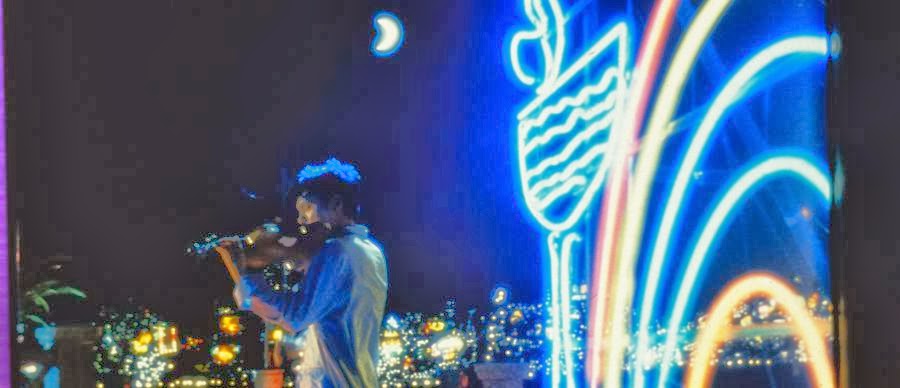
That is the The End apparently referred to in the title of my favorite film of 2013, La última película, directed by the veteran/first-timer team of filmmaker Raya Martin and critic Mark Peranson. A kind of remake of Dennis Hopper’s notorious Easy Rider follow-up The Last Movie (the more literal translation of the title), Alex Ross Perry plays a director named Alex who travels to Mexico on the eve of the Mayan Apocalypse in December of 2012 in order to make the last movie at the end of the world. To this end, he’s gathered all the remaining celluloid film and is going to use it all up. But that’s merely the starting point for a film less concerned with narrative (or rather with a single narrative) than a mishmash of ideas and theories and jokes and experiments with the technology of filmmaking. It’s a celebration not merely of film as a medium, but of talking about film, of the rabbit holes and circles and odd resonances and meanings we find when we truly dive into the movies. Goodbye cinema, hello cinephilia.

When we meet Alex, he’s filming in a wooded area talking with his guide, played by Mexican actor Gabino Rodríguez. Alex is asking about a stone wall he sees, if it is one of the ruins he’s come to use as the backdrop for his film. Gabino, nonplussed, tells him “No, man. That’s just a fence.” (All quotes herein are approximate, I’m going off my aged and inadequate memory.) They appear to have a relationship somewhat like that of William Blake and Nobody in Dead Man, with Alex in the role of the “stupid fucking white man”. Alex continues to question Gabino about the garbage he finds around him, a bottle, a TV set (“Do people just dump their old TV sets outside, on their own land here?” “Yeah man, it’s shitty.”), but this line of inquiry becomes more resonant shortly thereafter, when the two go to a museum and discuss the film Alex wants to make in relation to the things they find in the museum. He wants to make something that lasts, that stands the test of time. Yet what they find in the museum is that most of the stuff that survives is the junk that gets thrown out: old pots, cheap jewelry. It lasts long enough and it becomes history, it becomes art. Of course, 1000 years from now, none of the images we have today stored on film will exist in their present media, it decays too quickly. That’s one of the fatal flaws of film (and digital storage at present is even worse, though one hopes for technological advance in this area), but that ephemerality also makes it special, precious.
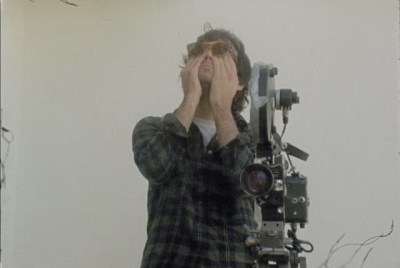
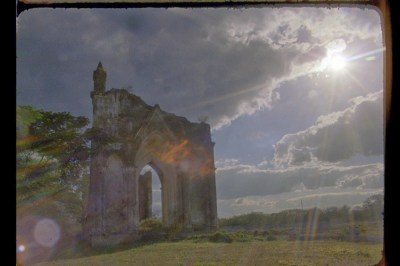
The flaws of filmmaking technology, and the specific beauties that result from them is the apparent subject of many of the interstitial sections of the movie. Martin and Peranson shot using a vast assortment of equipment, including Super 8, 16mm, a few kinds of digital camera, an iPhone, everything but 35mm in fact (which, in a neat twist, was the format the movie played on at Vancouver, one of only two film screenings at the entire festival). We revel in the fuzzy hypercolors of 16mm, recognize the hairs and scratches in the silent 8mm footage¹ (effects so warm and nostalgic that they form the basis of Instagram’s business model), dazzle at an underwater GoPro shot (apparently contributed by Leviathan director Verena Paravel², yes, the Sensory Ethnography Lab makes its presence felt here as well), and marvel at a long traveling shot of an inverted world achieved by simply holding the iPhone upside down and walking around³. That this digital technology is celebrated alongside the archaic photographic forms as well I think is important. Far from a maudlin lament about The Death of Cinema, as so many of those, heartfelt I’m sure, op-ed’s from a few years ago were, La última película looks as much to the future as it does the past. As Alex speculates at one point: time isn’t necessarily linear, it can be cyclical. Cinema ends, cinema is reborn. While there are certain effects, certain grains and textures we lose in the transition, there are things to gain as well. The end of film is not the end of cinema.

The funniest section of the film, and the part most apparently concerned with the non-cinematic world, is a central section wherein Alex and Gabino wander around the crowd gathered at some Mayan pyramids⁴ in anticipation of The End. It’s a hilarious, “Look at these fucking people” bit as Alex skewers the absurd white hippies gathered around, acting like clowns. It’s their presumption that they understand Mayan culture, Mayan philosophy that appalls him. Their eclectic blend of New Age sophistry gives them no real connection to the ruins, to the land. “They don’t understand what it would be like to stand in this empty field and want to build something. The hard labor of building these magnificent structures.” Perhaps this is about film after all, a complaint about those who don’t understand what it takes to make a movie? I doubt it, I find that complaint about critics being nothing but failed filmmakers, wannabe artists who have neither the talent nor the work ethic to actually create art, to be pretty ridiculous, but here at least is a critic in Mark Peranson who has made a film, for whatever that’s worth⁵. More to the point, I think, is the issue of appropriation. Cultural appropriation in this specific instance as a bunch of white people revel in the otherness of trendy Mayanness, but also in a larger sense. La última película itself is a remake, an appropriation of Hoper’s original film. And all criticism is appropriation in one form or another, it’s the taking of one thing and making something else out of it. The problem with these stupid white people then isn’t so much their borrowing, but rather the superficial nature of it. They’ve adopting bits and pieces, the trappings of an alien philosophy and integrated it into their own, rather lame, ideologies. If they better understood the Mayans, what it meant to be Mayan, what these pyramids, what this Apocalypse, is really about, they wouldn’t be so ridiculous. It’s their shallowness that is so offensive. As he discussed in the museum, Alex wants his film to be able to survive outside the context of its creation, he wants to make something that lasts, that will still be meaningful long after he and his world is gone. But seeing the crowds gathered at the remains of another past civilization, he has to wonder if that is impossible. If his film, which he’s poured so much into, is destined, at best, to be appropriated by the silly weirdos of the future.

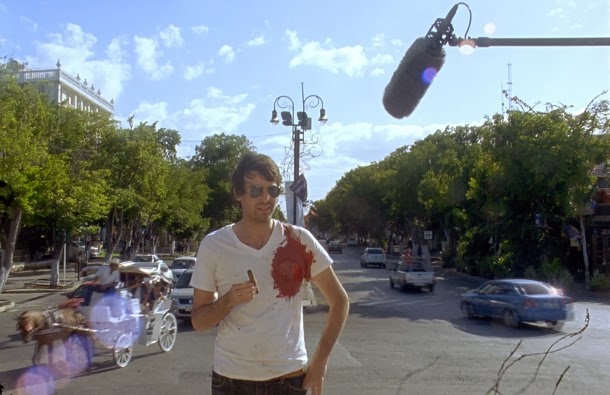
As Alex’s film shoot progresses, his film becomes about a director who runs afoul of the local authorities, it becomes about himself as the stupid white man violating an ancient culture. At first, he merely spends an innocuous night in jail (we see him go into a bar, followed by a “Scene Missing” title card ala Grindhouse)⁶. But later, as we learn through a helpful child’s drawing (yet another image medium)⁷, one of the crewmembers is accidentally killed and the director (Alex, playing himself) is sacrificed on a pyramid to the gods. We see this as “making of” style footage, with shots of the actors at work on a “ruin” that appears to be in the middle of a traffic circle with the crew and directors lining up the shot, working out the choreography of the movements and special effect and even lining up the clapboard. In this final third of the film, its folding in on itself becomes so tangled even the actors themselves have trouble understanding what’s going on. In a scene reminiscent of Peter Watkins’ La commune (Paris 1871), Alex and Gabino sit by a fire and discuss the film Alex is making. Then the actors Alex and Gabino begin talking about the film Raya and Mark are making, and how they don’t understand any of it. Apparently each had assumed the other knew what was going on. It’s not entirely clear that anyone does, and that seems to be the point: I don’t think the film is about any particular idea or set of ideas so much as it is about how much fun it is to think and talk about the ideas that films inspire within us. When you really get into a movie, talking about it with friends or just sitting and pondering, watching and rewatching it, it lights a fire, sends off sparks in all directions. Dead ends and curlicues and swirls of meaning that sometimes, usually, lead nowhere but every once in awhile change the way you think about, the way you see the world. La última película is a film as much in love with the love of movies as it is with the physical, tangible properties of the many forms film takes.

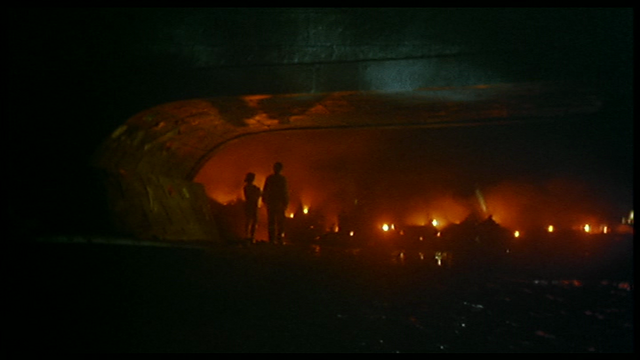
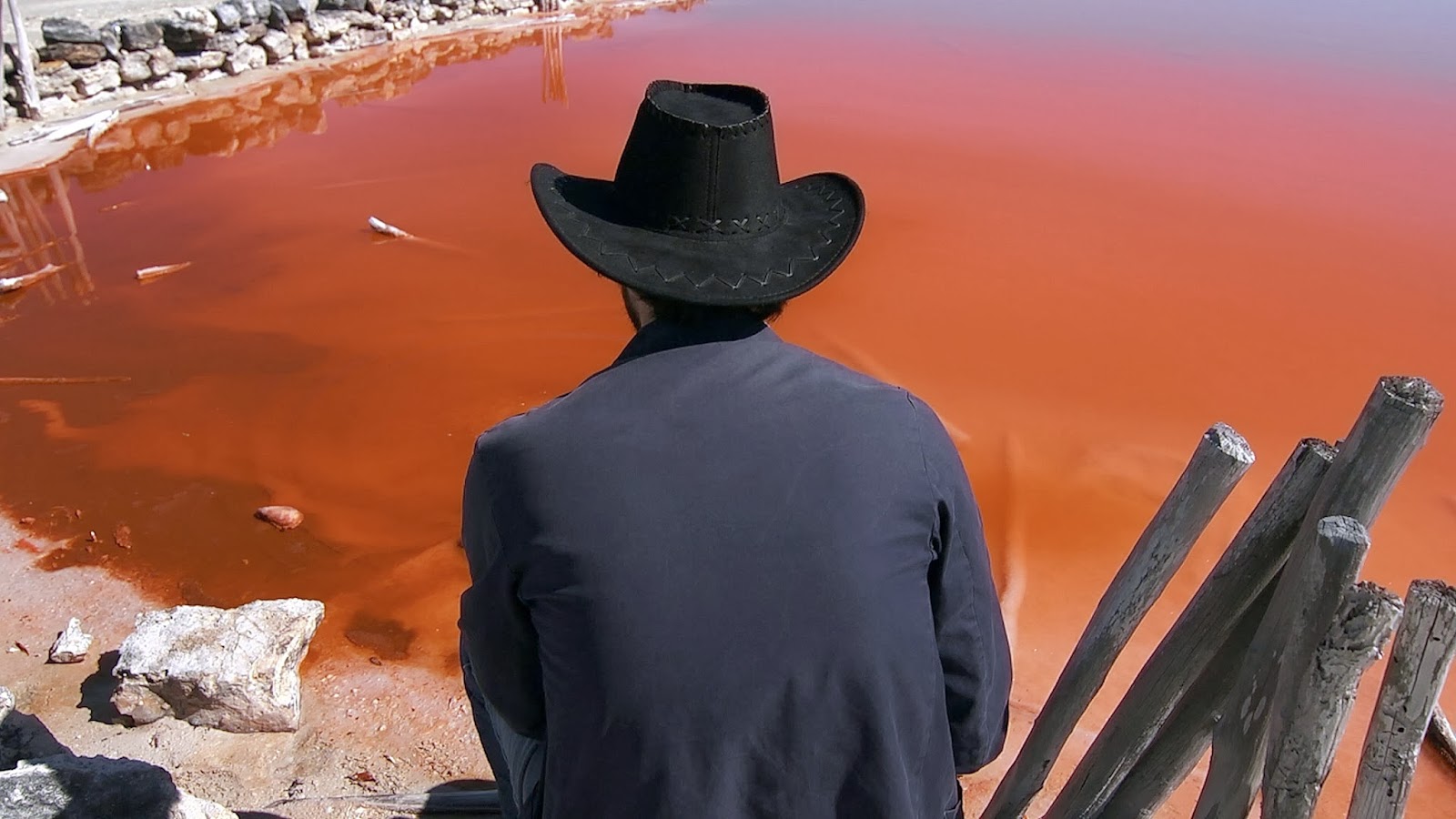
There are two extended song sequences in the film. The first shows an apocalypse⁸, the meteor that crashed into the Yucatan and destroyed the dinosaurs millennia ago, depicted in a beautiful practical effect (none of the film was digitally altered, according to Peranson at the Vancouver Q & A), a double exposure of a man on a beach watching a giant rock crash into the sea⁹. The second plays a version of “Me and Bobby McGee” as the world turns an incandescent red and Alex burns the final shreds of celluloid film and slowly fades into blackness. Alex gives a long speech in this section, which sounds like it may have come from Hopper’s film (I haven’t seen it yet, intentionally so. I want to figure out my reaction to this film before and after knowing Hopper’s. For some reason I feel this is important.)¹⁰ Alex, sitting by a blood red lake, talks about the film he wants to make, about how it won’t be like any other film. He wants to lay bare the machinery of cinema, to show all the takes of a single action for example, to show the audience the process of filmmaking. To demonstrate what it means to make a movie, to make choices. Art isn’t made simply by pointing the camera at something interesting. It has a form, an intelligence goes into it, it requires work and it means something.
Update: Mark Peranson helpfully sent along a few corrections on some of my mistakes and misremembrances and some explanations for some of the things I was unclear on. These are noted below.

1. The hairs and scratches are in 16mm
2. She didn’t shoot that, she shot the scene with the live shrimp in the restaurant, though you are certainly welcome to draw a connection there to Leviathan.
3. That one is on GoPro, not iPhone.
4. It’s Chichen Itza.
5. Well, I made another.
6. The “Scene Missing” card is an exact replica of the one used in The Last Movie — both are, and they occur at roughly the same points in both films.
7. It’s an ex voto, a drawing typically made by the Catholic Church, especially in Mexico, to commemorate miracles.
8. Well, it begins over a slide montage of Gabino’s parents’ Yucatan vacation.
9. It’s both Raya and myself on the beach, first him, then me. The song by the way is “My God and I” which also appears in The Last Movie, by John Buck Wilkin, who sings the version of “Bobby McGee” at the end as well.
10. The speeches he gives are somewhat influenced by the speeches in American Dreamer, but are not verbatim, except for two lines, when he’s shooting the guns and talks about Welles.

Running Out of Karma: Tsui Hark’s Young Detective Dee and the Rise of the Sea Dragon


Running Out of Karma is my on-going series on Johnnie To and Hong Kong cinema. Here is an index

The anarchist prankster Tsui Hark who burst onto the Hong Kong scene over 30 years ago with Dangerous Encounters – First Kind and We’re Going to Eat You still lurks underneath layers of glossy CGI as the eponymous detective, in order to counter-act their poisoned tea, orders all 1200 members of the Tang Dynasty Imperial household to drink bowls of eunuch urine.

Like the first Detective Dee film, this one is a tightly plotted adventure film, more Indiana Jones than Sherlock Holmes, set in a semi-magical 7th Century China (Dee was a real historical figure, fictionalized in an 18th Century detective novel that was translated into a series of English language novels in the 1940s and 50s by Robert van Gulik). It’s missing the star presence of Andy Lau, but Mark Chao does a creditable job taking over the starring role in this prequel, tall and thin with a neat goatee, he looks a bit like Tsui himself. (His rival, a fellow detective played by Feng Shaofeng, looks unnervingly like James Spader or Martin Sheen or some unholy combination thereof). Like Tsui’s last several films, digital effects dominate, not just in spectacular destruction sequences or massive background sets, but in the manipulation of actors and space in the fight scenes.

At some point, I’d like to explore in detail the effect of CGI on Hong Kong martial arts films. Since The Matrix (of course choreographed by HK legend Yuen Woo-ping), digital filmmaking has come to dominate the industry, the much-needed infusion of cash from the opening of the mainland market has made reasonably competent effects a part of seemingly every film. This is a fulfillment of the vision Tsui Hark himself had 30 years ago when he imported Hollywood technicians to work on the effects for Zu: Warriors form the Magic Mountain, but in doing so it seems to have shifted the balance away from the verisimilitude that so many people value in certain Hong Kong films. It’s the Jet Li vs. Jackie Chan, wire fu vs. realistic stunts argument again, but never has one side seemed so close to winning the argument outright, with even this generation’s most talented fighters choosing the safer, CGI-driven route (see the difference between Tony Jaa’s first Ong Bak film, all bone-crunching stuntwork and its two digital sequels (well, prequels I guess) in another, parallel film industry).

The problem with this is that so much of the CGI in these films is cheap-looking, at least to those of us used to the state of the art effects produced in Hollywood. But that was always the case. Zu, and the fantasy wuxia films that followed it, always looked phony compared to the blockbusters Hollywood was putting out in the 80s and 90s, and of course Hong Kong’s sound technology has made a tradition of cheap dubbing. But is there something about this particular version of cheapness that is somehow worse? I don’t know. We can look back now at the effects in, say, Ching Siu-tung’s 80s and 90s films like Swordsman II or the Heroic Trio films he did with Johnnie To and appreciate the verve of the filmmaking and the dizzying speed of his choreography. We don’t really get hung up on how cheap they look compared to The Abyss or Beetlejuice. Maybe it’s that we need more time, that eventually cheap CGI will acquire a patina of charming nostalgia.

I do know this, the quality of the effects is not enough alone to obscure the quality of the filmmaking. Despite its relative cheapness, Young Detective Dee contains more visual imagination, more creative sequences, more memorable images than any Marvel superhero film. The fight scenes, choreographed by longtime Johnnie To stunt coordinator Yuen Bun, are clever and fun, and Tsui films them with a youthful elan, cutting into slow motion to emphasize the beauty of a (yes digitally-enhanced) movement, or into a Matrix-inspired split image as a man flashes his sword faster than the eye could track to dispatch a swarm of angry digital bees. There’s even the best hanging from a cliff fight since Temple of Doom. Who cares how textured the image is when it’s of a man racing a horse across the half sunken remains of a battleship with poisoned fish flying through the air all around him and into the gaping maw of a giant sea dragon?

On Blue is the Warmest Color

What if everyone color-coded their outfits with the people they happened to be in love with?

I found the span of time to be a bit confusing, it seems like the movie covers about ten years in the life of Adele (two years of high school, followed by six years of college (she says she needs a master’s then specific training to be a teacher, in the US at least that’s 6 years, more if the master’s is in something other than teaching), then the crisis occurs her first year of teaching and the meet again at least one but no more than three, years after that. So by the end of the film, Adele should be 27-30 years old. Maybe she skipped college and went right to work?

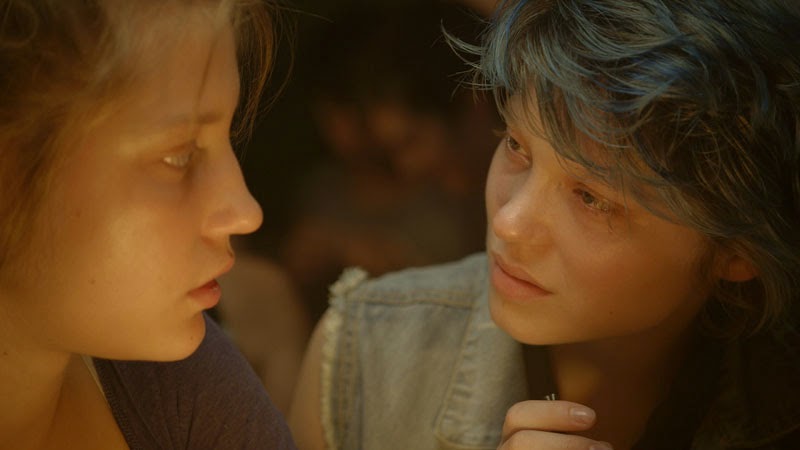
I say it’s confusing because Adele shows none of the signs of maturation or growth that most humans go through during their twenties. She begins her love affair in intoxication, seemingly convinced that not only have they discovered sex, but invented it as well. Perhaps it’s that addiction that stunts her growth, that prevents her from forming a fully adult relationship. Their meeting in the last third plays like a junkie taking heroin out for coffee, trying to be friends when they both know they have only one thing in common. Kechiche wants to get right up close and examine the tragedy (helpfully defined in class as the inevitability of destruction) of a person whose libido is limited to a single other person, who may not be that compatible otherwise.

As such, the film is strongest in its first half, a minute exploration of the first stages of love and teenage life (17 years old in France in 2013 is apparently much different than 17 years old in Spokane in 1993 was). The plot points are bluntly melodramatic (Adele’s friends react poorly to her apparent lesbianism, Emma’s parents are open while Adele is closed to hers), but the relaxed pace and close-up camera allows the actors room to create a realistic world (I especially liked the overlapping dialogue of her friends, as they argue about whether one girl was too harsh: clearly not all of them are jerks, but its unclear who the friends and enemies are as the group begins taking sides and Adele wanders off). The verisimilitude of course extends to the sex scenes, which seem a bit excessive, but that’s also kind of the point I guess.

I guess too that the realism falls apart with that ending. I just have never met anyone that was (or at least thought she was, which amounts to the same thing) attracted to only one other person. But the world is a weird place, what do I know? I think it likely that the film elides over Emma and Adele’s adult years because they never really have an adult relationship. They try to extend that chaotic passion of first love for as long as possible, but seem incapable of relating to each other as fully-formed individuals. Perhaps a useful comparison is Annie Hall, a far more convincing examination of the destruction of a relationship founded in some of the same issues (lack of self-respect driven by a perceived difference in class and intelligence). Annie and Alvy break up, reunite, break up again as they love each other but kind of hate each other as well. Adele and Emma have a passive aggressive fight, exchange some mournful glances at a party and then infidelity (of all things! In a movie about sexual obsession with one person, to be ruined by a dalliance with another!) ruins everything. Kechiche can’t dramatize a more interesting relationship, and a more interesting collapse to the relationship, because its sole basis is in that first look, that rush of lust and love that comes with a sidelong glance in a crosswalk. The film can’t go any deeper than that, but I’m also not sure that it should.