Summer of Sammo: Five Shaolin Masters and Shaolin Temple

I’ve declared this the summer of 2013 to be the Summer of Sammo. Throughout these months I’ve been writing about films starring or directed by Sammo Hung, as well as other Hong Kong genre films of the Sammo Hung era. Here’s an index.

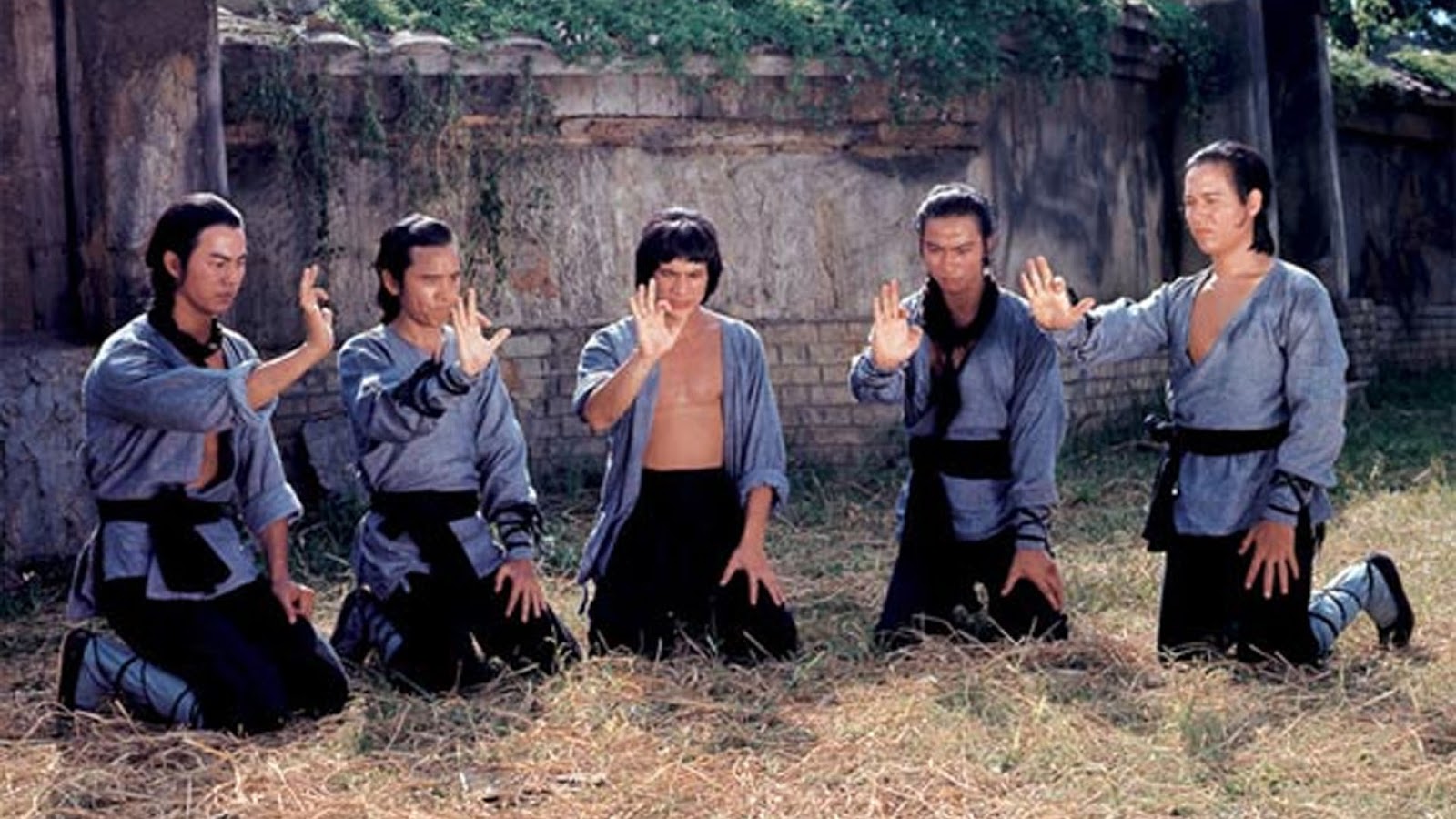
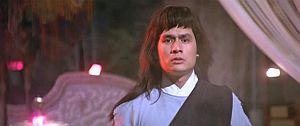
Five Shaolin Masters circles back and starts at the beginning of another 1974 Chang Cheh film, Heroes Two, with the destruction of the Shaolin Temple, but then goes off in the other direction. A narrator helpfully informs us that the Chen Kuan-tai character in that film went south and met the Alexander Fu Sheng character, but that this film is about the five survivors who went north, into central China.

Of course, Fu stars in this one too, playing a different, but similarly dopey character. Also starring are David Chiang, Ti Lung and Chi Kuan-chun, all of whom were also in Chang Cheh’s 1976 film Shaolin Temple, about the events leading up to the Manchu attack. Ti and Chiang play the same characters in both films, as does Wang Lung-wei playing the traitor Ma Fu-yi, though Ma was killed at the end of the prequel, and finds himself alive and well in this earlier film. Alexander Fu Sheng plays the folk hero Fong Sai-yuk in both Heroes Two and Shaolin Temple, though in most versions of his story Fong was never at the Temple (there is a version where he dies fighting at the Temple, but that doesn’t happen in any of these movies) and in the first film, he isn’t there either, running into Chen’s Hung Si-kuan shortly after its destruction. So basically the three films are mutually incompatible versions of the same story, in the same universe, one which bears a tenuous factual relationship to our own.

The Qing, or Manchu Dynasty, and its attempts to pacify the population of Southern Chinese loyal to the previous Ming Dynasty are common villains in Hong Kong films. They can easily be read as a corollary to Chinese Communists and their fight against the Nationalist Kuomingtang in the wake of World War II. Much of the Hong Kong population that flocked to Shaw Brothers movies were first or second generation refugees of those wars, and as a British colony were also strongly and openly anti-Communist.

Ni Kuang, who wrote almost all the best Shaw Brothers films of the period (and was a frequent collaborator with Chang Cheh) fled to Hong Kong in the late 50s, after working as a public security official under the Communists. Here’s an anecdote from wikipedia:

Ni’s reason for coming to Hong Kong was the fear of political persecution. When he was working for the CCP, he was tasked with writing death sentences. One time, he questioned his local party chief about why a particular man was sentenced to death, when the only crime stated on paper was that he was a landlord. The chief rebuked him and threatened him with the death sentence if he continued to ask such questions. According to Ni, he complied in fear of his own life. Nevertheless, this was not the worst death sentence he had written as there were many other questionable death sentences that the CCP carried out categorized under “others”. It was from these experiences that Ni made up his mind to escape from the People’s Republic of China.

It can be easy for us to scoff at kung fu films as cartoonish and cheesy. But it might help to remember that they were made by people with a real first-hand knowledge of death, oppression and tragedy. The monks of Shaolin Temple chose to harbor anti-Qing forces, though they knew it would ultimately lead to their destruction. They trained their disciples as much as they could, hoping the few survivors would pass on their learning to new generations, that Shaolin wouldn’t die though the Temple burned. Chang’s version of the Temple story has almost no religion, no philosophy. It couldn’t be further from the mystical visions of King Hu’s A Touch of Zen or the serene theology of Lau Kar-leung’s 36th Chamber. Chang is a materialist, and his Temple only has power if its members can act in the world. When his remaining Masters, having rededicated themselves to their training and defeated the once more-powerful Qing in a set of one-on-one battles, gather at the end of the film, rounding up the anti-Manchu forces at the Red Flower Pavilion, it is an expression of hope, of the people uniting in the face of an seemingly unbeatable foe.

But of course, they are doomed. The Ming were not restored. The anti-Qing movement degenerated from revolutionary political activity to organized criminal gangs called Triads that still exist today. At least, that’s the story the Triads tell themselves.

Summer of Sammo: The Sentimental Swordsman

I’ve declared this the summer of 2013 to be the Summer of Sammo. Throughout these months I’ve been writing about films starring or directed by Sammo Hung, as well as other Hong Kong genre films of the Sammo Hung era. Here’s an index.

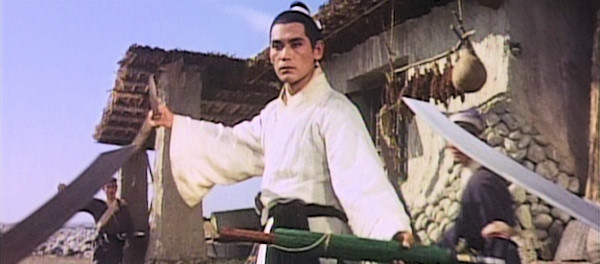
An exceptionally well-written wuxia film, one in which the characters are motivated by psychology rather than fulfilling roles as mere mythological character types, where the tsunami of exposition that swamps so many other films in the genre is distilled into action with the expeditious use of a MacGuffin (a mysterious red package that changes hands repeatedly throughout the first 30 minutes of the film, introducing all the major characters and establishing the ruthless and unstable nature of the film’s world) and where the central character is acted rather than performed, with star Ti Lung’s melancholy hero, haunted by his past, yet patient and honorable grounding the film in a realistic figure.

The plot involves the search of the Plum Blossom Bandit, a ruthless killer that Ti Lung has returned after 10 years in exile to capture. After the Bandit as well is a pretty girl who has promised to marry whoever kills him (he killed her father), drawing the attention of every wannabe hero for miles around, gathering at the home of Ti’s best friend and his wife, Ti’s former lover. Ti gets framed and everyone believes him to be the bandit, and the majority of the film involves the mob attempting to lynch him on the flimsiest of evidence as other, more shadowy figures keep trying to assassinate him (in this respect the film bears a passing resemblance to The Ox-Bow Incident or 12 Angry Men, but with poisoned soup). Ti survives all the attempts to kill him, of course, but his accusers keep dying along the way. But will he solve the mystery before everyone around him is dead?

What differentiates the film from a wuxia mystery I’ve never been a fan of, The Five Deadly Venoms, is the question of motivation. Rather than simply bad guys doing bad things and good guys trying to stop them (often taking way too long to figure out whodunnit), the schemes in The Sentimental Swordsman rely on specific character traits of the victims: the mob’s lust for the pretty girl makes them easy to manipulate, and Ti’s sentimentality, his emotional connection to the people and world around him, makes him an easy target for the cold, ruthless killer. A complex web of motivations is weaved (spider webs and spider imagery recur throughout the film) but the plot flows organically out of the nature of the characters, rather than a series of events being imposed upon a set of character types. This is an inversion of the usual wuxia formula, which is based on a more ancient, pre-psychological story-telling form (think The Illiad, The Epic of Gilgamesh, The Three Kingdoms).

Wuxia worlds tend to be built around ideas rather than emotions, specifically the ideals of loyalty and revenge, “You killed my master, I’ll kill you!” and so on. They’re medieval romance figures rather than the psychologically real characters you find in a novel (to take an example from Western literature: compare the shallow, plot-only types in Arthurian romances to the complex, rounded people in the Three Musketeers books). The other wuxia films I’ve seen from director Chor Yuen, like Heroes Shed No Tears or Heaven Sword and Dragon Sabre are more plot-and-spectacle oriented than The Sentimental Swordsman, but they still resonate more deeply than they probably should. Like those films, Chor creates a beautifully magical world, no one made more with the artificiality of Shaw Brothers sets than Chor, packing the frame with fog and flowers and painted moonlight. With those other two films, Chor often obscures the action, filming it in long shot with objects blocking the principals, out of focus tree branches or gauzy curtains. With this film, as well as Intimate Confessions of a Chinese Courtesan, another film grounded in character rather than myth, the action is more direct: framed but not hidden. More graphic novel than comic book. The tension between the visually artificial and the psychologically real, between the surface and the depth.

Summer of Sammo: Heroes Two

I’ve declared this the summer of 2013 to be the Summer of Sammo. Throughout these months I’ve been writing about films starring or directed by Sammo Hung, as well as other Hong Kong genre films of the Sammo Hung era. Here’s an index.

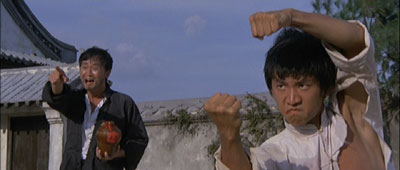
Chang Cheh’s take on the Fong Sai-yuk character has Alexander Fu Sheng playing him as a good-hearted but dim-witted boob who is quite easily gulled into capturing one of the few survivors of the destruction of the Shaolin Temple, Chen Kuan-tai’s Hung Si-kuan and handing him over to the actual, villainous perpetrators (Manchu troops, naturally) of said destruction. They constitute the two heroes of the title (it’s not a sequel to a movie called Heroes, but an enumeration of protagonists, like with Warriors Two or Brothers Five) as Fong eventually realizes his mistake and undertakes a daring rescue.

I’m a big fan of Corey Yuen’s Fong Sai-yuk movies, in which Jet Li plays him as a happy-go-lucky goofball, but the dopiness suits Fu Sheng well, his perplexed brow-furrows neatly framed by his arena rock mullet. That film follows a more conventional version of Fong’s story, where he learns his kung fu from his mother who herself learned it from one of the survivors of the Temple’s destruction, putting Sai-yuk two generations removed from the events of Heroes Two. But there are other versions of the Fong Sai-yuk legend, though based on a factual event (the destruction of the Temple by the Qing) it’s as much mythology as history, not unlike the Three Kingdoms stories from a much earlier age, or, on the other side of the globe, the Robin Hood legend. Chen Kuan-tai gets to play a more traditionally noble figure, though he spends half the movie chained to a wall. His character, in real life, created the Hung Gar fighting style, the one used by Wong Fei-hung and taught to his disciples, one of whom taught the father of Lau Kar-leung (it’s a small kung fu world). He’s idealized here, but otherwise isn’t given much to do. That’s a problem with the plot as a whole: aside from the central case of mistaken identity, not much happens: he gets caught, then he gets rescued, then everybody fights.

It starts great (in medias res with the burning of the Temple and Chen fighting his way out) and the fight scenes might be the best boxing scenes Lau Kar-leung and Tang Chia coordinated for Chang during their decade-long collaboration (Tang was a student of Yuen Woo-ping’s father Yuen Siu-tien, the small kung fu world grows even smaller), but the film doesn’t have the depth or resonance of most Chang films (in this respect it’s like Chang’s Duel of Fists), but this is but a small chapter of an epic folk tale. I have high hopes for his 1976 film Shaolin Temple, which hopefully will have a broader scope and delve further into Chang’s psychology of honor and violence while set during the same events.

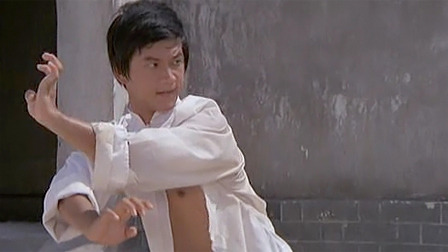
If you see the same DVD I rented, don’t miss the special feature where Chen and Fu Sheng show off the various forms of the fighting styles they use in the film. It’s pretty neat, and also a precursor to Lau Kar-leung’s distinctive opening credit sequences, with the actors performing against an abstract, dusky red backdrop, as if on an alien, supernatural plane.

The George Sanders Show: Episode Four – Duel of Fists and Tears of the Black Tiger

This week Mike and I journey to Thailand and discuss Chang Cheh’s 1971 Shaw Brothers boxing film Duel of Fists (aka Fist Attack) and Wisit Sasanatieng’s award-winning genre mashup Tears of the Black Tiger, from 2000. We also talk about the best movies of the year so far, our Essential Kung Fu Movies and the work of director Apichatpong Weerasethakul. Hear me tirelessly rail against the evils of Miramax, Netflix and disrespect for Asian genre cinema in general as Mike vainly tries to make me stick to the subject at hand.

You can subscribe to the show in iTunes, or download it directly from our website.

Next week we return from abroad to San Francisco, the setting for Woody Allen’s latest, Blue Jasmine. We’ll be watching a pair of Bay Area-based films, Otto Preminger’s Whirlpool, with The End of Cinema’s official PGOAT Gene Tierney and Phil Alden Robinson’s all-star caper/heist film Sneakers.

This Week in Rankings

Since the last rankings update, I wrote five more entries in my Summer of Sammo series on Hong Kong genre cinema, about King Hu’s genre-defing Come Drink With Me and Dragon Gate Inn, Lau Kar-leung’s debut The Spiritual Boxer, Chang Cheh’s iconic The One-Armed Swordsman and Chor Yuen’s opulent Heroes Shed No Tears. And Episode Three of The George Sanders Show covered Stanley Donen’s Charade its remake, The Truth About Charlie, directed by Jonathan Demme. But the big hit post of the week is apparently this thing I wrote about best of the year lists.

These are the movies I’ve watched and rewatched over the last week or so, along with where they place on my year-by-year rankings. Links are to my short letterboxd reviews, where applicable.

The Idle Class (Charles Chaplin) – 9, 1921
Dial M For Murder (Alfred Hitchcock) – 19, 1954
The Man Who Knew Too Much (Alfred Hitchcock) – 12, 1956
Come Drink With Me (King Hu) – 9, 1966
Dragon Gate Inn (King Hu) – 2, 1967

The One-Armed Swordsman (Chang Cheh) – 7, 1967
Golden Swallow (Chang Cheh) – 7, 1968
A Touch of Zen (King Hu) – 1, 1971
Heroes Two (Chang Cheh) – 18, 1974
The Spiritual Boxer (Lau Kar-leung) – 11, 1975

The Magic Blade (Chor Yuen) – 14, 1976
Heroes Shed No Tears (Chor Yuen) – 16, 1980
Wheels on Meals (Sammo Hung) – 2, 1984
Mr. Vampire (Ricky Lau) – 18, 1985
The Truth About Charlie (Jonathan Demme) – 29, 2002
Much Ado About Nothing (Joss Whedon) – 14, 2012

Summer of Sammo: Dragon Gate Inn

I’ve declared this the summer of 2013 to be the Summer of Sammo. Throughout these months I’ve been writing about films starring or directed by Sammo Hung, as well as other Hong Kong genre films of the Sammo Hung era. Here’s an index.

I keep saying The 36th Chamber of Shaolin is the Stagecoach of martial arts movies, but that’s wrong, this is. Or rather, they both are, but they represent two perfect forms of distinct subgenres of the martial arts film. 36th Chamber is the kung fu training film, where the hero must be humbled, learn new skills and then apply them to achieve his revenge and the betterment of society. Dragon Gate Inn is a swordplay film, one with fantasy elements (though these are more subdued than in the wilder flights the subgenre would explore as it ran its course, for example in Chor Yuen’s Heroes Shed No Tears or Tsui Hark’s Zu: Warriors from the Magic Mountain), one that aims more for mythology than philosophy. Hu made it in Taiwan, after splitting with the Shaw brothers over disagreements during the making of Come Drink With Me, released one year earlier in 1966. The film became a massive hit throughout Southeast Asia, and can be seen partially as the movie playing in Tsai Ming-liang’s end of cinema masterpiece Goodbye, Dragon Inn, the best film about working in a movie theatre ever made.

Structurally the film is elegantly simple. The first half sees the various factions arrive at the eponymous inn, a remote outpost on the Tartar frontier, a rocky desert landscape bordered by tall, forested mountains. The eunuch in charge of the nation’s secret police has had a prominent general killed and exiles his family to the edge of the Empire, hoping to flush out any pro-general elements. Arriving at the inn in turn are the bad guys, a wandering swordsman, the owner of the inn, and a heroic brother and sister (the girl in disguise as a boy). As each arrives, the villains try various subterfuges to draw them into a fight or poison them, while pretending to be friendly. At night, the villains attempt a sneak attack on their rooms, in a sequence very similar to one in Hu’s previous film, Come Drink With Me. At exactly the halfway mark of the film, 55 minutes in, one day and night has passed and all masks are lifted: the heroes have recognized each other and joined forces and will attempt to rescue the general’s family.

The second half of the film spreads over two days and one night. The first day, the family arrives and the heroes defend them and the inn against enemy attack. This is built around two action sequences, one with the sister fighting a band of soldiers, the other with the wandering swordsman taking on an even bigger band and facing off against the local bad guy in charge. That night, the heroes are reinforced by a small group of soldiers from a nearby outpost and a pair of brothers who defect from the eunuch’s forces. The second day is a chase sequence, as the heroes flee the inn and make their way through a mountain pass to safety. They’re surrounded by the bad guys and ultimately face off against the eunuch himself, joining forces to defeat him (as much by using his asthma against him as their own skill – this may be lost in the translation, but I wonder if the asthma is a side effect of his extreme kung fu skills).

As in Stagecoach, character is revealed along the way, as much through gesture as dialogue. It’s revealed that the heroes are all connected: the wandering swordsman, Hsiao, played by Shih Jun, who looks like a slightly less ghostly version of the villain in Come Drink With Me, white-robed and equipped with an umbrella (Wong Fei-hung style – identifying him as a good guy), is an old friend of the innkeeper, who was a lieutenant under the executed general and who also served with the father of the two siblings. The sister falls in love with Hsiao, though this is only apparent in the looks she gives him at certain key points. The two brothers have their own grudge against the eunuch. The eunuch doesn’t get much screen time, appearing first in silhouette as his retinue slowly makes its way to the inn, but Hu always accompanies his appearances with a wildly atonal brass blare, which builds from a simple fanfare to an actual theme as we see him up close for the first time. The film isn’t thematically deep, but the characters are individualized enough to become iconic rather than merely generic.

Dispensing with the effects-driven finale of his previous film, or the energy-shooting antics of wuxia films that came before and after it, Hu’s action scenes are more or less realistic. There are more than a few trampoline jumps hidden by the editing tricks David Bordwell so well highlights on his website. Similarly the heroes are able to wave away arrows shot at them by a simple cut and flash of a sword. The fights are fun and suspenseful, but they never shock with verisimilitude or craziness. Compared to later martial arts epics, Dragon Gate Inn has a much smaller scale and much less emphasis on the actuality of fighting movements and much less craziness. But those films can tend to overwhelm with spectacle: we become more impressed by the actors on-screen, or the opulence of the sets and costumes than engrossed in the narrative unfolding before us. What King Hu achieves here is a balance between plot and action, between structure and character, between fantasy and reality, a simplicity of design and movement that reminded me more than once of the minimalist Westerns of Budd Boetticher. With his next film, A Touch of Zen, Hu would go further into the philosophy underlying the wuxia mythology, melding the action movie with Buddhist spirituality to create a truly profound epic. With Dragon Gate Inn, however, he was content to make merely a perfect action picture.

Summer of Sammo: Heroes Shed No Tears

I’ve declared this the summer of 2013 to be the Summer of Sammo. Throughout these months I’ve been writing about films starring or directed by Sammo Hung, as well as other Hong Kong genre films of the Sammo Hung era. Here’s an index.

I’ve only seen a few Chor Yuen films, so I don’t know how much this is a signature of his, but with this movie he seems to be exploring what would have happened had Josef von Sternberg made a wuxia film. Or at least Von Sternberg’s set designer. Hong Kong films are by no means strangers to ornate imagery, but I’ve never seen one that piled so much stuff in the foreground between the audience and the action. Flower, trees, rocks, curtains, buildings: the frame is ringed with objects, which also sometimes intrude and obscure the actual action itself. It’s very striking, and Chor as well puts the full Shaw Brothers studio resources to work with vibrant violets and pinks and blues, flowing costumes, elaborate palaces and remote mountain sets that ooze fog from all sides.

Chor begins the film with a wild expositional burst impressive in its swirl even for the wuxia genre, introducing all the major characters and describing them and their motives in about five minutes. HK directors have never been afraid to throw the audience in the deep end, expecting them to keep up. After that initial burst, the film settles into a fatalistic tragedy about an evil genius playing all sides against each other in the hopes of coming out on top, kind of like Edgar in King Lear or Dashiell Hammett’s Continental Op, with the loose ends explained at the beginning all neatly tied up by the end.

Alexander Fu Sheng stars, playing a young swordsman sent by his master to prevent the biggest crisis of the century. With his Wayne’s World mullet and teardrop-stained sword, he mostly finds himself shunted off to the sides of the narrative as the various other factions get eliminated. The best character is a warrior who carries a magical wooden box that contains 36 weapons – he can pull out whichever he needs whenever he needs it. He thinks he’s destined to be killed by Fu’s cursed sword, and has a complicated personal history where he suspects he might be Fu’s brother or something, but ends up being wrong about that. It’s fruitless trying to predict the twists of fate and prophecy, even if you have a magic box.

Like many martial arts movies, the film is structured as a series of confrontations, as the various characters face off against each other either in fights or dialogue or both. The best comes about halfway through the movie as the woman at the center of some of the plotting exposes the villain’s evil schemes and then cuts off her own leg. She then picks it up and hops over to one of the men who loved her unrequitedly and gives it to him (“this is the leg you loved”) before heading off alone. It’s almost as moving as it is absurd.

I don’t see nearly the depth here that I found in Chor’s Intimate Confessions of a Chinese Courtesan, though it certainly shows that film’s aesthetic sense, its exploitation of the artificiality of Shaws resources for the kind of abstract prettiness that won’t really be topped in the martial arts genre until the 2000s and Crouching Tiger, Hidden Dragon  and Zhang Yimou’s trilogy of arthouse kung fu spectaculars. Chor’s The Magic Blade shares a source novelist (Gu Long) and similar noir-like manipulations within an underworld subculture (seen also in Chor’s Killer Clans). But while The Magic Blade plays as a rough and pulpy version of Willy Wonka and the Chocolate Factory with Lo Lieh and Ti Lung finding themselves competing to succeed the king of the wuxia world, whether they want the gig or not, Heroes Shed No Tears has grander, spacier ambitions. You can get so caught up in figuring out the plot that you don’t notice as wild little bits and images seep into your subconscious and linger, long after you’ve forgotten whether the sneaky advisor works for the guy from Braveheart Hall or if that’s the guy who danced with the girl for three days and nights, and whose master made the sword and why is it crying anyway and seriously, what’s up with Fu Sheng’s hair – did he steal Nigel Tufnel’s wig?

Summer of Sammo: The Spiritual Boxer


I’ve declared this the summer of 2013 to be the Summer of Sammo. Throughout these months I’ve been writing about films starring or directed by Sammo Hung, as well as other Hong Kong genre films of the Sammo Hung era. Here’s an index.

The most interesting thing about this, Lau Kar-leung’s first film as a director after a distinguished career as action choreographer and stunt man, is the prologue, which takes a sidelong glance at the Boxer Rebellion, in which groups of disaffected Chinese men, apparently convinced that through rigorous kung fu training and devout religious belief they could make themselves impervious to foreign weapons and attain a variety of other superpowers, rose up against the various imperialist forces that had been colonizing China for most of the 19th Century, slaughtering thousands of Christians and Europeans, and ultimately further weakening the Qing Dynasty in its last days as the various foreign powers unified to crush them. Lau calls out the Boxers as charlatans, exposing the trickery that enables them to convince the Dowager Empress of their abilities (as Chen Kuan-tai and Ti Lung appear invulnerable before her under the protective spell of a Taoist priest). The Boxers themselves, and Chen and Ti, don’t appear in the rest of the film, which is an amiable comedy about a small-time huckster who more or less accidentally does some good deeds. But the implications of the prologue loom large. For the Boxers’ trickery is that of the moviemakers: falsifiers of images, magicians who trick the audience into believing the impossible.

His first act as a director being the exposure of martial fraudulence, Lau then proceeds to build his career as a director on a contrary verisimilitude, on the depiction of actual martial arts by actual martial artists. This extends to the particular movements performed onscreen: Lau reportedly had serious clashes with Jackie Chan on the set of Drunken Master II over Chan’s refusal to perform the orthodox Drunken Boxing style. Most of Lau’s films will begin with a non-diegetic performance by the star or stars, in which the particular movements and kung fu styles that will be used in the film are demonstrated against a stark, one- or two-toned background. They are the baseline melodies of his films, the action scenes that follow are the variations and improvisations on these themes.
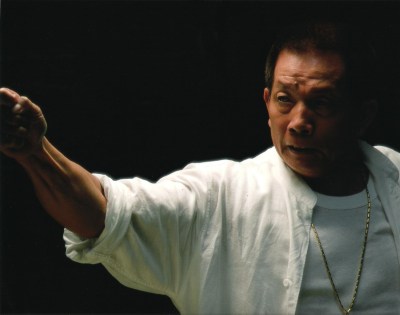
But of course, Lau will exaggerate. No one actually gets sliced, chopped or mutilated or killed in a Lau film. No one actually gets their teeth pulled out at the end of The Eight-Diagram Pole Fighter. What he brought to the martial arts genre was not documentary realism, but rather a grounding of his fictions in a basic reality, prefaced by a warning that not everything we see is to be believed, even stunts performed by the most skilled martial artists (as Chen Kuan-tai and Ti Lung, Lau’s phony Boxers, most definitely are). Rather than cut around performers who can’t actually perform the stunts required of them, or obfuscate with the rapid-editing, nauseatingly hectic handheld camera style of so many inelegant Hollywood action films, Lau’s films are as much about capturing an actual athletic performance as it actually occurred as they are about anything else: we see complete movements and he cuts for clarity and emphasis, not obfuscation. He’s not above the use of a trampoline to exaggerate the height of an actor’s leap, but the commitment to reality remains, though the edges may get a little smudged.

I’ve often said in these Summer of Sammo reviews that the key theme of the kung fu movie is the conflict between the desire for revenge and the moral imperative to forgive, between the demands of loyalty and duty and the desire to withdraw from worldly concerns in search of enlightenment and spiritual peace. The tension between fakery and realism is a a kind of meta-theme of the genre as well, an opposition between fantasy wuxia films, crazy movies where people perform impossible feats with magical swords and spiritual energy has a marked similarity to laser beams (such as the films of Tsui Hark or Ching Siu-tung), and kung fu films proper, which are set in a more real world and are more grounded in their special effects and tend to feature hand-to-hand combat rather than fights using weapons (the films of Sammo Hung, Corey Yuen and Jackie Chan – Yuen Woo-ping distinguishes himself as a master of both subgenres). There are exceptions and cross-pollinations across all these distinctions, but the setup generally works, I think, to identify two very different approaches to film, and two different ways we in the audience process those films: as wild imaginative spectacle or with wonderment at the possibilities of the human body. I treasure both experiences, but Lau positions himself firmly on the side of humanism versus abstract expression, and against the belief in the impossible.
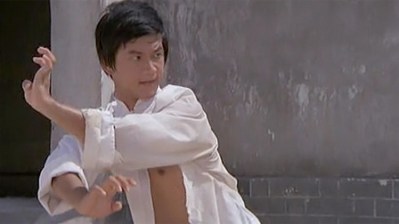
Circling back to the Boxers, the belief in them, and their own apparent belief in themselves, rested on a kind of credulity, that of a poor people living in an apocalyptic age, beset by calamity after calamity (invasion, natural disaster, economic collapse, governmental corruption, epidemic drug abuse) and turning an irrational eye toward leaders who would then exploit them for their own ends. The Boxers, when they’re shown as true believers, are tragic figures. Often when depicted in film (in Tsui Hark’s Once upon a Time in China II, or Lau’s later film Legendary Weapons of China), they’ll be played both ways: the masses as heroic yet pathetic victims of cynical leaders who tricked and manipulated them into committing terrorist and/or revolutionary acts. Lau’s Boxers are fakes tricking the Empress herself into believing in them. But the hero of The Spiritual Boxer is also a fraud, in that he does not really have the ability to act as an avatar of the various gods he gulls people into believe he can call upon. He knows his special effects are phony but comes to realize the very real power of his actual martial arts skills, taught to him by the same master who taught him to be a cheat and a con-man. He is a skilled fighter and he scores very real victories against the various villainous figures he encounters. Without the bells and whistles, the religion and the trick swords, he can defend the weak and defeat the villains.
The Best 2012 Movies of 2013, So Far

Due to the vagaries and inanities of motion picture distribution, most of the best movies of the year just now half completed had their premieres last year, either on the festival circuit, in limited engagements in The Only Cities That Matter (that’s NY & LA), or both. This kind of thing always results in chronological chaos: when a film’s eligibility is determined by local theatrical release date a movie can be a 2012 film in one city and a 2013 one in another and no one knows what to do with festival movies.  Take the case of Hong Sangsoo: In Another Country played festivals and in New York City in 2012, but opened in Seattle in 2013. But I, a Seattle-based critic (more or less), saw it at the Vancouver Film Festival in 2012. I also saw Hong’s Oki’s Movie at VIFF, but in 2010. However, it didn’t premiere theatrically in the US (New York or anywhere else) until 2012 (as did his The Day He Arrives, which played festivals in 2011 but I didn’t see until I rented it on DVD in 2012, a few weeks before it played (briefly) in a New York theatre – it has yet to play in a Seattle theatre to my knowledge). His latest film (Nobody’s Daughter Haewon) has played festivals in some cities, but has yet to become available at a theatre or video store near me, as far as I can tell. What year are the Hongs?

My solution for all my lists here at The End is to go by imdb date, which is based on the first time a film plays for an audience, festival or commercial, anywhere in the world. It makes more sense to say Hong made a film in each of 2010, ’11, ’12 and ’13, and that those films should be ranked (if we’re going to rank films) against the other films made that year (and set aside the fact that movies aren’t always initially released the year they were made, for it’s possible to go too far down the rabbit hole). Going by non-festival US theatrical release gives us no eligible Hongs for 2010 or 2011, and either two or three Hongs eligible for 2012 and zero or one or two for 2013, depending on where the list-maker just happens to live. Listological chaos.

(I won’t even mention the havoc going by local release dates plays with historical titles. Suffice it to say that Tokyo Story would become a 1953 film for a Japanese critic, a 1964 film for a Swedish one and a 1972 film for a New Yorker. This kind of absurdity played out in reality in 2006 when several critics (not just New Yorkers) put Jean-Pierre Melville’s 1969 classic Army of Shadows on their end of the year Best Of lists, more than 20 years after Melville’s death.)

By this standard, my 2013 Best of the Year so far list would contain only two titles, one of which is a TV series that as far as I know only played as a film at the Sundance Film Festival (Top of the Lake). But many of my favorite films of 2012 are showing up on a number of critics’ lists, as they follow a less logical system. So here I present my list of the Top Ten 2012 Movies that Show Up On Other People’s Best of 2013 So Far Lists Even Though They Really Shouldn’t Be Considered As Such:

1. Like Someone in Love (Abbas Kiarostami)

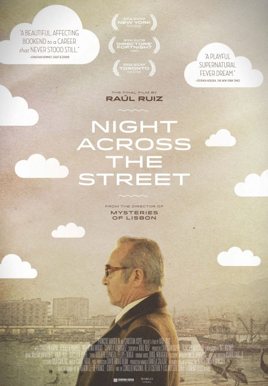
2. Night Across the Street (Raúl Ruiz)

3. Drug War (Johnnie To)

4. To the Wonder (Terrence Malick)

5. In Another Country (Hong Sangsoo)

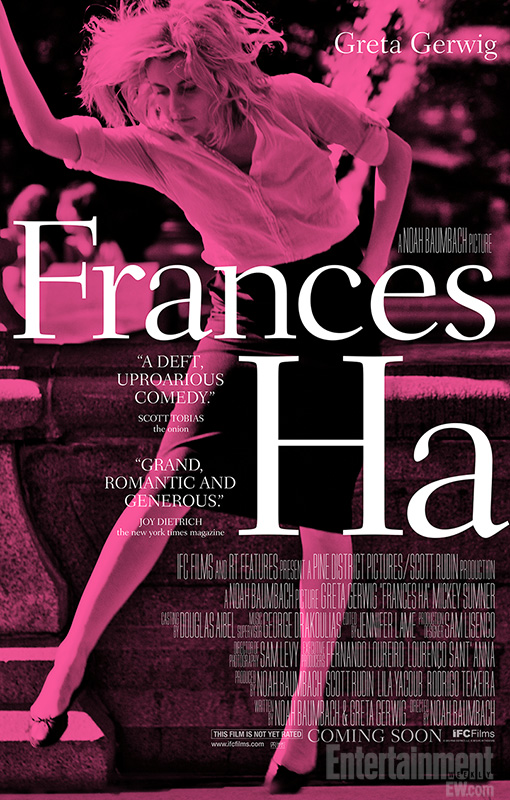
6. Frances Ha (Noah Baumbach)

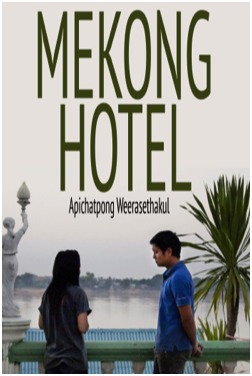
7. Mekong Hotel (Apichatpong Weerasethakul)

8. Tabu (Miguel Gomes)

9. Much Ado About Nothing (Joss Whedon)

10. When Night Falls (Ying Liang)

Note that of these, I’m pretty sure that numbers 2 and 10 have yet to play theatrically in Seattle, though they have played New York, while number 3 played the Seattle Film Festival but has yet to have a commercial release here or elsewhere around the US (though it played theatres in China last year, where Johnnie To already has had another film released this year).

Links are to my reviews, either here, on letterboxd or in podcast form.

Update October 2013: Current lists for 2012, 2013 and lots of other years can be found here.

Summer of Sammo: The One-Armed Swordsman


I’ve declared this the summer of 2013 to be the Summer of Sammo. Throughout these months I’ve been writing about films starring or directed by Sammo Hung, as well as other Hong Kong genre films of the Sammo Hung era. Here’s an index.

Probably not the first superhero origin story movie, or even the first great one, but it’s the earliest one I can think of and it remains one of the best in that now ubiquitous genre. After a bloody prologue, in which a man is killed protecting his master from gangsters, the film finds our hero, Jimmy Wang Yu as the son of the fallen hero, now a student of that same master, but one constantly picked on by the other, higher class students. Wang resolves to leave, but is met by his tormentors in the woods by Shaw studio moonlight. In a fit of psychopathic impetuosity, the master’s daughter lops off Wang’s arm.

Director Chang Cheh blows up the insanity of this act, as Wang stumbles away in through snow and the soundtrack goes wild with a free jazz freakout. Eventually rescued by a young farm girl and nursed back to health, the philosophical conflict of the film slowly reveals itself. Wang must choose between a simple, non-violent life as a farmer or the kung fu world, where he owes his master a filial debt of loyalty and is duty-bound to protect him and his family.

This central section of the film alternates between Wang learning a new, one-armed fighting style (gleaned from half a book the farm girl gives him: half a book for half a man, it requires too the use of half a sword – his father’s broken weapon he’d saved for many years as a relic) and the schemes of an evil gang, led by the mysterious (because we only see him from behind until the climax of the film) Long-Armed Devil (the name a contrast to Wang’s disability, a penis joke, or both). The gang has developed a weapon that locks onto the master’s broadsword, leaving him open to be knifed in the belly. The gang uses this weapon to kill off many of the master’s disciples, and then challenges the man himself at his compound. Only the One-Armed Swordsman can save them. That is, if he decides that the demands of loyalty trump his desire for a nice quiet life as the One-Armed Farmer.

Of course he comes to their rescue, killing and/or dismembering many a bad guy (including action director Lau Kar-leung), choosing honor over domestic happiness. But, in the end he gets the farm girl too and they head out for their new life together. It’s an unusually optimistic ending for Chang Cheh, the Sam Peckinpah of kung fu movies. In his later films, the price of loyalty will prove much greater and the conflict between personal happiness and martial obligation will prove irresolvable. Hints of the darker reality are seen in the pile of slaughtered men littering the master’s home in the wake of the Long-Armed Devil’s attack. But as Wang and his girl walk away, accompanied by a rollicking beat and blaring 1960s horns, in these early days of the kung fu movie Golden Age, happy endings are still possible.