This Week in Rankings

The past several weeks saw the Hou Hsiao-hsien Retrospective come and go in Seattle, and I covered it in detail over at Seattle Screen Scene (I also was lucky enough to be invited to introduce a handful of shows as well, which was fun). Over there I wrote lengthy reviews of The Boys from Fengkuei, The Time to Live, The Time to Die, Dust in the Wind, Flowers from Shanghai, Millennium Mambo and Café Lumière. I also covered the Seattle releases of Abel Ferrera’s Welcome to New York, Hal Hartley’s Ned Rifle and Lisandro Alonso’s Jauja.

I also submitted an annotated list of Underrated 1985 Films to Rupert Pupkin Speaks. And I don’t think I’ve mentioned it yet, but I also have a thing on my favorite Film Discoveries of 2014 over there too.

Over here at the end, I wrote about Chang Cheh’s Masked Avengers, part of my Running Out of Karma series, the index for which is fully updated. I’m closing in on 200 Chinese language films seen as part of the series, which is surely some kind of a milestone. Especially since I still pretty much hate the series’s title. My other indices are up-to-date as well: the Review Index as well as the Index of Essays and Podcasts.

These are the movies I’ve watched and rewatched over the last few weeks, and where they place on my year-by-year rankings.

Red Line 7000 (Howard Hawks) – 11, 1965
The Boys in the Band (William Friedkin) – 19, 1970
Cute Girl (Hou Hsiao-hsien) – 27, 1980
Masked Avengers (Chang Cheh) – 28, 1981
Three Crowns of the Sailor (Raoul Ruiz) – 8, 1983

The Boys from Fengkuei (Hou Hsiao-hsien) – 9, 1983
The Time to Live, The Time to Die (Hou Hsiao-hsien) – 2, 1985
Taipei Story (Edward Yang) – 7, 1985
Yes, Madam (Corey Yuen) – 9, 1985
The Terrorizers (Edward Yang) – 6, 1986

Dust in the Wind (Hou Hsiao-hsien) – 11, 1986
Project A 2 (Jackie Chan) – 18, 1987
Days of Thunder (Tony Scott) – 40, 1990
Only Yesterday (Isao Takahata) – 2, 1991
Twin Dragons (Tsui Hark & Ringo Lam) – 24, 1992

A Borrowed Life (Wu Nien-jen) – 11, 1994
Henry Fool (Hal Hartley) – 12, 1997
Flowers of Shanghai (Hou Hsiao-hsien) – 6, 1998
Millennium Mambo (Hou Hsiao-hsien) – 1, 2001
Fay Grim (Hal Hartley) – 19, 2006

It Felt Like a Kiss (Adam Curtis) – 2, 2009
All Watched Over by Machines of Loving Grace (Adam Curtis) – 23, 2011
Save the Date (Michael Mohan) – 82, 2012
Jauja (Lisandro Alonso) – 4, 2014
Approaching the Elephant (Amanda Wilder) – 31, 2014

Ned Rifle (Hal Hartley) – 53, 2014
World of Tomorrow (Don Hertzfeld) – 2, 2015
Bitter Lake (Adam Curtis) – 4, 2015
Furious 7 (James Wan) – 5, 2015

Running Out of Karma: Chang Cheh’s Masked Avengers

Running Out of Karma is my on-going series on Johnnie To, Hong Kong and Chinese-language cinema. Here is an index.

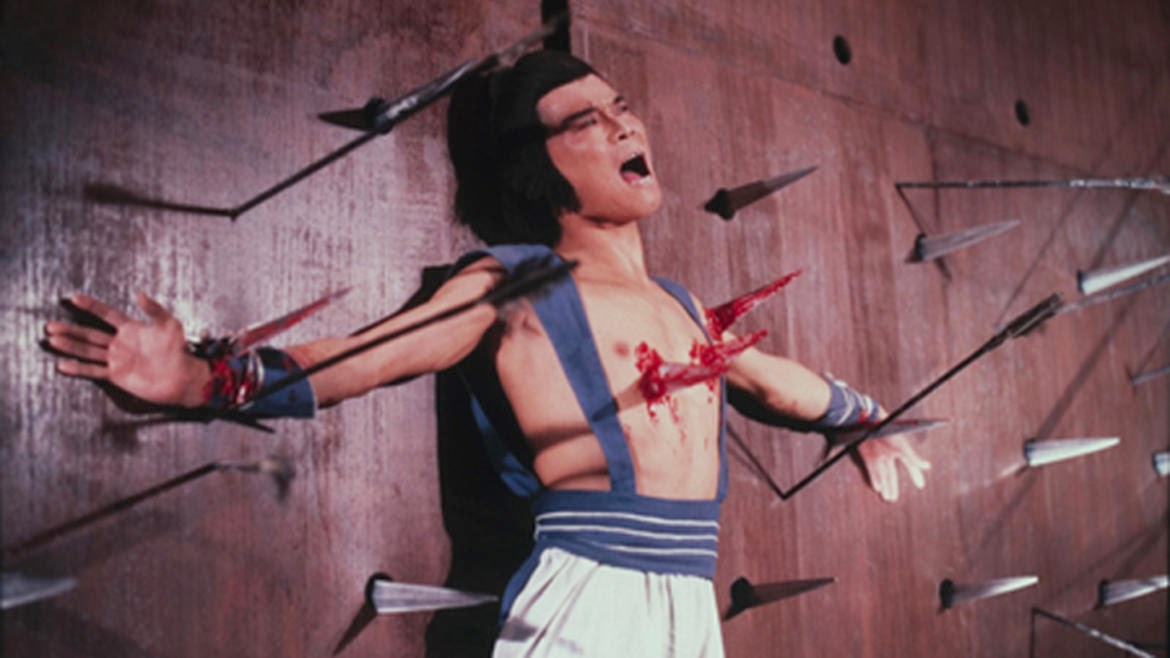
Masked Avengers was released in 1981, the latest in a series of films directed by Chang Cheh and starring a new group of actors and stunt performers generally known as the Venom Mob, after the 1978 film in which they were first gathered, The Five Deadly Venoms. The plot revolves around a martial arts group’s search for the leaders of a criminal gang of assassins. The bad guys wear masks, conduct elaborate sacrifices of their victims (including blood-drinking) and are surprisingly hard to find considering they’re the only other characters in the film. Except for one guy, a waiter who knows more than he lets on, who turns out to be a hero, which is also pretty obvious because he’s played by Philip Kwok, the most-recognizable of the Venoms (you know him as the badass killer from Hard-Boiled and also Johnnie To and Tsui Hark’s The Big Heat). Like the rest of Chang’s films from this period, the plots and characters are rote and mechanical, the fight scenes interminable and the sense of moral, cultural and philosophical decay overwhelming. They are bloody, bleak and crushing films, movies in which the heroes who in earlier years stuck defiantly to codes of honor and brotherhood are finally lost into their nihilistic world of violence and destruction.

Chang Cheh’s breakthrough films in the late 60s and early 70s are driven by the star charisma of David Chiang, Ti Lung and Jimmy Wang Yu and romantic notions of brotherhood, codes and bloody self-sacrifice (The One-Armed Swordsman, Golden Swallow, The DuelVengeance!, The Heroic Ones). His mid-70s films reflect a haphazard attempt to chart a history of kung fu (driven in some part by his collaboration with Lau Kar-leung), locating that code ideal in a centuries-old tradition, as well as an influx of new stars like Alexander Fu Sheng and Chen Kuan-ti (Shaolin Temple, Boxer Rebellion, Five Shaolin Masters, Heroes Two). His late 70s and 80s films ditch the romanticism of brotherhood and movie stardom in favor of a collective of highly skilled stunt performers, almost all of whom either lack star power or aren’t given a chance to express it in the confines of the claustrophobic gothic-detective narratives in which they find themselves. The films (In addition to Masked Avengers, I’ve seen The Five Deadly Venoms, Crippled Avengers, Ten Tigers from Kwangtung and Five-Element Ninjas) almost all exist outside of history or even the ephemeral political context of so many other kung fu films (Ten Tigers being the notable exception, as it is located on the Shaolin Temple-Wong Fei-hung timeline, about which I wrote a long piece last year that may be published someday) choosing instead to play out as either generic revenge tales or wholly unremarkable mystery plots.

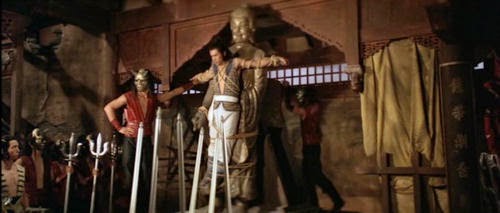
This has the effect of making the films seem even more nihilistic than Chang’s earlier paeans to bloody revenge. At least when David Chiang is sacrificing himself, he’s doing it for something. Even Wang Yu’s white-clad super-swordsman in Golden Swallow, alienated from the world by his bloody obsessions, at least has his moment of heroic glory, knowing he’s the greatest warrior of them all. The early Chang heroes die standing up, but in the late films, there’s no such glory to be found, only exhaustion. Driven by the percussive rhythms of their (over-)long fight sequences, which, without the drive to authenticity of Lau or the comic ingenuity of the New Wave of choreographers popping up at Golden Harvest and various independent production houses (Sammo Hung, Corey Yuen, Ching Siu-tung, Yuen Woo-ping) become exercises in brutality. The films become less action-entertainment than Sisyphean horror shows, the human body distorted beyond reality, mutilated and scarred by motiveless betrayals and the devious machinery of violence. The five venoms and ninjas are inhuman collectives, the avengers are crippled and demon-masked. The infernal dungeons and torture devices of Masked Avengers belong more to the world of Roger Corman’s Poe films than the bright studio sets of the Shaw Brothers (contrast Chang’s spare but for devilish implements of murder backgrounds to the stately Sternbergian clutter of Chor Yuen’s wuxia films of the same period (Heaven Sword and Dragon Sabre, Heroes Shed No Tears, and The Sentimental Swordsman), the ornateness of his mise-en-scene matched only by the wild curlicues of his and Gu Long’s dizzyingly complicated plots, narratives which pack more ingenious twists into any given ten minutes than the entirety of Chang’s bland mysteries). The Masked gang utilizes statues of the Buddha in its elaborate torture systems, imprisoning their victims within statues or crucifying them upon them, but they don’t propagate an alternate religion: their base is an abandoned temple, their world has no monks, no ideology, they kill people for money and that is all there is.

The kung fu film in the early 80s, like most generic cycles in their late stages, was falling apart as it dissolved in a multitude of directions. In a weird way, Chang, the oldest of the great kung fu directors, most captured the generational rage and nihilistic drive to (self-)destruction at the heart of New Wave classics like The Happening or Dangerous Encounters – First Kind. Masked Avengers embodies a bleakness that Sammo Hung can only hint at, that Tsui Hark ventured into only rarely before receding into the comic antics of Cinema City, that Lau Kar-leung took a breath-taking stab at in The Eight-Diagram Pole Fighter before walking away. In the 15 years between 1967’s The One-Armed Swordsman and 1982’s The Five-Element Ninjas, Chang Cheh directed somewhere in the neighborhood of seventy films. I’d hesitate to say these late films represent a kind of personal exhaustion, but my God, who wouldn’t be tired after all that?

This Week in Rankings

The 2014 Oscars came and went since my last update, and I wrote a few things in relation to them: my predictions (turned out pretty well, though I missed on the biggest awards of the night), the 2014 (and 1998) Endy Awards, and a long Oscars-inspired editorial, the kind of thing I don’t write very often. I also continued my look at 21st Century history films with reviews of Ridley Scott’s Gladiator and Robin Hood.

Most of my writing has been over at Seattle Screen Scene, where I covered Valentine’s Day, Lady Snowblood, A Fuller Life, the Fists and Fury Series, Casablanca, Chimes at Midnight, Maps to the Stars, 12 Golden DucksBallet 422, Wild Tales, and Another Hitchcock Series.

Coming up over the next couple of weeks, I’ll be introducing a number of screenings at Seattle’s version of the big Hou Hsiao-hsien retrospective that’s been traveling the world in recent months. I’ll be at Boys from Fengkuei at Scarecrow Video and then all five of the shows at the Northwest Film Forum (Dust in the Wind, Flowers of Shanghai, A Time to Live A Time to Die, Millennium Mambo and Good Men Good Women). I haven’t watched or written much about Hou at all over the past few years, so I’ve been studying up lately. A few years ago, we did a They Shot Pictures episode on Hou (you can listen here), and around that time I wrote about Café Lumière and Good Men, Good Women, and collected some images from Flight of the Red Balloon.

These are the movies I’ve watched and rewatched over the last few weeks, and where they place on my year-by-year rankings. Short reviews or comments for most of them can be found on my letterboxd page.

Where Danger Lives (John Farrow) – 23, 1950
Doctor Zhivago (David Lean) – 23, 1965
Darling (John Schlesinger) – 27, 1965
Lady Snowblood (Toshiya Fujita) – 15, 1973
Farewell, My Lovely (Dick Richards) – 14, 1975

Christine (John Carpenter) – 9, 1983
Last of the Mohicans (Michael Mann) – 1, 1992
Memoirs of an Invisible Man (John Carpenter) – 41, 1992
HHH: A Portrait of Hou Hsiao-hsien (Olivier Assayas) – 23, 1999
The Insider (Michael Mann) – 31, 1999

Gladiator (Ridley Scott) – 40, 2000
Ali (Michael Mann) – 11, 2001
The Power of Nightmares (Adam Curtis) – 10, 2004
Collateral (Michael Mann) – 13, 2004
Three Times (Hou Hsiao-hsien) – 2, 2005

Cigarette Burns (John Carpenter) – 26, 2005
The Trap: What Happened to Our Dream of Freedom (Adam Curtis) – 8, 2007
Public Enemies (Michael Mann) – 10, 2009
Robin Hood (Ridley Scott) – 39, 2010
J. Edgar (Clint Eastwood) – 34, 2011

A Fuller Life (Samantha Fuller) – 28, 2013
The Great Gatsby (Baz Luhrmann) – 55, 2013
Don’t Go Breaking My Heart 2 (Johnnie To) – 5, 2014
Tokyo Tribe (Sion Sono) – 20, 2014
The Last Five Years (Richard LaGravenese) – 36, 2014

Wild Tales (Damián Szifrón) – 37, 2014
Maps to the Stars (David Cronenberg) – 45, 2014
The Duke of Burgundy (Peter Strickland) – 47, 2014
The Iron Ministry (JP Sniadecki) – 49, 2014
Nightcrawler (Dan Gilroy) – 52, 2014

Birdman or (The Unexpected Virtue of Ignorance) (Alejandro González Iñárritu) – 58, 2014
Black Comedy (Wilson Chin) – 75, 2014
The Theory of Everything (James Marsh) – 76, 2014
Smog Journeys (Jia Zhangke) – 3, 2015

On Ridley Scott’s Gladiator

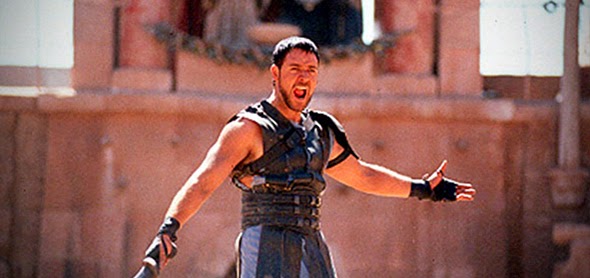
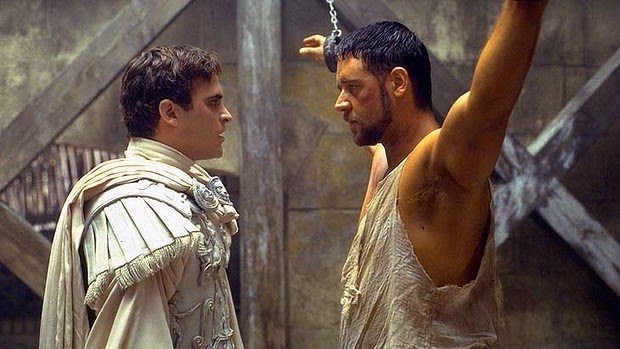
I’ve been building up to a rewatch of this one for awhile now, taking in a series of historical epics in anticipation of a second look at one of my least favorite Best Picture winners of the century so far. I do think there’s much to be made about the 2000 Best Picture race: here was a chance for The Academy to move in a new and progressive direction, honoring truly innovative and important work from outside America (though directed and written by Hollywood veterans and co-funded with American cash). It could have set the tone for a more globally open and innovative 21st century, not just for awards, but for US film distribution and viewing patterns. But instead the Academy opted for Ridley Scott’s CGI-fueled historical epic over Ang Lee’s CGI-fueled historical epic. And once the Weinsteins put a stranglehold on everything they could from Hong Kong, the chances of American audiences getting wide exposure to the most exciting and interesting cinema in the world quickly diminished. But this is a long digression, this is supposed to be about Gladiator itself.
The action, at least, is better than I remembered, it’s really only the opening battle that degenerates into an incoherent blur, the gladiator fights are instead simply middling examples of Hollywood obfuscation-as-excitement (the opening battle is also topped by a similar one in Oliver Stone’s Alexander which as well hinges on a daring cavalry maneuver, but manages to both ratchet up the excitement and violence while at the same time remaining historically accurate), although I quite liked the one with the tigers.
As history it’s abominable in just about every particular. It’s not so much that it is historically inaccurate, or even that it just doesn’t give a fuck about history, it’s that it is actively anti-historical, manipulating the facts of the past in service of the narrative it wants to tell, which is a story about two versions of manhood: one virile and stoic; one impotent and emotional. Commodus is transformed into a simpering weakling, a coward and an incestuous pervert. His villainy is sourced in his weakness. Opposite to him in every way is Maximus, the very ideal of honor, loyalty, fidelity, fatherhood and filial piety. Maximus is the guy Chris Kyle thought he was, and this is a Bush-era film to its core: it imagines a world in which peace and freedom can be instilled through violence, war and the sacrifices of noble men. That Marcus Aurelius never did much in the way of seeking eternal peace, his wars against the Marcomanni and Quadi, on-going at his death, was only concluded when Commodus decided he simply wasn’t interested in continuing the fight, is an inconvenient fact of history to be ignored, as is the indisputable fact that Marcus very much wanted Commodus to succeed him (and in fact Commodus had been in place as his Caesar for 14 years prior to Marcus’s death – co-Emperors were a fairly common practice in Rome, the senior being titled “Augustus” the junior “Caesar”). The idea that Marcus couldn’t possibly have made such a terrible decision is an enduring one, however, and it’d be hard to blame Scott for propagating the legend.
Indeed, Anthony Mann utilizes much the same premise in his Fall of the Roman Empire, though that film at least accepts the political realities of late Second Century Rome. There’s no question of the Senate, or the Roman populace (repeatedly identified as “the mob”) having any real power at all, which they hadn’t for at least a century, if not longer. The reason for this can only be contemporary: it’s the neoconservative vision of using force to establish freedom, transplanted to the Roman Empire. Marcus appoints Maximus as the Emperor needed to maintain order while the government transitions from autocracy to democracy, the military dictatorship preceding the withering away of the state. Then the film has the audacity to suggest that Marcus and Maximus’s “dream of Rome” a dream of freedom guaranteed by the Roman Senate (never mind that the Senate was never anything like what we’d recognize as democratic or even populist, rather a hereditary oligarchy built on a slave economy), actually will come true. When, in fact, after Commodus’s assassination (strangled in his bath by his wrestling partner: Commodus was in fact an energetic lover of games, often partaking in rigged gladiatorial combats, something which engendered popular dislike of him by the deeply class-conscious masses), the Senate quickly put the role of Emperor up for sale to the highest bidder (something Mann’s film does well to dramatize). The year following Commodus’s death is called the Year of the Five Emperors, you can guess from that how it went down. The ultimate victor in that civil war, Septimus Severus, established a tradition of military dictatorship, infighting and political assassination that came to be the norm for the next century (it’s collectively known as “The Crisis of the Third Century”), until Diocletion and then Constantine radically remade the Empire in the late 200s and early 300s. At no point did the Roman Empire ever become more democratic that it was when Commodus was alive: that’s why Gibbon started his book with his reign.
It’s interesting then to rewatch this now, 15 years after its release and after just having seen Scott’s Robin Hood, which similarly twists historical fact in the service of a political narrative, albeit one as informed by the Bush years as Gladiator is in anticipation of them. Crowe’s Robin is a mythical figure, a mask adopted by a foot soldier (well, archer, technically), one that, as Maximus does, embodies certain masculine ideals. But the implication is that all of these roles are merely poses, that the actual man is nothing more than a construct, an ephemerality. Just so is that film’s dream of freedom – it’s one that pointedly is not accomplished by film’s end, and indeed it’s strongly implied that it cannot ever be – rather the aim of the true hero is the struggle toward universal political freedom, not the justification of certain means of achieving it. The utopia Robin and Marion create can exist only in the magic of Sherwood Forest, and then not by force, but only by withdrawing from the world into a small-scale community, disconnected from the strife of the larger world.
Even still, given all that, I probably would have given it a positive rating if only Oliver Reed had thrown his hat and charged into combat at the end.

On Ridley Scott’s Robin Hood

Ridley Scott’s 2010 adaptation of the Robin Hood story is much better than I’d expected given both the critical reaction at the time and my usual responses to Scott’s historical epics. Expecting a repeat of Gladiator‘s obstinately counter-factual approach to Roman history, I was pleasantly surprised to find a much strong sense of the actuality of life in medieval England here (I watched the Director’s Cut version on the Blu-Ray). Sure, the film makes no mention of the cultural divide between the Normans and the Anglo-Saxons that is at the heart of a lot of the conflict between the ruling Plantagenets and the local nobility that was still in the process of working itself out in the late 12th Century (it would be another hundred years or so before a King of England spoke English as his first language, IIRC), but still, locating the Robin Hood story a bit later in time than is traditional, to the reign of John proper as opposed to the middle of Richard’s, is a strike of genius, tying the legend together with the complex mass of politics surrounding the Magna Carta. There are hints of ethnic or at least cultural difference between rulers and ruled, as Will Scarlet is identified as Welsh (and therefore Celtic) and Cate Blanchett’s Marion is a paragon of the strong Anglo-Saxon woman, of a type uniquely prevalent in the Kingdom of Mercia, of which Nottinghamshire was a part, as near as my geographic skills can tell. The haunting images of the orphaned children of Sherwood forest even recall stories of black magic practiced by the Celts encountered by the first Roman invaders on the island.

The other major twist to the legend is that our hero is no longer a petty nobleman, but an orphan who has forgotten his past who takes on the role of a Baron for various complicated but not really important reasons. Thus is Robin Hood doubly turned into a mirage: he’s a mask that Russell Crowe’s Robin Longstride adopts twice over: first a model of the chivalrous knight and beneficent lord, then as the paragon of democratic values and the communitarian ideal. Both images are false, but nonetheless necessary to the political causes they represent. Crowe’s character is a chameleon, adopting the ideal form of whatever world he finds himself in: warrior archer, petty nobility, political revolutionary. This conception of the character requires some plausibility stretching at times throughout the film, but all in service of a good cause (the quick turn of Léa Seydoux’s Isabella for example, or the ease with which the English troops turn to Robin as savior, both before and after the final battle, in direct insult to John).

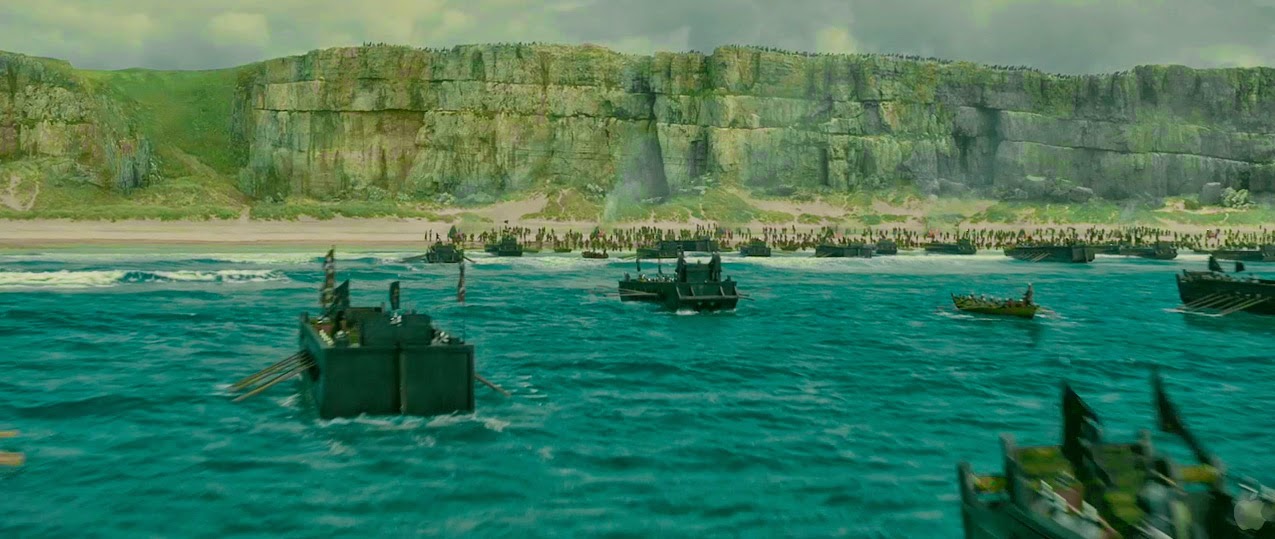
Unfortunately, much of what is of interest in the film dissolves in the final act, replaced by Scott’s worst instincts as a director of action. The reasonably-coherent and sensible action scenes interspersed throughout the film are replaced by a full-scale battle, a swirl of mud-brown and grey with the kind of shoddy camerawork and random editing we’ve come to take as normal from 21st century Hollywood. The logistics of the battle are increasingly absurd. First, the unified English army marches from Barnsdale to Dungeness in two days, in order to meet the invading French. That’s a journey of 173 miles, which, while it only would take a couple of hours today (Google Maps tells me its 3 hours and 10 minutes on the M11) is unlikely to have been traversed in less than a week, maybe four days at top speed for an entirely mounted small medieval army moving through their own terrain with no baggage train (50 miles per day). There’s no reason for the timeline to be given as two days, it’s a pointless throw-away bit of movie silliness. Similarly, the less said about Marion dressing in full armor to lead a group of children into battle against a professional army, and then taking on the biggest villain of the film in single combat, the better. It’s silly, but not in the fun way of Friar Tuck attacking the French with bees or Little John picking up chicks (“I’m proportionate!”), but in the depressing this-is-what-we-take-as-normal-in-Hollywood action-filmmaking sense. As Ridley Scott’s idea of realism gives, so it takes away.

Predictions for the 87th Annual Academy Awards

These are my predictions for the winners of this year’s Academy Awards. On Sunday night, I’ll be tweeting out the winners of the 2014 Endy Awards as the Oscar winners are announced. You can follow me there @theendofcinema. Here are the current Endy Award Nominees. We’ll also have a special Oscar edition of The George Sanders Show this weekend, picking our 2014 favorites and discussing two of the Best Picture nominees of 1965 that starred Julie Christie, Doctor Zhivago and Darling. And I have an Oscar Preview up as well at Seattle Screen Scene.

Best Picture:

American Sniper
Birdman
Boyhood
The Grand Budapest Hotel
The Imitation Game
Selma
The Theory of Everything
Whiplash 
Best Director:
Wes Anderson, The Grand Budapest Hotel
Alejandro González Iñárritu, Birdman
Richard Linklater, Boyhood
Bennett Miller, Foxcatcher
Morten Tyldum, The Imitation Game 
Actor:
Steve Carell, Foxcatcher
Bradley Cooper, American Sniper
Benedict Cumberbatch, The Imitation Game
Michael Keaton, Birdman
Eddie Redmayne, The Theory of Everything 
Actress:
Marion Cotillard, Two Days, One Night
Felicity Jones, The Theory of Everything
Julianne Moore, Still Alice
Rosamund Pike, Gone Girl
Reese Witherspoon, Wild
Supporting Actor:
Robert Duvall, The Judge
Ethan Hawke, Boyhood
Edward Norton, Birdman
Mark Ruffalo, Foxcatcher
JK Simmons, Whiplash 
Supporting Actress:
Patricia Arquette, Boyhood
Laura Dern, Wild
Keira Knightley, The Imitation Game
Emma Stone, Birdman
Meryl Streep, Into the Woods
Original Screenplay:
Alejandro G. Inarritu, Nicholas Giacobone, Alexander Dinelaris, Jr. & Armando Bo, Birdman, Or (The Unexpected Virtue Of Ignorance)
Richard Linklater, Boyhood
E. Max Frye and Dan Futterman, Foxcatcher
Wes Anderson and Hugo Guinness, The Grand Budapest Hotel
Dan Gilroy, Nightcrawler
Adapted Screenplay:
Jason Hall, American Sniper
Graham Moore, The Imitation Game
Paul Thomas Anderson, Inherent Vice
Anthony McCarten, The Theory Of Everything
Damien Chazelle, Whiplash
Foreign Language Film:
Ida
Leviathan
Tangerines
Timbuktu
Wild Tales

Documentary Feature:
CitizenFour
Finding Vivian Maier
Last Days in Vietnam
The Salt of the Earth
Virunga 
Animated Feature:
Big Hero 6
The Boxtrolls
How to Train Your Dragon 2
Song of the Sea
The Tale of the Princess Kaguya 
Film Editing:
American Sniper
Boyhood
The Grand Budapest Hotel
The Imitation Game
Whiplash 
Cinematography:
Birdman
The Grand Budapest Hotel
Ida
Mr. Turner
Unbroken 
Production Design:
The Grand Budapest Hotel 
The Imitation Game
Interstellar
Into the Woods
Mr. Turner 
Costume Design:
The Grand Budapest Hotel
Inherent Vice
Into The Woods
Maleficent
Mr. Turner 
Make-Up:
Foxcatcher
The Grand Budapest Hotel
Guardians of the Galaxy 
Sound Mixing:
American Sniper
Birdman or (The Unexpected Virtue of Ignorance)
Interstellar
Unbroken
Whiplash 
Sound Editing:
American Sniper 
Birdman or (The Unexpected Virtue of Ignorance)
The Hobbit: The Battle of the Five Armies
Interstellar
Unbroken
Visual Effects:
Captain America: The Winter Soldier
Dawn of the Planet of the Apes
Guardians of the Galaxy
Interstellar 
X-Men: Days of Future Past 
Original Score:
The Grand Budapest Hotel
The Imitation Game
Interstellar
Mr. Turner
The Theory of Everything 
Original Song:
“Everything is Awesome,” The LEGO Movie
“Glory,” Selma
“Grateful,” Beyond the Lights
“I’m Not Gonna Miss You,” Glen Campbell… I’ll Be Me
“Lost Stars,” Begin Again 
Documentary Short:
Crisis Hotline: Veterans Press 1
 Joanna
 Our Curse
 The Reaper (La Parka)
 White Earth  
Animated Short:
The Bigger Picture
The Dam Keeper
Feast
Me and My Moulton
A Single Life
Live Action Short:
Aya
Boogaloo and Graham
Butter Lamp (La Lampe au Beurre de Yak)
Parvaneh
The Phone Call 

This Week in Rankings

Since the last update I have, along with Mike from The George Sanders Show and Seema from They Shot Pictures, launched a new website, Seattle Screen Scene, dedicated to arthouse and repertory film in the Seattle-area. The site is inspired by New York’s wonderful Screen Slate, with listings of all the specialty showings in the city over a given week (also available as a weekly newsletter) but also featuring reviews, previews and other features (like Mike’s interview this week with Cinema Books owner Stephanie Ogle).

Other than a long review of Troy and various letterboxd short reviews, all my writing for the last month has been over there, with looks at Sleepless in Seattle, Two Days One Night, National Gallery, Adieu au langage, and a James Stewart double feature, along with revised and updated versions of reviews that originally ran here on The Taking of Tiger Mountain and Actress. Mike and I also did George Sanders episodes on Selma and Malcolm X and The Shopworn Angel and The Cheyenne Social Club.

I also announced the nominees for the 2014 Endy Awards. As with every award and ranking on this site, these are subject to revision, of course. In fact, I’m going to do a big update with all the new 2014 films I’ve seen since the initial post in the next couple of days. But I’ll be announcing the winners on Oscar night coming up in a couple of weeks (we’ll also have an Oscar preview episode of The George Sanders Show that weekend).

At letterboxd I updated my Best Movies of Every Year list and created some new lists for Clint Eastwood, William Goldman and James Stewart. I also made a big list of the Top (East) Asian Films of the Decade (So Far), to highlight cinemas that seem to constantly be underrepresented on such endeavors.

These are the movies I’ve watched and rewatched over the last few weeks, and where they place on my year-by-year rankings.

The Spring River Flows East (Cai Chusheng & Zheng Junli) – 10, 1947
The Sun Shines Bright (John Ford) – 5, 1953
The Fall of the Roman Empire (Anthony Mann) – 31, 1964
Alphaville (Jean-Luc Godard) – 10, 1965
Manhunter (Michael Mann) – 8, 1986

Heat (Dick Richards) – 41, 1986
Empire of the Sun (Steven Spielberg) – 11, 1987
Into the Woods (James Lapine) – 23, 1991
Malcolm X (Spike Lee) – 26, 1992
Sleepless in Seattle (Nora Ephron) – 55, 1993

You’ve Got Mail (Nora Ephron) – 50, 1998
The Fast and the Furious (Rob Cohen) – 39, 2001
The Century of the Self (Adam Curtis) – 16, 2002
2 Fast 2 Furious (John Singleton) – 24, 2003
Alexander (Oliver Stone) – 17, 2004

Troy (Wolfgang Petersen) – 42, 2004
The Fast and the Furious: Tokyo Drift (Justin Lin) – 31, 2006
Step Up (Anne Fletcher) – 54, 2006
Rocket Science (Jeffrey Blitz) – 44, 2007
Step Up 2 The Streets (Jon Chu) – 41, 2008

Fast & Furious (Justin Lin) – 59, 2009
A Separation (Asghar Farhadi) – 10, 2011
Fast Five (Justin Lin) – 42, 2011
Fast & Furious 6 (Justin Lin) – 64, 2013
Inherent Vice (Paul Thomas Anderson) – 9, 2014

Selma (Ava DuVernay) – 11, 2014
Whiplash (Damien Chazelle) – 12, 2014
The Taking of Tiger Mountain (Tsui Hark) – 14, 2014
Dear White People (Justin Simien) – 35, 2014
American Sniper (Clint Eastwood) – 38, 2014

Women Who Know How to Flirt are the Luckiest (Pang Ho-cheung) – 40, 2014
John Wick (Chad Stahleski & David Leitch) – 49, 2014
From Vegas to Macao (Wong Jing) – 52, 2014
Blackhat (Michael Mann) – 1, 2015
Jupiter Ascending (The Wachowskis) – 2, 2015

On Troy

I’ve been kicking around the idea of writing about a series of history films, mainly inspired by an on-going obsession with history podcasts (The History of Rome, The History of China, The British History Podcast, The History of Byzantium and more), along with my now 15-year antipathy toward Gladiator. Led by that unfortunately Oscar-winning hit, the current century as seen a resurgence of historical epics enlivened (perhaps) by the wonders of CGI and digital technology. Some are very good (John Woo’s Red Cliff) some are very bad (Gladiator), but most are movies I haven’t seen yet. First up is Wolfgang’s Petersen’s 2004 smash Troy (The Director’s Cut), starring Brad Pitt, Eric Bana, Peter O’Toole, Brian Cox, Brendan Gleeson, Sean Bean and, as always, Orlando Bloom.

To get the positive out of the way first: the action scenes and production design are, for the most part, very good. Though I do think Troy could have been a little less Egyptian in architecture and a little more Greek, or at least more horse-obsessed. The one big mass battle is a bit of a mess, but the one-on-one combat scenes are about as good as it gets from Hollywood this century, not a Ridleyism to be found.

But, the liberties this adaptation takes with its source material are frankly appalling. The Iliad is one of my favorite pieces of literature, and, I’ve long-thought, an immensely cinematic narrative, one which should be relatively easy to adapt (though as far as I know there’s never been a successful one, so maybe not). The writer, David Benioff, who had written The 25th Hour (both the novel and the screenplay) and would go on to co-write a much more successful adaptation of epic literature, Game of Thrones, wisely I think excises the divine intervention which plays a large role in Homer’s tale (it would simply be weird and unwieldily on film), creating a wholly materialistic vision of a mythological world (the people believe in magic, but nothing magical ever happens).

There are major, maddening deviations from tradition: Menelaus and Ajax are killed on the first day of fighting, Agamemnon on the last and the whole war appears to take place over roughy two weeks. Now, I’m sure if you don’t know who those people are or anything else about the Trojan War or the literature it has been inspiring for the last 3,000 years or so, that isn’t going to bother you. And all these decisions were made with the audience in mind: it makes the film smoother, more “satisfying”, more comprehensible. Killing Menelaus and Ajax, who have been shown to be fearsome warriors both, readily demonstrates Hector’s martial prowess; Agamemnon’s death is the bad guy getting his just desserts kind of ending Hollywood demands: we can’t have him triumph at Troy only to learn in voice-over or something that he’d meet a bad end once he got home, better to just get it over with, maybe by letting the most powerless person in the film do the tyrant-slaying. Sure, it leaves the literate folks in the audience wondering what Orestes and Electra are going to do about Clytemnestra now, or where Cassandra’s going to end up, or who’s going to tell Telemachus what happened to his father after the fall of Troy, or wasn’t Achilles dead before they built the Wooden Horse?, and so on. (I don’t know what to do with Ajax mid-battle quotation of Percy Shelley’s Ozymandias (“Look on my works, ye mighty, and despair!”), which is a poem about Rameses II (sort of), who was roughly contemporary with the Trojan War, but certainly wasn’t Greek, and he sure didn’t say it right before smashing some skulls. It might be a meta-commentary on this film and the wasteland it makes of Homer’s art, but I doubt it.)

But whatever, this is a movie, not a book-reading class. It’s the same rationale that led MGM to put a happy ending on Love, its adaptation of Anna Karenina from 1927, the one with Greta Garbo. Nobody has a problem with that, right? (On a related note: someone once complained to me that Funny Face spoiled Anna Karenina for them with Hepburn’s “Shall I show myself under the train?” line. So you see the world Benioff and director Wolfgang Petersen find themselves in.)

Most irritating to me, though, was the repeated, deliberate mispronunciation of character names. I thought maybe it was just me, that I had been saying them wrong in my head for years but now, thank the Gods, Hollywood had finally set me straight. But no, some internet research has confirmed that “Menelaus” does not rhyme with “house” and “Aeneas” has a central long ‘e’ sound not a long ‘a’. The internet appears to be mixed on “Priam”, but better sources seem to go with “Pry-am” not “Pree-am”.

Nonetheless, some of the central ideas of the poem are conveyed, though this has the feeling of accident rathe than intent. The struggle between Achilles and Agamemnon: the hero and the tyrant, soldier and politician, of course is central. But the brutality of the sack of Troy as well (something not in Homer as The Iliad ends with Hector’s funeral games), throws into stark relief the horror of ancient warfare and the utter alienness of the Greek value system, where their heroes and gods followed a very different kind of morality than we are familiar with. This last idea is most interesting to me, and there are hints of potentially deeper explorations of the basic weirdness of this other culture, one that nonetheless is foundational to our own, but they sadly remain only hints (Achilles can’t be upset that Agamemnon stole his slave girl, he has to be upset because he stole the strong independent woman that Achilles has fallen madly in love with after a single meeting, for example; similarly, Achilles must be upset at Patroclus’s death not because he was a cousin, a comrade-in-arms and (maybe) lover, but rather because he was a cousin, young innocent protege and (maybe) lover). In the attempt to translate Homer’s narrative to a wider audience, his characters are made more conventional, more contemporary in mood and ideology, more, ugh, relatable. It doesn’t take the legend as valuable in itself, only as the raw material for a blockbuster. Ten years on, this $500 million-grossing film is all but forgotten.

This Week in Rankings

A new year has come since the last rankings update, which of course means I made some year-end lists, one of My Favorite Discoveries of 2014 and another of the Best Films of the Year (More or Less). I’ve also written several long reviews, on Pang Ho-Cheung’s Aberdeen, Robert Greene’s Actress, Tsui Hark’s The Taking of Tiger Mountain, Wu Peng’s The True Story of Wong Fei-hung: Whiplash Snuffs the Candle Flame and, continuing my chronological look at the films of Johnnie To, his 1988 The Big Heat.  I also handed out some fake movie awards for 1999 and 1984.

On They Shot Pictures, we had our big two-part Year in Review Spectacular and should have our third John Ford episode up in the next few weeks. On The George Sanders Show we talked about Our Favorite Discoveries of 2014, the Best in Film from 1984 and the greatness of James Stewart.

These are the movies I’ve watched and rewatched over the last few weeks, and where they place on my year-by-year rankings. Capsule reviews or brief comments can be found for them on my letterboxd page.

The Shopworn Angel (HC Potter) – 8, 1938
Remember the Night (Mitchell Leisen) – 12, 1940
The True Story of Wong Fei-hung: Whiplash Snuffs the Candle Flame (Wu Peng) – 24, 1949
The Cheyenne Social Club (Gene Kelly) – 16, 1970
What’s Up, Doc? (Peter Bogdanovich) – 19, 1972

Coffy (Jack Hill) – 19, 1973
They All Laughed (Peter Bogdanovich) – 9, 1981
Conan the Barbarian (John Milius) – 15, 1982
Choose Me (Alan Rudolph) – 4, 1984
Streets of Fire (Walter Hill) – 14, 1984

The Cotton Club (Francis Ford Coppola) – 15, 1984
Sixteen Candles (John Hughes) – 16, 1984
Furious (Tim Everitt & Tom Sartori) – 22, 1984
Love Streams (John Cassavetes) – 24, 1984
Dune (David Lynch) – 28, 1984

Conan the Destroyer (Richard Fleischer) – 47, 1984
Revenge of the Nerds (Jeff Kanew) – 49, 1984
Sunday in the Park with George (Terry Hughes) – 15, 1986
The Big Heat (Johnnie To) – 23, 1988
The Muppet Christmas Carol (Brian Henson) – 37, 1992

Golden Chicken (Samson Chiu) – 4, 2002
The Raid (Gareth Evans) – 22, 2011
Company (Lonny Price) – 25, 2011
It’s Such a Beautiful Day (Don Hertzfeldt) – 10, 2012
The Kingdom of Dreams and Madness (Mami Sunada) – 29, 2013

Six by Sondheim (James Lapine) – 41, 2013
Frozen (Chris Buck & Jennifer Lee) – 48, 2013
Anchorman 2 (Adam McKay) – 69, 2013
Actress (Robert Greene) – 8, 2014
The Grand Budapest Hotel (Wes Anderson) – 9, 2014

Hit 2 Pass (Kurt Walker) – 10, 2014
The Taking of Tiger Mountain (Tsui Hark) – 11, 2014
Uncertain Relationships Society (Heiward Mak) – 12, 2014
Jersey Boys (Clint Eastwood) – 32, 2014

Into the Woods (Rob Marshall) – 34, 2014
Clouds of Sils Maria (Olivier Assayas) – 37, 2014
Aberdeen (Pang Ho-cheung) – 38, 2014
The Raid 2 (Gareth Evans) – 39, 2014

The Babadook (Jennifer Kent) – 43, 2014
Golden Chickensss (Matt Chow) – 44, 2014
Edge of Tomorrow (Doug Liman) – 50, 2014
The Imitation Game (Morten Tyldum) – 59, 2014

Running Out of Karma: The True Story of Wong Fei-hung: Whiplash Snuffs the Candle Flame

Running Out of Karma is my on-going series on Johnnie To, Hong Kong and Chinese-language cinema. Here is an index.

This film, released in 1949, was the first of 77 times Kwan Tak-hing played the kung fu folk hero Wing fie-hung, kicking off a wildly successful series of serials that ran steadily for the next 15 years or so (including 25 films alone in 1956). I’ve only been able to see him in later films, homages to the serials where fans Sammo Hung and Yuen Woo-ping had him reprise his famous role in The Magnificent Butcher and Dreadnaught, respectively. Yuen’s father, Yuen Siu-tien (most famous as Jackie Chan’s Drunken Master), plays one of the villains in this film, though he wasn’t a regular in the series (Kwan’s most frequent opponent was Shih Kien, the bad guy from Enter the Dragon). Lau Cham was a frequent actor, stunt man and choreographer on the series, and later his sons Lau Kar-wing and Lau Kar-leung worked on them as well.

I recently stumbled across this on youtube, it’s the only one of the Wong serials I’ve been able to find with English subtitles (you can watch it here. It’s in poor visual and audio quality, and the story is pretty rote. The first 30 minutes follows Wong as he rescues the wife of a local merchant from a bad guy who has kidnapped her and chained her in his basement (there are no credits, but I think this villain is Yuen Siu-tien). The second half involves a rivalry between Wong and another martial arts instructor, complicated by the heedless actions of Wong’s student Leung Foon (memorably played by Yuen Biao in Tsui Hark’s Once Upon a Time in China). The characterization is minimal: Wong’s a stand-up guy and everyone knows it, though there is a hilariously uncomfortable scene where he’s cornered in the bedroom of a young female admirer, the chasteness that was so essential to Jet Li and Tsui Hark’s version of the character already well-established.

What is most of interest here of course is the action. There’s a marked emphasis on performance, beginning with the opening shots of the film, a series of long takes of a lion dancer (Kwan himself) at work. In fact, the opening is very much reminiscent of the opening of Lau Kar-leung’s Martial Club, one of his Wong Fei-hung films, where (after Lau himself explains to the camera what a lion dance is) we see a long performance followed by a fight breaking out among rival groups which Wong himself breaks up. I’m almost certain Lau is calling back to this film. Regardless, the realism of the actors’ and stuntmen’s performances are constantly highlighted, with director Wu Peng opting for long takes and long shots, with very little of the cutting or zooming for emphasis that would later become kung fu movie staples, nor any of the cutting to obscure motion or impact that has always been the Hollywood standard. Throughout the film there are little asides where a performer will display some kind of technique (which the subtitler has neatly annotated for us), including some eight-diagram pole fighting, various kung fu stances, but also a long performance of a Dragon Boat song, on the history and meaning of which the subtitler has provided a lengthy disquisition. This emphasis on realism is in stark contrast to the wuxia fantasies that had dominated the Chinese action film since the dawn of cinema. Here, in post-war Hong Kong is a new kind of action film, populated by actual practitioners the arts, using genre film as a new means not just of showing off their skills, but passing on their knowledge and culture (specifically Southern Chinese, Cantonese culture) to the next generations. This pedagogic impulse would become a hallmark of Lau Kar-leung’s films.

There’s a remarkable shot about halfway through the film in the middle of a mass fight sequence (the choreography strikingly complex relative to the simplicity of the rest of the film) where the camera cuts to an overhead angle directly above two fighters on a balcony while at the same time slowing down the motion just enough to make the effect noticeable. Alien music rises, a Tchaikovsky piano concerto of all things, and you can imagine that, probably for the first time, someone in the audience thought, “You know, kung fu movies are kind of like musicals!”