
Uncategorized
Movie Roundup: Queen Of The Galaxy Edition
 Catching up before tomorrow night’s showing of Barbarella.
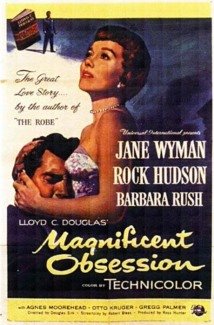
Magnificent Obsession – Rock Hudson stars in Douglas Sirk’s melodrama about a rich playboy who not only kills Jane Wyman’s husband (accidentally) but manages to blind her while trying to apologize for it. So he goes to medical school to learn who to cure her blindness, while romancing the poor girl without revealing his identity. There’s some more craziness in the story, but you probably wouldn’t believe it. Of course, since its Sirk, the whole thing manages to be not only beautiful, but absolutely convincing as a story. It ultimately plays as the anti-Fountainhead, with Hudson getting converted to a kind of extreme altruism as the key to spiritual and communal happiness. The #9 film of 1954.
Bombshell – Jean Harlow stars in a screwball comedy about a movie star with a wacky family trying to create a normal life for herself (husband, child, and so on). Never really works, mostly because Harlow, while great as the slutty girl in films like Red-Headed Woman or Red Dust, isn’t a particularly good comedic actress. The film just isn’t that funny. The #15 film of 1933.
Spirited Away – I’ve been very slowly catching up with the films of Hayao Miyazaki, after years and years of people telling me to see them. A few months ago I saw Howl’s Moving Castle and liked it a lot, mostly for its beautiful imagery and clever editing. Spirited Away has more of that, but within a more conventional (or at least, more explicable) fairy tale narrative. The film is more notable for its wildly inventive character designs than anything else: it never really gave me the jolt of awesomeness that some of the cuts in Howl’s did. But it is a more satisfying story than that later film. I’d have a hard time saying which film I liked better. The #6 film of 2001.
Ocean’s Eleven – I’d avoided seeing this for years, mostly because I’d heard they changed the ending. I wish I hadn’t bothered to give it a chance. Not only does the film have none of the wit or coolness of the original (everyone tries way too hard for that), but it fails to fulfill the most basic genre expectations. In a heist film, what we see is a plan being formed, and then carried out, with suspense created as the plan is put into action and circumstances arise which force the characters to deviate from that plan. This film, on the other had, never bothers to explain the plan, draining the actual heist sequences of suspense in favor of shock (allowing the audience to overlook the utter ridiculousness of everything that happens). One might argue that this is Soderbergh “deconstructing” the heist genre. I’d argue that he’s a hack. The #28 film of 2001.
Coraline – Went out to the big airplane hanger of a movie theatre at the Supermall to see this in 3D, but I can’t say it was really worth it. The movie itself is pretty good, a goofy-dark Neil Gaiman twist on Pan’s Labyrinth (and much better than that film, by the way) that inexplicably abandons character for action in the final 20 minutes. The new 3D effects are pretty cool, creating actual depth in the image as opposed to just throwing stuff at the audience to elicit gasps. But the glasses gave me a headache: I don’t think they really work for people who already wear glasses.
Cartesius – Another of Roberto Rossellini’s made for TV films about historical figures, this one about René Descartes, the “I think, therefore I am” guy. Not nearly as engaging as his Medici or Louis XIV films, partly because Descartes literally does nothing for the entire three hours of the film. It’s a major problem with a biopic about a man who saved up his ideas for decades until he was absolutely sure he had them right before telling anyone what they were. The film then becomes a chronicle of Descartes life as he wanders from town to town throughout France and The Netherlands, getting into the occasional impudent philosophical argument and ever so slowly fleshing out his philosophy. The arguments are always fun, but you never get the feeling that they are developing, but rather Descartes seems to have the same ideas at the beginning of the film that he does at the end: it just takes him 40 years (or however long the film covers) to find the words to explain it all. The #12 film of 1974.
 A Chinese Odyssey – The first part of Stephen Chow’s epic about the Monkey King. He plays the leader of a run down gang that gets caught up with a couple of immortals searching for Pandora’s Box, a MacGuffin. There’s lots of lowbrow comedy, some crazy action and complicated romances. It’s fun enough, but I still need to see the second half. The #38 film of 1994.
Wagon Master – One of John Ford’s most underrated films, it tends to fall under the radar not having any major stars like John Wayne, Henry Fonda or Jimmy Stewart. Instead, Ben Johnson and Harry Carey Jr play cowboys who sign on to lead a Mormon wagon train to their promised land. Along the way they encounter a troupe of drunken actors and a gang of evil gun men. It’s as pure a distillation as you’ll see of Ford’s ideas about family and community. It also might be his most musical film, with the Sons Of The Pioneers punctuating every transition in the story. The #8 film of 1950.
The Glass Key – I’ve got some kind of mental block when it comes to Dashiell Hammett, I think. I’ve read this book at least once, just a year or two ago, yet I honestly couldn’t tell you how much was changed in this film adaptation. I think the time system is all mixed up, with the main character in the book uncovering past events that happen present tense in the film, and I’m not sure that the protagonist is the same (though I may be confusing it with Red Harvest, which I’ve read at least twice and can’t remember). Anyway, this is the book, and even more so the film, that the Coen brothers based Miller’s Crossing on. Alan Ladd plays Ned Beaumont, the chief advisor to the town’s head gangster that gets in a fight with his boss over a woman (Veronica Lake), gets beat up a lot, briefly goes over to the rival gang leader’s side and eventually outsmarts everyone. Notable is William Bendix as the rival gang leader’s tough guy. He seems to enjoy beating up Ladd out of some implied attraction to Ladd’s prettiness, something the Coen Brothers utilize much more explicitly in their film. The #11 film of 1942.
 The Blue Dahlia – Another Ladd/Lake noir, this time with a screenplay by Raymond Chandler (though how much he actually wrote is debatable.) Ladd plays a vet who returns home from the war with his three buddies, only to argue with his wife and run out on her. When she turns up dead, he’s the prime suspect. Fortunately, veronica Lake’s there to help him out. Ladd’s army buddies are played by Hugh Beaumont (before he met June, I guess) and William Bendix, who goes a bit over the top on the crazy this time, but still has that great mix of sweetness and menace (despite looking exactly like Jon Faverau). The #12 film of 1946.
Ramrod – This was the third Veronica Lake film I watched in a attempt to stave off a cold last week, and it almost worked. Lake plays a ranch owner determined to stand up to the big evil ranch machine that chased off her fiance, a task for which she recruits her Sullivan’s Travels costar Joel McCrea to help. Director Andre De Toth gives real grit to this fairly grim story, reminding me a lot of Samuel Fuller (the film has a lot in common with Fuller’s Forty Guns, and Lake reminds me a lot of Barbara Stanwyck in that film, though she doesn’t have the range to really pull off this kind of character). De Toth’s one of those auteurs you never really hear about, and I this is the first of his films I’ve managed to see, but I’ll certainly see more. The #9 film of 1947.
Schizopolis – Hated it. The #70 film of 1996.
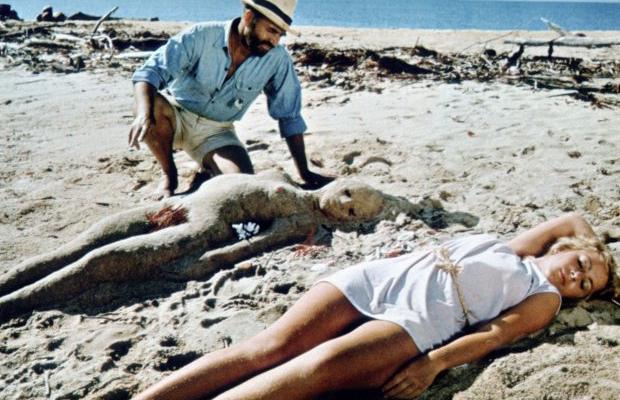
Age Of Consent – It’s half an old man’s version of paradise: tropical island populated by you and a nubile young girl who really really likes you; and half a touching vision of how art and beauty make life worth living. James Mason plays the old man, a successful artist who’s run out of ideas and can’t stand city life. He runs off to an island on Australia’s Great Barrier Reef to reconnect with nature and meets the young and hot Helen Mirren (her first movie role), who lives with her drunken grandmother gathering seafood and selling it in the town on the mainland. Mason gets Mirren to pose for him: she’s inspirational, especially so when she takes her clothes off. It was essentially director Michael Powell’s last feature film, coming almost ten years after Peeping Tom ruined his career. Both of these films are terrific, but they nonetheless show how necessary both parts of the Powell & Pressburger team were to their string of masterpieces: Powell’s solo films generally have pretty bad scripts, and their stories never reach the kind of magically hypnotic level of even the least of the Pressburger films (like The Small Back Room or The 49th Parallel). One hopes that Emeric would have seen and eliminated the annoyance that is the entire character of Mason’s buddy Nat Kelly (played, again annoyingly, by Jack MacGowran). It’s like an episode of Perfect Strangers shoehorned into the middle of The Red Shoes. The #4 film of 1969.
Woman On The Beach – The first film I’ve seen from celebrated Korean director Hong Sang-soo, it’s in keeping with the dominant minimalist style of contemporary Asian art films, though it’s a more playful film than, say, Hou hsiao-hsien’s films, and not as rigorously restrained as Tsai Ming-liang’s. Kim Seung-woo plays a film director who needs to get out of town for a few days to work on his new script, so he brings his producer (and the producer’s girlfriend) to the beach (which is largely abandoned: it’s the slow season). Kim then, of course, steals the girlfriend from the producer. But when she goes back to town, he hooks up with another vacationer, only to have the first girl return the next day. The lies pile up and get resolved some way or another. Honestly, I can’t remember how the film ended (it’s been a week since I saw it), but I do know I liked it. What struck me more than anything else was the sense of the beach they go to. It reminds me so much of the beaches we vacation at around here: overcast and relatively empty. Last year’s Thai film Wonderful Town similarly charmed me with its sense of place, but Hong manages to avoid the lame and depressing ending that film had (at least, Im sure I would have remembered if it had such a bad ending). The #13 film of 2006.
3 Bad Men – A remarkable John Ford silent film, at least, remarkable for me as I’ve only seen one of his other silents (The Iron Horse). What surprised me so much is just how, well, Fordian it all is, from the visual style, to the narrative about morally questionable guys helping the forces of civilization build a functional society in the wilderness, to the little details of characterization that make even the smallest part seem like recognizable people (or at least movie people). The plot is, more or less, A Night At The Opera, with the titular three men helping a nice young woman stake her claim in the Dakota land rush (there’s a nice prologue with newspaper headlines: “Gold Found On Indian Land” “Indians Move To New Reservation”, the kind of point-making that Ford was too subtle to get credit for) and get married to nice young man George O’Brien. There’s some comic relief involving drunkenness and some great action scenes (horses racing over the camera dug into the ground, another Ford trademark, a harrowing attack on a church). Really a tremendously enjoyable movie. The #1 film of 1926.
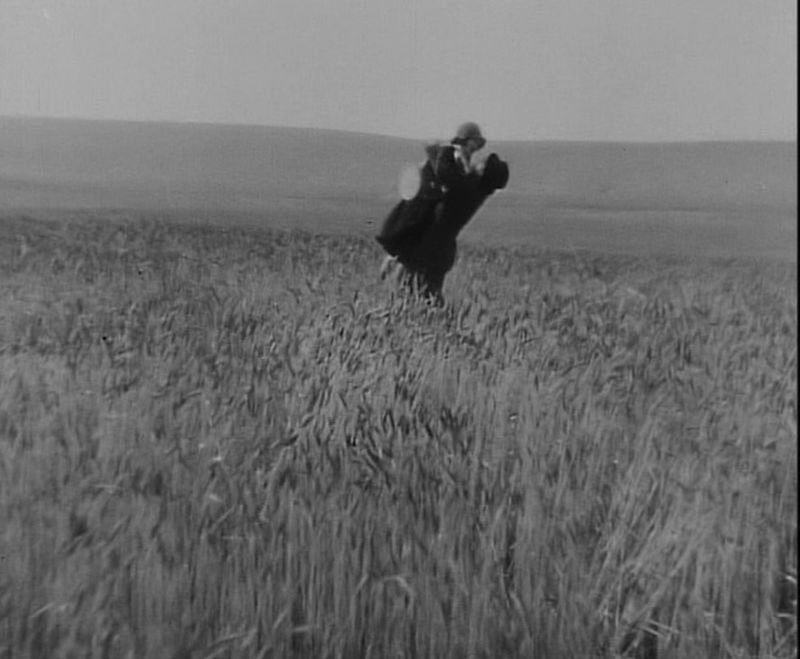
City Girl – FW Murnau’s followup to Sunrise: A Song Of Two Humans isn’t nearly as successful as that film (a high standard to be sure), but its nonetheless very good. A young farm boy heads to Chicago to sell some wheat (the importance of which is a recurring trope in the film’s first third, where bread references abound, the film was also known as Our Daily Bread). While there, he meets a cute waitress and marries her. When he gets back to the farm, his father is hopping mad (only a low class gold-digging girl would get married that fast), slaps the girl around and prevents the two from sleeping together. It’s chattier than any other Murnau I’ve seen (and not just the ones that eliminate intertitles altogether like The Last Laugh and Tabu: A Story Of The South Seas), which makes it seem a bit less poetic than it really is. The farm scenes in particular (the poor city is reduced to only a few locations (that look like sets actually) and seems much smaller than the town in Sunrise are really stunning: much of the film feels like Days Of Heaven was the film Murnau actually wanted to make (same location: wheat field in the upper midwest, attacked by a natural disaster, though Murnau doesn’t appear to have the budget for his hailstorm whereas Malick could afford locusts). I’d never though of Murnau and Malick together before, but they fit remarkably well, even beyond the simple fact that Murnau influenced everyone. The #4 film of 1930.
Bell, Book And Candle – There’s just a whole 10-15 years of comedy (from the mid fifties to the late sixties) guess I just don’t understand. Jimmy Stewart and Kim Novak, immediately before making Vertigo, star in this comedy about a witch who falls in love with a human (Novak’s the witch, Stewart’s the human). All that’s fine enough, I love the same premise with Veronica Lake and Frederic March in I Married A Witch, but for some reason, it just doesn’t seem funny here. Even Jack Lemmon is a bit dull in a supporting role. Fortunately, the direction by Richard Quine is pretty cool, with some off-kilter high angle shots, a nifty spell casting sequence with Novak and her cat and an establishing shot through a crystal ball. The #21 film of 1958.
The Unsuspected – I had this on while writing this, so I wasn’t really paying much attention. But then, there didn’t seem to be a whole lot to pay attention to. Claude Rains plays a radio-theatre host who’s killed a few people, but no one seems to notice. Rains didn’t really seem to be putting much effort into it. Does anyone think I should give this Michael Curtiz film a shot and watch it again?
Movie Roundup: Schizopolis vs. Reservoir Dogs Edition, Part Two
I wrote this for another website a couple days ago, but it took a lot of work so I’m going to post it here as well. Apologies if you’ve already read it.
Reservoir Dogs is a brilliant piece of filmmaking, a cheap, theatrical genre film that overcomes its limitations in location variety through masterful camerawork while simultaneously playing with the conventions of the heist film. The opening sequence is justly famous, with its gangsters having breakfast while arguing over the true meaning of “Like A Virgin” (prior movie gangsters would never admit to listening to Madonna) and whether or not to tip waitresses (the kind of mundane issue raised to importance through grandiose dialogue stylization that would become Tarantino’s trademark). But the third scene, I think, serves to show just how subtly effective Tarantino’s direction can be. There are many things to talk about in this film, but this scene struck me on watching it again, so I’d like to look at it in detail, if you’ll indulge me.
It starts just after Mr. Pink has arrived at the rendez-vous. He and Mr. White head to the back to wash up and try and reconstruct what happened at the heist. First, we have a long shot of Mr. White framed by a hallway. We’re distant from him (still wanting to linger with the quite dramatic Mr. Orange), and Mr. Pink is off-screen ranting. Isolating Mr. White leads us to privilege his POV over that of Mr. Pink:

This shot is held for several minutes, broken up by Keitel’s anxious walks to the doorway in the middle distance (to check on Mr. Orange), and finally by Mr. Pink’s entrance from behind the wall:
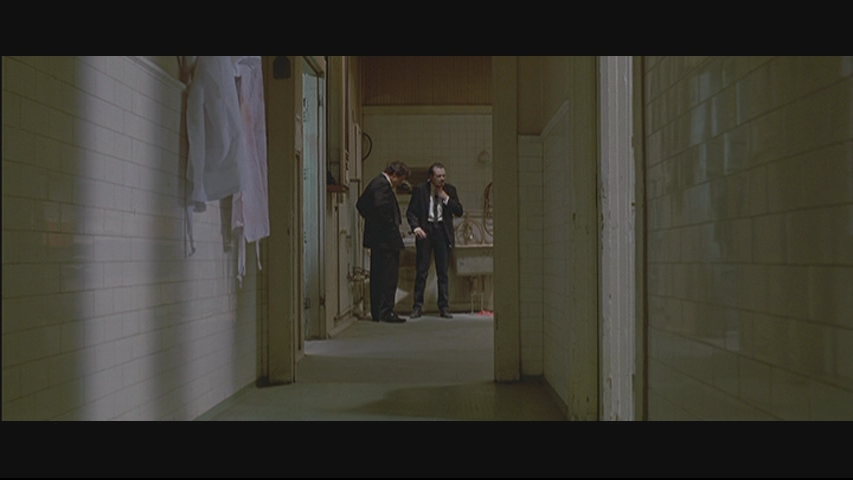
This setup only changes when Mr. White lights their cigarettes, leading us to a medium two-shot (slightly offcenter, with Pink pushing White to the edge of the frame befitting his agressive behavior) of the two of them arguing. From now on, we’ll be more concerned with their argument than the condition of Mr. Orange.
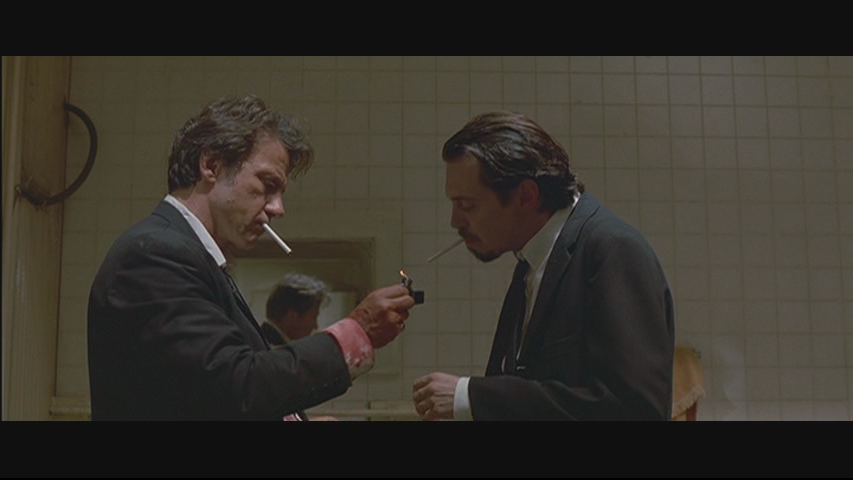
This setup is broken up by a flashback showing Mr. Pink’s escape from the police:

But soon, we’re back in the warehouse in a closer balanced shot:

Pink moves away, back and to the right, opening up the room into the first master shot we get, a low angle, diagonal shot with White in the far back corner and Pink in the right foreground:

Tarantino then sets up a shot/reverse shot pattern, but one that is not deteremined by the characters’ POVs, but instead an alternating series of closer shots from the POV of an offscreen observer:
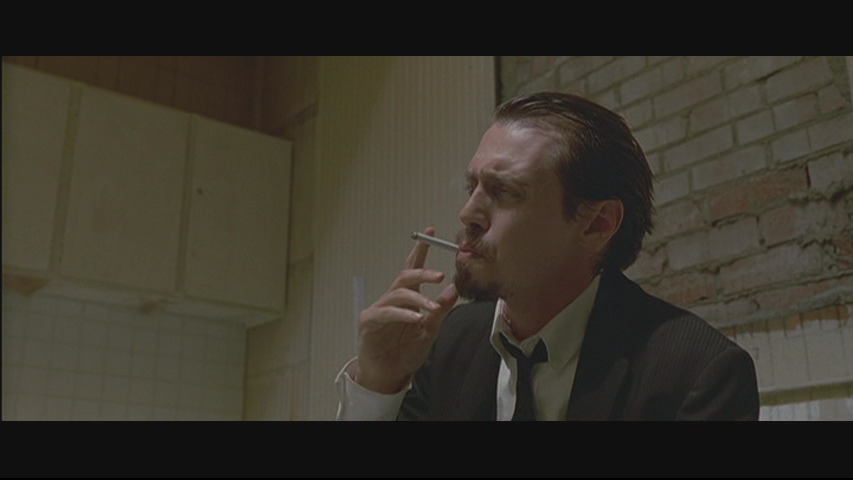
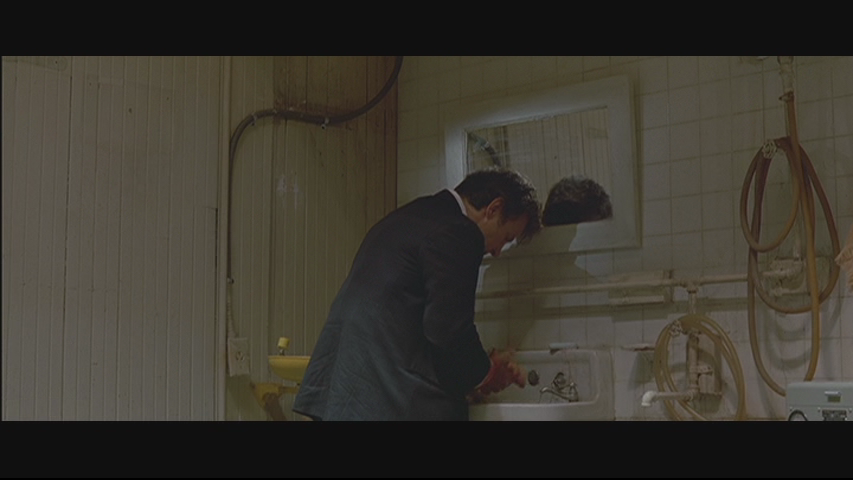
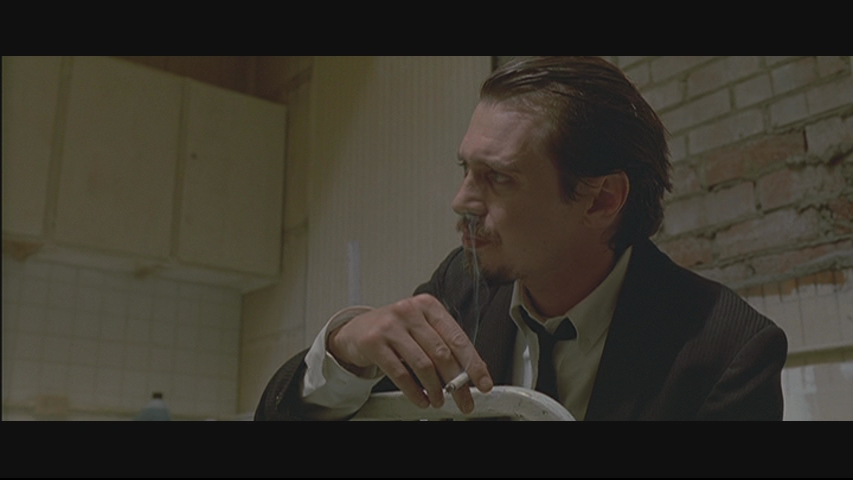

Note that the cuts here do not correspond to whoever is talking, as in most Hollywood films. Throughout this scene, as much dialogue is offscreen as it is on, with the camera lingering on the non-speaking actor as much as the histrionic one.
Anyway, the alternating shots continue for awhile, with the cutting getting more rapid as Mr. Pink pulls out and checks his gun:

Eventually, Pink gets up and approaches White, which we see from the same master shot, this time unbalanced with both charcters in the background:
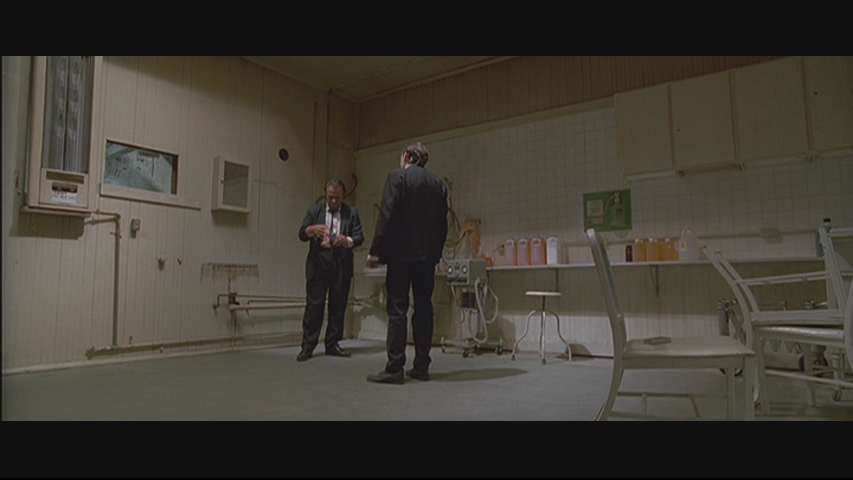
Then we cut axially to a closer version of the same shot:

And back out again:

This time, White walks off to the left, while Pink stays in place, setting up a new shot/reverse shot sequence:

The cut here is very smooth. Offscreen, Pink says “I got the diamonds”. We see White whril around to face him, and then cut to Pink:

And back to White:

Who walks into Pink’s frame for a congratulatory twoshot:

A reverse cut is followed by White moving back to his previous position, with a slight cmaera movement to recreate the framing of the inital shot/reverse shot setup:


Cut to Pink, now twisted to almost face the camera:
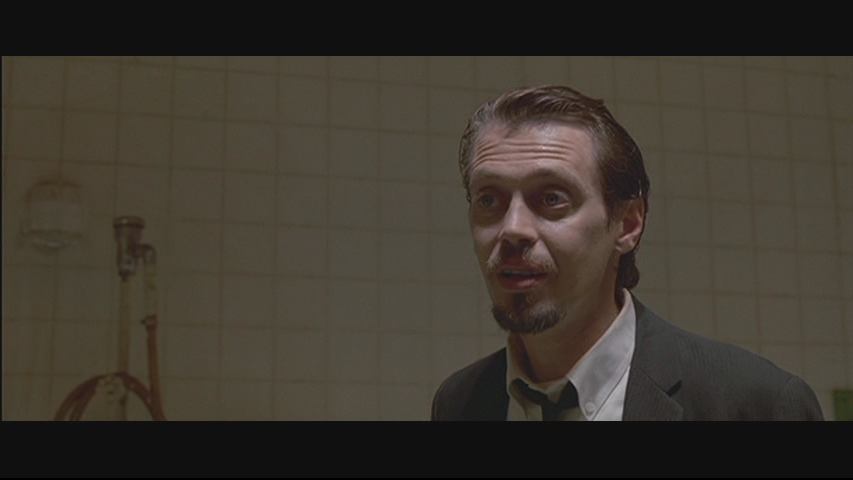
He rotates and the camera reframes as White moves to the mirror on the back wall:

White paces back and forth, and with the mention of an undercover cop, we cut back to the master shot:
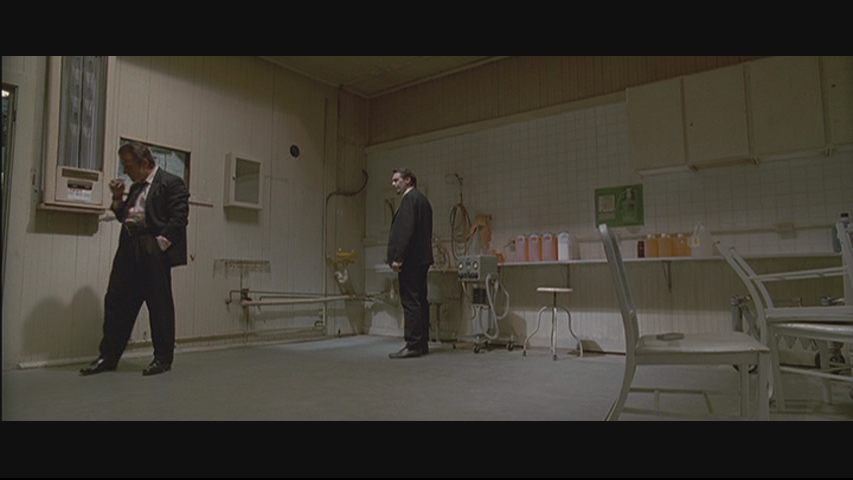
And back to the previous shot (its not really shot/reverse shot, but it is the third pair of alternating shots in the scene):
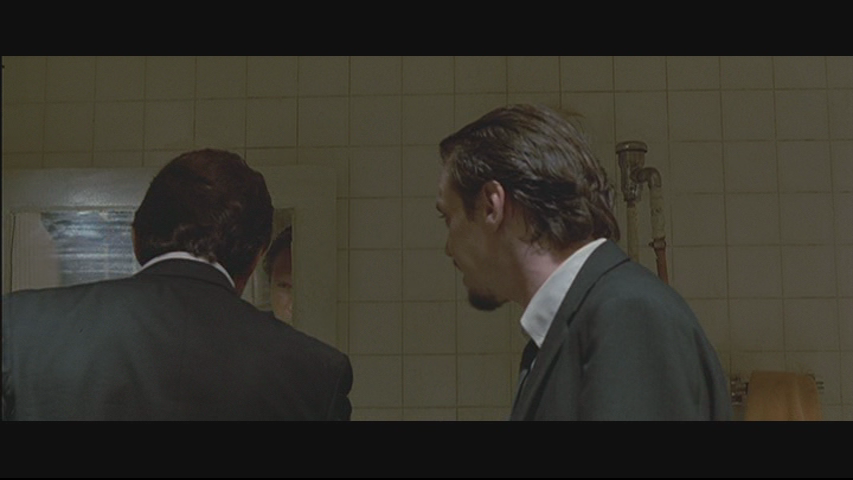
As they begin to argue over who the rat is, White turns and faces Pink, giving us a slightly off-balance two shot with both characters fighting for the middle of the frame:

And again out to the master:
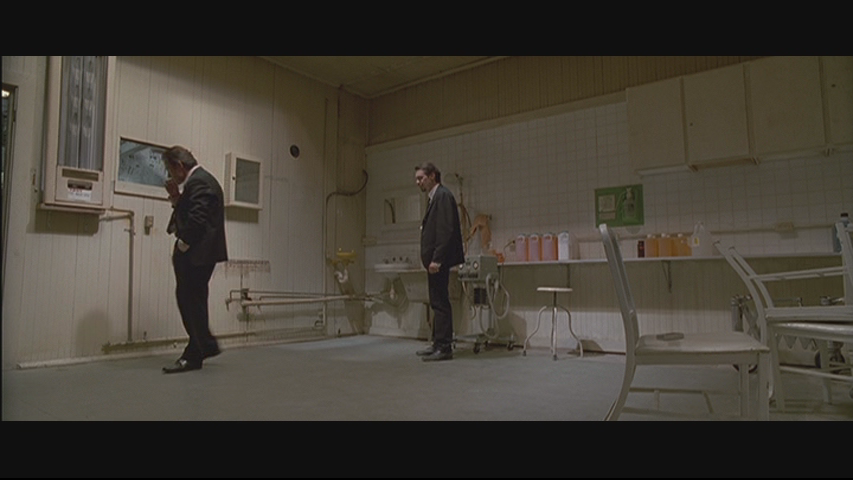
Pink exits to the left, and White is again alone in the distance, echoing the opening shot of the sequence and transitioning into his flashback (complete with title card).

Thus is a ten minute sequence consistenting of nothing but expository dialogue (no pop culture references, no jokiness) rendered consistently interesting. The characters are framed unconventionally, but in ways that tell us about who they are and what they’re thinking not with POV shots, but in their spatial relations within the frame. The editing is unconventional as well, avoiding contemporary Hollywood methodology while also mixing various styles for dramatic effects (long takes, quick cuts, choosing not to cut when simply moving characters is as effective). In all, Tarantino uses the full repertoire of classical Hollywood filmmaking (think Hawks and Curtiz) in a way few of his peers can manage, with their fast-cutting disregard for either spatial relations or the more elegant ways of utilizing mise-en-scene in favor of dueling over-the-shoulder shots.
The movie, of course, has many other things going for it aside from good direction. The performances, for the most part are excellent, with Keitel bringing a poignancy to his character’s relationship with Mr. Orange that’s unusually tender for a gangster film, balanced with his own brooding solidity. This is also possibly Buscemi’s best performance, the one where his natural weasliness is most balanced by a believable agressiveness (this is the only time he’s been the least bit imposing physically). Michael Madsen, of course, comes close to stealing the film as the psychotic Mr. Blonde, and Lawrence Tierney and Chris Penn are terrific as the father and son gangsters. The only real weak point is Tim Roth, who always seeems really fake to me. He doesn’t bring any naturalism to Tarantino’s dialogue the way Keitel and Buscemi do; he recites it in a way that would get an undercover cop killed. A brilliant film that has lost none of its enjoyability over time. I was really quite pleasantly surprised that it held up so well, as it had diminished in my memory.
Movie Roundup: Schizopolis vs. Reservoir Dogs Edition, Part One
I wrote this for another website a couple days ago, but it took a lot of work so I’m going to post it here as well. Apologies if you’ve already read it.

That pretty much sums up this movie: Steven Soderbergh filming himself masturbating (he does this three or four times over the course of the film.
It does have a clever idea, when he and his movie wife speak to each other in phrases implying the genericity of everyday communication:
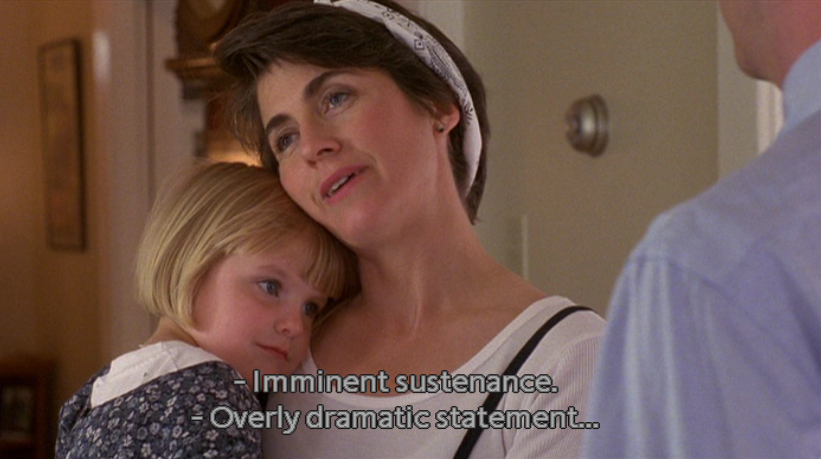
It’s a good premise, one that was used to hilarious purposes by a Chicago theatre troupe as heard a few weeks ago on This American Life. I can reasonably assume that they got the idea from Soderbergh, and credit him for a bit of originality here, but then I remembered this movie:
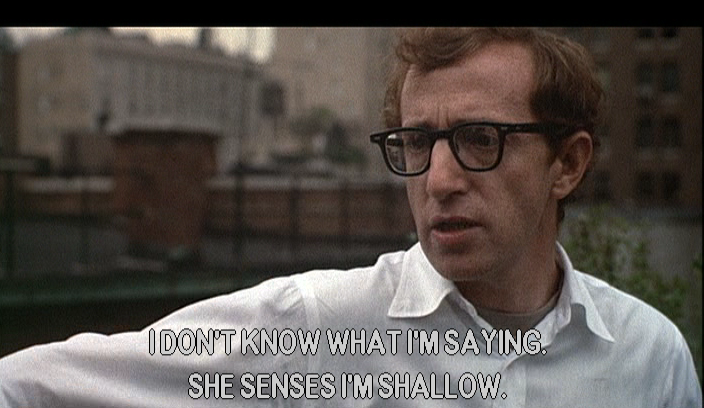
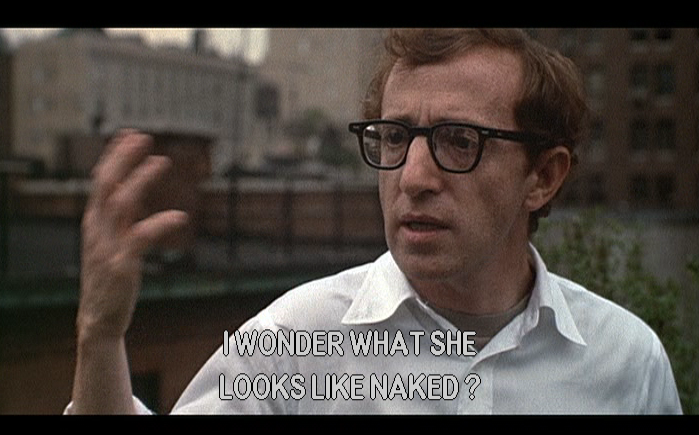
which uses the concept for hilarious purposes. And, of course this movie:

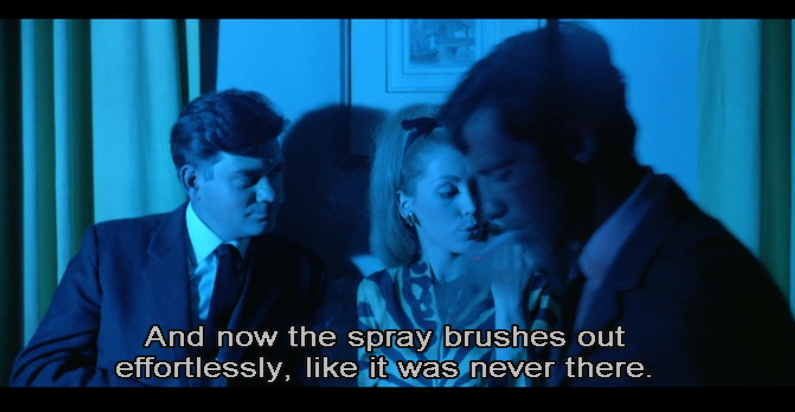
which uses it to make a political argument, while also being hilarious.
To what end does Soderbergh approach the issue of middle class miscommunication?
Political?
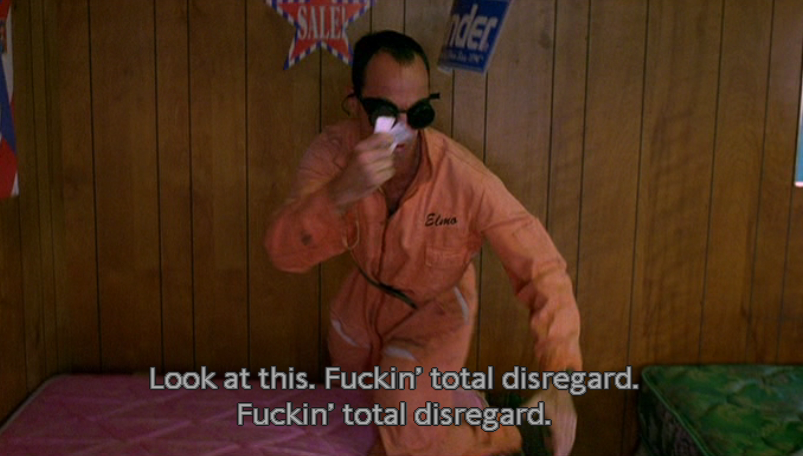
Nah, I don’t think that hoary standup comedy classic mattress tags counts.
Political/Economic?

Nah, that’s kind of racist
Sexual?

Heh, it’s funny because she’s fat.
Sexual/Political?
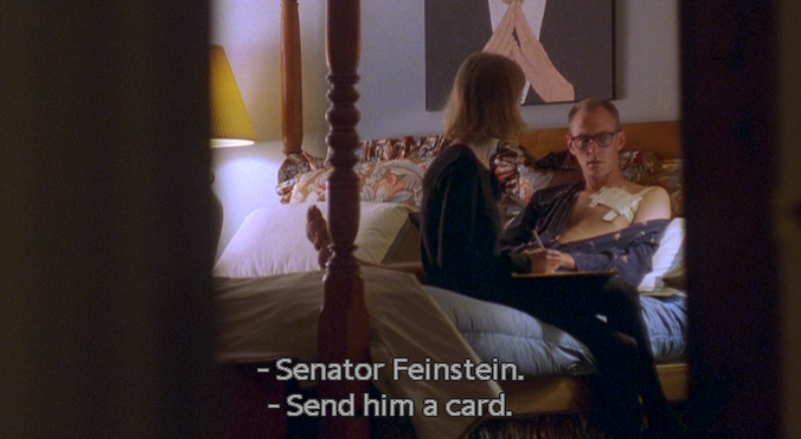
Ha! That Diane Feinstein is quite manly.
A biting satire of office life?
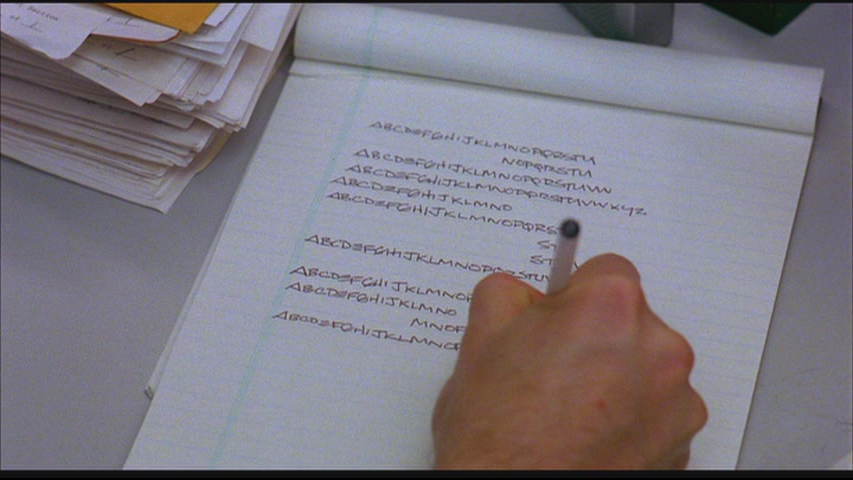
Meh, maybe. But that whole plotline disappears in the last two thirds of the film. Instead we get Soderbergh turning into a womanizing dentist who gets slapped with a sexual harassment suit. Followed by a shift in emphasis to his wife, where we pointlessly replay much of the rest of the film (the parts that had somewhat cleverly been disguised behind the generic statements, now even that critique is rendered moot as all the dialogue is literalized). And then, the scenes are replayed again, with Soderbergh as three characters, each speaking a different language based on lame cultural stereotypes!
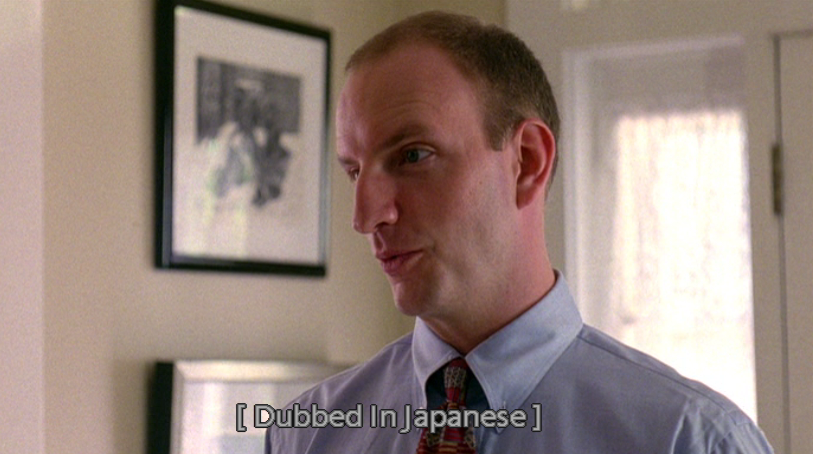
Worker-Soderbergh speaks in Japanese.

Womanizing Soderbergh speaks Italian (complete with tracksuit!)

Sensitive coffeshop Soderbergh speaks French (and wears black!)
This is then abandoned and various other plot threads (the gigolo exterminator, the lame Scientology parody, the office job) are tied together in a fake assassination. Why? Probably just to set up this joke:

It did provide the one time I laughed during the whole film, so that’s something.
To sum up:
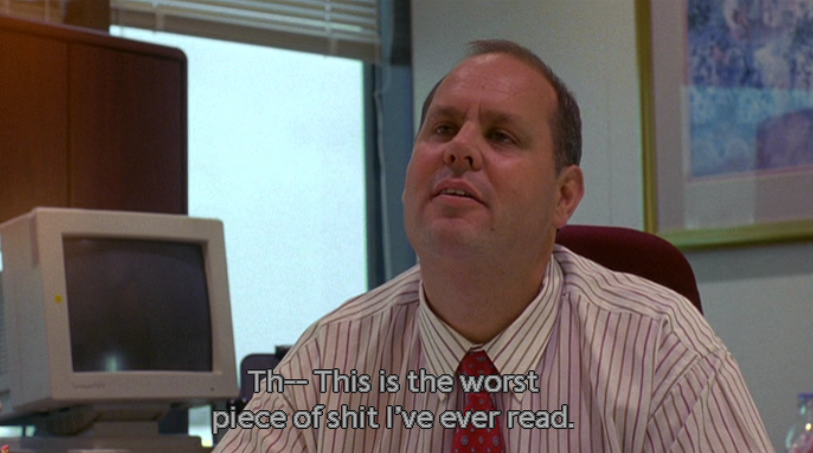
because the whole thing is a lot of Benny Hill-level comedy

that isn’t the least bit funny. And isn’t interesting either because it’s completely

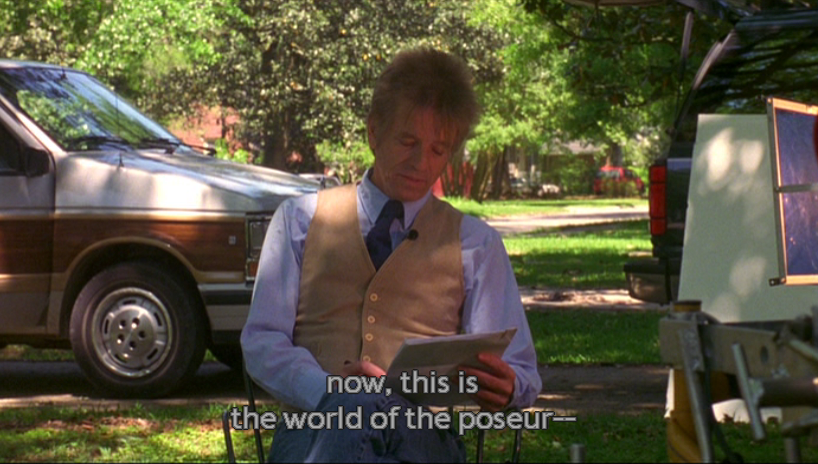
Yup, that pretty much sums it up.
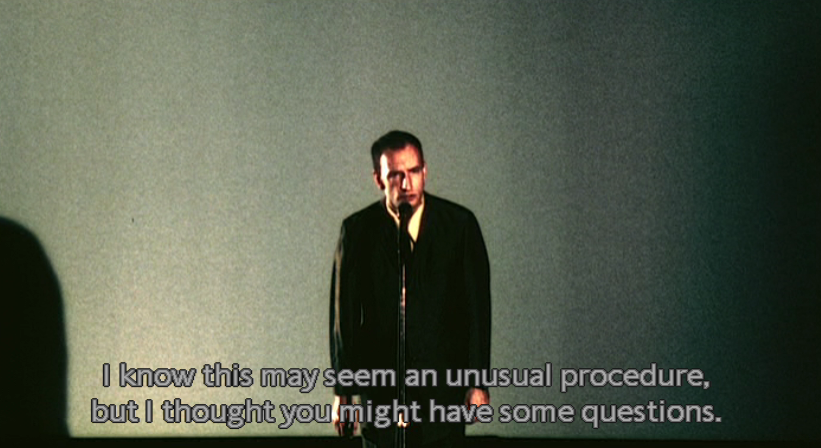
I don’t think so Steve.
Nope, once was more than enough.

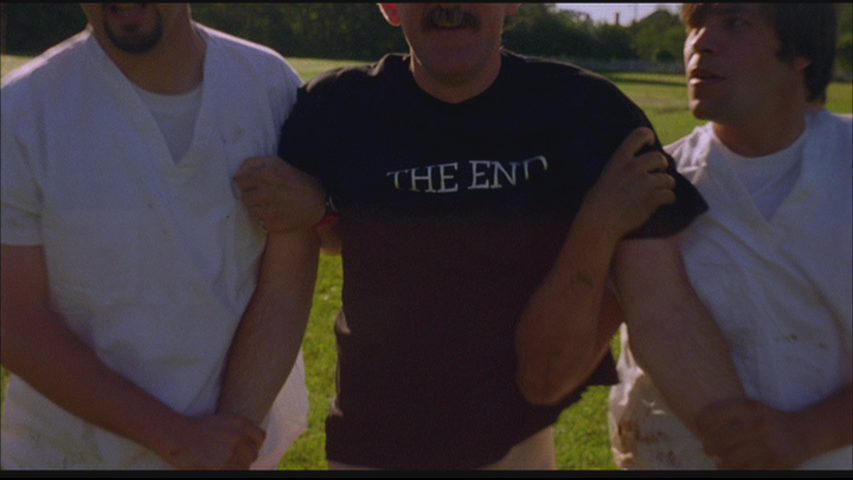
(it’s funny because he’s not wearing any pants! get it?!)
Sita Streams The Blues
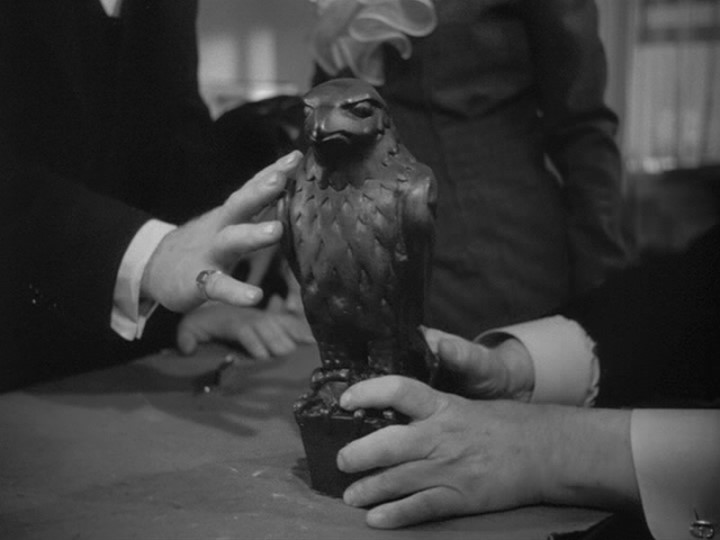
Sita Sings the Blues is now streaming online in anticipation of its public television debut next week. There are apparently higher quality streams and even DVDs in the works in the near future, according to director Nina Paley’s blog, but I’m just happy to have the chance to watch it again in any format. You won’t find a better movie to watch this week until The Maltese Falcon Wednesday night.
Oscarfever! ’09!
 After my poor performance with last year’s predictions, I’m going to have to win my theatre’s Oscar pool this year or no one will cheat by copying my ballots anymore. First is who I would give the award to, then who I think will win. The Oscar nominees can be found all over the place, the nominees for my awards can be found here.
Best Picture:
The End: WALL-E
Oscar: Slumdog Millionaire
Best Director:
The End: Andrew Stanton, WALL-E
Oscar: Danny Boyle, Slumdog Millionaire
Actor:
The End: Benicio Del Toro, Che
Oscar: Mickey Rourke, The Wrestler
Actress:
The End: Sally Hawkins, Happy Go Lucky
Oscar: Kate Winslet, The Reader
Supporting Actor:
The End: Heath Ledger, The Dark Knight
Oscar: Heath Ledger, The Dark Knight
Supporting Actress:
The End: Rosemarie DeWitt, Rachel Getting Married
Oscar: Penelope Cruz, Vicky Cristina Barcelona
Original Screenplay:
The End: Nina Paley, Sita Sings The Blues
Oscar: Dustin Lance Black, Milk
Adapted Screenplay:
The End: Wong Kar-wai, Ashes Of Time Redux
Oscar: Simon Beaufoy, Slumdog Millionaire
Foreign Language Film:
The End: Waltz With Bashir
Oscar: Waltz With Bashir
Documentary Feature:
The End: Waltz With Bashir
Oscar: Man On Wire
Animated Feature:
The End: WALL-E
Oscar: WALL-E
Film Editing:
The End: WALL-E
Oscar: Slumdog Millionaire
Cinematography:
The End: Danielle Feinberg and Jeremy Lasky, WALL-E
Oscar: Anthony Dod Mantle, Slumdog Millionaire
Art Direction:
The End: WALL-E
Oscar: The Curious Case Of Benjamin Button
Costume Design:
The End: Rachel Getting Married
Oscar: The Duchess
Make-Up:
The End: Hellboy II: The Golden Army
Oscar: The Curious Case Of Benjamin Button
Sound:
The End: WALL-E
Oscar: WALL-E
Sound Effects Editing:
The End: WALL-E
Oscar: WALL-E
Visual Effects:
The End: Speed Racer
Oscar: The Curious Case Of Benjamin Button
Original Score:
The End: Thomas Newman, WALL-E
Oscar: Slumdog Millionaire
Original Song:
The End: “Down To Earth”, Peter Gabriel, WALL-E
Oscar: “Down To Earth”, Peter Gabriel, WALL-E
Live-Action Short:
The End: NA
Oscar: New Boy
Animated Short:
The End: Presto
Oscar: Presto
Documentary Short:
The End: NA
Oscar: The Witness – From The Balcony Of Room 306
Soundtrack:
The End: Gonzo: the Life And Work Of Dr. Hunter S. Thompson
Sita Sings the Copyright Blues

Speaking of Adaptations, The Art Of The Title Sequence, as linked to by the essential Movie City News, is the latest site to pick up on the ongoing Free Sita! campaign being led by director Nina Paley, whose Sita Sings The Blues (my #2 movie of 2008) remains undistributed because she never cleared the rights for the 80+ year old songs she used in her film. In addition to the interview with her, they also posted a package of stills and illustrations for the film, along with its trailer. So here’s some pictures:


Metro Classics Returns!!

Just finalized is our schedule for this Spring. The theme this time is adaptations. We’ve got nine movies based on three different media (literature, drama, film/television), further subdivided into three different genres (adventure, sci-fi, musical).
Here’s the lineup:
Mar. 04 – The Maltese Falcon
Mar. 11 – Barbarella
Mar. 18 – Gentlemen Prefer Blondes
Mar. 25 – My Own Private Idaho
Apr. 01 – Forbidden Planet
Apr. 08 – Kiss Me Kate
Apr. 15 – A Fistful Of Dollars
Apr. 22 – The Fly
Apr. 29 – Pennies From Heaven
Movie Roundup: Pitchers And Catchers Edition
 Position players have already begun reporting to Spring Training and this is the best time of year to be a Mariners fan. There’s a new MLB Network this year, which I’m kind of getting into (the ’95 M’s are only the #6 comeback of all-time? Nonsense!). Here’s what I’ve watched over the last couple of weeks:
Hilary Hahn: A Portrait – It’s not really a movie, more like an hour long documentary that appears to have been done by some German TV station (or as a promotion by her record company). There’s a little bit of biographical information (she gives a a nice tour of the music school she spent 15 years growing up at, we see her packing her luggage) but mostly it’s only interesting for her performances: Most of a Korngold Violin Concerto, a rehearsal of a Mozart Sonata for Piano and Violin, a really cool performance at a bar that’s experimenting with classical music concerts in a club setting. Even better was the concert we went to last week (my first real classical concert). She was fantastic playing a program built around folk-influenced classical stuff (Charles Ives, Brahms’s Hungarian Dances, Bartók’s Romanian Dances) mixed with some show-offy virtuoso solo violin pieces by Ysaÿe. the #36 film of 2007.
The Age Of The Medici – Roberto Rossellini’s three-part film for Italian television, it runs about four hours in total and chronicles life in 1400s Florence at the time of Cosimo de Medici (powerful banker) and Leon Batista Alberti (architect and art theorist). It’s really unlike anything I’ve ever seen before. Imagine Robert Bresson directing those historical recreation TV series for The History Channel, only less flashy. The dialogue (and acting) is entirely without psychology (these are historical figures, not characters) and it’s never less than fascinating. The recreations aren’t particularly realistic (lots of painted backdrops and such) and the dialogue is poorly dubbed regardless of what language you watch it in (I chose English because that’s apparently what the actors were using), but none of that really matters. The film sucks you in with an non-stop onslaught of information: historical facts of political maneuvers, details of life in the Middle Ages, philosophical arguments about art, politics, religion etc. For a history geek like me, it’s irresistible. The #6 film of 1973.
 The Black Hole – Watched this a lot as a kid, but didn’t really remember much. Some trippy special effects, goofy (and scary) robots, a killer ending (Maximillian Schell trapped in his evil robot ruling over Hell!, oh yeah) and hey, it’s Robert Forster from Jackie Brown! The #18 film of 1979.
The Black Cauldron – Another one I hadn’t seen since I was a kid, and it wasn’t as good as I remembered. The animation’s pretty cool (looks a lot like a more awesome version of classic 80s arcade game Dragon’s Lair at times), but the characters are pretty bad (a pig? really?). Disney cut a bunch out of it to get it down to a PG rating, which is really weird, but the more violent version probably wouldn’t be any better, just more jarring with the silly kid elements. The #31 film of 1985.
One Million BC – The more I see Victor Mature, the more I think he looks exactly like Chris Noth (the guy from Law & Order and Sex And The City). Anyway, here he’s a caveman who gets kicked out of one warlike tribe and joins another, more pacifist group, which he teaches to fight and romances their hottest woman and ends up unifying the two tribes, or something like that. It’s pretty terrible, but with some cool giant lizard and volcano special effects. The #17 film of 1940.
Friday Night Lights – We’ve been watching the TV series, which is pretty good (we’re about halfway through Season One) and decided to check out the film. The main difference between the two is that the TV show has characters and the film has character types. We do get a lot of pretty shots of West Texas and its football stadiums though, and the ending ranks up there with The Bad News Bears as one of the great sports movie endings of all time. Director Peter Berg’s frenetic style keeps everything constantly moving in the Michael Bay style: fast cuts, lots of camera movements, no real rhyme or reason to any of it beyond the conveyance of mood. And that’s what the film provides: a sense of Texas football and an inkling of what the people who obsess about it (players and fans) are like. Essentially, it’s the opposite of Rossellini’s history films. The #24 film of 2004.
 Simon Of The Desert – This was either going to be part of a three-part omnibus film, or the producer just ran out of money before the end (depends on which special feature on the Criterion disc you believe), but it runs only about 40 minutes, which ends up (miraculously enough) being just about the perfect length. It’s Luis Buñuel’s film about a Christian ascetic who lives on a pillar and is tempted by the Devil in the form of Sylvia Pinal (the star of Viridiana). Funny and weird, the length gives it the feel of a really great episode of The Twilight Zone, which is kind of what Buñuel is at his best (and I mean that as a compliment). The #7 film of 1965.
The Time Machine – The Birds‘s Rod Taylor stars as H. G. Wells’s time-traveling hero in this decent enough George Pal film. Fed up with the capitalism of life in the 1900s (his friends are only curious about the commercial possibilities of his invention), Taylor travels far into the future and discovers a post-apocalyptic world where pretty blond and pastel people are feed to underground-dwelling blue monsters. Yvette Mimieux (who was interestingly also in The Black Hole) plays the prettiest blonde, whom Taylor attempts to rescue while teaching her society the merits of Victorian civilization (books, fire, concern for your own life and death, etc). Looking past the camp elements (and Taylor’s always horrific acting) there’s some truly funny and even poignant moments. The #19 film of 1960.
 The Taking Of Power By Louis XIV– From the same period and style as his Medici film, but unfortunately only 90 minutes long is this Roberto Rossellini film about, well, how Louis XIV took power (the secret: fashion!). Similarly devoid of psychology, the film is a bit flashier thanks to a few sweeping camera movements. The plot is really simple, but nonetheless it’s a lot of fun for any Dumas fan, noticing characters from The Three Musketeers (D’Artagnan! Louise de Valliere!) that would quite possibly mystify anyone who isn’t familiar with them. The #12 film of 1966.
Voyage To Italy – I’ve been hearing for years about this as Roberto Rossellini’s masterpiece, and having finally seen it, it did not disappoint. George Sanders and Ingrid Bergman (both great, as they always are) travel to Naples to settle an uncle’s estate and discover that despite being married for eight years, they really don’t like each other that much. They split up for a few days: she tours museums and ruins (in the film’s most documentary, and also most moving, scenes, perhaps prefiguring the cinematic direction Rossellini would take with his history films fifteen years later) while he tries to hook up with younger women. It’s an incredibly rich film based on an extremely simple premise: raising (and leaving unsettled) issues about art and life, the past and the present, the individual and the community, aging and love, business and family and even the British Protestant versus the Mediterranean Catholic view of work and the world. I can’t wait to watch it again. The #3 film of 1954.

 The End of Cinema