Uncategorized
On Frederick Wiseman’s Crazy Horse
Unlike his other recent dance films Ballet and La danse, Frederick Wiseman’s Crazy Horse, a look at a venerable Parisian burlesque club released in 2011, starts not with rehearsals, but the performance itself. With a bang we’re shown the naked bodies at work, as if to explain, “Yes, there are boobs here. Get over it.” The other two films showed us the process of creation, all the little things, all the effort and hard work that go into creating a stage performance. They alternate footage of the dancers being coached with their painstaking preparations, slowly building a performance and culminating with the final stage version. Crazy Horse gives us plenty of that same backstage detail: costumes, makeup, wigs, contentious management meetings, slyly filmed interviews, but mixes in fully-staged performances at regular intervals. This is by necessity: one of the main difficulties the director, Philippe Decouflé, is having is that he must design a whole new show while at the same time being open for business every night. But it breaks up the flow of the work, instead of organized creation we get musical numbers breaking up a documentary narrative. Like a vérité Cabaret with significantly fewer Nazis.
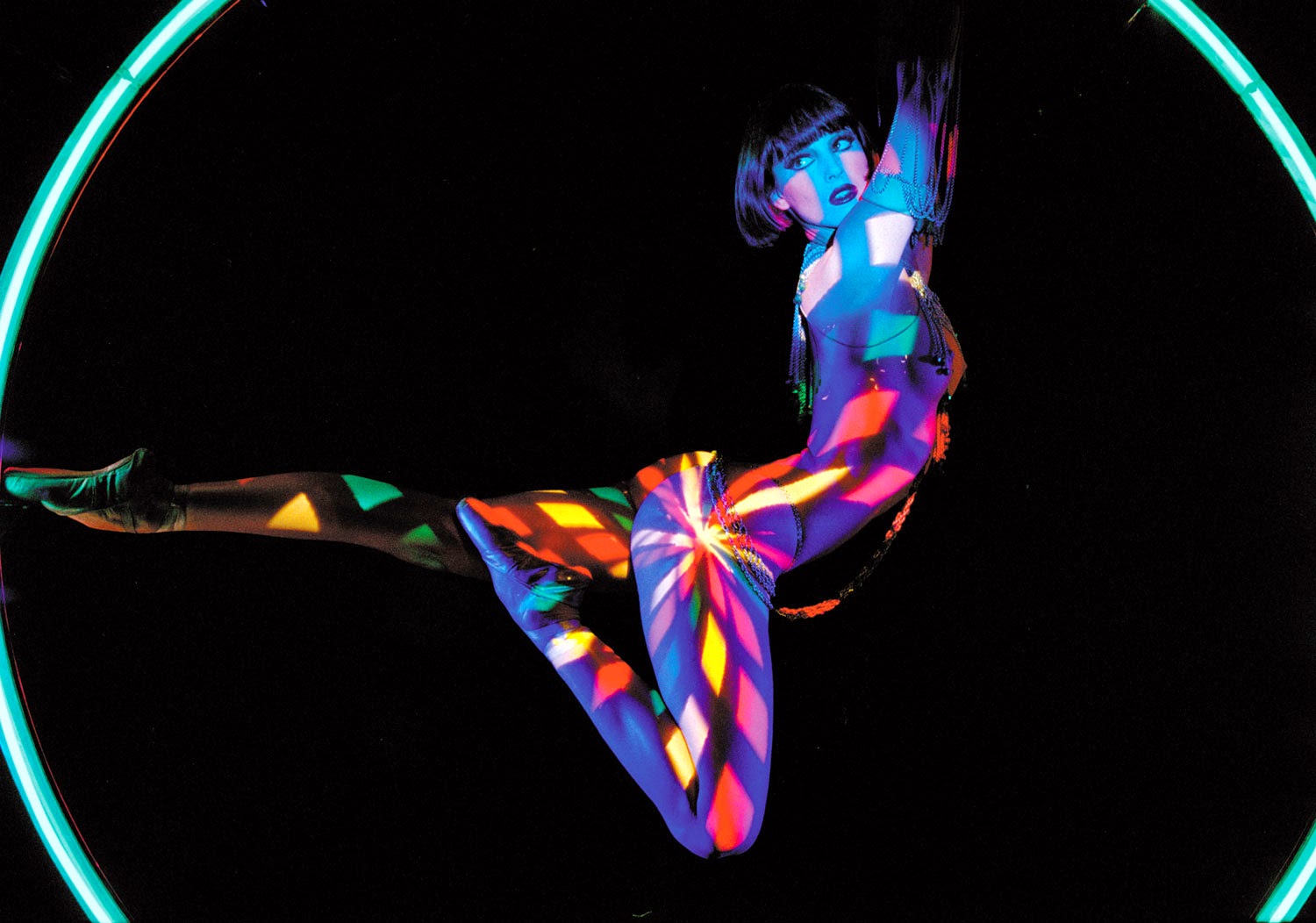
The shows are apparently the pinnacle of their style, “nude chic”. This is apparently a thing that fashionable people do: go to a club and drink champagne and watch naked women dance to mediocre pop music. I’m reminded of Jean Renoir’s dramatization of exactly the same activity in French Cancan, set 100 years earlier. The Renoir is a joyous celebration of vice, of sex and dance and music as life itself. In our more explicit age, where there is very little left that is concealed, the moral question remains of whether that licentiousness is a good thing, although it is framed from a much different side than were the puritanical mores of the past. Namely the question is: is the burlesque good for women? The artistic director, Ali, filmed by Wiseman giving a couple of third-party interviews, is very insistent on the empowering nature of the performances. As he says, he’s fascinated by the ways in which women can project the ideal versions of themselves on the stage. One has to question though how ideal is an art form that developed out of the brothel, one that literally depends upon the objectification of the female form. One dance has the women in scant military outfits, marching and saluting, a display of domination. Another has a woman tied up and suspended in the air. She does some great rope tricks, acrobatic and lovely, but she’s still a woman tied up, on a stage, displayed for an audience.
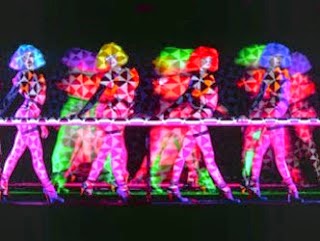
It’s the objectification that seems to fascinate Wiseman the most. The bodies are often shown in silhouette, or if not, with a dazzling light display: colored polka dots, myriad stars, horizontal lines, or even simply with parts of the bodies lit while the other remain in shadow. The effect is one of slicing up the body into individual parts. Less than parts even: curves, lines. Not the female form (and it’s impossible not to notice that all the women have the exact same form: no natural variety to be found here), but form itself. The effect is at once beautiful and completely anti-erotic (at least as far as I’m concerned, your mileage may vary, I make no judgements). I am, however, perplexed at how the segmentation of a woman’s body into its constituent shapes and shadows is supposed to be empowering, even if it does serve an artistic purpose beyond mere titillation.
There’s a short but telling scene of the dancers backstage, watching what appears to be a youtube compilation of on-stage errors by Russian ballet dancers. A blooper reel where dancers collide, fall down, struggle to lift each other and trip as they collapse off-stage. The women snicker at the, admittedly hilarious, disasters. But there’s a nasty edge to it, as there is in all such laughing at others’ misfortune. The burlesque of the Crazy Horse is a vulgar version of the ballet, the dancers work in an artistic netherworld that isn’t quite “art” and isn’t quite stripping. Both forms of dance prize form and shape over natural human anatomy, though the ballet features slightly more clothing and a whole lot more technique and athleticism, as well as, pointedly, male dancers every bit as much on display as the women. Is their laughing at the ballet an act of aggression, of bringing the snobs down to their level? Or is it the laughter of identification, of equivalence? A recognition that even the stars of the Russian ballet too can fall on their shapely asses. Wiseman doesn’t answer these questions, of course. At least not explicitly. And nor should he.
On Frederick Wiseman’s Ballet
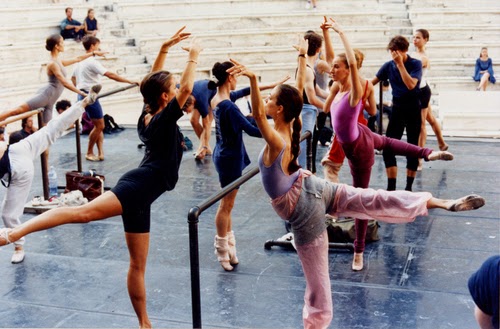
Venerable documentarian Frederick Wiseman’s La danse: The Paris Opera Ballet from 2009 is one of my favorite films of the century so far, so you can imagine my surprise when I happened upon this film while accidentally finding myself in the Wiseman section of Scarecrow Video last week. Released in 1995 and covering parts of 1992 and 1993 in the operation of the American Ballet Theater, in structure and content it is essentially identical to the later film, running about ten minutes longer (just shy of three hours).
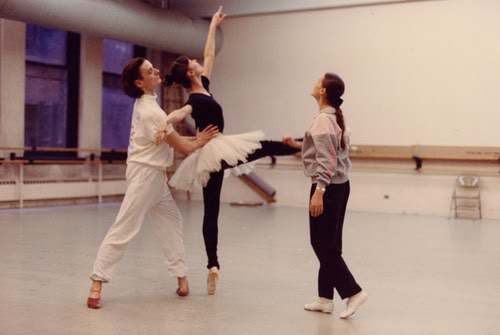
Both films are cinéma vérité chronicles of the rehearsals and backstage preparations that make up the day to day routines of the company. There are practices, classes, physical therapy, costuming and makeup sessions and eventually fully staged performances. Wiseman punctuates the passage of time occasionally with outside shots of the home city (New York in the case of Ballet, Paris, of course, for the other film), as if to give us a nudge: as we walk down the street the buildings we pass by and pay no attention to may contain artists at work. More frequently transitions between the various milieux of the company are made with shots of the dancers lounging or stretching, reading a book, listening to music, checking a call sheet, going over routines in their memories, looking nervous and scared and bored. In Ballet there is less of an emphasis on the monetary side of things, with only a couple of phone calls where company director Jane Hermann (hilariously) yells at the Met for screwing them over serving as a reminder that this, too, is a business.
More poignant are a couple of scenes of applying dancers, one being advised that they’d like her to join, another being told that now is not the right time for him. In both instances, the man doing the explaining uses the same gentle tone of voice, and the prospective dancers sport the same expression of doom. As well, a lengthy scene of a dancer being instructed by a teacher (who, if I understand correctly, was herself a world-famous dancer in her youth) is followed by the student dancer taking a break and walking to the side of a woman where a father and his maybe nine year old daughter are waiting for the woman to autograph a pair of shoes for her. This dancer maybe a star, a leading ballerina in one of the top company’s in the world and an idol to aspiring dancers, but backstage she’s just another student, needing to practice and work and improve. Maybe it’s just the difference in setting between New York and Paris, between a largely American cast and a largely European one, but the ABT shown here feels lighter, looser, more fun than the Paris Ballet did. Or maybe its just that Wiseman finds some time in the second half of the film, between touring performances, to send us out with the dancers as they act as tourists: to the beach, to a funky nightclub, to an amusement park in Copenhagen.
The real gem of Ballet, though, is Agnes DeMille, in the last year of her life, choreographing (from a wheelchair) what would end up being her final work (The Other, with Amanda McKerrow). We get to sit in on an interview with DeMille (a sneaky way for Wiseman to get his subjects to talk like they would in a less strictly vérité documentary is to show them being interviewed by someone else, a newspaper or magazine reporter), as she talks about dance and getting older and the integration of dance into a narrative whole (you can’t just perform a dance in isolation because it might not make sense out of context. Of course, this is exactly what Wiseman does throughout the film). But better yet is watching her work, the way she and McKerrow and their assistants work to bring one short, gorgeous scene to life, the way she coaxes McKerrow to flap her arms in just the right way so she looks like like a chicken and more “like something that’s absolutely broken and stuck up in the wind.” This is one of the rehearsed dances we don’t get a full stage version of in the second half of the film, where it and DeMille are sadly missing. But after seeing this one stretch of movement come together over the first half of the film, the final, almost finished version is heart-breaking.
The performances at the end of the film are pretty spectacular. They were performed and filmed the next year in Athens and Copenhagen after a rough patch for the company (not at all discussed in the film: the New York Times notes that the company underwent a change of director and had serious financial trouble, and also that Wiseman couldn’t include any of the New York season because he couldn’t get permission to film at the Met). They include more well-known and recognizable ballets than the ones featured in La danse. We see a bit of The Rite of Spring (suitably audacious in costumes and earthy sexuality) and a bit of Romeo and Juliet (passionate and lovely). It’s what you’d expect from a ballet company that was trying desperately to draw an audience. Obvious works to be sure, but to my knowing-nothing-about-dancing eye, pretty inventive and shockingly emotional nonetheless. Most striking might be the sounds Wiseman captures, not just of the music, hardly at all of the music (there isn’t even an orchestra at the Athens performance: Wiseman gives us a close-up of the giant tape recorder filling in for the band), but rather the grunts and thuds and squeaks of the dancers’ shoes on the surface of the stage. The sound of gravity in an artform that aspires to weightlessness.
Still though, the rehearsals remain the most compelling part of the film, even more so than they were in La danse, and I wonder why that is. Is it just the novelty of it? The footage reminds us that dance, that performance, is tremendously hard work, something we may forget when we only see the finished product, and so getting a glimpse, however brief or free of context, of everything that goes into a finished work is something new, something we haven’t seen before. Or is it the sheer joy of deconstruction, of taking a performance a part to see how it is put together, like an eight-year-old with a mechanical clock? Or is it a reaction against the slickness of our modern entertainment, that in the sweep of CGI and production values, we’ve lost the chaotic frustration of effort, the little imperfections that serve as reminders of our own humanity and what wonders other humans, with enough effort and inspiration, can achieve? Probably.
1984-A-Thon: Tsui Hark’s Shanghai Blues
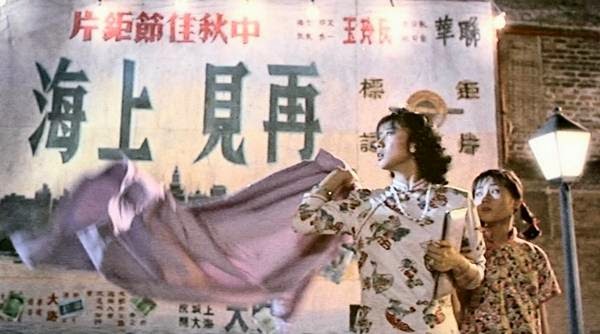
In his essential book Planet Hong Kong, David Bordwell examines a sequence in the 1986 film Peking Opera Blues where director Tsui Hark deftly coordinates the movements of his actors as they try to remain hidden from an inquisitive father (three of them, two men and a woman, are in his daughter’s bed and at least two of them shouldn’t be). It’s a short scene, only a couple of shots over a couple of minutes, and Bordwell uses it as an example of the simple virtuosity of Hong Kong filmmakers, how they are able, again and again, to make an exciting and fun sequence out of almost nothing, budget-wise, and specifically how Tsui’s mastery of cutting and framing keeps the whole sequence as light and airy as it is inexpensive. Peking Opera Blues’s less well-known precursor, the 1984 film Shanghai Blues, is essentially a feature length version of that scene.
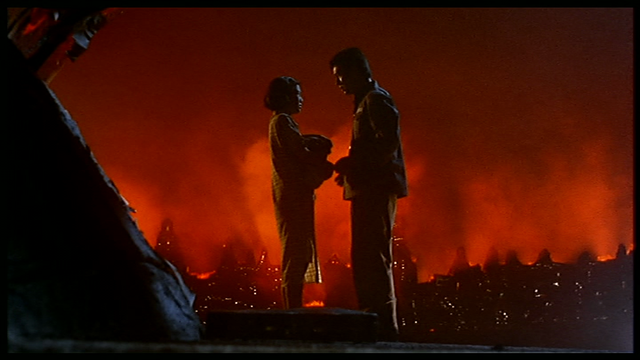
The film opens with the night in 1937 when the Japanese bombing of Shanghai begins and the whole city erupts in panic and fire. Kenny Bee (popstar and star of a pair of euphoniously titled but not very good early Hou Hsiao-hsien films, Play While You Play (aka Cheerful Wind) and The Green Green Grass of Home) and Sylvia Chang (one of the brightest stars of Hong Kong cinema in the 1980s, she’s also well an accomplished screenwriter (All About Ah-Long) and director (Tempting Heart, 20 30 40) find themselves under a bridge across the harbor from the rest of the city, which we see only in the kind of hallucinogenic orange William Cameron Menzies brought to the middle climax of Gone with the Wind. Bee and Chang, despite the fact that they can’t see each other, share the kind of blindingly momentous romantic moment war seems to inspire (see also, for example, Vincente Minnelli’s The Clock or Mervyn LeRoy’s 1940 Waterloo Bridge). They are quickly separated by the crowd, but vow to meet again at the same spot when the war is over. The rest of the film is then set in the chaotic interregnum between the end of World War II in 1945 and the end of the Civil War that would bring the Communists to power in 1949. Bee, a returned veteran, is trying to make it big as a songwriter while failing at a variety of increasingly clownish odd jobs (we saw him briefly as a literal clown in the prologue, now he’s a tuba player in a marching band, later some weird kind of promotional thing where he pops out of a box and plays a bugle). Rather than pay attention to his work, he tends to wander off whenever he sees a girl he thinks might be the girl from the bridge. One such woman turns out to be Sally Yeh (best known in the US as the woman Chow Yun-fat accidentally blinds in The Killer, and now that I wrote that, that song she sings is stuck in my head again), newly arrived in town and about to have her pocket picked. Bee gets the thief, but loses the girl, then the thief gets away with Bee’s own money. Then Yeh meets Chang, now a streetwise and weary showgirl, and ends up moving in with her, into a tiny apartment that just happens to be a floor below Kenny Bee’s home. The rest of the film will then follow various combinations of the three central characters and their inability to see each other.
Far too many people squeezed into ramshackle apartments where, despite the forced proximity, nobody ever really manages to see anyone else clearly. At least nobody on-screen: Tsui is careful to make all the action and failed interaction perfectly legible for the audience: we always know more than any given character at any given time. Tsui plays out the comic misapprehension scenario a few times in a few different ways as we get to know the three characters and familiarize ourselves with the spaces of their apartments. In an early scene, Yeh and Bee both go to the roof to hang laundry and just barely miss seeing each other. When she finally does see him, she almost loses her balance and, as she looks over the edge she hadn’t noticed to the street below, exclaims “Look where I may have fallen!” The film’s most extraordinary segment comes about halfway through. Chang and Bee, still not recognizing each other, are caught in the rain and he invites her to his room to change into dry clothes (he accidentally catches a glimpse of her changing, leading to consternation and profuse apology). Then Yeh, who now has a crush on Bee, pops in to visit him, which sends Chang into a closet. Then a buddy of Bee’s shows up, which sends Yeh into the same closet, but a separate part where she can’t see Chang. And while all this is going on, that same pickpocket from the beginning of the film is skulking about the edges of the frame, just out of sight of everyone but the audience. It is as perfect an example of the choreography of physical comedy and physical space, the comedy of escalation, as has been seen since the days of Keaton, Chaplin and Laurel & Hardy.
This kind of romance, where the two heroes can’t see each other though they occupy the same space (same frame), dates back at least as far as Paul Fejos’s 1928 Lonesome, and Tsui appears to be specifically riffing on this tiny subgenre. The early shot of Bee and Chang’s separation in the crowd in particular recalls that early sound film, where the chaotic urban mass drives the lovers apart despite their (and our) strong desire to see them united. Johnnie To’s 2003 film Turn Left, Turn Right, one of his most underrated films (even among his romantic comedies, which are of course underrated as a whole. I think maybe it has a lower profile because it lacks any of his signature stars, with Takeshi Kaneshiro and Gigi Leung instead of Sammi Cheng and Andy Lau or Louis Koo), follows that tradition as well, even adopting Lonesome‘s conceit that the two destined lovers are unwitting neighbors, sharing not only a building, but a wall. In Lonesome, the heroes just miss each other through their parallel stories, but they rarely share the same filmic space.
In Shanghai Blues, they’re almost always in the same space, often literally not seeing each other but just as often looking right at and not recognizing each other, while at the same time every peripheral character in the film seems to be actively attempting to avoid being seen by someone else. A timid young girl at the nightclub where Chang works hides from a lecherous gangster. Yeh mistakenly joins a modeling audition (a Calendar Girl-type contest) and is appalled by people looking at her (and then when she later gets the job, she’s mobbed by men everywhere she goes – her fame has made her unable not to be seen). Even the film’s only really villainous character is a rich guy who tries to roofie Yeh at a party. True to form he first drugs the wrong woman, then when Yeh gets drunk and passes out anyway, the bad guy still manages to sleep with the wrong woman. (An aside: I have no idea why, but drug-induced date rape appears to have been in the air as a plotline in 1984 Hong Kong, you can find it as well in Patrick Tam’s bizarre romantic comedy Cherie, where Chor Yuen keeps trying and failing to drug Cherie Chung). In the To film no one is intentionally hiding, it is instead apparently chance and fate (and the machinations of other potential lovers) that prevents the destined couple from meeting, though through much of the film we see them together in the same frame. Tsui sets his avoidance dances in confined spaces (tiny apartments, backstage dressing rooms), but To’s are set out in the open: a fountain in a public park, a street corner, a sidewalk (a similarly choreographed scene plays out as well early in Romancing in Thin Air, itself a kind of compendium of all of To’s romantic comedies, where Sammi Cheng and Louis Koo wander outside the grounds of the hotel, oblivious to each others’ presence despite occupying the same film frame).
This idea of seeing and not being seen seeps into every corner of Shanghai Blues, a film about a brief space between two apocalypses. In the other two films, there is a force that keeps the lovers apart, and the films are as much about the things that control us as they are about romance and love. Lonesome is all about the city as labyrinth, a part of the city symphony subgenre of films in the late 20s and early 30s (Man with a Movie Camera, Berlin: Symphony of a Great City, À Propos de Nice, People on Sunday, even Sunrise: A Song of Two Humans) a time of rapid urbanization throughout the Western world. As people flocked from the farms and the countryside to new, anonymous urban centers, cut off from the family and communal structures that had supported their lives for generations the fear of becoming lost in the crowd (or The Crowd) was palpable. Turn Left, Turn Right is about chance and fate, the interplay of which forms one of the thematic cores of To’s work, expressed across genres in romantic comedies and gangster epics alike. But in Shanghai Blues there is no outside force at work, but rather chaos itself. They’re seen and not seen not because of some sociological or metaphysical interplay, rather the choreography of the comedy sequences is an expression of the contradictions of their impossible lives. The lovers find themselves in a world that’s lost all its moorings, a world defined by the dislocating effects of war and an irrational, tragic hope for the future. A world where everyone is trying to keep their head down and get by, hoping nobody notices them, while they dream of becoming a star. It’s about people who have just barely lived through one war and aren’t sure that what comes next won’t be much, much worse. Two key quotes: First from one of the band of disabled and homeless veterans who now live under Chang and Bee’s bridge: “We didn’t survive the war just to die here. Our time will come.” Second from Chang herself, as she turns down an old friend who proposes to her as he’s leaving Shanghai for Hong Kong. He asks if he has any hope. Her reply: “I have hope. If I give it to you, I won’t have any more.” Their world is the in-between, defined by contradiction, controlled by chaos. They are here and not here, visible and invisible, smashed together and pulled apart.
Like most Hong Kong comedies, actually like most Hong Kong films in general, Shanghai Blues is broad in every sense of the world. The colony is a world of extremes and that’s reflected in its cinema: garish, gorgeous, vulgar, sublime, bloody, lush, romantic, nihilistic. Tsui Hark, a dominant force in Hong Kong film for almost 40 years now, embodies each and every one of those extremes, often all smashed together within the same 100 minute film. In his best comedies (the two Blues films and 1985’s Working Class, as well as 1995’s Love in the Time of Twilight), the cartoonish slapstick is leavened with intricate plot structures, intricately constructed set-pieces and an earnest wistfulness underneath a youthful strain of punkish anarchism. Peking Opera Blues ends with its heroes, having (finally) joined together to save the day, riding off vowing that they’ll meet again soon, though we know with historical hindsight that the contingencies of the wars (the film is set in the years just before the Japanese invasion) make that extremely unlikely. Similarly, when two of the heroes of Shanghai Blues leave the others behind as they board the train for Hong Kong, we know they too will never see each other again. Just another pair of couples here and gone, lost in the churn of history.
And then as the one train leaves, another pulls into the station. A young woman gets off, wearing the same plain dress that Yeh wore when she arrived in Shanghai, the same dress Chang wore when the bombs started falling. As Yeh had been, she’s pushed by the crowd to a giant billboard display, an advertisement for night club where a giant arm holding a fan swings back and forth across an image of a half-naked woman. She joins the motion of the crowd, their heads bobbing back and forth, left to right in perfect time with the movement of the inverted pendulum.
This Week in Rankings
After recording the last episode of They Shot Pictures, the one on Lau Kar-leung, I decided to take a few weeks off from Hong Kong film. It’s been a year and a half now since a more or less random decision to rent a couple Johnnie To movies I hadn’t seen yet around Valentine’s Day of 2013 led first to a massive To and Milkyway binge and podcast and then an off-hand rental of Eastern Condors followed by The Summer of Sammo, an exploration of Hong Kong martial arts cinema centered around the rotund yet mercurial Sammo Hung. That in turn was followed by a more consciously-determined look at Hong Kong film with Running Out of Karma, ostensibly primarily concerned with Johnnie To and his influences and contemporaries, but really an exploration of the whole panorama of Hong Kong and Chinese language cinema. Along the way I’ve watched dozens (if not hundreds) of films, which is great, but every once in awhile I need to step back and re-orient myself with some classical Hollywood cinema, which had been the main focus of my movie-watching for years before I caught the Hong Kong bug. Of course, after about three weeks of this, I couldn’t help but dive right back into Hong Kong and am now in the midst of preparations for the next They Shot Pictures, on King Hu.
Over the last few weeks I’ve posted a number of reviews here, as well as my mid-year look at the Best Films of the Year So Far (or rather, the Best Films from Last Year that Have Come Out this Year, So Far). I’ve got some other big lists over at letterboxd as well. For The George Sanders Show, Mike and I created an Alternate Top 100 Films of All-Time list (you can see my individual list here). On the occasion of Filmspotting‘s 500th episode, I came up with a Top 50 Films of the Last Ten Years list. And in response to a Film4 list that I feel neglected Chinese-language cinema, I wrote a 100 Must-See Chinese Language Films of the 21st Century list.
In addition to the big list, we’ve also had a couple episodes of The George Sanders Show since my last update. We covered Bong Joonho’s Snowpiercer and Hong Sangsoo’s Virgin Stripped Bare by Her Bachelors (the episode features a great interview Mike did with Bong himself), a couple of films called Lola by Jacques Demy and Rainer Werner Fassbinder, and a pair of Hollywood studio films with Hellzapoppin’ and The Barefoot Contessa. The last includes our discussion of Thomas Schatz’s seminal history of the studio-era, The Genius of the System, a book about which I had some serious reservations and disagreements.
These are the movies I’ve watched and rewatched over the last few weeks and where they place on my Year-By-Year Rankings. Links are to the reviews I’ve written here. Reviews or comments for the rest can be found over at letterboxd.
Napoleon (Abel Gance) – 6, 1927
The Criminal Code (Howard Hawks) – 13, 1931
Come and Get It (Howard Hawks, William Wyler) – 9, 1936
The Road to Glory (Howard Hawks) – 13, 1936
Empress Wu Zetien (Fang Peilin) – 29, 1939
Hellzapoppin’ (HC Potter) – 4, 1941
Dream of the Red Chamber (Bu Wancang) – 19, 1943
Christmas Holiday (Robert Siodmak) – 23, 1944
The Breaking Point (Michael Curtiz) – 22, 1950
Anne of the Indies (Jacques Tourner) – 21, 1951
French Cancan (Jean Renoir) – 5, 1954
The Barefoot Contessa (Joseph L. Mankiewicz) – 12, 1954
Indiscreet (Stanley Donen) – 29, 1958
The Enchanting Shadow (Li Han-hsiang) – 10, 1960
The Grass is Greener (Stanley Donen) – 17, 1960
Lola (Jacques Demy) – 2, 1961
The Story of Sue San (King Hu) – 24, 1964
Sons of the Good Earth (King Hu) – 15, 1965
The Young Girls of Rochefort (Jacques Demy) – 2, 1967
Dragon Gate Inn (King Hu) – 3, 1967
The Fate of Lee Khan (King Hu) – 11, 1973
The Fury (Brian DePalma) – 11, 1978
The Driver (Walter Hill) – 13, 1978
Legend of the Mountain (King Hu) – 7, 1979
Lola (Rainer Werner Fassbinder) – 13, 1981
Une chambre en ville (Jacques Demy) – 13, 1982
Gung Ho (Ron Howard) – 50, 1986
Maurice (James Ivory) – 47, 1987
He Ain’t Heavy, He’s My Father (Peter Chan) – 24, 1993
Painted Skin (King Hu) – 51, 1993
Crimson Tide (Tony Scott) – 37, 1995
Jackie Brown (Quentin Tarantino) – 3, 1997
Full Alert (Ringo Lam) – 26, 1997
Primary Colors (Mike Nichols) – 27, 1998
Devils on the Doorstep (Jiang Wen) – 9, 2000
The House of Mirth (Terence Davies) – 10, 2000
Golden Chicken (Samson Chiu) – 9, 2002
Golden Chicken 2 (Samson Chiu) – 12, 2003
House of Flying Daggers (Zhang Yimou) – 14, 2004
Oxhide (Liu Jiayin) – 3, 2005
Isabella (Edmund Pang Ho-cheung) – 5, 2006
Summer Palace (Lou Ye) – 41, 2006
Like You Know It All (Hong Sangsoo) – 8, 2009
Sophie’s Revenge (Eva Jin) – 31, 2009
Love in a Puff (Edmund Pang Ho-cheung) – 9, 2010
Love in the Buff (Edmund Pang Ho-cheung) – 30, 2012
Snowpiercer (Bong Joonho) – 33, 2013
Enough Said (Nicole Holofcener) – 42, 2013
Lucy (Luc Besson) – 6, 2014
They Came Together (David Wain) – 8, 2014
Guardians of the Galaxy (James Gunn) – 11, 2014
Running Out of Karma: King Hu’s Legend of the Mountain
It starts with a Wagnerian incantation: elemental imagery calling forth the natural world, music rising with the sun, the mountain, the clouds and the river, always the river, rushing, falling, churning. A Touch of Zen begins much the same way, but this world is depopulated, not even a spider mars its surface. When the lone scholar does appear, he’s dwarfed by his surroundings, a pinprick of consciousness in an beautifully indifferent nature.
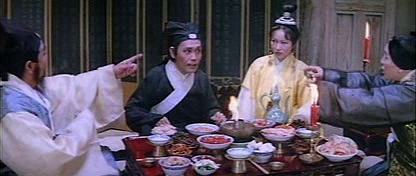
What follows is a ghost story, one that, unlike A Touch of Zen, Painted Skin and The Enchanting Shadow is not an adaptation from medieval Chinese literature (at least as far as I can tell, credits are murky) but rather an original screenplay by King Hu himself. An itinerant scholar, played by Hu mainstay Shih Chun, is tasked with translating a powerful Buddhist sutra. So he can work in peace, he’s sent to a remote, supposedly abandoned temple complex. The people he finds there are a little odd, most notably Tien Feng’s demonic mute servant Chang and Hsu Feng’s pretty young girl Melody. Shih gets drunk one night and ends up marrying Melody, but it turns out she’s a ghost who wants to steal the sutra for herself (in reciting it, an evil spirit will gain the power to control any human). Exactly how many people Shih meets are ghosts and how many aren’t becomes the central mystery of the film, with everyone, his friend Tsui, a mysterious pair of priests (one Buddhist, one Taoist) and a local barmaid (Sylvia Chang, looking impossibly pretty) knowing more than they’re willing to say, everyone’s hiding something, no one will simply tell poor Shih what is going on. Throughout Shih will remain largely clueless to this other world that surrounds, guides, manipulates and tricks him.
Where A Touch of Zen follows a kind of religious progression from everyday superstition to the abstract awesomeness of Roy Chiao’s Buddha-nature, Legend of the Mountain looks backward, not to any one religious doctrine, but to a fundamental level of reality that neither Buddhism nor Taoism can fully explain or control. For long stretches the film is wordless, with the music and Harry Chan’s images of nature giving us a glimpse, a feeling of this foundational world, one where the border between life and death, past and present and future is more porous than we are trained to believe it is.
But yet, far from a dry spiritual meditation, or even a Malickian heartfelt grasp at inexplicable profundity, Legend of the Mountain is also really funny. The film’s central montage, on the occasion of Shih Chun’s wedding night, duplicates the rhythm of the opening, but throws in lots of shots of insect sex, because, you know, nature (I nominate “King Hu’s Nature-Sex Montage” as the next great band name). The ghosts are constantly bickering and conspiring amongst themselves, no one listens, everyone is afraid of everyone else. Hu plays out these shifting alliances and secrets, the quick eyes, the halting speech, in long shots, where we always see more than any one character, most especially the hapless Shih Chun. As a wuxia mystery film, it feels more in the spirit of Tsui Hark’s debut The Butterfly Murders (also from 1979) and other New Wave works than it does the contemporary kung fu films of Sammo Hung, Yuen Woo-ping, Lau Kar-leung and Chang Cheh. Hu was always slightly out of step with the mainstream of martial arts cinema, but always leading the way forward.
Shih is terrific as the scholar, dogged yet constantly befuddled, but ultimately competent (you do feel for him when he finally discovers how much he’s been manipulated and the film’s final shots wouldn’t work if we didn’t know this man so well as he stands alone against a raging river). It’s a very different character than his ultra-confident swordsman in Dragon Gate Inn or even his not-as-clever-as-he-thinks scholar in A Touch of Zen. And enough cannot be said about Sylvia Chang, her ingenue performance here, as in Li han-hsiang’s 1977 Dream of the Red Chamber (a stunning musical she starred in with Brigitte Lin), is almost unrecognizable from her grown-up roles in the late 80s (the Johnnie To films Seven Years Itch and All About Ah-long (which she also wrote), let alone her work as the best thing about the Aces Go Places sequels. More recently she’s become a director of note, though I’ve only seen her short from the Taiwanese 10 + 10 compilation, a very moving film about capital punishment and religion.
The film was shot in Korea, at the same time and with some of the same sets as Hu’s other 1979 film, the similarly titled Raining in the Mountain. There’s apparently a longer, three hour cut of the film (the one I saw was just of the standard 100 minutes) that sounds amazing. Harry Chan shot both films, two of his first screen credits (he shot two other films in 1979: Ronny Yu and Philip Chan’s The Servant and Cecile Tang Shu-shuen’s The Hong Kong Tycoon. Chan spent the 80s and 90s working mostly in Hong Kong, on a couple of the Aces Go Places films as well as Tsui Hark’s Working Class, and worked for Peter Chan’s UFO in the 90s (He’s a Woman, She’s a Man). He’s apparently spent the last 15 years or so working in Canadian television, including The Collector, jPod (his last credit, in 2008) and Saban’s Ninja Turtles: The Next Mutation.
Running Out of Karma: Liu Jiayin’s Oxhide
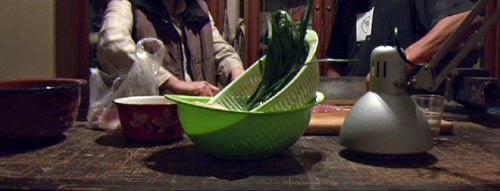
Liu Jiayin’s Oxhide II was my favorite film at the 2009 Vancouver Film Festival. It’s one of those marvelous film-going experiences where you don’t know what you’re seeing, and it turns out to be something wondrous, in this case a two and a half hour movie about a family making dumplings, shot in nine long takes, each set-up 45 degrees counterclockwise from the previous shot. It remains one of my favorites, and her short 607, which I saw at the 2010 VIFF (the family in a hotel room bathroom, making an undersea adventure out of their hands and a few mundane props), only confirmed by belief that Liu is one of the great filmmakers of our time.
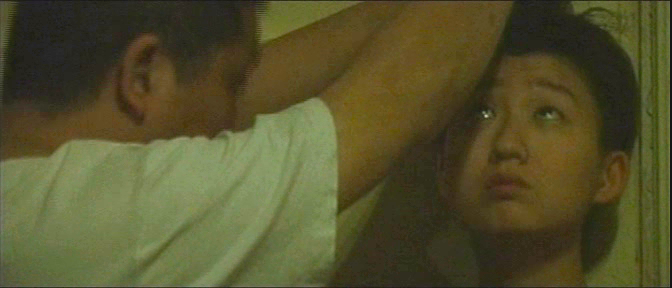
So it was with great trepidation that I finally sat down to watch her first film, Oxhide, which won the VIFF Dragons & Tigers competition at the 2005 festival. I’ve had it here for months, but finally I built up the nerve and was not disappointed. Not as rigid as the sequel, or as magical as the short, it is nonetheless a striking piece of filmmaking. Again starring Liu and her parents, her long, oblique takes follow some period of time in their day to day lives. Process sequences: examining a piece of leather for defects, making sesame paste fit for consumption with noodles, cleaning some dirty windows, are interspersed with family arguments, which tend to be about one of two things: money and why Jiayin isn’t growing any taller.
The money angle is somewhat expected, but Liu brings a fresh take on it. Her father initially prints some signs for a sale: everything 50% off. This works and he brings in some much needed cash to their tiny apartment (made all the tiny by Liu’s compressed scope frames). But soon he becomes disgusted with this. He’s set a fair price that compensates him for his labor. Why should he be forced to offer things at a discount, even a fake discount (by raising the initial price)? It’s the charming obstinance with which a generation that’s seen massive economic and social change negotiates the truly weird places they find themselves. You can’t help but admire the guy for all his pig-headed foolishness.
Always Liu’s camera is looking slightly away, she’s giving us only side-long glances at her family (the murky quality of the available images certainly doesn’t help, on film Oxhide II looked much brighter than what I have available here). Like what we’re seeing is caught accidentally, not framed and composed for the cinema (though, as I recall, everything is carefully scripted beforehand in both Oxhide films). This can be frustrating at times (we spend five minutes staring at a table as Jiayin and her father work on the computer – why can’t we see what they’re working on), but I wonder why we’re so curious. Shouldn’t we be somewhat ashamed to look straight-on into other people’s lives? Nothing tabloid-like or scandalous goes on here, and maybe that makes our peeping even worse.
Running Out of Karma: King Hu’s Painted Skin
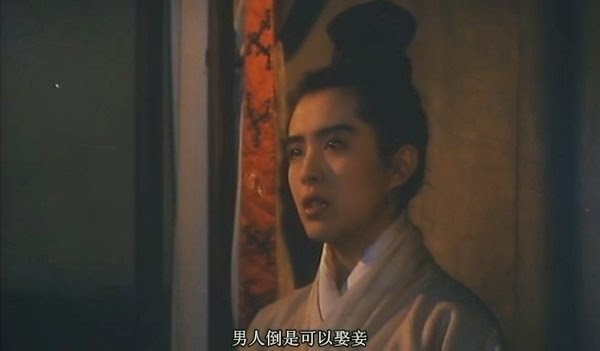
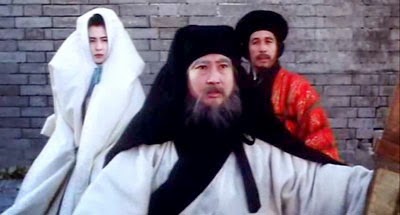
King Hu’s final film, it is, like his greatest work (A Touch of Zen) and his first film as an assistant director (The Enchanting Shadow), an adaptation of a story from the 18th Century collection of folk and supernatural tales Strange Stories from a Chinese Studio by Pu Songling. Hu’s previous film had been a failed collaboration with Tsui Hark and Ching Siu-tung on the first Swordsman film, and I wonder if there wasn’t a bit of “I’ll show you” at work in Hu’s decision to make a film so closely related to Tsui and Ching’s A Chinese Ghost Story, going so far as to include that film’s female star, Joey Wong, in his cast.
Like Zen and Come Drink with Me, Painted Skin features a shifting protagonist. We begin with Adam Cheng’s bourgeois nobody. He meets the ghost of Joey Wang and learns she’s being trapped in-between the afterlife and reincarnation by a demon called “The King of Yin/Yang” and seeks out two Taoist priests to help her out. Then Cheng disappears from the narrative and we follow the priests (played by veteran supporting performers Wu Ma and Shun Lau) for awhile as they seek out an even better priest to fight the demon. Then we follow the super-priest (Sammo Hung) through the final third of the story.
In Zen, the similar progression from everyman to super-priest is tied up with every other element of the film, as the heroes become less worldly and more divine, Hu’s filmmaking becomes more abstract, more purely visual, more inexplicable. Painted Skin though remains grounded in the same kind of swathed in pale blue light early 90s wuxia world from beginning to end. The villains, whether through poor subtitling or lack of budget or both, always seem slightly comical and ridiculous, even when they’re committing horrible acts (a far cry from the baby-killing demons in Ching Siu-tung and Johnnie To’s The Heroic Trio, which also was released in 1993 and involves the netherworld creeping into the everyday and a journey into darkness to defeat it). Hu doesn’t cut his wire-work stunts at the dizzying pace Ching does, but neither does he find time or space for more realistic fighting. The result is just a slower version of silly fights. If Hu didn’t have such a brilliant eye for composition, light and space, the film would be intolerable.
It’s fitting that Hu’s final film would star Sammo Hung. The two had a long and fruitful collaboration, with Hung reportedly serving as an assistant action director on Come Drink with Me, though he was only 14 years old. He had small supporting roles in Dragon Gate Inn, A Touch of Zen and The Valiant Ones, and served as action director on the latter two as well as The Fate of Lee Khan. He looks old here, made up with a gray beard and wizard robes, aside from his introductory scenes, he doesn’t really get time or space to develop his Taoist Gandalf character, nor does he have much opportunity to show off his fighting skills, given the supernatural nature of the action (Lam Ching-ying gets such a chance in a too-small cameo role as “The Purple Taoist”).
Sammo appears to have peaked with 1989’s Pedicab Driver. His 1990s directorial efforts are of low reputation (the only one I’ve seen is his final film, Once Upon a Time in China in America, the idea for which he either stole from Jackie Chan (Shanghai Noon) or vice versa) and he hasn’t directed anything at all since 1997. That year he left Hong Kong for the US (oh how I long for a DVD set of his cop show with Arsenio Hall, Martial Law) and since his return to Hong Kong, has worked exclusively as choreographer, producer and supporting actor. All lot of small roles like his performance in Painted Skin, tantalizing with memories of past greatness but almost never reaching the heights of his previous work.
Running Out of Karma: Samson Chiu’s Golden Chicken 2
The first Golden Chicken filtered 30 years of Hong Kong history through the life of one ridiculous prostitute and dared you not to be moved by her. Samson Chiu’s sequel, released one year later tries the same trick, but with 30 years of Hong Kong cinema instead, most specifically the work of Wong Kar-wai.
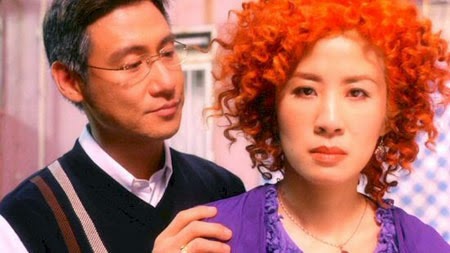
Beginning in the year 2046 (the year Hong Kong finally will be fully incorporated into the People’s Republic, and also of course the title of Wong’s career-summarizing masterpiece, the editing for which was still in progress when this film was released), we meet Sandra Ng’s Kum, the eponymous hooker. Now an old lady (she’s had some work done), she meets a despondent young man and tries to talk him out of erasing his memory (as Hong Kongers of the future will do to deal with their romantic traumas). She tells him stories of a very bad year she had, 2003, with the message that as bad as it was, she wouldn’t give up the memory for anything. The bulk of the film then is three stories of Kum’s year. The first is her comical involvement with a couple of terrible johns: Ronald Cheng plays a man who is weirdly obsessed with her body hair (he has a memory problem: keeps forgetting his wife, Angelica Lee) and Anthony Wong as a client who’s apparent goofy kinkiness is actually suicidal. Next is a section devoted to the SARS epidemic and the medical workers who work tirelessly to fight it, epitomized by a masked doctor played by Leon Lai. The third and by far longest story is Kum’s lifelong relationship with her cousin (think As Tears Go By) Quincy, played by Jacky Cheung.
This story weaves Quincy into the margins of Kum’s life as told in the first film. He’s an inveterate schemer, an amoral capitalist who shows up every few years to charm Kum out of some money and break her heart. He’s an ideal of a kind of Hong Kong ideology: one Christmas his big romantic gesture is a massive set of Christmas lights covering a skyscraper, drawing a giant $ on the HK skyline. Cheung matches Ng’s manic performance, and both wring surprising pathos out of a film where the main character is named “Kum”.
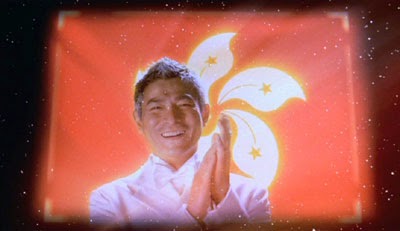
As in the first film, the high point comes with an Andy Lau cameo at the end. He leaves us, and Kum, with the promise that when we close our eyes and open them, we’ll see our Hong Kong, the one we love most. Kum sees the 1980s skyline at night, blue and red and yellow and black, bright and in constant motion, a shot that could have come from any number of John Woo or Tsui Hark or Ringo Lam classics. I’m going to say it’s from A Better Tomorrow.
Running Out of Karma: Notes on Alex Law’s Painted Faces
A lovely account of youth spent in the China Drama Academy Peking Opera school, based on the experiences of Sammo Hung, Jackie Chan, Yuen Biao, Corey Yuen and the other members of the Seven Little Fortunes performing troupe that grew up to dominate Hong Kong Cinema from the late 70s through the mid-90s (and beyond). Sammo himself plays their teacher, Yu Jim-yuen (“Yu Ho” in the film) tough (hitting the kids with a stick is his preferred method of punishment) but sentimental and adorably awkward at times. In a sweetly romantic subplot, Sammo walks all over the island looking for a birthday cake for Cheng Pei-pei, a fellow teacher he’s sweet on. Each of the interactions between these two kung fu movie icons is gold, and with nary a punch or kick between them.
The film is somewhat unexpectedly effective at conveying the double outsider status of the students: not only are many of them immigrants to Hong Kong (the master himself is from Peking) but their devotion to a dying artform, and the anti-modern schooling methods that make them great at it (most of the kids are essentially illiterate) doubly separate them from the quickly Westernizing world around them.
The film even takes the time to explore the world of Shaw Brothers stunt men, with Lam Ching-ying as Sammo’s old friend, trying to get by, who takes one blow to the head too many. We and the young students witness his on-set breakdown, a scene made horrifying as much by the fact that we know what these kids are going to spend their lives doing as it is by Lam’s harrowing performance.
I like to think that the scene of Jackie Chan (known throughout as “Big Nose”) standing on a railing serenading his teacher on the eve of the school’s closure served as an inspiration for the end of Dead Poets Society.
There’s an odd Mobius effect whenever Sammo the actor is talking to Sammo the character, we’re watching an older man constantly in the presence of his younger self, knowing that this kid will grow up to be this actor, making this movie about this kid who will grow up to be this actor. Sammo’s performance is brilliant regardless (he won the Hong Kong Film Award for Best Actor), but that extra element makes the movie all the more poignant. Also he uses a turtle to prop up his bed, a position which said turtle appears perfectly happy to occupy for years and years.
This is the first of only three movies directed by Alex Law, who previously co-wrote the very solid Chow Yun-fat-Cherie Chung melodrama An Autumn’s Tale, which was directed by Mabel Cheung, who co-wrote Painted Faces with Alex Law.