The new Dylan video, for Thunder On The Mountain, is out:
http://services.brightcove.com/services/viewer/federated_f8/271557392
The new Dylan video, for Thunder On The Mountain, is out:
http://services.brightcove.com/services/viewer/federated_f8/271557392
Some more movie thoughts as I try to catch up with the big backlog of movies I’ve managed to build up while holding back the tears caused by the rumored Rafael Soriano for Horacio Ramirez trade. That’s the wrong Ramirez, dumbass!
Yi Yi – Recently released in a beautiful Criterion DVD, Edward Yang’s novelistic film of a family in contemporary Taiwan is warm and humanistic where the very similar Short Cuts is cynical and misanthropic. Each member of the family has their own storyline: the father tries to bring some honor and art to the business he co-owns while his partners play games with the sole goal of making money, and he meets up with his first love, a woman he hasn’t seen in 30 years; the teenage daughter falls in love for the first time; the mother has a nervous breakdown and goes away for awhile; the young son gets in trouble at school and likes taking picture of the backs of people’s heads; the grandmother falls into a coma after the film’s opening wedding scene. A massive and profound film, one of the highlights of the great New Asian Cinema. The #4 film of 2000.
House Of Usher – The first of the Roger Corman Edgar Allen Poe adaptations starring Vincent Price. It’s not nearly as successful as Masque Of The Red Death, in pretty much every way. The non-Price acting is pretty terrible, especially by Mark Damon, who plays the young man who finds himself caught up in the incestual/necrophiliac horrors of the Usher family. The ultra-low budget shows is the cheesy staginess of the production, whereas Masque had the benefit of using sets leftover from the big budget Becket. Still, Corman has a distinctive style and a good eye for color, and Price is always fun to watch. The #14 film of 1960.
The Prestige – The latest Christopher Nolan film is also the second magic-themed movie of the season (I haven’t seen The Illusionist). Hugh Jackman and Christian Bale star as feuding magicians, who spend some period of years trying to top each other’s tricks to humiliate and revenge themselves on each other. The omnipresent Scarlett Johansson shows up as an alternating love interest, Michael Caine plays an older mentor-magician and David Bowie’s nearly unrecognizable as the inventor Nikola Tesla. Aside from a creditable amount of period detail, the film isn’t all that much to look at, and the story suffers from the fundamental flaw of all trick movies: once you figure out the trick, the movie’s not nearly as interesting. The unique problem this trick film has is that the audience figures everything out long before the characters themselves do, making the last 30 minutes or so nearly unbearable.
Vampyr – Carl Theodor Dreyer’s classic horror film (his follow up to The Passion Of Joan Of Arc) relies almost entirely on light and shadow to create as sense of eerie terror unmatched by any but the very best examples of the genre. A young man (Julien West) comes to a creepy village and has a night filled with horrific visions of very odd things about town. Eventually, it’s discovered that there are vampires about after a girl falls ill. The only way to stop them is to drive an enormous stake through the heart of the lead vampire in her crypt. West is pretty bad in the lead role, but acting is a very minor part of this film. The print I saw, on TCM, was pretty terrible, with Gothic lettered subtitles taking up the whole bottom half of the screen. I’ve now seen five Dreyer films, and they’re all great:
1. The Passion Of Joan Of Arc
2. Day Of Wrath
3. Vampyr
4. Ordet
5. Gertrud
Les Mistons and Antoine & Colette – Two short films by François Truffaut. Les Mistons is from 1957, two years before the New Wave hit it big with the Truffaut-scripted Breathless. It follows a group of delinquent boys as they torment a young couple in love (Gérard and Bernadette) over the course of a summer. At 17 minutes long, it’s a slight but interesting film, famous mostly for the icky sequence in which the boys sniff Bernadette’s bicycle seat. Eww. The #12 film of 1957.
Antoine & Colette is part of the anthology film Love At Twenty, and a continuation of the autobiographical Antoine Doinel series Truffaut began with his debut film, The 400 Blows. Jean-Pierre Léaud reprises his role as Antoine, now a young adult with a job and no annoying parental units. He meets Colette, falls in love, takes her to concerts, even moves into the apartment across the street from her, but can’t ever manage to escape the friend ghetto. I haven’t seen any of the later Doinel movies, but I understand he becomes more successful at the whole romance thing. The #16 film of 1962.
Faster, Pussycat! Kill! Kill! – Russ Meyer’s camp classic about a gang of three evil strippers who torment a young girl, kill her boyfriend and become caught up in a creepy family’s power struggles. The opening half hour, when the gang meets the square couple and have a nice friendly car race is by far the best part of the film. After that, the high intensity pitch of the film degenerates into a campy weirdness. There are some cool sequence in the rest of the film (a battle between a giant manly man and a car in particular), but it’s that first half hour that makes the film worth watching. The #9 film of 1965.
Killer’s Kiss – Stanley Kubrick’s first feature film, it has all the trademarks of a first film, good and bad. The plot is conventional B-noir, a boxer on his way out of town stops to save the hooker next door being tormented by one of her clients. The low-budget is largely hidden by Kubrick’s masterful camera work and the stylization of the noir mise-en-scène, and the no-name actors are surprisingly effective. Like many a first film, it’s very show offy, as Kubrick tries every trick he can think of to show what a great director he can be: expressive shadows, deep focus, showy camera movements, off-kilter camera angles, you name it, and this film’s got it. Especially notable is a long shot of a rooftop case where the hero runs far into the background and loops back to the camera, the space elongated by the telephoto lens stretching the rooftop into and endless desert. With this, I’ve now seen all of Kubrick’s features:
1. Dr. Strangelove
2. 2001
3. A Clockwork Orange
4. The Shining
5. Paths Of Glory
6. Eyes Wide Shut
7. Killer’s Kiss
8. The Killer
9. Full Metal Jacket
10. Barry Lyndon
11. Spartacus
12. Lolita
Adam’s Rib -Reportedly the best of the Katherine Hepburn – Spencer Tracy films, though I’ve only seen the mediocre Guess Who’s Coming To Dinner and The pretty good Woman Of The Year. Tracy and Hepburn play married lawyers on opposite sides of a case in which a young wife shoots her husband when she catches him with another woman. The case metastasizes into a rumination on the merits of feminism, and quite nearly ends more than one marriage. Judy Holliday is terrific as the would-be murderer. Especially notable is a very long-take scene in which Hepburn talks to her client for the first time. Director George Cukor holds the two actresses in a two shot, at opposite sides of the frame and separated by a table for the entire sequence. The film also stars Tom Ewell (The Seven-Year Itch) as the unfaithful husband and Jean Hagen (Singin’ In The Rain) as the other woman.
I Walked With A Zombie – The second of Jacques Tourneur’s horror films for producer Val Lewton is apparently a voodoo version of Jane Eyre. Since I’m totally Brontë-ignorant, I can’t say anything about that, but this is a superb noir-horror film. A young nurse comes to a small Caribbean island and becomes the object of conflict between the two white brothers who dominate the island. She’s there to take care of the wife of one of them, who the other one was in love with as well and who may or may not be a zombie. A zombie in the voodoo sense, not quite in the George Romero, must eat brain sense. Like in the previous Lewton-Tourneur collaboration, the great Cat People, the horror is more a function of psychology expressed through light, shadow, camera movement and general eerieness of mise-en-scène that the shock and gore of modern examples of the genre.
The Leopard Man – The third Lewton-Tourneur film is a lot less successful than either of the previous two. Playing like a straight version of Bringing Up Baby, a hungry leopard is on the loose in a small New Mexican town and manages to kill a couple girls. The question is: who let the cat out? Not as interesting psychologically or visually as its predecessors, it still has some great moments, specifically the first cat attack (cattack?) and the finale set during a creepy holiday celebrating imperialist massacre, complete with black robes and masks.
Seven Men From Now – The first of the low-budget Westerns directed by Budd Boetticher and starring Randolph Scott, and also the first one I’ve seen. Scott plays an ex-sheriff on a quest to kill the seven men who held up a bank and (accidentally) killed his wife. Along the way he helps a young married pioneer couple travel across the country (out-manlying the husband, naturally) and meets a couple of outlaws, led by Lee Marvin, playing his specialty: a cagey amoral nihilist. Psychologically complex in it’s study of revenge, the film would make a great double-feature with The Searchers. Shot in an existentialist Technicolor, with larger than life men struggling against vast, terrible landscapes. It’s too bad more Boetticher films aren’t available.
Goodbye, Dragon Inn – A run-down movie theatre showing King Hu’s kung fu classic Dragon Inn is the setting for this very slow film by Taiwanese director Tsai Ming-liang. There’s no dialogue at all until about halfway through the film, instead there are a series of long shots of the few moviegoers watching (or more specifically not-watching) the movie, along with the box office attendant making her lunch, eating it, and limping her way very slowly around the theatre. None of the patrons seem especially interested in watching the movie; we spend a lot of time following around a young man looking to pick up a guy, any guy he can find and being totally unsuccessful. In the weirdest sequence of the film, he wanders through a backstage maze, walking past dozens of the apparent ghosts of all the random encounters in the theatre’s past. the films always teeters on the edge of boredom, but never quite falls off. Instead, it works as a loving tribute to the movie theatre culture, a lot more interesting than the vastly overrated Cinema Paradiso, for sure. The #4 film of 2003.
Just about done getting over my cold, but still trying to recover from Sunday’s trip to see a very big movie. here’s some thoughts while trying not to refresh USS Mariner every five minutes to see if the Mariners have done anything at the Winter Meetings yet (please can I have Manny Ramirez for Christmas?)
April Story – The first film I’ve seen from director Shunji Iwai, but it won’t be the last. Takako Matsu plays a young girl (Uzuki) from Hokkaido who goes off to college in Tokyo. She moves into an apartment, meets her classmates, joins the fly-fishing club, goes book shopping, watches a movie and falls in love. That’s about it for the film’s 67 minute running time. Uzuki regularly gets into situations which would, in a lesser film, be played for horror are disturbing “realism” but Iwai always chooses the romantic option instead (much like Miranda July did in Me & You & Everyone We Know). It’s beautifully shot in a rather soft focus hand-held style, with what appears to be some kind of filter create a white glow throughout the film (that could just be the focus and lighting, though). Simple (in the best sense) and perfectly charming, but may cause the heads of the cynical to explode with rage. The #5 film of 1998.
Written On The Wind – Classic Douglas Sirk melodrama starring Rock Hudson, Lauren Bacall, Robert Stack and Dorothy Malone. Stack (looking weirdly like Sean Penn) plays an alcoholic heir to an oil tycoon, Malone’s his sister who’s in love with Hudson, his annoyingly perfect best friend. Stack and Hudson meet Bacall and both fall in love with her. She marries Stack, but his drinking and jealousy of his friend soon cause everything to fall apart. There’s some fights, some crying, a mysterious pregnancy and amazing audio-only flashback (terrifically acted by Malone) all told in Sirk’s sweeping, hyperbolic style. The #4 film of 1956.
7 Women – John Ford’s last fiction film is about a small mission in Northern China in 1935. The mission’s threatened by a Mongol bandit on the warpath and its quiet conservative life is disrupted by the arrival of Anne Bancroft, a doctor who bears a striking resemblance (in attitude and dress) to Katherine Hepburn. Above all, a visual experience in the manner of the very best Ford films, it’s surprisingly short, so the women don’t become as well-defined as in, say, Seven Samurai, instead the film is more a relaxed examination of the interactions between types. Relaxed in the way that only an old, great director can make a film. The #5 film of 1966.
Mary Of Scotland – Katherine Hepburn stars as the eponymous Queen of Scots in yet another Ford film, this from 1936. Fredric March displays his customary, uniquely elm-like approach to acting as Mary’s boyfriend and ideal of Scottish manliness the Earl of Bothwell. The plot is standard modified for Hollywood historical epic, with Elizabeth I villainized and Mary idealized, concealing a not so subtle anti-feminist rant as Elizabeth symbolizes the ruthless career gal while Mary’s a mother and a woman in love. Hepburn’s performance is able to overcome that for the most part, but the film’s really only interesting as an example of Ford’s growth as a filmmaker, as he experiments with expressive shadows, low camera angles (lots of ceilings) and purposeful zooms, visual experiments which would pay off in the late 30s-early 40s with Young Mr. Lincoln, Stagecoach, The Long Voyage Home and How Green Was My Valley.
The Fountain – I’ve decided I can’t really discuss it without giving away too many spoilers, so suffice it to say at this point that I liked it alright. It wasn’t great, nor particularly profound (or rather, original), but I wouldn’t call it pretentious either. I appreciate the sincerity and ambition behind it, and while I don’t think the film is totally successful, I admire Aranovsky’s effort. Visually it was somewhat interesting, but not especially beautiful, though that opinion could change with further study. In particular Aranovsky does a lot of repetition and variation on certain shots, where the similarities and differences convey thematic meanings, but that’d take more than one viewing for me to sort out. Both Jackman and Weisz were pretty good, which I’ve never thought of either of them before. It’s actually grown on me in the couple weeks since I watched it, but I still don’t think it’s as great as it wants to be.
Masque Of The Red Death – Reportedly the best of Roger Corman’s Vincent Price Poe adaptations, this film plays like a vibrantly colored B-horror version of The Seventh Seal. Sometime in Medieval Italy, a young innocent redhead is kidnapped and held prisoner by the local Count (Price). Turns out the Count and all his court are Satanists, and there’s a plague raging in the town outside (part of the eponymous Red Death). The Count tries to corrupt the young girl with lengthy philosophical discussions and demonstrations of the correctness of his evil religion, while her boyfriend tries to rescue her and big parties rage through the castle. Dizzying, expressionistic and always weird. The #9 film of 1964.
Sátántangó – How could I possibly capsulize a film like this? Béla Tarr’s 7 1/2 hour epic certainly lived up to the hype, it was even better than I expected. Believe it or not, despite its extreme length, the remarkable length of the takes (there’s only 230 or so shots in the whole film, about the same as two minutes of a Tony Scott film), and the subject matter (decollectivizing a small village in post-communist Hungary) the film is never boring. Either the camera or the actors are almost always in motion, and when the shot is static, the effect is so striking that you can’t look away. It runs the whole range of human emotion and experience: horror, love, awe, happiness, confusion, friendship, hope, depression, resignation and drunkenness. The film’s also shockingly funny, in a mordant, Eastern European sort of way. 
More poetic than other novelistic films I’ve seen (Marcel Carné’s Children Of Paradise, Gone With The Wind, Reds, Birth Of A Nation, and so on), often there’s very little happening plot wise, but amazing things occurring visually (movements across landscapes, amazing super-winds, a seemingly endless dance-sequence that’s as exhausting for the audience as it is for the dancers).
It’ll be out on DVD in North America soon, but theatrically is the way to see it if you get the chance. Above all, don’t break it up into separate segments. It’s meant to be seen all at once and works perfectly that way. Spreading it across a couple of days would only ruin its effect by destroying the considerable momentum the film builds up. Take a day and watch it, you won’t regret it. The #3 film of 1994, behind only Chungking Express and Pulp Fiction.
I was going to have something more substantive this weekend, but I caught a cold instead. And now I’m off to spend the rest of the day watching Béla Tarr’s 450 minute classic chronicle of life in a small Hungarian village after the collapse of Soviet collectivism, Sátántangó. It’s never been screened theatrically in Seattle, and probably never will be again. Hopefully it won’t be too insistent.
As we as a nation prepare to execute millions of large flightless birds in honor of our gods, some thoughts on a few recently seen movies.
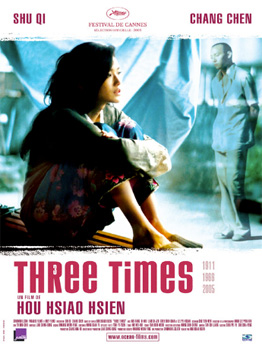
Three Times – The latest Hou Hsiao-hsien is three love stories set in three different time periods with the same two actors in each story (Shu Qi, from Millenium Mambo and Chang Chen from Crouching Tiger, Hidden Dragon). The first, concerning a soldier looking for the girl he loves, a pool hall attendant, is set in 1966 and the mood and quirky humor of the story is reminiscent of Wong Kar-wai’s trilogy of period films (Days Of Being Wild especially). The second section, set in 1911, concerns a young revolutionary and the prostitute who loves him and hopes to marry him. The whole section is in the style of a silent movie, complete with intertitles, but shot in a vivid color, dominated by purple, brown and gray. The third sequence is set in the present, with the man as a photographer, in love with a singer despite the both of them having girlfriends of their own. Like all Hou films, it’s beautiful, with long, floating takes from a fixed point of view (the camera pans but does not swirl or track). It’s a small film with an epic’s worth of meanings: the changing definitions and codes and styles of love, the transformations in the way men and women relate to each other, the history of Taiwan over the last 100 years, both politically and culturally, and most interestingly (to me) how in the 21st century the past is just another aspect of the present. In the future the past will be ever present. The #2 film of 2005, behind only The New World.
A Night To Remember – This 1958 telling of the story of the sinking of the Titanic was amply ripped off in The Biggest Movie Ever. It manages to avoid all the bad parts about James Cameron’s epic (the generic love story, Paxton and Zane), while telling the always moving, if exceedingly familiar story. Director Roy Ward Baker (who?) shoots in a stark, realistic black and white style that, combined with the relatively non-existent histrionics makes this the stereotypically stiff-upper lipped British reaction to disaster, right down to the ending noting the socially beneficial responses to the tragedy. The #5 film of 1958.
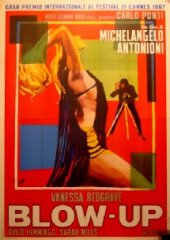
Blowup – Michelangelo Antonioni’s Swinging London mystery about a photographer who thinks he may have accidentally captured a murder on film while shooting in a park one afternoon. He tries to investigate the crime, but keeps getting distracted by the temptations of life in the mid-60s: hot clubs, sex with multiple wanna-be models, Vanessa Redgrave, the need to buy a giant wooden propeller, mimes, and so on. David Hemmings plays the photographer with the same blank, bored cool that one would expect in a film by the director of L’Aventura, the classic icy ode to ennui. I enjoyed this film a lot more than that one, the ideas are the same, but Blowup is more playful. The #4 film of 1966.
The Tao Of Steve – Entertaining, if typical, Gen X indie comedy about a fat slacker with a quirky philosophy and his adventures in search of true love. Donal Logue is very good as the slacker, and the setting (Santa Fe, New Mexico) is new and interesting, and there are some clever lines, but the supporting performances are below par, even for an indie. A slight, but watchable film. The #21 movie of 2000.
The Lost Patrol – Another in the John Ford marathon, this 1934 film stars Victor McLaglen (The Quiet Man, She Wore A Yellow Ribbon) as the leader of a troop of British soldiers in Mesopotamia, surrounded at an oasis by unseen Arabs who snipe them off one by one. The unseen nature of the enemy eventually drives the men nuts. The music, by Max Steiner, is more than a little reminiscent of the score he’d write eight years later for Casablanca. There’s some nice imagery, a shirtless McLaglan mowing down a line of Arabs with a machine gun seems right out of Rambo III, and some good supporting performances (including a histrionic Boris Karloff). An entertaining enough little film, barely over an hour long, but it doesn’t really compare to Ford’s greatest films (unfair, I know).
The Hurricane – Part of the six movie John Ford marathon on TCM yesterday, five I’ve which I hadn’t seen and tivo’d. It’s hurt by weak, ethnically inappropriate, and mediocre, lead actors (Jon Hall and Dorthy Lamour), but gets fine supporting performances from Thomas Mitchell and Raymond Massey. Massey plays the French colonial administrator of a small South Seas Island who unbendingly enforces the law against an unjustly convicted native (a hero to his people, played by Jon Hall). After repeated attmpts at escaoe from prison, Hall finally makes his way home, only to see the entire island wiped away by a massive hurricane. The special effects in the final sequence are amazing for any time, but especially for 1937. There are even echoes of themes Ford would develop fully in The Searchers (and certainly the mileu is something he’d return to in his late light classic Donovan’s Reef). Mary Astor (from The Maltese Falcon) is largely wasted in a supporting role as Massey’s wife.
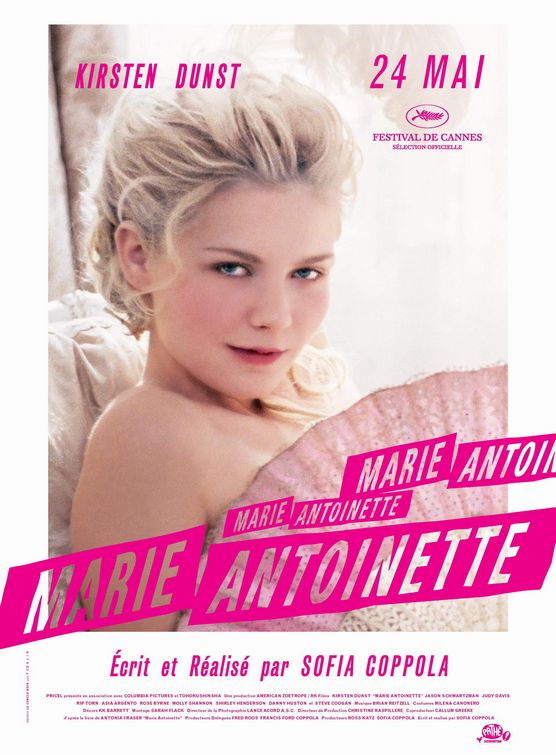
Marie Antoinette – Some notes on the most controversial film of the year so far:
I thought Kirsten Dunst was very good, but I’ve a weakness for her. Steve Coogan, Danny Huston and Judy Davis are largely wasted. I liked Jason Schwartzman a lot. His Louis XVI is benign, incompetent and amiably clueless and surprisingly understated for Schwartzman, who’s usually pretty broad.
Cinematographically, it was pretty but not all that interesting. I think the film is really overrated visually. It has a lot in common with the similarly overrated Memoirs Of A Geisha. Both films are full of shots of beautiful things shot in a not particularly interesting or innovative style. The costume design was great. the set decoration was ridiculously baroque, I’m not sure if it’s historically accurate or over-the-top or both.
I thought the parallels in the film between the fads Marie Antoinette takes up and contemporary fads of upper class women were potentially very clever (the sequence in Petit Trianon with the herbs and the lambs was hilarious), but I’m unsure if Coppola’s aware of that irony. I’m not sure if the film is satire or tragedy, but I don’t think it can be both.
I liked the improvisational vignette style through the first two-thirds of the film, but as the events of the film became more serious, I found the lack of historical context really annoying. There’s no explanation for why the French people turn against her. We just experience it as a series of seemingly random horrible things happening to her. I don’t believe that Marie Antoinette was as ignorant of the larger context of her life and society as this film is. The fact that we have glimpses (only glimpses) of her larger awareness confounds me. If the point is to show a girl adrift in a world she doesn’t understand, why create scenes where she understands her world perfectly? Radically divorced from social context, the film is not about Marie Antoinette, but about Sofia Coppola. And I really don’t care how difficult Sofia Coppola thinks her life of privilege is. Try as I might, I really don’t think there’s anything to this film other than “aww, look at the poor little rich girl.” At least she’s cute, I guess.
Much like in Lost In Translation, Coppola totally lost it in the last third of the film. She has good taste in the directors she likes to copy (Hou and Wong in particular are obvious stylistic influences), but she has yet to make a truly meaningful statement out of all that style. Without any real meaning, it’s all just a pose, it’s all fashion.
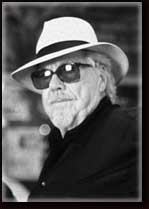
Robert Altman died today at age 81. He was one of the great American directors of the last 40 years, creating dozens of idiosyncratic, personal films. He was most well-known for his long takes of large ensemble casts, as well as his habit of overlapping dialogue, with multiple characters talking at the same time, but mixed in such a way that we hear exactly what he wants us to hear. After his first big hit with MASH, he proceeded to make a number of classic films, and wound his way in and out of critical and popular favor, always retaining his independence.
I’ve seen a few Altman films, but not as many as I want to. Here’s what I’ve seen:
1. Nashville
2. MASH
3. The Player
4. McCabe & Mrs. Miller
5. Short Cuts
6. Vincent & Theo
7. Popeye
8. Gosford Park
And a top 5 that I need to see:
1. The Long Goodbye
2. A Prairie Home Companion
3. Secret Honor
4. Buffalo Bill & The Indians
5. The Company
Reading moviecitynews on Zhang Yimou’s upcoming Curse Of The Golden Flower, I found a link to this review of Zhang’s Hero by Armond White. White’s an interesting writer, but I’ve always seen him as more provocateur than critic, and the bulk of his glowing review is what you’d expect: it looks great, Zhang’s an artist unlike those Hollywood hacks, a dig at Tarantino, praise for Christopher Doyle, some blatant ignorance of Chinese film, but two paragraphs contain the germ of an idea that resolves the tension I’ve always had with the film, namely its seeming pro-fascist political statement (that violent abuses by the state against its people are justified in the name of national unity).
White writes:
Hero is an exercise in what academics call narrativity. Nameless represents the anonymous handing-down of legend, and when his stories are matched by the emperor’s own counter-myths, the film grows into an elaborate—hell, magnificent—demonstration of pop-culture communication. Zhang shows how stories that are eagerly received can also be improved upon—for reasons that are either political, emotional or for sheer creative inspiration.
. . . .
Zhang and Doyle turn love and war—ecstasy and tragedy—into surreal extravagance. It’s not decorative, it’s volatile. And they keep the marvels coming: a showdown amidst golden leaves that change color as if they possessed mood, a resting place on a glistening lake that suggests an Asian Valhalla, as well as the psychic lunarscapes in Wong Kar Wai’s Ashes of Time.
These settings seem heightened (if not created) by each character’s longing. Every one of Jet Li’s tales as Nameless situates a scene in a personal motive, yet, soon, the same imagery is doomed by mankind’s intrigues. No other Jet Li film I’ve seen has been this sophisticated about national myth. Zhang explores the moral complexity of history.
This conception of the film, as a series of competing narratives, each one topping the other in order to create a foundational national myth transforms the film into an investigation into and even an attack on the kind of authoritarianism I (and Senses Of Cinema) saw in the film. Instead of valorizing Jet Li’s assassin sacrificing himself to the murderous Qin Emperor on the altar of national unity, Zhang’s instead showing how the state creates such myths in order to consolidate its own power over the people. It’s therefore a critique of both the state and the large majority of patriotic propaganda films. Such an attack is consistent with Zhang’s other films and his reputation as a Mainland Chinese filmmaker who’s worked for 30 years subverting and obliquely critiquing that country’s bizarre form of government from within.
So, a Yay! and a Thanks! to Armond White!
Addendum: I just watched Hero again, and I think this interpretation works. Not only is Zhang critiquing the use of narrative to support the state, but he’s more specifically attacking the whole idea of Taoist/Buddhist “passivity” in the face of authoritarianism. Tony Leung’s Broken Sword is a Taoist who achieves a kind of enlightenment through calligraphy and renounces fighting in the name of peace. He convinces Jet Li’s Nameless of the correctness of his position: that fighting is pointless and counterproductive to the unity of “Our Land”. Nameless spares the Emperor when the Emperor claims to understand the secret in Broken Sword’s calligraphy (“The ultimate ideal is when the sword disappears altogether. The warrior embraces all around him. The desire to kill no longer exists. Only peace remains.”) In the end, though, the Emperor has Nameless executed (in a scathing attack on the anti-individualist, anti-humanist hive mentality of bureaucracy, when dozens of his advisors, all speaking in one voices, demand Nameless be killed). Thus the Taoist renunciation accomplishes only the death of the “hero” and the elevation of the murderous tyrant.
Not much time for Not Blogging lately, what with crazy Borat business sucking all the life out of me at work (the movie’s great, by the way. Number 3 on the year so far, after Miami Vice and The Departed.) In addition, i went out and bought the new Final fantasy game, beginning my twice yearly video game binge, so i haven’t been watching any movies at all.
Some interesting stuff going on however. There was the election, of course. And let me sum up my reaction this way: YIPPEE! But I’m still concerned for the future. I anticipate a Clinton-Obama ticket that will probably lose to McCain-Jeb or something. Could be worse, I guess.
David Bordwell’s got his book on Yasujiro Ozu, Ozu and The Poetics Of Cinema available for download here. I haven’t read it yet, but Bordwell’s legit so I imagine it’s pretty good. And Ozu’s always fascinating.
Mike’s got an interesting post at Vinyl Is Heavy about a Wired magazine article on Atheism and sad little anti-prayer atheist groups contrasted with lively Protestant gatherings. It’s an interesting subject, but ultimately my opinion on the whole atheism vs. theism debate is that it doesn’t make a bit of difference whether or not God exists. I have my doubts, but I don’t particularly care. Nor do I really have any interesting in convincing people that what they choose to believe is wrong. People look for all kinds of things to give their lives meaning, to experience some combination of community and transcendence: church, sports, art, atheism groups, whatever. If it works for them, I’m happy for them. Though it’s easy to see, without looking too hard, that not much is really sacred.
All religions are made up of a morality and a mythology. One doesn’t need to believe the myth to agree with the moral: you can have the Golden Rule without the Trinity. The mythologies of various religions are fascinating though, not just in a psychological Carl Jung/Joseph Campbell sense, but also because all of Western Art (music, literature, you name it.) is founded on Judeo-Christian mythology (same with Eastern Art and Religion, as far as I can tell as well). Whether we believe in it or not, much of the way we see and understand the world is shaped by religion and the discourses surrounding it. And the world is richer for having those myths and metaphors. You don’t need to be Catholic to appreciate Martin Scorsese, but you can’t understand his work without understanding Catholicism. So this is the other problem with atheism as a doctrine: a world without religion is much less interesting, we lose many of our most versatile and powerful metaphors. Cinema would be a much poorer place without The Seventh Seal, The Passion Of Jeanne D’Arc, Andrei Rublev, The Last Temptation Of Christ, Au Hasard Balthasar, The Mission and on and on and on.
The problem with religion is not people who believe the myth and the morality, but with people who believe the myth and ignore the morality. This is the basic error in fundamentalist thinking, Christian, Jewish and Muslim. It’s caused, not by religion itself, but by our woeful ability to think critically about ourselves and our world. Bertrand Russell, and many other atheists blame religion itself for this, as organized religion (they assert) discourages doubt and questioning in father of received wisdom and dogma. I can’t disagree with that, but it’s a chicken and egg thing. The fact is that less dogmatic religions have just as much trouble with authoritarianism and lack of self-examination as Western nations have seems to be evidence that the problem lies not with God but with ourselves. It’s that longing for community again, making it so easy for us to sublimate our own judgment to the instruction of charismatic leaders. Is it religion that makes us ripe for exploitation by authoritarians, or our need for community that makes us accept so willingly whatever we’re told religion demands of us? I don’t know, and neither did Russell or any other group, prayer or anti-prayer.