Deeper Into Movies


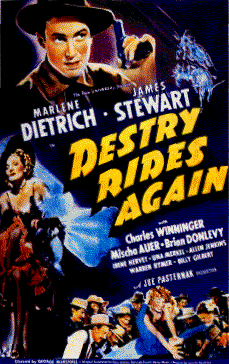
Watched Destry Rides Again a few days ago. Stars Jimmy Stewart, in one of his first starring roles and Marlene Dietrich. Advertised as a comedy, it isn’t really, though it does have funny moments. It’s a lot like The Man Who Shot Liberty Valance, a film Stewart made 20 years later, in that it makes explicit the underlying theme of every Western: the transition from anarchy to civilization. Like Shenandoah, the movie is remarkable mostly for Stewart’s performance. He’s terrific as a zen genius of a deputy sherriff who doesn’t believe in guns, essentially the same character he played in Harvey, only without the delusions.

Disappointing, though, was Marlene Dietrich. Her acting’s fine, and her scenes with Stewart are terrific, but her songs are awful and she looks as bad as I’ve ever seen her. Which is weird, considering she was electric in Josef von Sternberg’s The Devil Is A Woman just four years earlier, and she looked great in films through the 40s and into the 50s. Must be the excessive make-up and ridiculous Western costumes.


Watched Kill Bill Vol. 2 last night. While I liked it better than the first time I saw it, I still prefer the first part. Volume 1 is overflowing with manic energy and joy of making movies fun. The second is much more controlled, more static. The first is inspired by Kung-Fu and exploitation movies but it transcends its genre models, takes them to new artistic heights. Vol. 2, however, simply does not match up to the Films Noir and Spaghetti Westerns it is modeled after.

It might be the soundtrack. The reason those Sergio Leone movies never seem slow, despite the long takes where not much happens, is Ennio Morricone’s scores. While the soundtrack to Kill Bill Vol. 1 is perfect, there’s hardly anything memorable about the sound in Vol. 2.

There are great parts of the film though: the whole Pai Mei chapter, a great performance by Michael Madsen, the fight with Darryl Hannah. It’s just never as exciting or innovative as Volume 1. It is Jackie Brown to Volume 1’s Pulp Fiction.
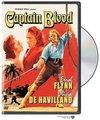

Just finished, literally, watching Captain Blood. Released in 1935, it’s Errol Flynn’s first starring role. Basically the same team got together a few years later and made the Adventures of Robin Hood, a much superior film. Flynn, Basil Rathbone, and Olivia de Havilland star in and Michael Curtiz directs both films. The whole first hour of the movie as devoid of action, as Flynn is arrested and sold into slavery and slowly, very slowly, works his way into becoming a pirate. Once that happens, the film picks up pace and becomes interesting. Rathbone is criminally underused as an evil pirate, he really only gets two scenes, one of which is a good fight scene with Flynn, but not as good as the ones in Robin Hood. The ship to ship battles are also very good, but it just isn’t enough to save the film. Doomed by a boring first half and a second half dotted with sanctimonious speech-making.
I Need Japanese Steel


Went DVD shopping today and picked up Ghostbusters and a trio of Tarantino films (Pulp Fiction, Reservoir Dogs and Kill Bill Vol. 2). Which leads me to a question John posed below in the comments. He writes:

I thought “Kill Bill, Vol. 1” was too violent and had a lot of pointless running around. I must be missing something, especially considering I haven’t seen many samurai movies at all.

Why on earth do you think it’s easily the best movie of 2003?

Well, first of all, these things are subjective. Some people don’t like violent movies, that’s OK. I’m not gonna tell you you should like it, just try to explain why I do.

First off, some background. Kill Bill is an homage to a certain genre of film. The Martial Arts, Samurai/Yakuza and Blaxploitation films of the 70s, to be specific. What these films all have in common is violence. Not just plain old Die Hard style violence, but crush your head like a melon, spray the screen with fake blood level violence. The violence is not meant to be realistic, nor do people look at it that way. Usually, in these films, its all in fun: people like to see blood geysering out of a severed head. Well. . .some people do. There is that element of playfulness and jokiness to the violence in Kill Bill, but there’s more to it than just that.

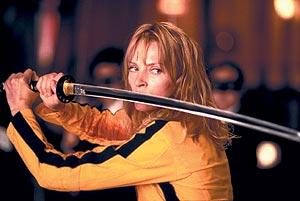
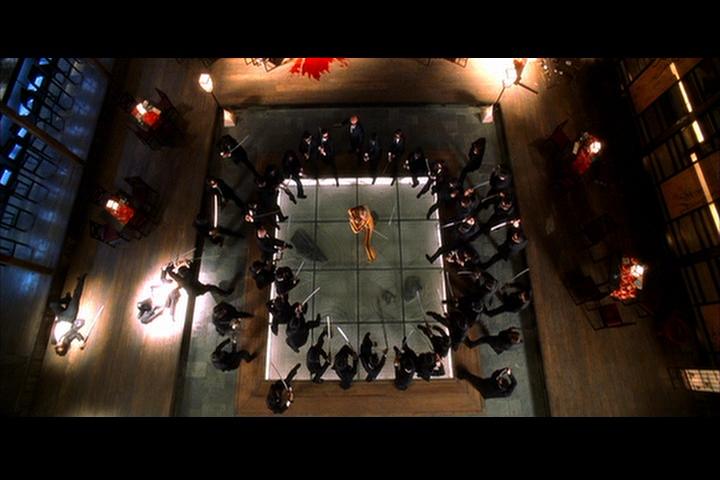
Take, for example, the sequence near the end of the big fight scene between the Bride and the Crazy 88s. Someone (for no apparent reason) shuts off the power in the Inn. The Bride and her combatant are only visible as black silhouettes on a blue background. The fight is abstracted to it’s essence: bodies moving through space. This is what people mean when they compare kung fu movies to ballet: both art forms are primarily concerned with the image of the human body as it moves and interacts with other bodies. In ballet, you have toe shoes and a tutu. In Kill Bill, a motorcycle suit and a badass sword. The point is the same: it looks pretty, and it looks cool.

Another, non-violent yet terrific thing about Kill Bill is the way it’s written. Not just the catchy dialogue, of which there’s less of than in any other Tarantino film, but in the structure and economy of the narrative.

It may be cliche now to start a movie in the middle and jumble up it’s timeline (Tarantino’s done it in three of his four films) but it still works as a way of keeping the audience on edge and guessing and involved with the plot. In fact, that might be one of the reasons I prefer Vol. 1 to Vol. 2: aside from the long flashback sequence, the narrative in Vol. 2 is strictly A to B.

But it’s the economy of the script that really stands out to me. The way Tarantino can create wholly unique, interesting and memorable characters with just a few lines of dialogue is amazing. For a film with so little dialogue, there are a remarkable number of fascinating characters in Kill Bill: Hattori Hanzo, GoGo Yubari, O-Ren Ishii, Buck, The Sherriff, not to mention The Bride herself.

And there’s more: terrific acting by Uma Thurman, Lucy Liu, and, especially, Sonny Chiba, the best use of music of any Tarantino film, and any film at all since Boogie Nights, the great, long steadycam tracking shot setting the scene for the House of The Blue Leaves sequence, the absurd, yet beautiful, snowscape for the final battle between The Bride and O-Ren, the audacity of putting a long (violent) anime sequence right in the middle of the film, and on and on.

There isn’t a filmmaker alive who loves movies more than Quentin Tarantino, and that shows in every frame of this movie. It’s a movie for people who love movies by people who love movies. It isn’t surprising, then, that film geeks tend to like it a lot more than normal people.

If We Don’t Try, We Don’t Do. And If We Don’t Do, Why Are We Here On This Earth?

Caught Shenandoah as part of James Stewart Day on TCM. Small-scale Civil War movie with Stewart as the head of an anti-war Southern clan. Really more of an anti-war movie than anything else. It came out in 1965, which seems a little early for such an obvious Vietnam commentary, but there it is nonetheless. Great performance by Stewart in his angry, depressed old man period. The story is awfully dark, but you never get the full effect of depression you’d get if such a film were made today. I blame Technicolor: the movie’s way to bright and colorful for it’s subject matter. It looks like Chitty Chitty Bang Bang, but could have been The Deer Hunter. And the terrible supporting cast Stewart has to work with (outside of Katherine Ross), certainly doesn’t help. Recommended for Stewart’s performance though. He really is very good.

Also saw Once Upon A Time In China 2 dubbed, panned, and scanned on the Encore Action channel. There are a lot Once Upon movies, 4 of which star Jet Li. The fourth (or sixth) one, Once Upon A Time In China And America, in fact was ripped off by Jackie Chan and turned into Shanghai Noon.

Li plays Wong Fei-Hung, who is to China what Robin Hood would be to England if he lived in the early 20th Century. He was a real person, a legend in his own time, so to speak. In fact, he was the first martial arts movie star, acting in a number of pre-war Chinese films (with his umbrella). He’s been adapted into a lot of films, either keeping his name (like in Jackie Chan’s Drunken Master movies, though Chan came up with the ‘drunken’ part as a joke) or being the basic mold for another character (as in Jet Li’s Fong Sai-Yuk films, which are really similar plot-wise to the Once Upon movies, though set hundreds of years earlier).

Anyway, in this movie, Wong has to help protect Sun Yat-Sen and his group of revolutionaries from the anti-Western White Lotus Clan and corrupt members of the Chinese government who appear to have sold out to the Japanese. As in many films of this genre, the hero is out to defend ordinary Chinese from foreign invaders (usually either the Manchu or the Japanese). The twist of the Once Upon movies is that, while Wong fights the Eastern foreigners, he’s curious about, and very fond of, the West (mainly British and Americans and their inventions and weird customs).

It’s well-directed by Tsui Hark, one of the best Hong Kong directors of the 90s: his Swordsman 2, also starring Jet Li, is highly recommended as possibly the best film in this genre. The martial arts are choreographed by Yuen Wo-Ping, the guy who’s choreographed every martial arts sequence in every film made in the last 10 years, and with good reason. Donnie Yen (Hero, Shanghai Knights) is the only recognizable co-star, though I didn’t recognize him at all. All the Once Upon movies are recommended, though they probably aren’t the best way to start in the genre.

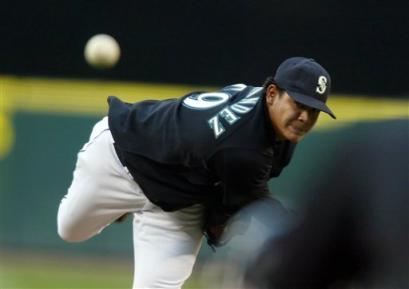
King Felix Update

8 IP, 5 H, 2 ER, 1 BB, 9 K

29 IP, 16 H, 4 BB, 30 K, 1.24 ERA

and still no extra-base hits allowed.

After only 4 starts, he is now the Mariners’ second most valuable pitcher by Runs Saved Above Average, tied with Julio Mateo at 10, behind Eddie Guardado’s 14. He’s fourth among the team’s pitchers with 13.9 VORP, behind Jamie Moyer, Mateo and Guardado. After 4 starts.

Hail to the King.

Silly Caucasian Girl Likes To Play With Samurai Swords

Watched Kill Bill Vol. 1 again tonight. Easily the best film of 2003. I really need to get the DVD of Volume 2 so I can see it again: I didn’t like it nearly as much as the first part the only time I saw it. . . .I wonder when Tarantino’s gonna release those special editions. . . .

In other news, Felix Hernandez pitches tonight at 4:30 in Minnesota. Be there or be square.

I Like American Music

What’s On The iPod This Week:
Bach’s Cello Suites by Yo-Yo Ma.

Been trying to educate myself on Bach, this is my latest purchase. I’d say i like it better than the Well-Tempered Clavier, but not as much as The Art of Fugue. Ma played one of these on The West Wing, I believe.

Kind Of Blue by Miles Davis.

I don’t know much about Jazz, but I know this is great.

Exile On Coldharbour Lane by A3.

You know them as the theme song from The Sopranos. Radical left-wing country-blues-gospel-acid house-fusion. Good stuff. I think they may have been mildly famous when I wasn’t paying attention, but I’m not sure.

Bitches Brew by Miles Davis.

More Miles, more awesome.

I Don’t Know Where You Pixies Came From, But I Like Your Pixie Drink

Baseball teams as Simpsons characters at the above link.

Here’s a few:

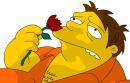
Seattle Mariners – Barney Gumble – Struggling against their personal demons. Just when you thought they were going to clean themselves up and they were looking bulletproof, they suffered an unfortunate relapse.


New York Yankees – C. Montgomery Burns – Driven to success by an almost unimaginable wealth of resources, which they use to ruthlessly crush their enemies, although typically not by the most efficient means possible (blocking out the sun, Bernie Williams). Seemingly unaware of the (obvious) reasons why they are hated. They seem to have been a key actor in pretty much everything important that happened before 1970.

Boston Red Sox – Lisa Simpson – Beloved by all. Used to being overlooked and trod upon, so that when they finally get a day in the sun, they don’t really know what to do with it. Unfortunate tendency to get a little self-righteous. Antagonistic relationship with those in positions of power.

Baltimore Orioles – Maggie Simpson – Never says or does much of anything, but constantly brought up in discussions by virtue of their close associates. Stubbornly hanging onto something disgusting despite other people’s well-meaning efforts to take it away (pacifier, Sidney Ponson).