On Ridley Scott’s Robin Hood

Ridley Scott’s 2010 adaptation of the Robin Hood story is much better than I’d expected given both the critical reaction at the time and my usual responses to Scott’s historical epics. Expecting a repeat of Gladiator‘s obstinately counter-factual approach to Roman history, I was pleasantly surprised to find a much strong sense of the actuality of life in medieval England here (I watched the Director’s Cut version on the Blu-Ray). Sure, the film makes no mention of the cultural divide between the Normans and the Anglo-Saxons that is at the heart of a lot of the conflict between the ruling Plantagenets and the local nobility that was still in the process of working itself out in the late 12th Century (it would be another hundred years or so before a King of England spoke English as his first language, IIRC), but still, locating the Robin Hood story a bit later in time than is traditional, to the reign of John proper as opposed to the middle of Richard’s, is a strike of genius, tying the legend together with the complex mass of politics surrounding the Magna Carta. There are hints of ethnic or at least cultural difference between rulers and ruled, as Will Scarlet is identified as Welsh (and therefore Celtic) and Cate Blanchett’s Marion is a paragon of the strong Anglo-Saxon woman, of a type uniquely prevalent in the Kingdom of Mercia, of which Nottinghamshire was a part, as near as my geographic skills can tell. The haunting images of the orphaned children of Sherwood forest even recall stories of black magic practiced by the Celts encountered by the first Roman invaders on the island.

The other major twist to the legend is that our hero is no longer a petty nobleman, but an orphan who has forgotten his past who takes on the role of a Baron for various complicated but not really important reasons. Thus is Robin Hood doubly turned into a mirage: he’s a mask that Russell Crowe’s Robin Longstride adopts twice over: first a model of the chivalrous knight and beneficent lord, then as the paragon of democratic values and the communitarian ideal. Both images are false, but nonetheless necessary to the political causes they represent. Crowe’s character is a chameleon, adopting the ideal form of whatever world he finds himself in: warrior archer, petty nobility, political revolutionary. This conception of the character requires some plausibility stretching at times throughout the film, but all in service of a good cause (the quick turn of Léa Seydoux’s Isabella for example, or the ease with which the English troops turn to Robin as savior, both before and after the final battle, in direct insult to John).
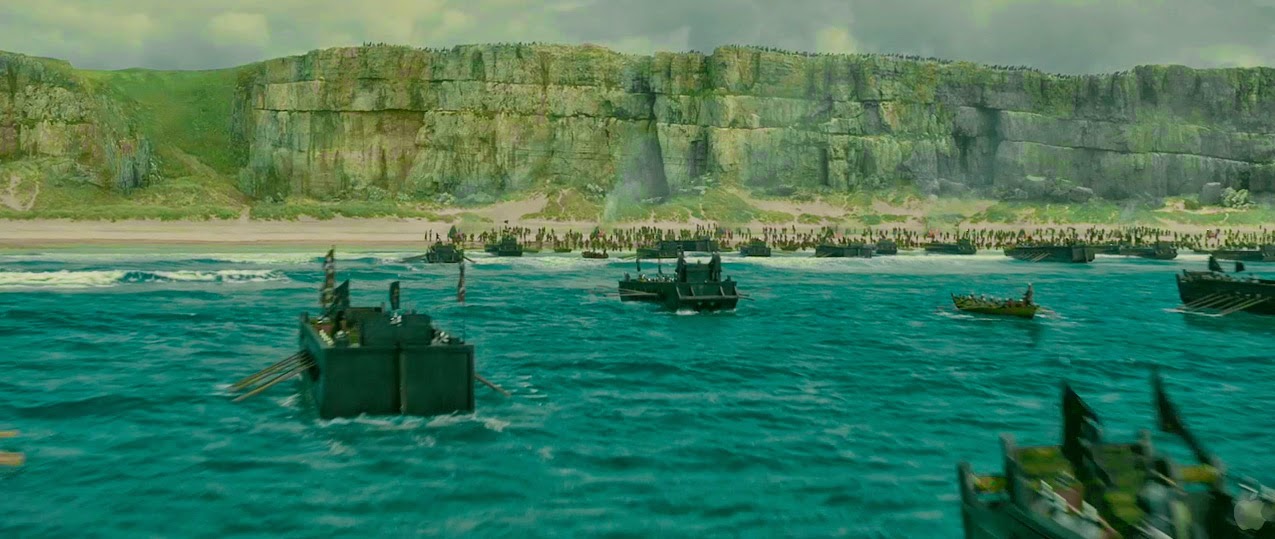
Unfortunately, much of what is of interest in the film dissolves in the final act, replaced by Scott’s worst instincts as a director of action. The reasonably-coherent and sensible action scenes interspersed throughout the film are replaced by a full-scale battle, a swirl of mud-brown and grey with the kind of shoddy camerawork and random editing we’ve come to take as normal from 21st century Hollywood. The logistics of the battle are increasingly absurd. First, the unified English army marches from Barnsdale to Dungeness in two days, in order to meet the invading French. That’s a journey of 173 miles, which, while it only would take a couple of hours today (Google Maps tells me its 3 hours and 10 minutes on the M11) is unlikely to have been traversed in less than a week, maybe four days at top speed for an entirely mounted small medieval army moving through their own terrain with no baggage train (50 miles per day). There’s no reason for the timeline to be given as two days, it’s a pointless throw-away bit of movie silliness. Similarly, the less said about Marion dressing in full armor to lead a group of children into battle against a professional army, and then taking on the biggest villain of the film in single combat, the better. It’s silly, but not in the fun way of Friar Tuck attacking the French with bees or Little John picking up chicks (“I’m proportionate!”), but in the depressing this-is-what-we-take-as-normal-in-Hollywood action-filmmaking sense. As Ridley Scott’s idea of realism gives, so it takes away.


2014 Endy Awards

These are the 2014 Endy Awards, wherein I pretend to give out maneki-neko statues to the best in that year in film. Awards for many other years can be found in the Endy Awards Index. Eligibility is determined by imdb date and by whether or not I’ve seen the movie in question. Nominations and winners are subject to change. And the Endy goes to. . .

Best Picture:
 

1. Don’t Go Breaking My Heart 2
2. Hill of Freedom
3. Horse Money
4. Inherent Vice
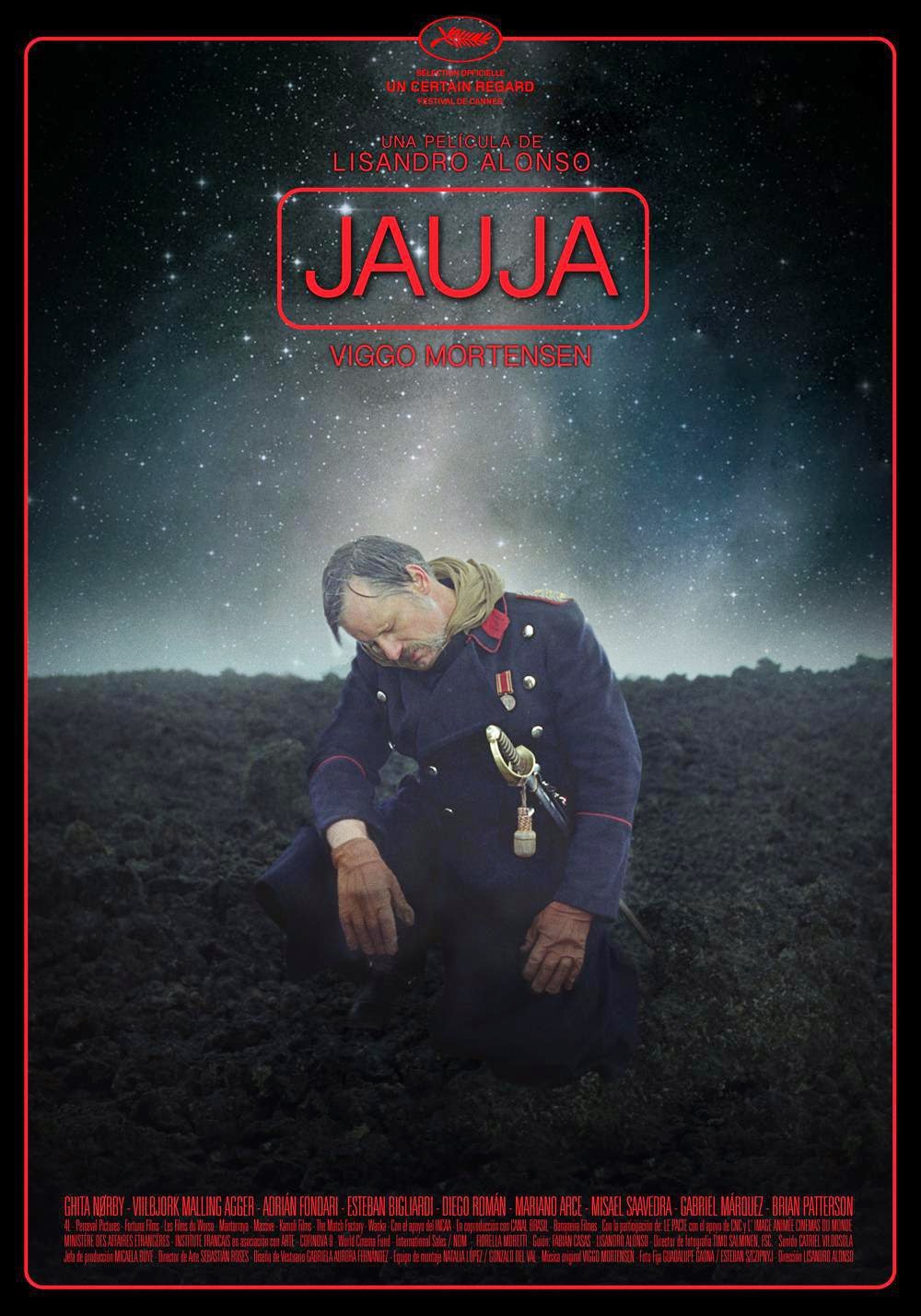
5. Jauja
6. Journey to the West
7. A Matter of Interpretation
8. The Midnight After
9. National Gallery
10. Phoenix

I wrote about Fruit Chan’s film a couple of times this past year, after the Seattle International Film Festival and again at the Vancouver Film Festival.

Best Director:

1. Jean-Luc Godard, Adieu au langage
2. Paul Thomas Amderson, Inherent Vice
3. Pedro Costa, Horse Money
4. Lisandro Alonso, Jauja
5. Fruit Chan, The Midnight After

I totally understand the logic of not splitting the winners or nominees of the Directing and Picture categories, especially for a practicing auteurist like me. But what can I say, the Endy voters like to spread the recognition around, hence the nominations for veterans Costa and Godard instead of Wiseman and Hong (both of whom have been nominated recently: Wiseman in 2009 and Hong in 2010, 2011 and 2013 (he won in 2010)). Of course, that didn’t stop me from nominating Johnnie To again, for the fourth straight year and the 12th time since 1999 (he won in 2003, 2006 and 2008). This is Godard’s first Endy nomination, but it won’t be the last as we move further into the past (the Endys run reverse-chronologically).

Best Actor:

1. Ralph Fiennes, The Grand Budapest Hotel
2. Joaquin Phoenix, Inherent Vice
3. Timothy Spall, Mr. Turner
4. David Oyelowo, Selma
5. Gerard Depardieu, Welcome to New York

A solid group of actors this year, with none really standing out. I could just as easily have nominated any of: Bradley Cooper (American Sniper), Haluk Bilgier (Winter Sleep), Ronald Zehrfeld (Phoenix), Miles Teller (Whiplash), Ryo Kase (Hill of Freedom), Louis Koo (Don’t Go Breaking My Heart 2), Viggo Mortensen (Jauja), Jake Guyllenhaal (Nightcrawler), Fabrizio Rongione (La Sapienza), Jason Schwartzman (Listen Up Philip), Michael Keaton (Birdman), or Randeep Hooda (Highway).

Best Actress:

1. Brandy Burre, Actress
2. Arielle Holmes, Heaven Knows What
3. Anna Kendrick, The Last Five Years
4. Jenny Slate, Obvious Child
5. Marion Cotillard, Two Days, One Night

I recently changed the Endy rules to only allow one film per person per nomination, as I felt the results were unfairly favoring directors like Johnnie To and Hong Sangsoo who make multiple films per year. Under the old system, Anna Kendrick would have been a lock for Best Actress this year, with three terrific lead performances in The Last Five YearsHappy Christmas and Into the Woods. Instead, she loses out to Marion Cotillard, who was a close-runner-up in 2013 for The Immigrant.

Honorable Mentions: Nina Hoss (Phoenix), Tang Wei (The Golden Era), Rosamund Pike (Gone Girl), Alia Bhatt (Highway), Gwei Lun-mei (Black Coal, Thin Ice), Tessa Thompson (Dear White People), Zhao Wei (Dearest), and Juliette Binoche (Clouds of Sils Maria).

Supporting Actor:

1. Ethan Hawke, Boyhood
2. Tyler Perry, Gone Girl
3. Jonathan Pryce, Listen Up Philip
4. Lam Suet, The Midnight After
5. JK Simmons, Whiplash

Simmons and Pryce are especially terrific, but the Endys love Lam Suet beyond all reason. This is his second nomination, having previously won Supporting Actor in 2003 for PTU. Of the ten nominees for Actor and Supporting Actor this year, only Lam has been nominated previously.

Supporting Actress:

1. Kristen Stewart, Clouds of Sils Maria
2. Miriam Yeung, Don’t Go Breaking My Heart 2
3. Katherine Waterston, Inherent Vice
4. Emily Blunt, Into the Woods
5. Elisabeth Moss, Listen Up Philip

Blunt is arguably the lead in Into the Woods, but I can’t see how anyone would be billed ahead of Anna Kendrick and so she has to be Supporting. The race comes down to Moss vs. Yeung. This is Moss’s first nomination, though she is one of our favorite television actresses. Yeung lost Best Actress to the Certified Copy Binoche juggernaut in 2010. In previous years, Yeung’s strong work in another supporting role in Aberdeen would have tipped the scale, but alas, no more.


Original Screenplay:
 

1. Xin Yukun & Feng Yuanliang, The Coffin in the Mountain
2. Wes Anderson & Hugo Guinness, The Grand Budapest Hotel
3. Hong Sangsoo, Hill of Freedom
4. Lee Kwang-kuk, A Matter of Interpretation
4. Heiward Mak, Uncertain Relationships Society

Adapted Screenplay:

1. Wai Ka-fai, Ryker Chan & Yu Xi, Don’t Go Breaking My Heart 2
2. Gillian Flynn, Gone Girl
3. Paul Thomas Anderson, Inherent Vice
4. Fruit Chan & Chan Fai-hung, The Midnight After
5. Gillian Robespierre, Obvious Child

This is Hong’s seventh Original Screenplay nomination and second win (2010 for Oki’s Movie). This is Wai Ka-fai’s twelfth Screenplay nomination (nine Original, three Adapted). It’s the fifth Screenplay nomination for both Wes Anderson and Paul Thomas Anderson.

Non-English Language Film:

1. Don’t Go Breaking My Heart 2 (Johnnie To)
2. Hill of Freedom (Hong Sangsoo)
3. Horse Money (Pedro Costa)
4. Jauja (Lisandro Alonso)
5. The Midnight After (Fruit Chan)

This is the tenth time the Best Picture and Best Non-English Language Film Endys have overlapped since 1999, but the first time since 2010 (Oki’s Movie).

Documentary Feature:

1. Actress (Robert Greene)
2. Ballet 422 (Jody Lee Lipes)
3. Beyond Zero: 1914-1918 (Bill Morrison)
4. Hit 2 Pass (Kurt Walker)
5. National Gallery (Frederick Wiseman)

This is Wiseman’s fifth Best Documentary nomination and third win (he previously won for Belfast, Maine in 1999 and La danse in 2009.

Animated Film:

1. Lava (James Ford Murphy)
2. Song of the Sea (Tomm Moore)
3. When Marnie Was There (Hiromasa Yonebayashi)

Short Film:

1. Camera falls from airplane and lands in pig pen–MUST WATCH END!! (Mia Munselle)
2. Inside Voices (Ryland Walker Knight)
3. The Rehearsal (Carl-Antonyn Dufault)
4. Blanket Statement #2: It’s All or Nothing (Jodie Mack)
5. White, Heat, Lights (Haruka Hakunetsuke)

Best title of the year too, obviously.

Unseen Film:

1. Haider (Vishal Bhardwaj)
2. Life of Riley (Alain Resnais)
3. A Pigeon Sat on a Branch Reflecting on Existence (Roy Andersson)

Film Editing:

1. Adieu au langage
2. The Duke of Burgundy
3. The Midnight After
4. National Gallery
5. Whiplash

Most editing, sure, but Whiplash does it right. Love those retro dissolves in Duke of Burgundy to be sure, and Godard and Wiseman are of course among the best editors ever.

Cinematography:

1. Adieu au langage
2. The Duke of Burgundy
3. Horse Money
4. Jauja
5. The Midnight After

Fabrice Aragno might have earned this award simply for the brain-splitting 3D shot that is the year’s most memorable image, but I’m also in love with the variety and texture of the digital colors of Adieu‘s landscape shots. Horse Money‘s brilliant compositions of earthy browns and impenetrable blacks finish a close second.

Honorable Mentions: Tokyo Tribe, Don’t Go Breaking My Heart 2, The Golden Era, Mr. Turner, Birdman, Nightcrawler, Aberdeen, Heaven Knows What and Inherent Vice.

Production Design:

1. Aberdeen
2. The Grand Budapest Hotel
3. Inherent Vice
4. La Sapienza
5. Tokyo Tribe

Sneaking away with the win is the last 2014 movie I saw before awards night, Sion Sono’s hip-hip musical prowl through a post-apocalyptic Tokyo gangland. Making furniture out of people counts as set decoration, right?

Costume Design:

1. The Grand Budapest Hotel
2. Inherent Vice
3. Into the Woods
4. The Midnight After
5. Tokyo Tribe

Similarly the Sono snakes this award at the last minute. Honestly, I’m not all that thrilled about any of these.

Make-up:

1. The Grand Budapest Hotel
2. Guardians of the Galaxy
3. The Midnight After
4. Noah
5. The Taking of Tiger Mountain

Only one of these movies has a guy walking around with a hatchet in his shoulder for half the film.

Original Score:

1. Gone Girl
2. The Grand Budapest Hotel
3. Highway
4. Inherent Vice
5. Tokyo Tribe

I mean, it’s wall-to-wall Japanese hip-hop, what’s not to love?

Adapted Score:

1. Eden
2. Into the Woods
3. Jersey Boys
4. The Last Five Years
5. Whiplash

This was an amazing year for film musicals, probably the best since 1984. The adaptation of Into the Woods drew a lot of ire for softening the harshness of the play’s second act, but I don’t know, I think it works just as well in this new version. The Midnight After, Heaven Knows What and Inherent Vice just missed the cut.

Sound:

1. Adieu au langage
2. Heaven Knows What
3. Into the Woods
4. The Midnight After
5. Whiplash

Sound Editing:

1. American Sniper
2. John Wick
3. The Midnight After
4. Pompeii
5. Whiplash

Visual Effects:

1. Aberdeen
2. Lucy
3. The Monkey King
4. Noah
5. Pompeii

These last three categories are pretty self-explanatory: drums, guns and one big volcano. That’s 2014 in film.

Predictions for the 87th Annual Academy Awards

These are my predictions for the winners of this year’s Academy Awards. On Sunday night, I’ll be tweeting out the winners of the 2014 Endy Awards as the Oscar winners are announced. You can follow me there @theendofcinema. Here are the current Endy Award Nominees. We’ll also have a special Oscar edition of The George Sanders Show this weekend, picking our 2014 favorites and discussing two of the Best Picture nominees of 1965 that starred Julie Christie, Doctor Zhivago and Darling. And I have an Oscar Preview up as well at Seattle Screen Scene.

Best Picture:

American Sniper
Birdman
Boyhood
The Grand Budapest Hotel
The Imitation Game
Selma
The Theory of Everything
Whiplash 
Best Director:
Wes Anderson, The Grand Budapest Hotel
Alejandro González Iñárritu, Birdman
Richard Linklater, Boyhood
Bennett Miller, Foxcatcher
Morten Tyldum, The Imitation Game 
Actor:
Steve Carell, Foxcatcher
Bradley Cooper, American Sniper
Benedict Cumberbatch, The Imitation Game
Michael Keaton, Birdman
Eddie Redmayne, The Theory of Everything 
Actress:
Marion Cotillard, Two Days, One Night
Felicity Jones, The Theory of Everything
Julianne Moore, Still Alice
Rosamund Pike, Gone Girl
Reese Witherspoon, Wild
Supporting Actor:
Robert Duvall, The Judge
Ethan Hawke, Boyhood
Edward Norton, Birdman
Mark Ruffalo, Foxcatcher
JK Simmons, Whiplash 
Supporting Actress:
Patricia Arquette, Boyhood
Laura Dern, Wild
Keira Knightley, The Imitation Game
Emma Stone, Birdman
Meryl Streep, Into the Woods
Original Screenplay:
Alejandro G. Inarritu, Nicholas Giacobone, Alexander Dinelaris, Jr. & Armando Bo, Birdman, Or (The Unexpected Virtue Of Ignorance)
Richard Linklater, Boyhood
E. Max Frye and Dan Futterman, Foxcatcher
Wes Anderson and Hugo Guinness, The Grand Budapest Hotel
Dan Gilroy, Nightcrawler
Adapted Screenplay:
Jason Hall, American Sniper
Graham Moore, The Imitation Game
Paul Thomas Anderson, Inherent Vice
Anthony McCarten, The Theory Of Everything
Damien Chazelle, Whiplash
Foreign Language Film:
Ida
Leviathan
Tangerines
Timbuktu
Wild Tales

Documentary Feature:
CitizenFour
Finding Vivian Maier
Last Days in Vietnam
The Salt of the Earth
Virunga 
Animated Feature:
Big Hero 6
The Boxtrolls
How to Train Your Dragon 2
Song of the Sea
The Tale of the Princess Kaguya 
Film Editing:
American Sniper
Boyhood
The Grand Budapest Hotel
The Imitation Game
Whiplash 
Cinematography:
Birdman
The Grand Budapest Hotel
Ida
Mr. Turner
Unbroken 
Production Design:
The Grand Budapest Hotel 
The Imitation Game
Interstellar
Into the Woods
Mr. Turner 
Costume Design:
The Grand Budapest Hotel
Inherent Vice
Into The Woods
Maleficent
Mr. Turner 
Make-Up:
Foxcatcher
The Grand Budapest Hotel
Guardians of the Galaxy 
Sound Mixing:
American Sniper
Birdman or (The Unexpected Virtue of Ignorance)
Interstellar
Unbroken
Whiplash 
Sound Editing:
American Sniper 
Birdman or (The Unexpected Virtue of Ignorance)
The Hobbit: The Battle of the Five Armies
Interstellar
Unbroken
Visual Effects:
Captain America: The Winter Soldier
Dawn of the Planet of the Apes
Guardians of the Galaxy
Interstellar 
X-Men: Days of Future Past 
Original Score:
The Grand Budapest Hotel
The Imitation Game
Interstellar
Mr. Turner
The Theory of Everything 
Original Song:
“Everything is Awesome,” The LEGO Movie
“Glory,” Selma
“Grateful,” Beyond the Lights
“I’m Not Gonna Miss You,” Glen Campbell… I’ll Be Me
“Lost Stars,” Begin Again 
Documentary Short:
Crisis Hotline: Veterans Press 1
 Joanna
 Our Curse
 The Reaper (La Parka)
 White Earth  
Animated Short:
The Bigger Picture
The Dam Keeper
Feast
Me and My Moulton
A Single Life
Live Action Short:
Aya
Boogaloo and Graham
Butter Lamp (La Lampe au Beurre de Yak)
Parvaneh
The Phone Call 

This Week in Rankings

Since the last update I have, along with Mike from The George Sanders Show and Seema from They Shot Pictures, launched a new website, Seattle Screen Scene, dedicated to arthouse and repertory film in the Seattle-area. The site is inspired by New York’s wonderful Screen Slate, with listings of all the specialty showings in the city over a given week (also available as a weekly newsletter) but also featuring reviews, previews and other features (like Mike’s interview this week with Cinema Books owner Stephanie Ogle).

Other than a long review of Troy and various letterboxd short reviews, all my writing for the last month has been over there, with looks at Sleepless in Seattle, Two Days One Night, National Gallery, Adieu au langage, and a James Stewart double feature, along with revised and updated versions of reviews that originally ran here on The Taking of Tiger Mountain and Actress. Mike and I also did George Sanders episodes on Selma and Malcolm X and The Shopworn Angel and The Cheyenne Social Club.

I also announced the nominees for the 2014 Endy Awards. As with every award and ranking on this site, these are subject to revision, of course. In fact, I’m going to do a big update with all the new 2014 films I’ve seen since the initial post in the next couple of days. But I’ll be announcing the winners on Oscar night coming up in a couple of weeks (we’ll also have an Oscar preview episode of The George Sanders Show that weekend).

At letterboxd I updated my Best Movies of Every Year list and created some new lists for Clint Eastwood, William Goldman and James Stewart. I also made a big list of the Top (East) Asian Films of the Decade (So Far), to highlight cinemas that seem to constantly be underrepresented on such endeavors.

These are the movies I’ve watched and rewatched over the last few weeks, and where they place on my year-by-year rankings.

The Spring River Flows East (Cai Chusheng & Zheng Junli) – 10, 1947
The Sun Shines Bright (John Ford) – 5, 1953
The Fall of the Roman Empire (Anthony Mann) – 31, 1964
Alphaville (Jean-Luc Godard) – 10, 1965
Manhunter (Michael Mann) – 8, 1986

Heat (Dick Richards) – 41, 1986
Empire of the Sun (Steven Spielberg) – 11, 1987
Into the Woods (James Lapine) – 23, 1991
Malcolm X (Spike Lee) – 26, 1992
Sleepless in Seattle (Nora Ephron) – 55, 1993

You’ve Got Mail (Nora Ephron) – 50, 1998
The Fast and the Furious (Rob Cohen) – 39, 2001
The Century of the Self (Adam Curtis) – 16, 2002
2 Fast 2 Furious (John Singleton) – 24, 2003
Alexander (Oliver Stone) – 17, 2004

Troy (Wolfgang Petersen) – 42, 2004
The Fast and the Furious: Tokyo Drift (Justin Lin) – 31, 2006
Step Up (Anne Fletcher) – 54, 2006
Rocket Science (Jeffrey Blitz) – 44, 2007
Step Up 2 The Streets (Jon Chu) – 41, 2008

Fast & Furious (Justin Lin) – 59, 2009
A Separation (Asghar Farhadi) – 10, 2011
Fast Five (Justin Lin) – 42, 2011
Fast & Furious 6 (Justin Lin) – 64, 2013
Inherent Vice (Paul Thomas Anderson) – 9, 2014

Selma (Ava DuVernay) – 11, 2014
Whiplash (Damien Chazelle) – 12, 2014
The Taking of Tiger Mountain (Tsui Hark) – 14, 2014
Dear White People (Justin Simien) – 35, 2014
American Sniper (Clint Eastwood) – 38, 2014

Women Who Know How to Flirt are the Luckiest (Pang Ho-cheung) – 40, 2014
John Wick (Chad Stahleski & David Leitch) – 49, 2014
From Vegas to Macao (Wong Jing) – 52, 2014
Blackhat (Michael Mann) – 1, 2015
Jupiter Ascending (The Wachowskis) – 2, 2015

On Troy

I’ve been kicking around the idea of writing about a series of history films, mainly inspired by an on-going obsession with history podcasts (The History of Rome, The History of China, The British History Podcast, The History of Byzantium and more), along with my now 15-year antipathy toward Gladiator. Led by that unfortunately Oscar-winning hit, the current century as seen a resurgence of historical epics enlivened (perhaps) by the wonders of CGI and digital technology. Some are very good (John Woo’s Red Cliff) some are very bad (Gladiator), but most are movies I haven’t seen yet. First up is Wolfgang’s Petersen’s 2004 smash Troy (The Director’s Cut), starring Brad Pitt, Eric Bana, Peter O’Toole, Brian Cox, Brendan Gleeson, Sean Bean and, as always, Orlando Bloom.

To get the positive out of the way first: the action scenes and production design are, for the most part, very good. Though I do think Troy could have been a little less Egyptian in architecture and a little more Greek, or at least more horse-obsessed. The one big mass battle is a bit of a mess, but the one-on-one combat scenes are about as good as it gets from Hollywood this century, not a Ridleyism to be found.

But, the liberties this adaptation takes with its source material are frankly appalling. The Iliad is one of my favorite pieces of literature, and, I’ve long-thought, an immensely cinematic narrative, one which should be relatively easy to adapt (though as far as I know there’s never been a successful one, so maybe not). The writer, David Benioff, who had written The 25th Hour (both the novel and the screenplay) and would go on to co-write a much more successful adaptation of epic literature, Game of Thrones, wisely I think excises the divine intervention which plays a large role in Homer’s tale (it would simply be weird and unwieldily on film), creating a wholly materialistic vision of a mythological world (the people believe in magic, but nothing magical ever happens).

There are major, maddening deviations from tradition: Menelaus and Ajax are killed on the first day of fighting, Agamemnon on the last and the whole war appears to take place over roughy two weeks. Now, I’m sure if you don’t know who those people are or anything else about the Trojan War or the literature it has been inspiring for the last 3,000 years or so, that isn’t going to bother you. And all these decisions were made with the audience in mind: it makes the film smoother, more “satisfying”, more comprehensible. Killing Menelaus and Ajax, who have been shown to be fearsome warriors both, readily demonstrates Hector’s martial prowess; Agamemnon’s death is the bad guy getting his just desserts kind of ending Hollywood demands: we can’t have him triumph at Troy only to learn in voice-over or something that he’d meet a bad end once he got home, better to just get it over with, maybe by letting the most powerless person in the film do the tyrant-slaying. Sure, it leaves the literate folks in the audience wondering what Orestes and Electra are going to do about Clytemnestra now, or where Cassandra’s going to end up, or who’s going to tell Telemachus what happened to his father after the fall of Troy, or wasn’t Achilles dead before they built the Wooden Horse?, and so on. (I don’t know what to do with Ajax mid-battle quotation of Percy Shelley’s Ozymandias (“Look on my works, ye mighty, and despair!”), which is a poem about Rameses II (sort of), who was roughly contemporary with the Trojan War, but certainly wasn’t Greek, and he sure didn’t say it right before smashing some skulls. It might be a meta-commentary on this film and the wasteland it makes of Homer’s art, but I doubt it.)

But whatever, this is a movie, not a book-reading class. It’s the same rationale that led MGM to put a happy ending on Love, its adaptation of Anna Karenina from 1927, the one with Greta Garbo. Nobody has a problem with that, right? (On a related note: someone once complained to me that Funny Face spoiled Anna Karenina for them with Hepburn’s “Shall I show myself under the train?” line. So you see the world Benioff and director Wolfgang Petersen find themselves in.)

Most irritating to me, though, was the repeated, deliberate mispronunciation of character names. I thought maybe it was just me, that I had been saying them wrong in my head for years but now, thank the Gods, Hollywood had finally set me straight. But no, some internet research has confirmed that “Menelaus” does not rhyme with “house” and “Aeneas” has a central long ‘e’ sound not a long ‘a’. The internet appears to be mixed on “Priam”, but better sources seem to go with “Pry-am” not “Pree-am”.

Nonetheless, some of the central ideas of the poem are conveyed, though this has the feeling of accident rathe than intent. The struggle between Achilles and Agamemnon: the hero and the tyrant, soldier and politician, of course is central. But the brutality of the sack of Troy as well (something not in Homer as The Iliad ends with Hector’s funeral games), throws into stark relief the horror of ancient warfare and the utter alienness of the Greek value system, where their heroes and gods followed a very different kind of morality than we are familiar with. This last idea is most interesting to me, and there are hints of potentially deeper explorations of the basic weirdness of this other culture, one that nonetheless is foundational to our own, but they sadly remain only hints (Achilles can’t be upset that Agamemnon stole his slave girl, he has to be upset because he stole the strong independent woman that Achilles has fallen madly in love with after a single meeting, for example; similarly, Achilles must be upset at Patroclus’s death not because he was a cousin, a comrade-in-arms and (maybe) lover, but rather because he was a cousin, young innocent protege and (maybe) lover). In the attempt to translate Homer’s narrative to a wider audience, his characters are made more conventional, more contemporary in mood and ideology, more, ugh, relatable. It doesn’t take the legend as valuable in itself, only as the raw material for a blockbuster. Ten years on, this $500 million-grossing film is all but forgotten.

This Week in Rankings

A new year has come since the last rankings update, which of course means I made some year-end lists, one of My Favorite Discoveries of 2014 and another of the Best Films of the Year (More or Less). I’ve also written several long reviews, on Pang Ho-Cheung’s Aberdeen, Robert Greene’s Actress, Tsui Hark’s The Taking of Tiger Mountain, Wu Peng’s The True Story of Wong Fei-hung: Whiplash Snuffs the Candle Flame and, continuing my chronological look at the films of Johnnie To, his 1988 The Big Heat.  I also handed out some fake movie awards for 1999 and 1984.

On They Shot Pictures, we had our big two-part Year in Review Spectacular and should have our third John Ford episode up in the next few weeks. On The George Sanders Show we talked about Our Favorite Discoveries of 2014, the Best in Film from 1984 and the greatness of James Stewart.

These are the movies I’ve watched and rewatched over the last few weeks, and where they place on my year-by-year rankings. Capsule reviews or brief comments can be found for them on my letterboxd page.

The Shopworn Angel (HC Potter) – 8, 1938
Remember the Night (Mitchell Leisen) – 12, 1940
The True Story of Wong Fei-hung: Whiplash Snuffs the Candle Flame (Wu Peng) – 24, 1949
The Cheyenne Social Club (Gene Kelly) – 16, 1970
What’s Up, Doc? (Peter Bogdanovich) – 19, 1972

Coffy (Jack Hill) – 19, 1973
They All Laughed (Peter Bogdanovich) – 9, 1981
Conan the Barbarian (John Milius) – 15, 1982
Choose Me (Alan Rudolph) – 4, 1984
Streets of Fire (Walter Hill) – 14, 1984

The Cotton Club (Francis Ford Coppola) – 15, 1984
Sixteen Candles (John Hughes) – 16, 1984
Furious (Tim Everitt & Tom Sartori) – 22, 1984
Love Streams (John Cassavetes) – 24, 1984
Dune (David Lynch) – 28, 1984

Conan the Destroyer (Richard Fleischer) – 47, 1984
Revenge of the Nerds (Jeff Kanew) – 49, 1984
Sunday in the Park with George (Terry Hughes) – 15, 1986
The Big Heat (Johnnie To) – 23, 1988
The Muppet Christmas Carol (Brian Henson) – 37, 1992

Golden Chicken (Samson Chiu) – 4, 2002
The Raid (Gareth Evans) – 22, 2011
Company (Lonny Price) – 25, 2011
It’s Such a Beautiful Day (Don Hertzfeldt) – 10, 2012
The Kingdom of Dreams and Madness (Mami Sunada) – 29, 2013

Six by Sondheim (James Lapine) – 41, 2013
Frozen (Chris Buck & Jennifer Lee) – 48, 2013
Anchorman 2 (Adam McKay) – 69, 2013
Actress (Robert Greene) – 8, 2014
The Grand Budapest Hotel (Wes Anderson) – 9, 2014

Hit 2 Pass (Kurt Walker) – 10, 2014
The Taking of Tiger Mountain (Tsui Hark) – 11, 2014
Uncertain Relationships Society (Heiward Mak) – 12, 2014
Jersey Boys (Clint Eastwood) – 32, 2014

Into the Woods (Rob Marshall) – 34, 2014
Clouds of Sils Maria (Olivier Assayas) – 37, 2014
Aberdeen (Pang Ho-cheung) – 38, 2014
The Raid 2 (Gareth Evans) – 39, 2014

The Babadook (Jennifer Kent) – 43, 2014
Golden Chickensss (Matt Chow) – 44, 2014
Edge of Tomorrow (Doug Liman) – 50, 2014
The Imitation Game (Morten Tyldum) – 59, 2014

Running Out of Karma: The Big Heat

Running Out of Karma is my on-going series on Johnnie To, Hong Kong and Chinese-language cinema. Here is an index. An earlier version of this review appeared here almost two years ago.

So here we come to the first film in the genre that Johnnie To would become best known for: the urban crime thriller. Released a mere seven months after his first big hit, The Eighth Happiness, The Big Heat finds To working with Tsui Hark for the first and only time. In 1986, Tsui (he claims) had convinced the comedians that ran Cinema City to make A Better Tomorrow, even though it wasn’t a comedy (“Why would anyone want to see a depressing movie?” they protested according to Tsui in Lisa Morton’s The Cinema of Tsui Hark). That film’s runaway success launched a whole genre’s worth of imitators, radically transforming the Hong Kong movie scene, the effects of which are still felt today. Films like Ringo Lam’s City on Fire and Prison on Fire, Parkman Wong’s Final Justice, Wong Jing and Corey Yuen’s Casino Raiders (which To would direct the sequel to in a few years), Taylor Wong’s Rich and Famous, Yuen Wo-ping’s Tiger Cage, Patrick Tam’s My Heart is that Eternal Rose, Wong Kar-wai’s As Tears Go By, Corey Yuen’s She Shoots Straight, Lau Kar-leung’s Tiger on the Beat films (and on a parallel track, kung fu films descending from Jackie Chan’s Police Story, the Yes, Madam and In the Line of Duty movies featuring Michelle Yeoh, Cynthia Rothrock and Donnie Yen, along with Yuen Biao’s Righting Wrongs, most of which were directed by Corey Yuen or Yuen Woo-ping), and more all quickly followed before the end of the decade. Into this genre stepped Johnnie To, maker of wuxia television and slapstick romantic farces.

big-heat

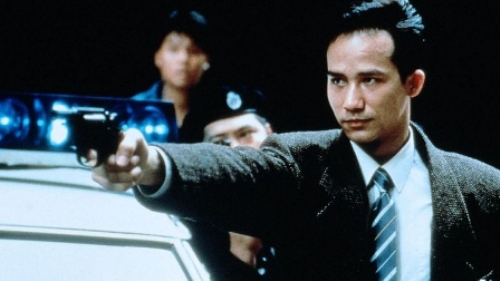
The film was apparently a very troubled production (see this interview with its screenwriter, Gordon Chan, who would go on to write and direct one of Jet Li’s greatest films, Fist of Legend, in 1994) and Tsui, producing the film with Cinema City and his own production house Film Workshop, was in the midst of a half-decade of problematic working relationships with directors like John Woo (on the two A Better Tomorrow sequels) and King Hu (on Swordsman), relationships that seem to presage To’s own difficulties in the late 90s in trying to produce other directors’ films in the early days of Milkyway Image. The Big Heat went through a variety of directors, and while To is the primary name, the mishmash nature of the film makes it hard to credit any one thing to a particular authorial voice. It’s a cops vs. gangsters story, with Waise Lee as the about-to-retire veteran who learns his ex-partner (injured in the line of duty, a bad leg ala Mark in A Better Tomorrow) has been brutally murdered in Malaysia. He takes the case and assembles a team which includes a callow rookie, a Malaysian cop who always wears sunglasses, and his regular partner, Philip Kwok, one of the Five Deadly Venoms, to take down the criminals. The plot moves briskly, with a minimum of melodrama or characterization (Joey Wang is sadly underused as the rookie’s love interest), rarely taking the time to explain something in words that can be inferred from images, like the fact that Lee suffers from nerve damage in his left hand, which is why he wants to retire. Whether a byproduct of a chaotic writing and editing process, or an intentional storytelling choice, the result is a brisk and exciting cop movie, a step above the Taylor Wongs of the period.

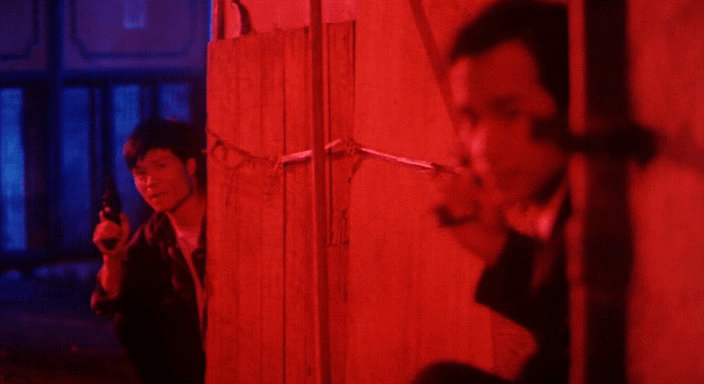
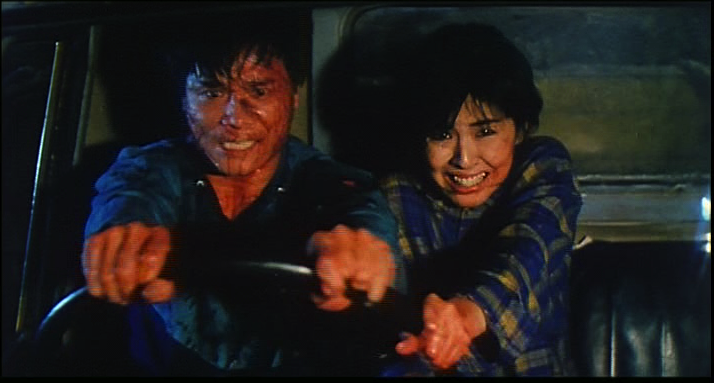
There are other echoes of later To films, the most obvious example being a shootout between two groups of cops, one side suffused in fire engine-red light, with the other in deep blue (much like the blue in the opening of To’s 1999 film Where a Good Man Goes), a ne plus ultra of late-80s Hong Kong neon. In its visual stylization and willingness to pause the action for several beats as the gunmen plan their actions, it presages many of To’s later gun battles. The violence in the film is nauseatingly realistic, from the opening images of a hand punctured by a drill: bodies are beheaded, set aflame, run over by cars again and again, limbs shattered by bullets. It’s more graphic than anything To would later depict (though the early Milkyway films certainly don’t shy away from violence), more like the grotesque horror-comedy of something like Tsui’s We’re Going to Eat You or Ringo Lam’s 1992 Full Contact than the restrained cool of Drug War or the Election films. Most To-like though is a magical bit of release near the middle of the film as the cops, rejecting a bribe from the film’s villain, throw piles of cash into the air, watching it blow in the breeze, that recalls moments of childlike freedom snatched from bleaker realities in Throw Down (as when the plot is temporarily suspended so the three main characters can collaborate to free a red balloon from a tree) or Sparrow or the Running Out of Time films, which take what are ostensibly dark and violent gangster movie settings and turn them into spaces for play and possibility.

Waise Lee, the heel from A Better Tomorrow and Bullet in the Head, is excellent playing against type as the hero (as is Chu Kong, Chow Yun-fat’s friend in The Killer) playing equally against type as the bad guy. Lee is yet another To hero with a disability, see also: Throw Down, Mad Detective, Running on Karma, Running Out of Time, Vengeance, Yesterday Once More, Love on a Diet, Wu Yen, Blind Detective and, if being dead counts as a handicap, A Hero Never Dies and My Left Eye Sees Ghosts. But where most of those other films use the disability as a launching point for the character’s transcendence of physical limitations, either spiritually or through an existential stand in the name of honor, loyalty, friendship, and/or love, The Big Heat remains thoroughly materialist, grounded in the world of Hong Kong’s cops and gangsters before the fall. The sense of vague dread, of millennial fatalism that hangs over much of To’s later work is present here, but it’s given a more explicit and specific, and (therefore) rather less interesting, name: the gangsters openly discuss their plans to cash in while they can before the ’97 handover of Hong Kong to China. The end is a plot motivation, rather than a mood. The result of these compromises is a very solid action movie that at times seems like it’s going to burst free of its genre, but is missing that last little twist that would become the hallmark of To’s Milkway Image films beginning a decade later.

The stand-out performance might be that of Philip Kwok. Kwok has done just about everything you can do in movies: direct, star, write (he was one of the writers on Once Upon a Time in China and America, the sixth(!) in the series started by Jet Li (who took the fourth and fifth films off) and Tsui Hark and the one which was ripped off by Jackie Chan for the big international hit Shanghai Noon (aka, the kung fu movie that my mom likes), although I’ve heard that Tsui and Sammo Hung may have ripped the idea off from Chan before he was able to make his version of the story), choreograph, produce, he even has an art direction credit (for Wilson Yip’s 2004 film Leaving Me, Loving You, starring Leon Lai and Faye Wong). He was of course the Lizard in Chang Cheh’s Five Deadly Venoms, but is probably most recognizable as Mad Dog, the bad guy with the eye patch in John Woo’s Hard-Boiled.

Running Out of Karma: The True Story of Wong Fei-hung: Whiplash Snuffs the Candle Flame

Running Out of Karma is my on-going series on Johnnie To, Hong Kong and Chinese-language cinema. Here is an index.

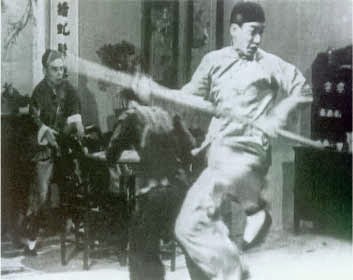
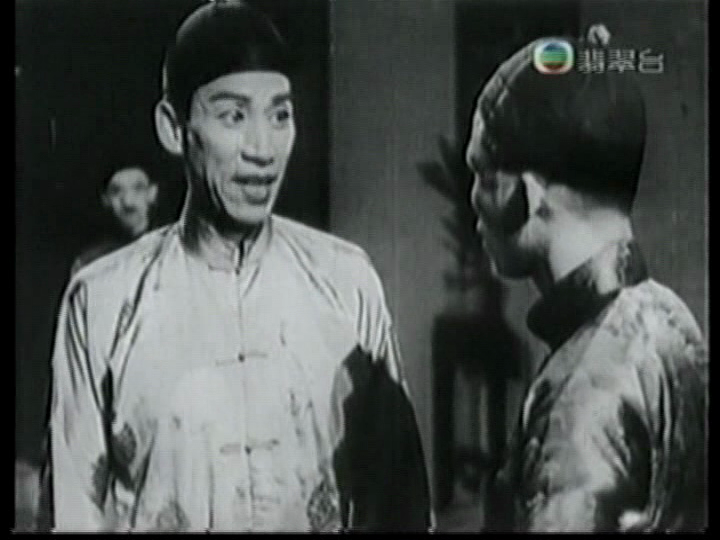
This film, released in 1949, was the first of 77 times Kwan Tak-hing played the kung fu folk hero Wing fie-hung, kicking off a wildly successful series of serials that ran steadily for the next 15 years or so (including 25 films alone in 1956). I’ve only been able to see him in later films, homages to the serials where fans Sammo Hung and Yuen Woo-ping had him reprise his famous role in The Magnificent Butcher and Dreadnaught, respectively. Yuen’s father, Yuen Siu-tien (most famous as Jackie Chan’s Drunken Master), plays one of the villains in this film, though he wasn’t a regular in the series (Kwan’s most frequent opponent was Shih Kien, the bad guy from Enter the Dragon). Lau Cham was a frequent actor, stunt man and choreographer on the series, and later his sons Lau Kar-wing and Lau Kar-leung worked on them as well.

I recently stumbled across this on youtube, it’s the only one of the Wong serials I’ve been able to find with English subtitles (you can watch it here. It’s in poor visual and audio quality, and the story is pretty rote. The first 30 minutes follows Wong as he rescues the wife of a local merchant from a bad guy who has kidnapped her and chained her in his basement (there are no credits, but I think this villain is Yuen Siu-tien). The second half involves a rivalry between Wong and another martial arts instructor, complicated by the heedless actions of Wong’s student Leung Foon (memorably played by Yuen Biao in Tsui Hark’s Once Upon a Time in China). The characterization is minimal: Wong’s a stand-up guy and everyone knows it, though there is a hilariously uncomfortable scene where he’s cornered in the bedroom of a young female admirer, the chasteness that was so essential to Jet Li and Tsui Hark’s version of the character already well-established.

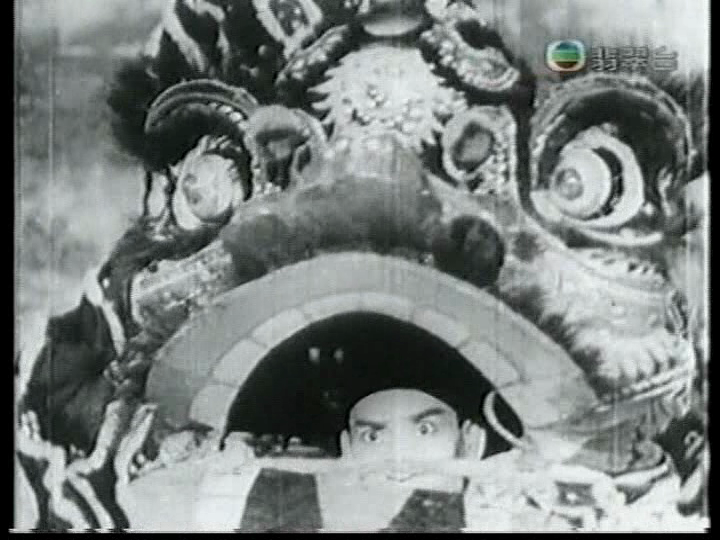
What is most of interest here of course is the action. There’s a marked emphasis on performance, beginning with the opening shots of the film, a series of long takes of a lion dancer (Kwan himself) at work. In fact, the opening is very much reminiscent of the opening of Lau Kar-leung’s Martial Club, one of his Wong Fei-hung films, where (after Lau himself explains to the camera what a lion dance is) we see a long performance followed by a fight breaking out among rival groups which Wong himself breaks up. I’m almost certain Lau is calling back to this film. Regardless, the realism of the actors’ and stuntmen’s performances are constantly highlighted, with director Wu Peng opting for long takes and long shots, with very little of the cutting or zooming for emphasis that would later become kung fu movie staples, nor any of the cutting to obscure motion or impact that has always been the Hollywood standard. Throughout the film there are little asides where a performer will display some kind of technique (which the subtitler has neatly annotated for us), including some eight-diagram pole fighting, various kung fu stances, but also a long performance of a Dragon Boat song, on the history and meaning of which the subtitler has provided a lengthy disquisition. This emphasis on realism is in stark contrast to the wuxia fantasies that had dominated the Chinese action film since the dawn of cinema. Here, in post-war Hong Kong is a new kind of action film, populated by actual practitioners the arts, using genre film as a new means not just of showing off their skills, but passing on their knowledge and culture (specifically Southern Chinese, Cantonese culture) to the next generations. This pedagogic impulse would become a hallmark of Lau Kar-leung’s films.

There’s a remarkable shot about halfway through the film in the middle of a mass fight sequence (the choreography strikingly complex relative to the simplicity of the rest of the film) where the camera cuts to an overhead angle directly above two fighters on a balcony while at the same time slowing down the motion just enough to make the effect noticeable. Alien music rises, a Tchaikovsky piano concerto of all things, and you can imagine that, probably for the first time, someone in the audience thought, “You know, kung fu movies are kind of like musicals!”

Running Out of Karma: On Tsui Hark’s The Taking of Tiger Mountain

Running Out of Karma is my on-going series on Johnnie To, Hong Kong and Chinese-language cinema. Here is an index.

Look deep into the movie listings this January, past the big name awards fodder, the PT Andersons and the Rob Marshalls, the biopics and social problem films, and you’ll find, in limited release, the latest picture from one of the most influential and important directors of the past 40 years, Tsui Hark, whose name remains so unknown in the US he’s as likely to be identified by his personal name as his family name (for the record: he is Mr. Tsui, not Mr. Hark; pronounced “Choy – Hok”). As director, producer, writer and even actor, Tsui has played a prominent role in every stage of Hong Kong cinema since the mid-1970s, from the New Wave through “heroic bloodshed” and the wuxia revival of the 80s and early 90s; from the pre-Handover exodus to Hollywood to the present-day integration with the Mainland and the proliferation of digital technology. With at least a dozen classics spanning just as many genres, Tsui stands among the most accomplished directors in film history, Hong Kong or otherwise.

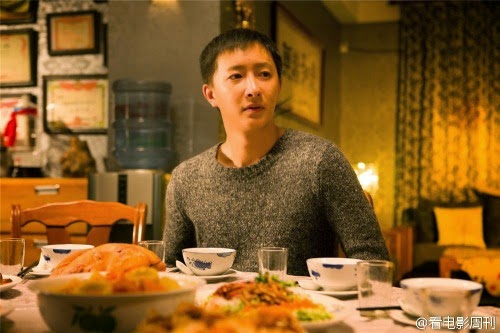
His latest film, The Taking of Tiger Mountain, like his previous two films shot in 3D, is the latest in a string of works linking traditional genres to contemporary digital technology, recasting gong’an crime fiction and King Hu-era wuxia in the language of modern CGI-spectacle with his Detective Dee films and Flying Swords of Dragon Gate, respectively. Tiger Mountain is ultimately based on a 1957 novel by Qu Bo called Tracks in the Snowy Forest, a story from which was adapted into the Peking Opera Taking Tiger Mountain by Strategy which was itself the chosen by Madame Mao as one of the Eight Model Operas during the Cultural Revolution. The film begins in the present, in New York City in the winter of 2015. A young man is at a cosmopolitan, multilingual and multi-racial party with friends  (it appears to be his own going-away party) and encounters on the karaoke machine a scene from the 1970 film version of the Tiger Mountain opera. (This is similar to Tsui’s own experience seeing the film when he was a young man in New York in the early 1970s, as he recounts in this interview.) It sends him into a fit of nostalgia (“It’s your hometown!” jokes one of his friends), a reverie that will last the course of the film as he takes a detour from his cross-country trip to a new job all the way back home to China, where he watches the opera-film on his telephone and a smash cut brings Tsui’s movie to life on-screen. We’ll return to the young man at the end of the film, his story will remain merely the frame through which we view our war movie.

And a war movie it is, a fine example of a venerable genre. A small band of People’s Liberation Army fighters are in the midst of the civil war that followed Japanese defeat at the end of World War II, operating against the forces of the Nationalist Kuomintang Party and various gangs of criminal warlords in the snowy chaos of Northern China. Righteous defenders of the common people, the PLA set-up base in a ravaged village and try to take down a gang headquartered at a former Japanese fortress and arsenal on Tiger Mountain. One man, Yang Zirong (played by Mainland actor Zhang Hanyu), attempts to infiltrate the gang while the rest of the 30 or so cold and starving freedom fighters, led by a wise and stoic figure known only as Captain 203, dig-in to defend the village. (Somewhat interestingly: in Teddy Chan’s 2009 film Bodyguards and Assassins, Zhang played Sun Yat-sen, the revolutionary founder of the KMT, instrumental in the overthrow of the Qing Dynasty. Sun himself is a heroic figure as well in Tsui’s Once Upon a Time in China II). The bulk of the first half of the film is a series of war movie character-establishing cliches (nickname-based male camaraderie, women and children in peril), though the film is blessedly free of pathos-inspiring backstory, punctuated by brief bursts of suspense and action (most impressively when Yang is attacked in the forest by a giant CGI tiger). The Other Tony Leung plays Hawk, the villainous gang leader, a veteran of the anti-Japanese war twisted both morally and physically (he looks as much like Danny DeVito’s Penguin as he does the toweringly handsome Leung we’ve seen in so many other films), with a penchant for inventive means of punishing his enemies (you know you’re in for a night when 15 minutes into the film a bad guy gets eaten by a bird). The second half of the film is a series of increasingly spectacular action sequences, beginning with a long and impressive, mostly practical-effect-driven, defense of the village that recalls no less than Seven Samurai in its depiction of the geography of battle and culminating with an explosive assault on the mountain fortress built around increasingly implausible, but no less wildly enjoyable, computer effects.

The film returns to its frame at the end, with the young man back in his home village, visiting his (great-?)grandmother at Lunar New Year. This ending deviously recontextualizes the film we’ve just seen. Rather than simply a fine, if rather rote genre picture made by a filmmaker named Tsui Hark, we’re invited to see it instead as a product of the young man’s imagination: it is his picture, not Tsui’s. What Tsui gives us is his version of the way a person today might imagine what had been actual events, just as Madame Mao’s opera was her vision, just as Qu Bo’s novel was his version of events in the lives of the actual people who fought in the actual war, the actuality of which is impossible for us to experience or anyone to express. Thus the film’s limitations (and strengths) are instead the limitations (and strengths) of our own era’s imagination. Genre and tradition, the ways we tell stories, are the way we experience history, the way we keep the past alive. The way we depict the heroes of our past says more about us than it does about them, but if we do it right, the core of their experience, the heroism and idealism we valorize, will remain intact. What we pass on need not be the facts of heroism, the realism of it, but the spirit, the meaning of heroism. In this way, Tiger Mountain is somewhat similar to Nina Paley’s Sita Sings the Blues, in which a woman reinterprets the Ramayana (and the sad jazz of 1920s chanteuse Annette Hanshaw) to help cope with the collapse of her marriage. More of a stretch but I still think similar too are the transformations James Lapine and Stephen Sondheim made to their play Into the Woods for the current adaptation, toning down the darkness and complexity to reflect (and perhaps appeal more to) a broader, literally more Disney-fied, audience. With Tiger Mountain, Tsui takes the politics out of what had been a deeply propagandistic work: his PLA never mentions Mao, never talks about revolution or the proletariat. Not being overtly political is as much a fact of the present blockbuster as the enforced ideology of the Model Operas was. The film we see, the young man’s film, celebrates less controversial, more ancient, more universal virtues, virtues passed down from the past to the present, linked by the telling of a story. Tsui Hark has spent his career translating ancient stories to a contemporary vernacular, from The Butterfly Murders and Zu: Warriors of the Magic Mountain, to his epics chronicling folk hero Wong Fei-hung’s adventures from the Boxer Rebellion to the collapse of the Qing Dynasty, to updated versions of Chinese Ghost Stories, Green Snakes and Butterfly Lovers. With a giddy embrace of the new and a slyly anarchic wit that at times overflows with into an expression of nihilistic rage (The Blade, Dangerous Encounters-First Kind), Tsui keeps pushing the past into the future, but the translation has never before been so felt, the absence of the past’s conventions, or of a political point of view, so apparent. The young man, joyously, finds his connection to the past, yet we are adrift in history. We have great machinery for the telling of stories.

1984 Endy Awards

These are the 1984 Endy Awards, wherein I pretend to give out maneki-neko statues to the best in that year in film. This is also a tie-in with our 1984 Year in Review episode of The George Sanders Show. Awards for many other years can be found in the Endy Awards Index. Eligibility is determined by imdb date and by whether or not I’ve seen the movie in question. Nominees are listed in alphabetical order and the winners are bolded. And the Endy goes to. . .

Best Picture:

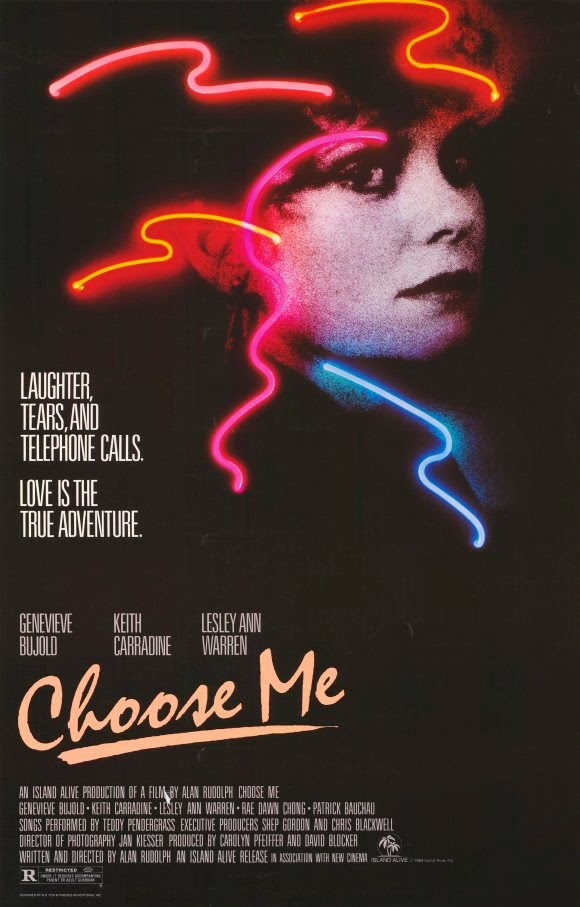
1. Choose Me
2. The Eight-Diagram Pole Fighter
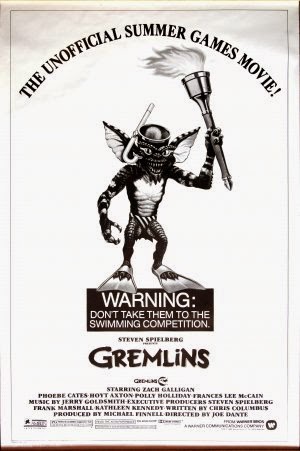
3. Gremlins
4. Shanghai Blues
5. Stop Making Sense
6. Starman
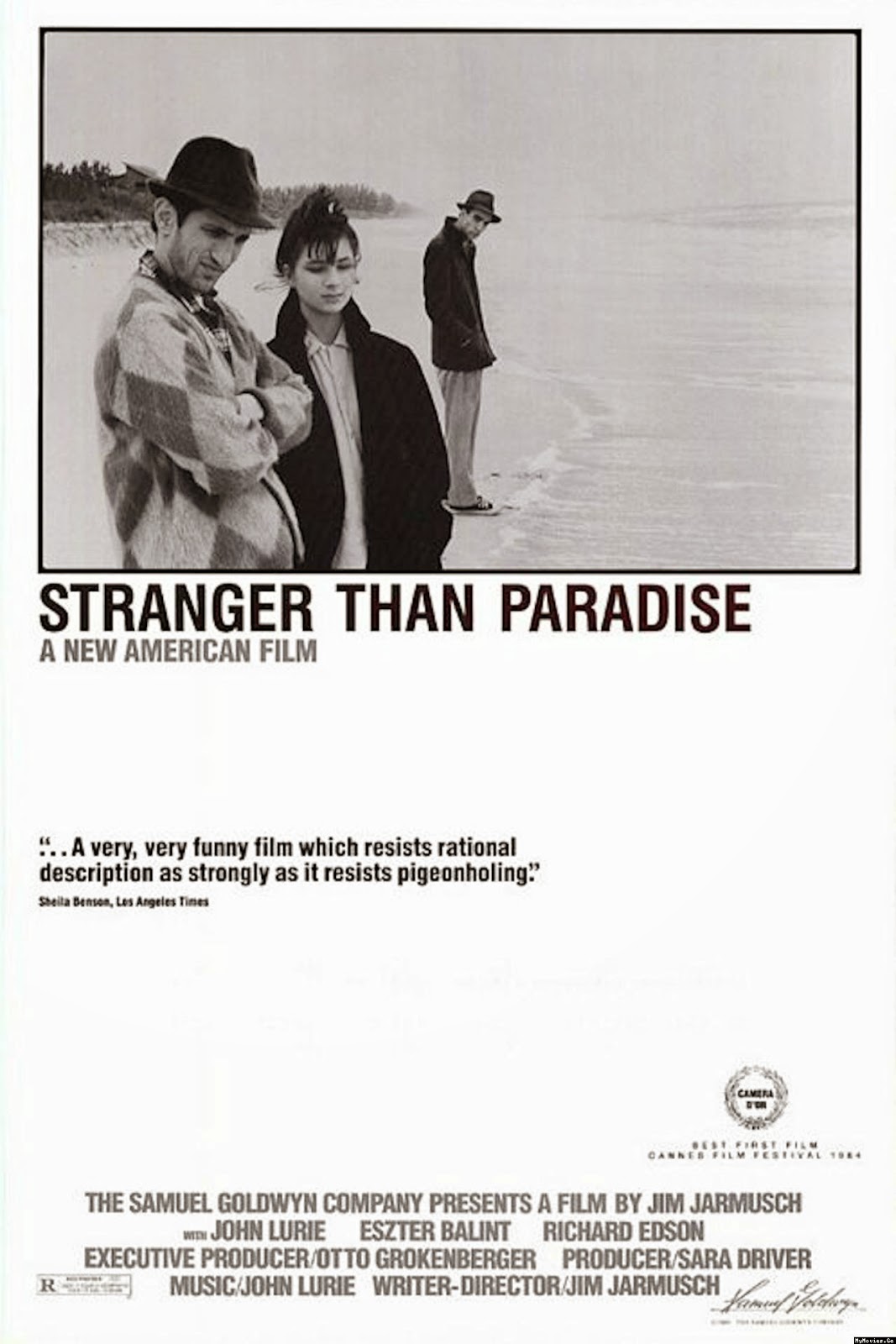
7. Stranger Than Paradise
8. This Is Spinal Tap
9. The Terminator
10. Wheels on Meals

Best Director:

1. Alan Rudolph, Choose Me
2. Lau Kar-leung, The Eight-Diagram Pole Fighter
3. Tsui Hark, Shanghai Blues
4. Jim Jarmusch, Stranger than Paradise
5. Sammo Hung, Wheels on Meals

Best Actor:

1. Bill Murray, Ghostbusters
2. John Cassavetes, Love Streams
3. Robert DeNiro, Once Upon a Time in America
4. Jeff Bridges, Starman
5. David Byrne, Stop Making Sense

Best Actress:

1. Lesley Ann Warren, Choose Me
2. Gena Rowlands, Love Streams
3. Sylvia Chang, Shanghai Blues
4. Karen Allen, Starman
5. Eszter Balint, Stranger than Paradise

Supporting Actor:

1. M. Emmet Walsh, Blood Simple
2. Fred Gwynne, The Cotton Club
3. Rick Moranis, Ghostbusters
4. Pat Morita, The Karate Kid
5. Christopher Guest, This is Spinal Tap

Supporting Actress:

1. Mia Farrow, Broadway Danny Rose
2. Diane Lane, The Cotton Club
3. Phoebe Cates, Gremlins
4. Jennifer Connolly, Once Upon a Time in America
5. Sally Yeh, Shanghai Blues

Original Screenplay:

1. Alan Rudolph Choose Me
2. Dan Aykroyd & Harold Ramis, Ghostbusters
3. Chan Koon-chung, Szeto Cheuk-hon & Raymond To, Shanghai Blues
4. Jim Jarmusch, Stranger than Paradise
5. Christopher Guest, Michael McKean, Harry Sheareer & Rob Reiner, This is Spinal Tap

Adapted Screenplay:

1. Peter Shaffer, Amadeus
2. William Kennedy & Francis Ford Coppola, The Cotton Club
3. Fengcho, Love in a Fallen City
4. Hayao Miyazaki, Nausicaä of the Valley of the Wind
5. Leonardo Benvenuti, Piero De Bernardi, Enrico Medioli, Franco Arcalli, Franco Ferini & Sergio Leone, Once Upon a Time in America

Non-English Language Film:

1. The Eight-Diagram Pole Fighter (Lau Kar-leung)
2. The Long Arm of the Law (Johnny Mak)
3. Shanghai Blues (Tsui Hark)
4. Wheels on Meals (Sammo Hung)
5. Yellow Earth (Chen Kaige)

Documentary Film:

1. Stop Making Sense (Jonathan Demme)
2. The Times of Harvey Milk (Rob Epstein)

Animated Film:

1. Nausicaä of the Valley of the Wind (Hayao Miyazaki)

Unseen Film:

1. Fear City (Abel Ferrara)
2. The Hit (Stephen Frears)
3. The Home and the World (Satyajit Ray)
4. Secret Honor (Robert Altman)
5. Under the Volcano (John Huston)

Film Editing:

1. Indiana Jones and the Temple of Doom
2. Once Upon a Time in America
3. Shanghai Blues
4. Stop Making Sense
5. Wheels on Meals

Cinematography:

1. Choose Me
2. Once Upon a Time in America
3. Shanghai Blues
4. Stranger than Paradise
5. A Summer at Grandpa’s

Art Direction:

1. Amadeus
2. Dune
3. Once Upon a Time in America
4. Shanghai Blues
5. Streets of Fire

Costume Design:

1. Amadeus
2. Dune
3. Full Moon in Paris
4. Once Upon a Time in America
5. Wheels on Meals

Make-up:

1. Amadeus
2. Dune
3. Ghostbusters
4. Star Trek III: The Search for Spock
5. The Terminator

Original Score:

1. Choose Me
2. Once Upon a Time in America
3. Purple Rain
4. Starman
5. This is Spinal Tap

Adapted Score:

1. Amadeus
2. The Cotton Club
3. Footloose
4. Stop Making Sense
5. Stranger than Paradise

Original Song:

1. “Axel F”, Harold Faltermeyer, Beverly Hills Cop
2. “Holding Out for a Hero”, Bonnie Tyler, Footloose
3. “Let’s Hear it for the Boy”, Deniece Williams, Footloose
4. “Purple Rain”, Prince, Purple Rain
5. “When Doves Cry”, Prince, Purple Rain

Sound:

1. Amadeus
2. Choose Me
5. The Cotton Club
4. Stop Making Sense
3. The Terminator

Sound Editing:

1. Dune
2. Ghostbusters
3. Gremlins
4. Star Trek III: The Search for Spock
5. The Terminator

Visual Effects:

1. The Eight-Diagram Pole Fighter
2. Ghostbusters
3. Gremlins
4. Indiana Jones and the Temple of Doom
5. The Terminator

Continue reading