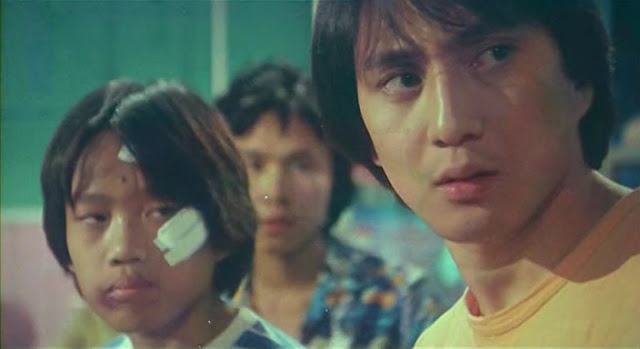
I’ve declared this the summer of 2013 to be the Summer of Sammo. Throughout these months I’ve been writing about films starring or directed by Sammo Hung, as well as other Hong Kong genre films of the Sammo Hung era. Here’s an index.
The George Sanders Show Episode Seven: Logan’s Run and WALL-E
This week, we tackle a pair of sci-fi classics with discussions of Michael Anderson’s 1976 film Logan’s Run and Andrew Stanton’s acclaimed Pixar film WALL-E. We also discuss Stanton and Pixar in general, the Essential Animated Films of the 21st Century and the latest news in Harvey Weinstein’s scissors and Dr. Who‘s casting.
You can subscribe to the show in iTunes, or download or listen to it directly from our website.
On Sergeant Rutledge
The military as a vehicle for the assimilation of a despised minority is an oft-recurring subject for John Ford, hanging around the margins of the cavalry trilogy (Ward Bond in Fort Apache, for example, whose medal of honor isn’t enough to raise him in class high enough from his Irish immigrant statue for Henry Fonda’s snobbish Col. Thursday). Ford explores this in greater detail here, but through the lens of the 9th Cavalry, the ‘Buffalo Soldiers’, many of them ex-slaves who spent the latter half of the 19th Century fighting America’s Indian Wars. The theme song lays out the impossible standard Sergeant Rutledge, who carries with him always the paper that made him a free man 20 years earlier, must hold himself to: he must be better than the best to survive, let alone hope to thrive.
Have you heard about a soldier in the U.S. Cavalry
Who is built like Lookout Mountain taller than a redwood tree?
With his iron fist he’ll drop an ox with just one mighty blow
John Henry was a weakling next to Captain Buffalo.
He’ll march all night and he’ll march all day
And he’ll wear out a twenty mule team along the way.
With a hoot and holler and a ring-a-dang-do.
Hup-two-three-fo’ – Captain Buffalo! Captain Buffalo!
Said the Private to the Sergeant ‘Tell me sergeant if you can
Did you ever see a mountain Come a-walking like a man?’
Said the sergeant to the private, ‘You’re a rookie ain’t you though
Or else you’d be a-recognizing Captain Buffalo.’
And the thing is, Rutledge, as we see him and as Ford frames Woody Strode, towering over everyone else in the frame, stiffly formal in both posture and diction, the very model of a soldier, actually meets that Bill Braskian standard.
And yet he very nearly gets lynched anyway.
Rutledge is accused of the rape and murder of a white girl, and the killing of her father, his commanding officer. The story is told in a series of flashbacks during the court martial, with each new witness moving the story forward in time. All the circumstantial evidence points toward Rutledge, but Jeffrey Hunter, as a cavalry lieutenant and Rutledge’s attorney, saves him, by dramatically uncovering the real killer. But this isn’t an example of the helpless black man being rescued by the benevolent white person. Hunter never pities Rutledge and he’s not his friend. Their relationship is one of mutual respect, not sentimentality. Hunter does his duty as an officer and recognizes and admires that same sense of honor in Rutledge. But they are never peers, there is no vision of universal racial harmony. Such a thing is inconceivable.
Not only does Ford avoid the patronizing stance of so many liberal do-gooder movies, from To Kill a Mockingbird to The Blind Side, he exposes that paternalism in both its condescension (the court martial judges congratulating themselves for not mentioning Rutledge’s race, a twin of the bourgeois hypocrisy seen in Billie Burke, Mae Marsh and their old white lady friends giddy over the prospect of hearing the lurid details of the crime) and more nefarious manifestations (at the conclusion of the trial, spoilers).
Beyond that, Ford gives not just a proud dignity and pathos to Rutledge, but allows for complex characterizations of his fellow 9th Cavalry troopers. I cannot recall a single film I’ve seen from studio-era Hollywood that featured a scene like the extended one Ford gives us of black men talking and reasoning among themselves, with nary a white person in sight, as they wrestle with the moral complexity of what their proper course of action should be with respect to Rutledge: to protect him and help him escape white (in)justice or do their duty as soldiers and follow the letter of the law. In fact, I have trouble thinking of any Hollywood directors today who would film such a scene.
But Ford played a Klansman in Birth of a Nation.
On My Darling Clementine
Not a perfect film, but there are a lot of perfect things in it. As such it’s a perfect example of Ford’s tendency to let the small, plot-unrelated moments take over his films. And thus a simple, largely fact-free story about a legendary event becomes a film about bringing civilization to the barbaric west, about building a church and brushing up your Shakespeare.
It’s not really about the Earp boys as a family: while Wyatt gets most of the screen time, Morgan and Virgil fade to the background and the less said about James the better. It’s certainly not about the Clantons, whose motivations are unclear (why don’t they just let the Earps pass through?) and who seem to exist merely as an embodiment of the brutal crudity of the lawless West.
It’s almost about Doc Holliday, the Eastern doctor who moved West out of despair and finds himself caught between two women who love him: the pure white lady from Boston and the mixed race saloon girl. Doc isn’t so much a character as he is a collection of self-destructive urges. He’s is the East in the process of immolating itself in the desert. But as a protagonist he remains slippery.
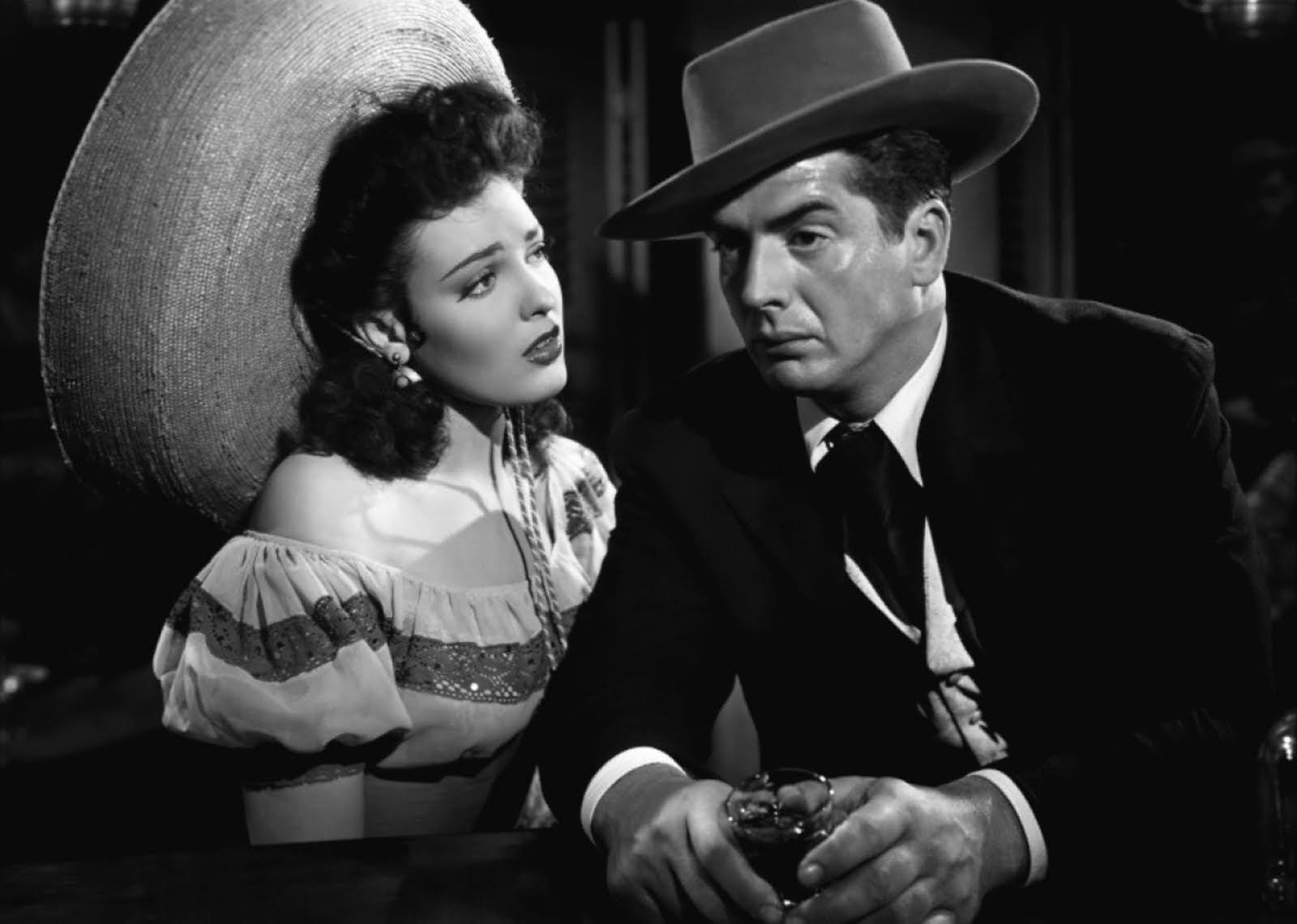
That leaves us with Wyatt Earp, a man Ford knew personally when he was young and Earp was old and both were in Hollywood. Fonda plays him as a superheroic figure: always one step of ahead of everyone else, patiently gathering evidence before enacting legal revenge against the men who killed his brother and stole his cattle. As this heroic figure, Wyatt is ostensibly meant to be viewed as admirable, and in most respects he is. But he also embodies all the racist sentiment in the film. It’s Wyatt who enforces the explicitly racial contrast between the two women who love Doc (he threatens to send Linda Darnell’s Chihuahua “back to the Apache Reservation, where you belong” while he fawns over Cathy Downs’s purity as Clementine), and in an early sequence he establishes his lawman competence by chasing a drunk Indian out of town (“What kind of a town is this, giving liquor to Indians?” he asks, exasperated). For this reason, the film could easily be read as a racist expression by Ford.
But John Ford is a complicated man. Just because Ford depicts Wyatt as racist does not mean Ford himself is racist. Come to think of it, Ford’s characterization of Wyatt’s racial views is likely the most historically accurate thing about the film. That doesn’t mean he endorses them, but in all other respects Wyatt is depicted as virtuous and heroic, the ideal individualist Western hero. Ford would better complicate these men in later films. As it is, Ford’s Wyatt is an unsteady blend of noble and repugnant. His best quality is Fonda’s awkwardness.
But also, there’s this:
“Mac, you ever been in love?” “No, I’ve been a bartender all me life.”
“I can almost smell the honeysuckle.” “No that’s me. . . . Barber.”
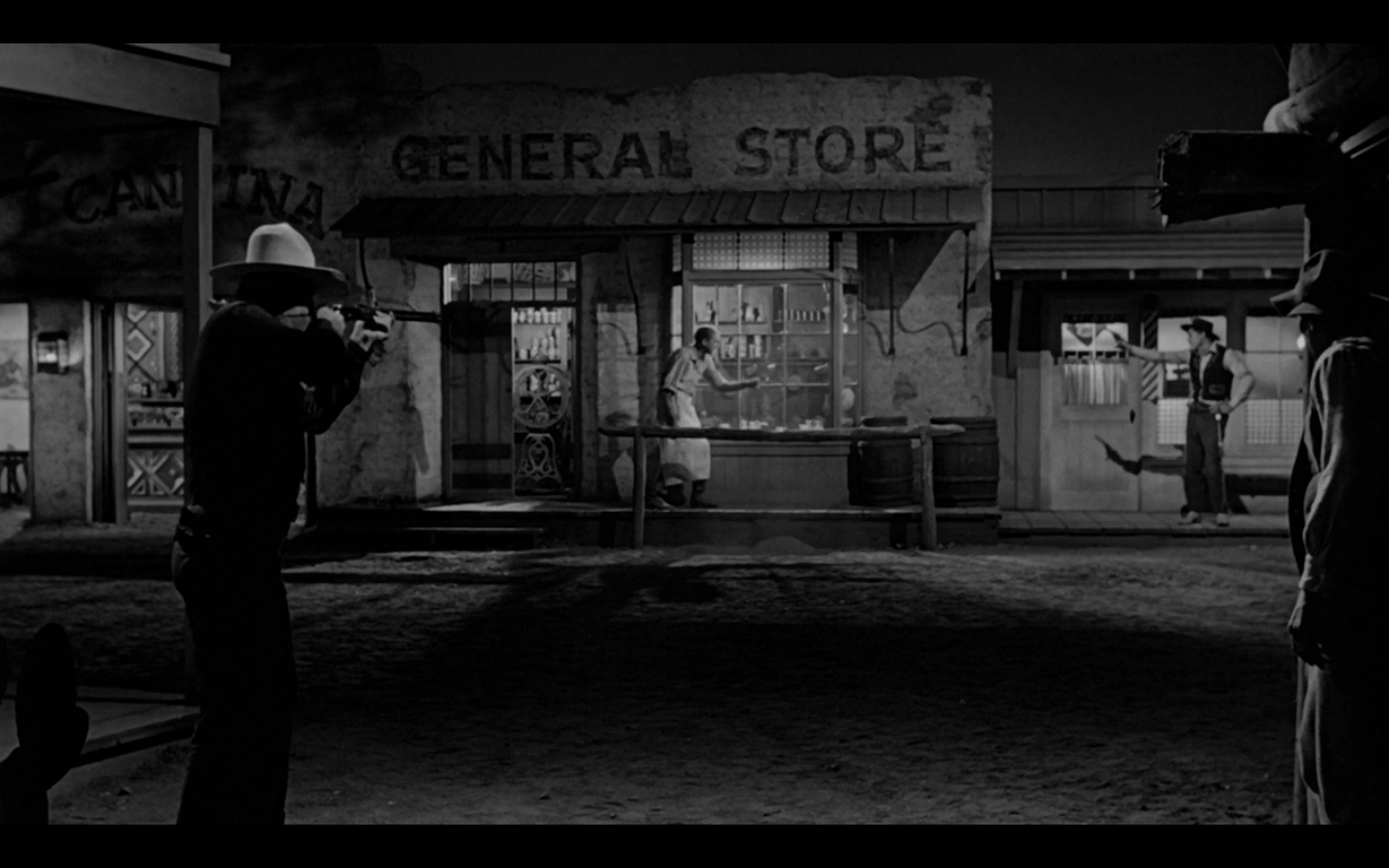
The shadows. This is probably Ford’s most Expressionist Western, with darkness dominant and the characters, even the supposed hero Earps, often finding themselves in silhouette, or simply blacked out the by the absence of light. Ford could tend to let his Expressionist side run wild, as in The Informer or The Long Voyage Home, but this is a good middle ground between those experiments and the more restrained visions of Stagecoach and Fort Apache, and a far cry from the flat interiors of Liberty Valance.
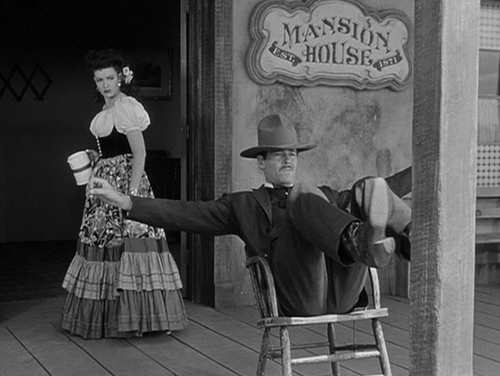
Henry Fonda’s two dances: the balancing act on the chair, and his goofy church dance with Clementine, his mouth wide in a grin of pure happiness. Contrast with the regimental formality of the dance in Fort Apache, where Fonda’s Col. Thursday daren’t crack a smile.
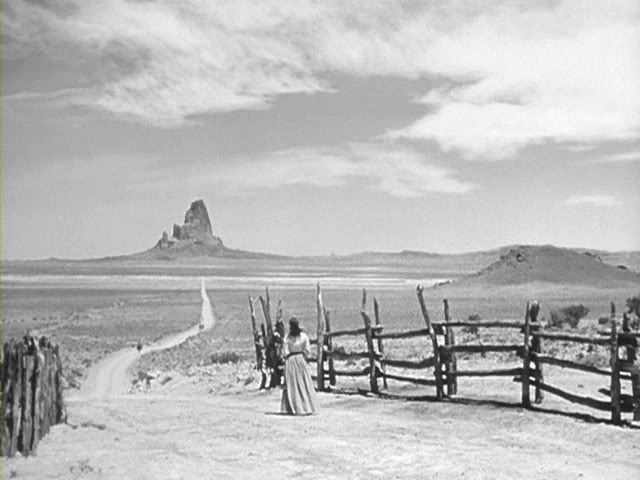
Monument Valley.
This Week In Rankings
It’s been a a couple weeks since I updated these, so it’s more like this three weeks in rankings, but whatever. Since the last update, I’ve posted three episodes of The George Sanders Show (on Duel of Fists and Tears of the Black Tiger, Sneakers and Whirlpool, and Two Lovers and Two English Girls) and started preparing for my next episode of They Shot Pictures, on the Westerns of John Ford.
I’ve also posted a number of reviews of films by Chang Cheh (Heroes Two, Five Shaolin Masters and Shaolin Temple, Return of the One-Armed Swordsman, Vengeance!, and The Heroic Ones), Chor Yuen (The Sentimental Swordsman and Heaven Sword and Dragon Sabre Parts I & II) and John Ford (Fort Apache and The Man Who Shot Liberty Valance).
Over at letterboxd, I’ve got lists for Woody Allen, Gene Tierney, Otto Preminger and my trips to the Vancouver International Film Festival in 2008, 2009, 2010 and 2012, as well as updates to previously-created director lists.
These are the movies I’ve watched and rewatched over the last week or so, along with where they place on my year-by-year rankings. Links are to my short letterboxd reviews.
The Big Trail (Raoul Walsh) – 9, 1930
The 39 Steps (Alfred Hitchcock) – 5, 1935
Fort Apache (John Ford) – 2, 1948
Whirlpool (Otto Preminger) – 14, 1949
The Man Who Shot Liberty Valance (John Ford) – 2, 1962
Return of the One-Armed Swordsman (Chang Cheh) – 11, 1969
The Heroic Ones (Chang Cheh) – 3, 1970
Vengeance! (Chang Cheh) – 6, 1970
Two English Girls (François Truffaut) – 6, 1971
Duel of Fists (Chang Cheh) – 15, 1971
The Fate of Lee Khan (King Hu) – 10, 1973
The House of 72 Tenants (Chor Yuen) – 14, 1973
Five Shaolin Masters (Chang Cheh) – 14, 1974
Boxer Rebellion (Chang Cheh) – 6, 1976
Shaolin Temple (Chang Cheh) – 10, 1976
The Sentimental Swordsman (Chor Yuen) – 7, 1977
Heaven Sword and Dragon Sabre (Chor Yuen) – 10, 1978
Heaven Sword and Dragon Sabre II (Chor Yuen) – 15, 1978
Five Element Ninjas (Chang Cheh) – 19, 1982
Sneakers (Phil Alden Robinson) – 28, 1992
Tears of the Black Tiger (Wisit Sasanatieng) – 9, 2000
Two Lovers (James Gray) – 6, 2008
The George Sanders Show Episode Six: Two Lovers and Two English Girls
This week we explore some romantic geometry with James Gray’s 2008 film Two Lovers and François Truffaut’s Two English Girls from 1971. We also discuss Truffaut’s career in general, along with their picks for the Essential Love Triangle movies and the dire state of summer blockbuster cinema.
You can subscribe to the show in iTunes, or download or listen to it directly from our website.
A Thought on the Ending of The Man Who Shot Liberty Valance

Tom Doniphon shoots the outlaw thug Liberty Valance from the shadows, keeps it a secret, then realizes that his girl Hallie is in love with Ransom Stoddard, whereupon he burns his house to the ground (starting with the new wing he’d built for her. When Stoddard is wracked with guilt thinking he killed Valance, Doniphon relieves his conscience, leaving him free to pursue his political career, founded on his false heroism. Does this make sense?
Setting aside the question of why Stoddard thinks it’s morally acceptable to base his career on a lie, but not on the real killing (he’d rather have people think he killed Valance than actually do it), rewatching the film this most recent time it’s Doniphon that fascinates me. His tragedy is his unwillingness to act. He’s the toughest man in town, admired by all, the only one brave enough, strong enough, fast enough to stand up to Valance, except he won’t do it. Everyone similarly assumes he and Hallie will get married, but he never asks her. He’s even elected as a delegate to the territorial convention but refuses to serve. Despite his many abilities, he simply will not take part in the community. Even his house is far outside the town (whereas Stoddard lives in its heart: at the restaurant and newspaper office). Why does Doniphon hesitate? In all other respects, he’s the same character John Wayne played in countless films throughout his career, the competent hero, cool under fire, respected by all. It would be easy for him to assume the title of town marshal from lovable cowardly drunk Andy Devine, and yet he has no interest. He’s the individualistic strain in American history: the isolationist, the Randian, the pioneer who wants not to build a community, but his own private empire. But he’s conflicted: he finds himself drawn back to the community time and again, ostensibly by his love for Hattie, but also from an honest desire to help the townspeople avoid being killed by Valance and other instruments of the “Northern cattle interests” that are attempting to block statehood, and thus the establishment of law and order in the territory (statehood means the end of the so-called ‘open range’ the literal and symbolic manifestation of the raw capitalist power of the cattle barons: the land belongs to them because they have the power to take it). His sympathy for the townspeople is real, but not enough to motivate him to take action on their behalf.
So why then does he shoot Liberty Valance? And more importantly, why does he do it in secret? Supposedly he likes Stoddard and doesn’t want to see him killed, but what prevents him from announcing his presence before hand, or even after? Why does this man, who has no trouble dominating a political meeting while simultaneously refusing to participate in it, skulk in the shadows like a thief, a coward? Is it that the Randian half of him is ashamed of his altruistic impulses? Seeing how his act of heroism has won Hattie for Stoddard, he becomes disgusted with himself, burning his home, the symbol of his hopes for the future as well as his isolation from the community, to the ground. In a final act of self-negation, he tells Stoddard the truth, absolving him of the act of killing (to which Stoddard had remained steadfastly opposed throughout his ordeal in the West), and taking the sin on himself to suffer alone. That Stoddard, thus relieved of the sin of murder has no problem committing the sin of dishonesty says as much about the nature of politicians as it does his own character.

But what if Doniphon is lying, what if Stoddard really is the man who shot Liberty Valance? In this scenario, Doniphon is not simply a radical individualist who refuses to partake in community out of a twisted kind of idealism, rather he’s simply a coward. Sure, he talks a big game, and he certainly has a certain degree of martial prowess, but he refuses to put it to use, perhaps for fear of failure. This is why he can make a scene at the town meeting, mocking the participants and the rules (“the Law says the bar is closed!”) while turning down appointment to the delegation: if appointed, he might embarrass himself, perhaps showing himself to be ignorant of the rules or other social expectations. Much safer to hide behind sarcasm and mockery. Stoddard has none of this embarrassment. He has no fear about standing up for what he believes is right, regardless of his physical inability to defend it or himself. Stoddard thus fascinates and shames Doniphon. He is everything Doniphon wishes he could be.
And so, when Doniphon sees that Stoddard killed Valance, and thus won the heart of the girl Doniphon was too afraid to propose too, he shatters in self-disgust. He knows that his cowardice has lost him his chance at happiness. But still he admires Stoddard immensely. He goes to the convention and sees Stoddard break down and try to flee rather than stand for election. Recognizing that that kind of cowardice is his own and not Stoddard’s, he gives him a pep talk and tells him what he wants to hear: that he did not violate his belief in non-violence, that he is the man he always thought he was. Thus buoyed, Stoddard rushes off to become the heroic figure that will dominate the politics of the territory, and then state, for decades to come.
Either way, the film ends with the question of whether Doniphon’s nature is individualistic or cowardly (or whether there’s really any difference between the two) deemed irrelevant. As is the question of who really killed Liberty Valance. It’s not just a matter of “printing the legend”: it really makes no difference. Either way, Doniphon destroys of himself in favor of Stoddard’s elevation, and America is built on a lie.

Summer of Sammo: The Heroic Ones
The King is based on Li Keyong, a Shatuo warlord (the Shatuo were a Turkic tribe from the north, between Mongolia and China proper, based around Shanxi, just west of Beijing) who came to the defense of the Emperor in the face of rebellion during the last stages of the Tang Dynasty, the breakup of which lead to the Five Dynasties and Ten Kingdoms Period, with his oldest son later becoming the first Emperor of the Later Tang Dynasty. In 881, Li was called in to fight the rebel Huang Chao who had captured Chang’an (located to the southwest of Shanxi). He chased him off but was later attacked by an ostensible ally after he made a big drunken scene at the ally’s castle. Li survived and led a ridiculously eventful life. He also had 13 Generals, sons and adopted sons, the most renowned of which was the youngest, Li Cunxiao, an adopted son, who rebelled against his father after being falsely accused of conspiring with his father’s enemies by one of his jealous brothers. This act of petulance resulted in his execution at his father’s hands by drawing and quartering.

It’s unclear if Chang Cheh and Ni Kuang based their screenplay on the historical record or one of the literary adaptations of events. Apparently Li Cunxiao is presented as a heroic figure in Luo Guanzhong’s Romance of the End of Tang and Five Dynasties Histories (Luo’s better known novel is Romance of the Three Kingdoms, which I’ve read half of: it forms the basis of a number of video games as well as John Woo’s recent epic Red Cliff), but I’m not sure if this is an adaption of that, at least it isn’t credited as such. Chang’s film is narrated very much in the classical romance mode, a pre-novel style of literature that flowered in the late Yuan and Ming Dynasty period (14th Century), roughly contemporaneous with the same period in Western literature, for example in the Arthurian romances of Chrétien de Troyes, who wrote in the late 12th century or The Canterbury Tales, written by Geoffrey Chaucer around the same time Luo was writing Three Kingdoms (as well as editing The Water Margin, another of the Four Great Classical Novels of Chinese literature, one which Chang and Ni would adapt in a 1972 film of the same name as well as 1975’s All Men Are Brothers. (Wikipedia has this brilliant note on the film of The Water Margin that sums up the level of respect with which these film classics were treated at the time, the situation has not much improved: “The film was bought for release in the US by New World Pictures. Roger Corman cut out a third of the film, had the Shaw brothers shoot an additional sex scene and added a new narration.”)) This style of storytelling is episodic and pre-psychological, with character defined by action rather than an internal monologue or soliloquy along Shakespearean lines. The characters tend to represent types or abstract qualities more than fully-fleshed out human beings. You can find echoes of this in modern Hong Kong action films like Drug War, where the main characters are given no life outside the mechanics of the plot, where everything we understand about them as people can only be inferred by their actions or the physical behavior the actor.
As the generals attempt to capture Chang’an by infiltration and assassination, two of them disobey Chiang’s order and blow the group’s cover. They find refuge at the home of a loyal young woman (played by Lily Li) whom Chiang rescues when those same two sons try to rape her. After they escape and the city is recaptured (the bandit Huang burns the town and flees in the face of Li’s army), Chiang will return to her empty house, vainly searching for her. It’s the rare scene of romance romance (as opposed to historical Romance) in a Chang Cheh film, shot in a lovely orange studio sunset as Chiang realizes thanks to the ravages of war, he’ll never again find this girl he might have loved.
After the ambush, the jealous brothers have one last trick to play, leading to Chiang’s character reaching the same ending his historical counterpart suffered (in the same grisly manner, quite artfully shot by Chang) but without the stink of defiance falling on his hero. In reality, Li Cunxiao rebelled against his father out of spite: because he was accused of disloyalty he acted disloyal. In Chang’s world, Li Cunxiao is a victim, but only because he’s so willing to believe the best in his brothers. It is Chiang who prevents their father from beheading them after their transgressions in Chang’an, and their final trick is based entirely on his willingness to trust them to an absurd extent. Thus does a real person, complicated and contradictory and almost certainly unpleasant, become a heroic, romantic figure, one whose tragic weakness is his loyalty and belief in his brothers. It’s the brotherly code that makes the rebellious generals so vile, but it’s the code also that enables their treachery to go so far undetected. This contradiction, the Code cutting both ways, will form the heart of the heroic bloodshed genre as it gets further developed from Chang to John Woo and Ringo Lam to Johnnie To.
![]()
Summer of Sammo: Vengeance!
The George Sanders Show Episode Five: Sneakers and Whirlpool
This week we journey to the Bay Area, sort of, for a pair of movies that are kind of set in San Francisco, Phil Alden Robinson’s all-star 1992 caper/heist film Sneakers and Otto Preminger’s 1949 noir melodrama Whirlpool. We also talk about our Essential Hacker Films, the career of Robert Redford and share the definitive list of the 12 Greatest Living Narrative Filmmakers.
You can subscribe to the show in iTunes, or download or listen to it directly from our website.