Summer of Sammo: Heaven Sword and Dragon Sabre, Parts One & Two


I’ve declared this the summer of 2013 to be the Summer of Sammo. Throughout these months I’ve been writing about films starring or directed by Sammo Hung, as well as other Hong Kong genre films of the Sammo Hung era. Here’s an index.

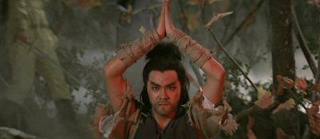
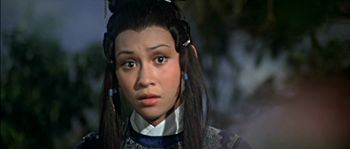
It took me way too long to realize this was an adaptation of the same material as Kung Fu Cult Master (aka Lord of the Wu Tang), a crazy Jet Li wuxia film from 1993 directed by Wong Jing, one that I’ve seen three or four times. The problem is that where Wong’s story is hyperkinetic, cutting faster than the audience can orient itself, the wild shifts in plot creating a dizzying spasm of color and cheap HK special effects, director Chor Yuen manages to make the story reasonably coherent, establishing a variety of distinct and memorable characters amid the swirl.

The movies are based on a novel by Louis Cha, a mid to late 20th century author many of whose works have been adapted into films (the Swordsman movies with Jet Li, Wong Kar-wai’s Ashes of Time and The Eagle Shooting Heroes, Chang Cheh’s Brave Archer series). I’ve read only the first part of his The Deer and the Cauldron (adapted into Stephen Chow’s The Royal Tramp movies) and it was a lot of fun. It reminded me of Terry Pratchett, a satirical take on the medieval fantasy world and conventions. But this is apparently unusual for Cha: it was his last novel and was intended “as a satire to his previous work, a reminder to the readers for a reality check”. That quotes comes from Wikipedia quoting Cha’s friend, the screenwriter and novelist Ni Kuang, who made a study of Cha’s work as well as writing many of the great Shaw Brothers films of the 60s and 70s.

Heaven Sword and Dragon Sabre is much more serious, at least in Chor Yuen’s version. It still takes place in a comic book fantasy world (the opening credits and narration even play out over a colorful painted scroll) but he treats the material more respectfully than Wong Jing does. That’s not too surprising, given that Wong is responsible for some of the grossest lowest common denominator stunts of 80s and 90s Hong Kong cinema. When in doubt, blame everything on Wong Jing, I always say.

The hero, Zhang Wuji, is an orphan, marked for death as a child by a Freezing Palm attack that leaves him marked and sickly. He’s kept alive into young adulthood by a healer living in an isolated woods (the cabin in the woods being an archetypal kung fu location, like the inn, the temple, the palace, etc). Eventually he gets caught up in a massive clan war, as the eight various schools of martial arts (Shaolin, Wu Tang, Er Mei, Ming Cult and so on) are manipulated into warring against each other, and most specifically against the Ming Cult, by a pair of shadowy figures: one a disgraced monk with a connection to the hero’s past, the other a Princess of the ruling Yuan Dynasty (the Yuan were the Mongol rulers of China descended from Genghis Khan, for more about the Chinese revolution against the Yuan, see King Hu’s The Fate of Lee Khan.) It’s unclear in the film whether the Ming Cult is supposed to be related to the Ming Dynasty. Apparently the novel explains that the cult comes from Persia, and is based on Manicheaism, which is why the other clans, all orthodox Buddhists, see it as an ‘evil cult’.

The film is split in half. Part One follows Zhang from childhood through his accidentally healing himself and learning some advanced martial arts (he has a knack for stumbling across hidden treasures) to his assuming the leadership of the Ming Cult after rescuing its masters from attack by the other clans. The second half follows his attempts to unify the clans to oppose the Yuan and the evil monk, as well as rescue his godfather, a blind recluse who knows the whereabouts of the famed Dragon Sabre, which the bad guys want to get because it contains a hidden secret. The prime movers of the plot are almost all women, and Zhang has complicated love/hate relationships with at least four major female characters. The reversals of the plot are too dizzying to relate quickly, but at least Zhang doesn’t seem able to keep up with the plot either.

Like Heroes Shed No Tears, Chor Yuen’s wuxia world is bright and colorful, with the objects like flowers and tree branches creating frames within the frame, and fog machines liberally sprinkled around the sets. He’s patient with the exposition, allowing the dialogue to play out in long talky scenes in the same way he films the action. It’s about movement in space: the shifts of the actors as they fight and the story as the plot twists itself up then slowly unravels. It doesn’t have the psychological nuance of The Sentimental Swordsman or Intimate Confessions of a Chinese Courtesan, nor the tightness and inevitability of the scenario in Heroes Shed No Tears. It’s a gorgeous storybook world he builds, one of endless adventure and possibility.

Notes on John Ford’s Fort Apache

Every time I see Fort Apache, I think ‘Surely this must be Ford’s best film.’
But I say the same about a half dozen other Ford films: Stagecoach, The Searchers, The Quiet Man, My Darling Clementine, The Man Who Shot Liberty Valance, Young Mr. Lincoln.
I’ll probably say it about How Green Was My Valley the next time I watch that, too.
Interesting compare/contrast with Raoul Walsh’s Custer film They Died with Their Boots On. Walsh takes a real figure and makes him heroic, entirely in the face of history, Ford takes a fictional figure and matches him to anti-heroic history.
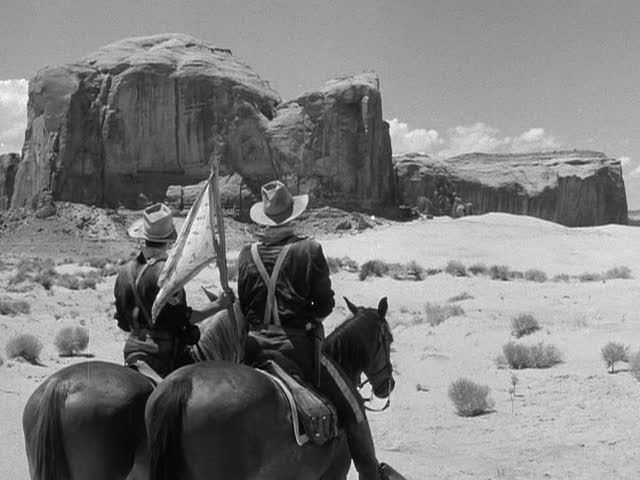
John Wayne’s character whitewashing Thursday for the press is more subtle than the same scene in Liberty Valance. He turns Thursday into an ideal, a symbolic figure with no basis in the reality we’ve just seen. Despite the false image, the unjustifiability of their war, the heroism of the cavalry is very real.
See also Two Rode Together, where Ford makes explicit the critique of pioneer racism he showed in The Searchers, for the benefit of those who didn’t get it the first time.
Thursday doesn’t hate Indians, he just sees them as less than human. Barely a step above the Irishmen he finds himself surrounded by on the frontier. He despises the corrupt Indian agent, but treats him with more respect than anyone else he meets because his title as a representative of the US Government gives him a class status the others can’t match. Even Ward Bond’s Medal of Honor isn’t enough in Thursday’s eyes: it’s not what a man does, but what he’s called. Social mobility is an impossibility. And yet, Thursday is obsessed with the fact that he’s been unable to rise in the ranks.
Shirley Temple is terrific as the marvelously named Philadelphia Thursday, openly lusting after John Agar with an intense, Judy Garland-esque stare. Cinema lost a great deal when Temple went into diplomacy.
Anna Lee is marvelous as well playing George O’Brien’s wife. Ford gives the women the same hero framing he does the men, as the cavalry marches off to a doom everyone but Fonda knows is coming. She gets the best line of the film, watching her husband disappear for the last time: “I can’t see him. All I can see are the flags.”

If you want to truly understand John Ford, pay attention to the women.

Perhaps Thursday knows what’s coming as well: at the end of the world, the only thing he can think to do is die with a flourish. The Apaches sweep across the last stand like a force of nature: we don’t see Fonda and Bond and McLaglen and Amendariz and the rest of the men die: they are simply erased by the wave.
It’s one of Fonda’s best performances. Only a truly great actor could dance like that without cracking a smile.

Summer of Sammo: Return of the One-Armed Swordsman

I’ve declared this the summer of 2013 to be the Summer of Sammo. Throughout these months I’ve been writing about films starring or directed by Sammo Hung, as well as other Hong Kong genre films of the Sammo Hung era. Here’s an index.

Chang Cheh’s sequel to his hit 1967 superhero movie finds Jimmy Wang Yu’s hero happily retired to a farm life when he’s asked to join a competition. It seems the top eight local bandits have gathered under one leader and are holding a contest to see who in the martial world gets to claim the title “Sword King”. This is, of course, a ruse to draw out all the local hero-types and capture or kill them. Wang refuses of course, he has no interest in the martial world any longer, but after the first wave of slaughter his remaining human sympathies drag him into the fight by the students of the ensnared masters, who beg for his help.

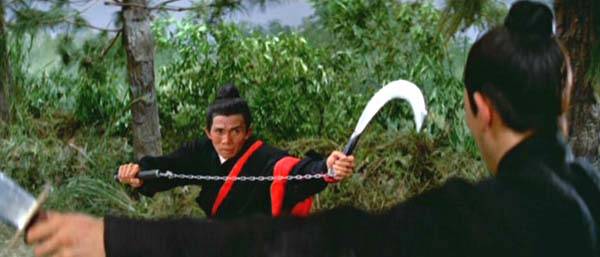
What follows is a video game schematic plot as Wang and the students take one one bad guy at a time and work their way up to the BIg Boss. Each of the villains has a gimmick, and they’re organized as pairs of opposites (one has a sword on a chain, so he attacks from far away (and is played by Lau Kar-leung), a woman uses her wiles to get in close and attack from there, etc: the oppositions are: Near-Far, Above-Below, Strength-Weakness (Poison), Day (wheel-like swords in the shape of suns)-Night (the final villain, who stealth attacks in the darkness). Wang thinks up clever ruses to defeat most of the bad guys, like a net for the strong man, or standing on bamboo trees for the guys who attack from below, but mostly the fight scenes are just lots of people getting killed. Lots and lots of people, an excessive amount, really.

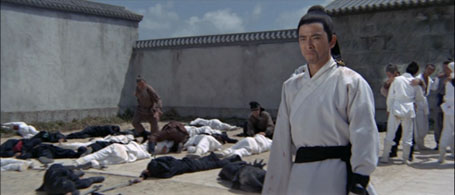
Gradually it becomes apparent that these are not your typical fun and games action movie deaths. The sheer volume of the calamity becomes thematic: it’s not a movie about action: it’s a movie about death. The villains have no real motivation. The heroes have no distinct personality. Wang is disgusted by the whole thing, but goes through the motions of killing all the bad guys because he’s the only one that can. As the film nears its conclusion, Chang lingers more and more on the aftermaths of the battles, the bodies piled everywhere. The befuddled, powerless yet rescued masters, all their sons and students needlessly slaughtered, can think only to give Wang a shiny gold medal. The villains aren’t characters, in the sense that they aren’t really people. They’re ambition personified, that desire to be the best that drives people to destruction. Only Wang, with his single-minded dedication to his family and his desire to withdraw from worldly concerns is able to defeat the bandits. While so many heroic sons have died, sacrificing themselves for honor and clan, he learns his wife is pregnant.

Summer of Sammo: Five Shaolin Masters and Shaolin Temple

I’ve declared this the summer of 2013 to be the Summer of Sammo. Throughout these months I’ve been writing about films starring or directed by Sammo Hung, as well as other Hong Kong genre films of the Sammo Hung era. Here’s an index.

Five Shaolin Masters circles back and starts at the beginning of another 1974 Chang Cheh film, Heroes Two, with the destruction of the Shaolin Temple, but then goes off in the other direction. A narrator helpfully informs us that the Chen Kuan-tai character in that film went south and met the Alexander Fu Sheng character, but that this film is about the five survivors who went north, into central China.

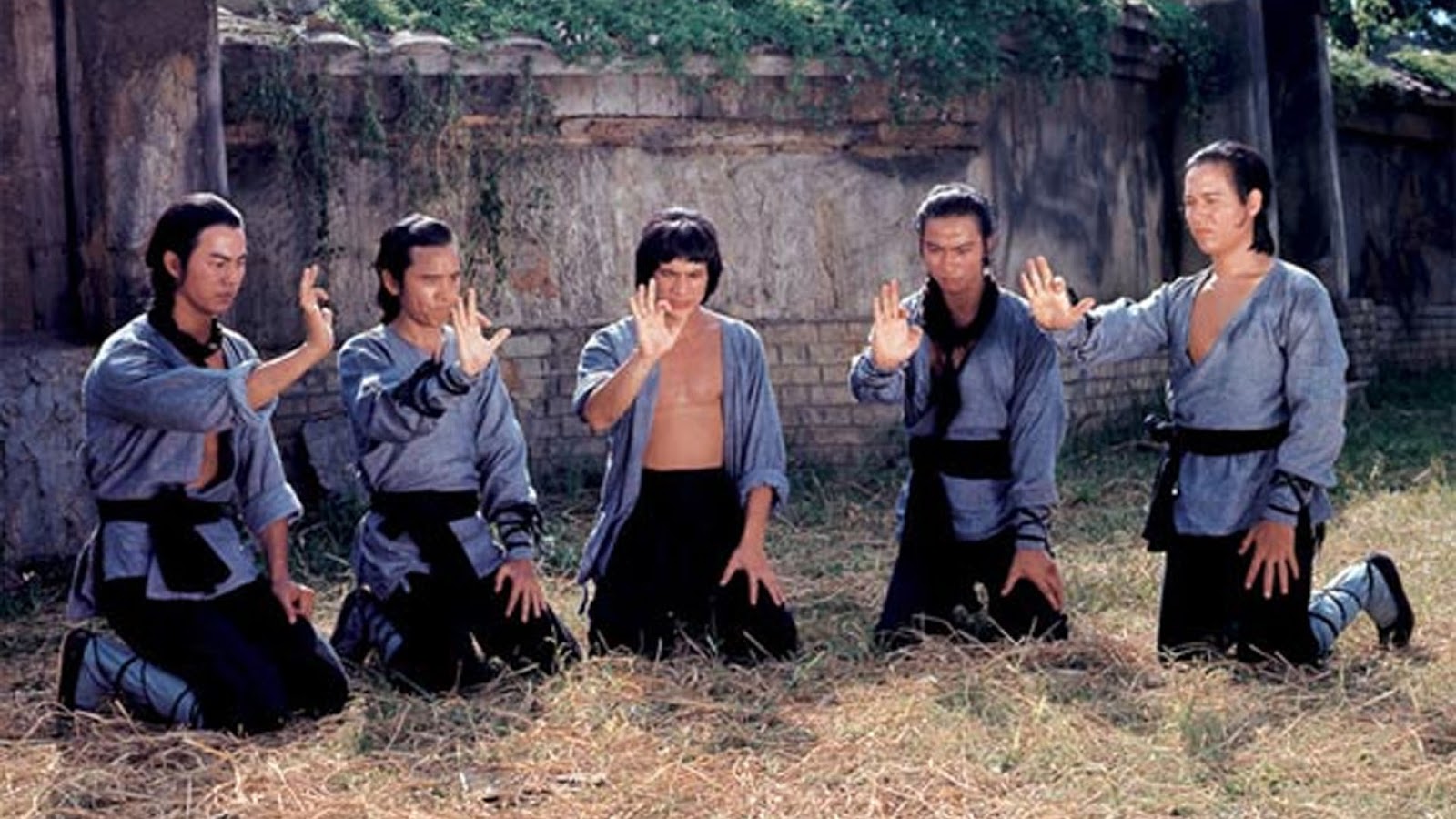
Of course, Fu stars in this one too, playing a different, but similarly dopey character. Also starring are David Chiang, Ti Lung and Chi Kuan-chun, all of whom were also in Chang Cheh’s 1976 film Shaolin Temple, about the events leading up to the Manchu attack. Ti and Chiang play the same characters in both films, as does Wang Lung-wei playing the traitor Ma Fu-yi, though Ma was killed at the end of the prequel, and finds himself alive and well in this earlier film. Alexander Fu Sheng plays the folk hero Fong Sai-yuk in both Heroes Two and Shaolin Temple, though in most versions of his story Fong was never at the Temple (there is a version where he dies fighting at the Temple, but that doesn’t happen in any of these movies) and in the first film, he isn’t there either, running into Chen’s Hung Si-kuan shortly after its destruction. So basically the three films are mutually incompatible versions of the same story, in the same universe, one which bears a tenuous factual relationship to our own.

The Qing, or Manchu Dynasty, and its attempts to pacify the population of Southern Chinese loyal to the previous Ming Dynasty are common villains in Hong Kong films. They can easily be read as a corollary to Chinese Communists and their fight against the Nationalist Kuomingtang in the wake of World War II. Much of the Hong Kong population that flocked to Shaw Brothers movies were first or second generation refugees of those wars, and as a British colony were also strongly and openly anti-Communist.

Ni Kuang, who wrote almost all the best Shaw Brothers films of the period (and was a frequent collaborator with Chang Cheh) fled to Hong Kong in the late 50s, after working as a public security official under the Communists. Here’s an anecdote from wikipedia:

Ni’s reason for coming to Hong Kong was the fear of political persecution. When he was working for the CCP, he was tasked with writing death sentences. One time, he questioned his local party chief about why a particular man was sentenced to death, when the only crime stated on paper was that he was a landlord. The chief rebuked him and threatened him with the death sentence if he continued to ask such questions. According to Ni, he complied in fear of his own life. Nevertheless, this was not the worst death sentence he had written as there were many other questionable death sentences that the CCP carried out categorized under “others”. It was from these experiences that Ni made up his mind to escape from the People’s Republic of China.

It can be easy for us to scoff at kung fu films as cartoonish and cheesy. But it might help to remember that they were made by people with a real first-hand knowledge of death, oppression and tragedy. The monks of Shaolin Temple chose to harbor anti-Qing forces, though they knew it would ultimately lead to their destruction. They trained their disciples as much as they could, hoping the few survivors would pass on their learning to new generations, that Shaolin wouldn’t die though the Temple burned. Chang’s version of the Temple story has almost no religion, no philosophy. It couldn’t be further from the mystical visions of King Hu’s A Touch of Zen or the serene theology of Lau Kar-leung’s 36th Chamber. Chang is a materialist, and his Temple only has power if its members can act in the world. When his remaining Masters, having rededicated themselves to their training and defeated the once more-powerful Qing in a set of one-on-one battles, gather at the end of the film, rounding up the anti-Manchu forces at the Red Flower Pavilion, it is an expression of hope, of the people uniting in the face of an seemingly unbeatable foe.

But of course, they are doomed. The Ming were not restored. The anti-Qing movement degenerated from revolutionary political activity to organized criminal gangs called Triads that still exist today. At least, that’s the story the Triads tell themselves.

Summer of Sammo: The Sentimental Swordsman

I’ve declared this the summer of 2013 to be the Summer of Sammo. Throughout these months I’ve been writing about films starring or directed by Sammo Hung, as well as other Hong Kong genre films of the Sammo Hung era. Here’s an index.

An exceptionally well-written wuxia film, one in which the characters are motivated by psychology rather than fulfilling roles as mere mythological character types, where the tsunami of exposition that swamps so many other films in the genre is distilled into action with the expeditious use of a MacGuffin (a mysterious red package that changes hands repeatedly throughout the first 30 minutes of the film, introducing all the major characters and establishing the ruthless and unstable nature of the film’s world) and where the central character is acted rather than performed, with star Ti Lung’s melancholy hero, haunted by his past, yet patient and honorable grounding the film in a realistic figure.

The plot involves the search of the Plum Blossom Bandit, a ruthless killer that Ti Lung has returned after 10 years in exile to capture. After the Bandit as well is a pretty girl who has promised to marry whoever kills him (he killed her father), drawing the attention of every wannabe hero for miles around, gathering at the home of Ti’s best friend and his wife, Ti’s former lover. Ti gets framed and everyone believes him to be the bandit, and the majority of the film involves the mob attempting to lynch him on the flimsiest of evidence as other, more shadowy figures keep trying to assassinate him (in this respect the film bears a passing resemblance to The Ox-Bow Incident or 12 Angry Men, but with poisoned soup). Ti survives all the attempts to kill him, of course, but his accusers keep dying along the way. But will he solve the mystery before everyone around him is dead?

What differentiates the film from a wuxia mystery I’ve never been a fan of, The Five Deadly Venoms, is the question of motivation. Rather than simply bad guys doing bad things and good guys trying to stop them (often taking way too long to figure out whodunnit), the schemes in The Sentimental Swordsman rely on specific character traits of the victims: the mob’s lust for the pretty girl makes them easy to manipulate, and Ti’s sentimentality, his emotional connection to the people and world around him, makes him an easy target for the cold, ruthless killer. A complex web of motivations is weaved (spider webs and spider imagery recur throughout the film) but the plot flows organically out of the nature of the characters, rather than a series of events being imposed upon a set of character types. This is an inversion of the usual wuxia formula, which is based on a more ancient, pre-psychological story-telling form (think The Illiad, The Epic of Gilgamesh, The Three Kingdoms).

Wuxia worlds tend to be built around ideas rather than emotions, specifically the ideals of loyalty and revenge, “You killed my master, I’ll kill you!” and so on. They’re medieval romance figures rather than the psychologically real characters you find in a novel (to take an example from Western literature: compare the shallow, plot-only types in Arthurian romances to the complex, rounded people in the Three Musketeers books). The other wuxia films I’ve seen from director Chor Yuen, like Heroes Shed No Tears or Heaven Sword and Dragon Sabre are more plot-and-spectacle oriented than The Sentimental Swordsman, but they still resonate more deeply than they probably should. Like those films, Chor creates a beautifully magical world, no one made more with the artificiality of Shaw Brothers sets than Chor, packing the frame with fog and flowers and painted moonlight. With those other two films, Chor often obscures the action, filming it in long shot with objects blocking the principals, out of focus tree branches or gauzy curtains. With this film, as well as Intimate Confessions of a Chinese Courtesan, another film grounded in character rather than myth, the action is more direct: framed but not hidden. More graphic novel than comic book. The tension between the visually artificial and the psychologically real, between the surface and the depth.

Summer of Sammo: Heroes Two

I’ve declared this the summer of 2013 to be the Summer of Sammo. Throughout these months I’ve been writing about films starring or directed by Sammo Hung, as well as other Hong Kong genre films of the Sammo Hung era. Here’s an index.

Chang Cheh’s take on the Fong Sai-yuk character has Alexander Fu Sheng playing him as a good-hearted but dim-witted boob who is quite easily gulled into capturing one of the few survivors of the destruction of the Shaolin Temple, Chen Kuan-tai’s Hung Si-kuan and handing him over to the actual, villainous perpetrators (Manchu troops, naturally) of said destruction. They constitute the two heroes of the title (it’s not a sequel to a movie called Heroes, but an enumeration of protagonists, like with Warriors Two or Brothers Five) as Fong eventually realizes his mistake and undertakes a daring rescue.

I’m a big fan of Corey Yuen’s Fong Sai-yuk movies, in which Jet Li plays him as a happy-go-lucky goofball, but the dopiness suits Fu Sheng well, his perplexed brow-furrows neatly framed by his arena rock mullet. That film follows a more conventional version of Fong’s story, where he learns his kung fu from his mother who herself learned it from one of the survivors of the Temple’s destruction, putting Sai-yuk two generations removed from the events of Heroes Two. But there are other versions of the Fong Sai-yuk legend, though based on a factual event (the destruction of the Temple by the Qing) it’s as much mythology as history, not unlike the Three Kingdoms stories from a much earlier age, or, on the other side of the globe, the Robin Hood legend. Chen Kuan-tai gets to play a more traditionally noble figure, though he spends half the movie chained to a wall. His character, in real life, created the Hung Gar fighting style, the one used by Wong Fei-hung and taught to his disciples, one of whom taught the father of Lau Kar-leung (it’s a small kung fu world). He’s idealized here, but otherwise isn’t given much to do. That’s a problem with the plot as a whole: aside from the central case of mistaken identity, not much happens: he gets caught, then he gets rescued, then everybody fights.

It starts great (in medias res with the burning of the Temple and Chen fighting his way out) and the fight scenes might be the best boxing scenes Lau Kar-leung and Tang Chia coordinated for Chang during their decade-long collaboration (Tang was a student of Yuen Woo-ping’s father Yuen Siu-tien, the small kung fu world grows even smaller), but the film doesn’t have the depth or resonance of most Chang films (in this respect it’s like Chang’s Duel of Fists), but this is but a small chapter of an epic folk tale. I have high hopes for his 1976 film Shaolin Temple, which hopefully will have a broader scope and delve further into Chang’s psychology of honor and violence while set during the same events.

If you see the same DVD I rented, don’t miss the special feature where Chen and Fu Sheng show off the various forms of the fighting styles they use in the film. It’s pretty neat, and also a precursor to Lau Kar-leung’s distinctive opening credit sequences, with the actors performing against an abstract, dusky red backdrop, as if on an alien, supernatural plane.

The George Sanders Show: Episode Four – Duel of Fists and Tears of the Black Tiger

This week Mike and I journey to Thailand and discuss Chang Cheh’s 1971 Shaw Brothers boxing film Duel of Fists (aka Fist Attack) and Wisit Sasanatieng’s award-winning genre mashup Tears of the Black Tiger, from 2000. We also talk about the best movies of the year so far, our Essential Kung Fu Movies and the work of director Apichatpong Weerasethakul. Hear me tirelessly rail against the evils of Miramax, Netflix and disrespect for Asian genre cinema in general as Mike vainly tries to make me stick to the subject at hand.

You can subscribe to the show in iTunes, or download it directly from our website.

Next week we return from abroad to San Francisco, the setting for Woody Allen’s latest, Blue Jasmine. We’ll be watching a pair of Bay Area-based films, Otto Preminger’s Whirlpool, with The End of Cinema’s official PGOAT Gene Tierney and Phil Alden Robinson’s all-star caper/heist film Sneakers.

This Week in Rankings

Since the last rankings update, I wrote five more entries in my Summer of Sammo series on Hong Kong genre cinema, about King Hu’s genre-defing Come Drink With Me and Dragon Gate Inn, Lau Kar-leung’s debut The Spiritual Boxer, Chang Cheh’s iconic The One-Armed Swordsman and Chor Yuen’s opulent Heroes Shed No Tears. And Episode Three of The George Sanders Show covered Stanley Donen’s Charade its remake, The Truth About Charlie, directed by Jonathan Demme. But the big hit post of the week is apparently this thing I wrote about best of the year lists.

These are the movies I’ve watched and rewatched over the last week or so, along with where they place on my year-by-year rankings. Links are to my short letterboxd reviews, where applicable.

The Idle Class (Charles Chaplin) – 9, 1921
Dial M For Murder (Alfred Hitchcock) – 19, 1954
The Man Who Knew Too Much (Alfred Hitchcock) – 12, 1956
Come Drink With Me (King Hu) – 9, 1966
Dragon Gate Inn (King Hu) – 2, 1967

The One-Armed Swordsman (Chang Cheh) – 7, 1967
Golden Swallow (Chang Cheh) – 7, 1968
A Touch of Zen (King Hu) – 1, 1971
Heroes Two (Chang Cheh) – 18, 1974
The Spiritual Boxer (Lau Kar-leung) – 11, 1975

The Magic Blade (Chor Yuen) – 14, 1976
Heroes Shed No Tears (Chor Yuen) – 16, 1980
Wheels on Meals (Sammo Hung) – 2, 1984
Mr. Vampire (Ricky Lau) – 18, 1985
The Truth About Charlie (Jonathan Demme) – 29, 2002
Much Ado About Nothing (Joss Whedon) – 14, 2012

Summer of Sammo: Dragon Gate Inn

I’ve declared this the summer of 2013 to be the Summer of Sammo. Throughout these months I’ve been writing about films starring or directed by Sammo Hung, as well as other Hong Kong genre films of the Sammo Hung era. Here’s an index.

I keep saying The 36th Chamber of Shaolin is the Stagecoach of martial arts movies, but that’s wrong, this is. Or rather, they both are, but they represent two perfect forms of distinct subgenres of the martial arts film. 36th Chamber is the kung fu training film, where the hero must be humbled, learn new skills and then apply them to achieve his revenge and the betterment of society. Dragon Gate Inn is a swordplay film, one with fantasy elements (though these are more subdued than in the wilder flights the subgenre would explore as it ran its course, for example in Chor Yuen’s Heroes Shed No Tears or Tsui Hark’s Zu: Warriors from the Magic Mountain), one that aims more for mythology than philosophy. Hu made it in Taiwan, after splitting with the Shaw brothers over disagreements during the making of Come Drink With Me, released one year earlier in 1966. The film became a massive hit throughout Southeast Asia, and can be seen partially as the movie playing in Tsai Ming-liang’s end of cinema masterpiece Goodbye, Dragon Inn, the best film about working in a movie theatre ever made.

Structurally the film is elegantly simple. The first half sees the various factions arrive at the eponymous inn, a remote outpost on the Tartar frontier, a rocky desert landscape bordered by tall, forested mountains. The eunuch in charge of the nation’s secret police has had a prominent general killed and exiles his family to the edge of the Empire, hoping to flush out any pro-general elements. Arriving at the inn in turn are the bad guys, a wandering swordsman, the owner of the inn, and a heroic brother and sister (the girl in disguise as a boy). As each arrives, the villains try various subterfuges to draw them into a fight or poison them, while pretending to be friendly. At night, the villains attempt a sneak attack on their rooms, in a sequence very similar to one in Hu’s previous film, Come Drink With Me. At exactly the halfway mark of the film, 55 minutes in, one day and night has passed and all masks are lifted: the heroes have recognized each other and joined forces and will attempt to rescue the general’s family.

The second half of the film spreads over two days and one night. The first day, the family arrives and the heroes defend them and the inn against enemy attack. This is built around two action sequences, one with the sister fighting a band of soldiers, the other with the wandering swordsman taking on an even bigger band and facing off against the local bad guy in charge. That night, the heroes are reinforced by a small group of soldiers from a nearby outpost and a pair of brothers who defect from the eunuch’s forces. The second day is a chase sequence, as the heroes flee the inn and make their way through a mountain pass to safety. They’re surrounded by the bad guys and ultimately face off against the eunuch himself, joining forces to defeat him (as much by using his asthma against him as their own skill – this may be lost in the translation, but I wonder if the asthma is a side effect of his extreme kung fu skills).

As in Stagecoach, character is revealed along the way, as much through gesture as dialogue. It’s revealed that the heroes are all connected: the wandering swordsman, Hsiao, played by Shih Jun, who looks like a slightly less ghostly version of the villain in Come Drink With Me, white-robed and equipped with an umbrella (Wong Fei-hung style – identifying him as a good guy), is an old friend of the innkeeper, who was a lieutenant under the executed general and who also served with the father of the two siblings. The sister falls in love with Hsiao, though this is only apparent in the looks she gives him at certain key points. The two brothers have their own grudge against the eunuch. The eunuch doesn’t get much screen time, appearing first in silhouette as his retinue slowly makes its way to the inn, but Hu always accompanies his appearances with a wildly atonal brass blare, which builds from a simple fanfare to an actual theme as we see him up close for the first time. The film isn’t thematically deep, but the characters are individualized enough to become iconic rather than merely generic.

Dispensing with the effects-driven finale of his previous film, or the energy-shooting antics of wuxia films that came before and after it, Hu’s action scenes are more or less realistic. There are more than a few trampoline jumps hidden by the editing tricks David Bordwell so well highlights on his website. Similarly the heroes are able to wave away arrows shot at them by a simple cut and flash of a sword. The fights are fun and suspenseful, but they never shock with verisimilitude or craziness. Compared to later martial arts epics, Dragon Gate Inn has a much smaller scale and much less emphasis on the actuality of fighting movements and much less craziness. But those films can tend to overwhelm with spectacle: we become more impressed by the actors on-screen, or the opulence of the sets and costumes than engrossed in the narrative unfolding before us. What King Hu achieves here is a balance between plot and action, between structure and character, between fantasy and reality, a simplicity of design and movement that reminded me more than once of the minimalist Westerns of Budd Boetticher. With his next film, A Touch of Zen, Hu would go further into the philosophy underlying the wuxia mythology, melding the action movie with Buddhist spirituality to create a truly profound epic. With Dragon Gate Inn, however, he was content to make merely a perfect action picture.

Summer of Sammo: Heroes Shed No Tears

I’ve declared this the summer of 2013 to be the Summer of Sammo. Throughout these months I’ve been writing about films starring or directed by Sammo Hung, as well as other Hong Kong genre films of the Sammo Hung era. Here’s an index.

I’ve only seen a few Chor Yuen films, so I don’t know how much this is a signature of his, but with this movie he seems to be exploring what would have happened had Josef von Sternberg made a wuxia film. Or at least Von Sternberg’s set designer. Hong Kong films are by no means strangers to ornate imagery, but I’ve never seen one that piled so much stuff in the foreground between the audience and the action. Flower, trees, rocks, curtains, buildings: the frame is ringed with objects, which also sometimes intrude and obscure the actual action itself. It’s very striking, and Chor as well puts the full Shaw Brothers studio resources to work with vibrant violets and pinks and blues, flowing costumes, elaborate palaces and remote mountain sets that ooze fog from all sides.

Chor begins the film with a wild expositional burst impressive in its swirl even for the wuxia genre, introducing all the major characters and describing them and their motives in about five minutes. HK directors have never been afraid to throw the audience in the deep end, expecting them to keep up. After that initial burst, the film settles into a fatalistic tragedy about an evil genius playing all sides against each other in the hopes of coming out on top, kind of like Edgar in King Lear or Dashiell Hammett’s Continental Op, with the loose ends explained at the beginning all neatly tied up by the end.

Alexander Fu Sheng stars, playing a young swordsman sent by his master to prevent the biggest crisis of the century. With his Wayne’s World mullet and teardrop-stained sword, he mostly finds himself shunted off to the sides of the narrative as the various other factions get eliminated. The best character is a warrior who carries a magical wooden box that contains 36 weapons – he can pull out whichever he needs whenever he needs it. He thinks he’s destined to be killed by Fu’s cursed sword, and has a complicated personal history where he suspects he might be Fu’s brother or something, but ends up being wrong about that. It’s fruitless trying to predict the twists of fate and prophecy, even if you have a magic box.

Like many martial arts movies, the film is structured as a series of confrontations, as the various characters face off against each other either in fights or dialogue or both. The best comes about halfway through the movie as the woman at the center of some of the plotting exposes the villain’s evil schemes and then cuts off her own leg. She then picks it up and hops over to one of the men who loved her unrequitedly and gives it to him (“this is the leg you loved”) before heading off alone. It’s almost as moving as it is absurd.

I don’t see nearly the depth here that I found in Chor’s Intimate Confessions of a Chinese Courtesan, though it certainly shows that film’s aesthetic sense, its exploitation of the artificiality of Shaws resources for the kind of abstract prettiness that won’t really be topped in the martial arts genre until the 2000s and Crouching Tiger, Hidden Dragon  and Zhang Yimou’s trilogy of arthouse kung fu spectaculars. Chor’s The Magic Blade shares a source novelist (Gu Long) and similar noir-like manipulations within an underworld subculture (seen also in Chor’s Killer Clans). But while The Magic Blade plays as a rough and pulpy version of Willy Wonka and the Chocolate Factory with Lo Lieh and Ti Lung finding themselves competing to succeed the king of the wuxia world, whether they want the gig or not, Heroes Shed No Tears has grander, spacier ambitions. You can get so caught up in figuring out the plot that you don’t notice as wild little bits and images seep into your subconscious and linger, long after you’ve forgotten whether the sneaky advisor works for the guy from Braveheart Hall or if that’s the guy who danced with the girl for three days and nights, and whose master made the sword and why is it crying anyway and seriously, what’s up with Fu Sheng’s hair – did he steal Nigel Tufnel’s wig?