Summer of Sammo: The Iron-Fisted Monk

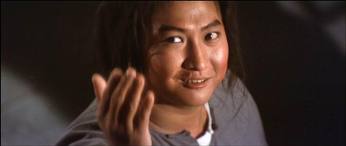
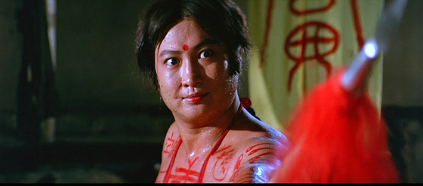
Sammo Hung’s debut film as a director, while heavily steeped in the 1970s Shaw Brothers style, already shows evidence of his distinct personality as a filmmaker. Based, like so many kung fu films, on a bit of folklore involving the struggle of the Southern Chinese to resist their new Northern rulers during the early days of the Qing Dynasty, the plot somewhat resembles that of Lau Kar-leung’s Return to the 36th Chamber, released in 1980. Both films involve a dye factory in conflict with Manchu gangsters and who are aided in their struggle by a former resident of the Shaolin Temple. That film stars Gordon Liu as a man impersonating San Te, the legendary figure Liu played in the first film in Lau’s Shaolin Trilogy, 1978’s The 36th Chamber of Shaolin. In this film, however, Sammo doesn’t play a real monk either, he’s just a guy who was sent to the Temple to learn to defend himself by an actual monk (the one with iron fists, apparently, though not much is made of these appendages) who hoped he’d return someday to help people.

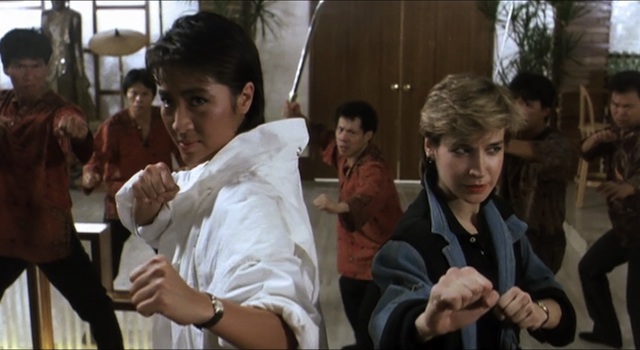
Like in Hung’s next film as a director, Warriors Two, the moral contradiction that is a revenge-seeking monk is not really explored, instead the film adopts a more Western ideal of justice: an eye for an eye, a fist for a fist. Unlike the more mystically-inclined Lau, Hung really appears to believe that violence can be a productive solution to social problems. His world is darker than the world of the Shaw Brothers, more graphically violent, with more nudity, more depravity. Given the situations that Hung’s characters find themselves in, with the sheer evil of their enemies (in this case, a gang that wanders around town raping and murdering women whenever they feel the urge), this mindset seems perfectly justified. But the cracks in this ideology begin to show in the 1980s, in the endings of Hung’s Encounters of the Spooky Kind, Jackie Chan’s Police Story and Corey Yuen’s Yes, Madam.

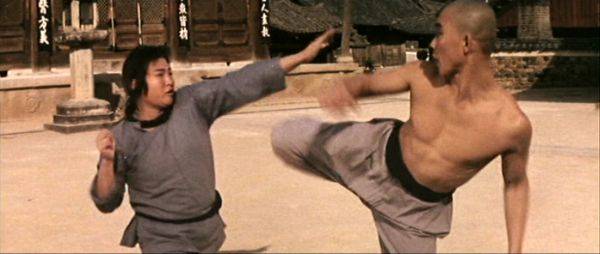
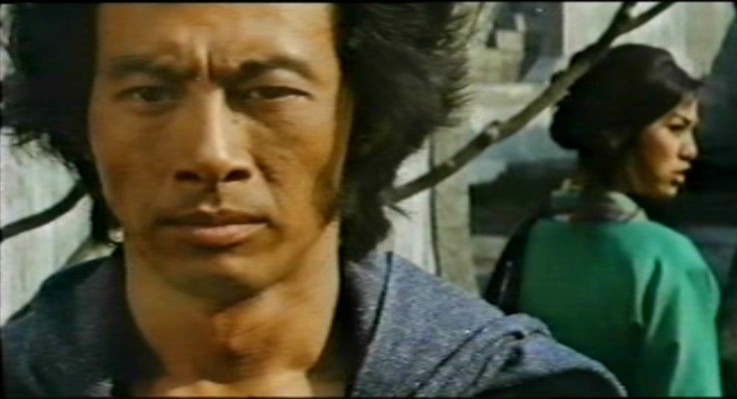
Similarly distinguishing Hung from his peers is his apparent reluctance to dominate the center stage, even in his own movies. Jackie Chan, Jet Li, Gordon Liu and the like are the unquestioned stars of their films: not just physically in that they’re clearly the most talented fighters on-screen, but they’re the most charismatic, the most fully-realized characters, the funniest and the most active protagonists. They drive their films, the plot and the rest of the cast merely revolving around them. Not so with Sammo Hung. He appears distinctly uncomfortable in the foreground, preferring to stock his films with ensembles, decentering the narrative into a story about a group rather than a single star persona. The Sammo character in this film has his revenge motive (Manchus killed his father and trashed their noodle shop), but the prime mover of the action is a dye-worker named Liang, whose sister is raped by the Manchus and whose quest for revenge happens to intersect with Sammo. Similarly, the film ends not with Sammo standing alone against his enemies, but with he and the Iron-Fisted Monk (played by Chen Sing) joining forces to battle the villains. This fluidity of protagonism extends as well to Hung’s directorial style, integrating match cuts into otherwise typical Shaw-style fight sequences (deft mixes of long shots and close-ups with occasional handheld rushes-in for effect, the emphasis always on clarity of action and movement within a coherent space). He will occasionally (too frequently would ruin the effect) cut from Sammo throwing a punch to Chen’s enemy receiving it, and back again, linking the two heroes in our minds as we mentally connect the two shots and mimicking the fight choreography that sees the quartet acrobatically switch partners in a two-on-two stand-off. I don’t recall seeing these kinds of match-cuts in any other 70s kung fu films, but they will recur in later Sammo Hung films.

As will the diffusion of the solitary hero into a pair or team. Pairs can be found in Warriors Two (Sammo and Cassanova Wong, who makes a brief appearance near the beginning of The Iron-Fosted Monk as Sammo’s sparring partner, compare to the Gordon Liu solo kung fu demonstrations that open many a Lau Kar-leung film) and Knockabout (created by Hung to provide a showy debut for his childhood friend Yuen Biao) in which Hung gives himself third-billing, as he also will in Wheels on Meals (behind Yuen and Jackie Chan). The Lucky Stars films (starting with Winners & Sinners) revolve around an ensemble, as does the film that kicked off this Summer of Sammo, Eastern Condors, in which Sammo hangs around the background for most of the movie while providing showcases to highlight Yuen Biao, Haing S. Ngor, Yuen Woo-Ping and Corey Yuen, among others. Pedicab Driver, the darkest Hung film I’ve seen to date, begins as a dual protagonist movie, shifts to an ensemble and ends with Sammo standing alone, most of his friends having been killed. Even Encounters of the Spooky Kind, which features Sammo as the sole protagonist throughout, shifts him to a supporting role in the final battle in which he becomes literally the puppet of a more powerful hero-figure (the friendly Taoist monk). I don’t know of any other major star so willing to subordinate himself to the group.

This Week in Rankings

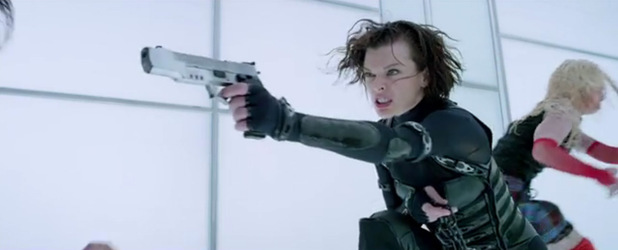
This past week I finally finished the series on Paul WS Anderson and Modern Auteurism I started back in April, Army of Milla (Part One: On Vulgar Auteurism, Part Two: On the Resident Evil Movies, Part Three: Resident Evil and Classical Auteurism). The controversy around Vulgar Auteurism gained in volume as the week wore on as other essays on the subject popped up across the internet. I particularly recommend this piece by Peter Labuza and this post by Girish Shambu. Late yesterday, John Lehtonen and Ignatiy Vishnevetsky posted this revision of the original Vulgar Auteurism post at Mubi, in the hopes of deflating some of the criticisms the movement has received by clarifying its intent and canon. I remain unconvinced that Paul WS Anderson is significantly more than the George Sidney of our time, but I also really like George Sidney.

My Summer of Sammo continued this week with reviews of Encounters of the Spooky Kind, Winners & Sinners and Pedicab Driver (and more to come). Someone at letterboxd is trying to create a site-wide survey to compete with the imdb Top 250, this list was my submission. It’s the Top Ten I made last year, due to be revised late this summer, around Labor Day weekend.

This weekend I hope to accomplish two things I’ve been talking about for a long time: finally record the Akira Kurosawa episode of They Shot Pictures (talking about No Regrets for Our Youth, The Idiot and Red Beard) and make it out to a theatre to see Frances Ha. We’re leaving for the movie in a matter of hours, my fingers remain crossed for the podcast.

These are the movies I’ve watched and rewatched over the past week, and where they place on my year-by-year rankings. Links are to my letterboxd comments, where applicable.

The Iron-Fisted Monk (Sammo Hung) – 11, 1977
Knockabout (Sammo Hung) – 15, 1979
Encounters of the Spooky Kind (Sammo Hung) – 8, 1980
Winners & Sinners (Sammo Hung) – 8, 1983

Yes, Madam (Corey Yuen) – 9, 1985
Pedicab Driver (Sammo Hung) – 5, 1989
The Chinese Feast (Tsui Hark) – 22, 1995
The Talented Mr. Ripley (Anthony Minghella) – 40, 1999
Sleepy Hollow (Tim Burton) – 52, 1999

Summer of Sammo: Pedicab Driver

This 1989 film once again finds Sammo Hung mixing tones in a highly unusual way, as what appears to be a light-hearted farce about human taxis turns into a very dark indeed exploration of human trafficking and prostitution in the lower class Macao underworld. Sammo plays the garrulous leader of the town’s pedicab union, and the film begins with a tense negotiation with the rival rickshaw drivers union in a warehouse like restaurant. Spooked by a cameo of Eric Tsang with a cleaver (chasing an unrelated cat), the two sides begin brawling, showing off some impressive group kung fu choreography (and a clever Star Wars parody). After this prologue, the first half of the film follows Sammo and his best friend Malted Candy’s attempts to woo a pair of pretty girls. Sammo’s girl is named Ping and she works at the bakery where he’s also a lodger. Ping is lusted after by the master baker, and he and Sammo get in several fights over her (she prefers Sammo, of course). Ping is quite casually treated as an object by both men (Sammo has no compunction about embarrassing her to prove his superiority to the baker), the only difference being the gross lasciviousness of the baker’s lust and the generally good-hearted nature of Sammo’s character. Malted Candy’s girl, Hsiao-Tsui, however, turns out to be a prostitute, and her pimp, Master 5, brings the first bit of horror into the film in an early scene that initially doesn’t appear to have much bearing on the plot. His men have tracked down a runaway prostitute and her new husband as she’s about to give birth at a midwifery. Master 5 has his men to kill the husband and, as for the baby, “If it’s a boy, throw it in the river. If it’s a girl, send it to the brothel.”

Sammo first encounters Master 5 on the street, where he’s propositioning Ping. Sammo steps in to help her and the two run away in a fun chase sequence. They end up crashing into a gambling house, where Sammo is set upon by a new, unrelated group of gangsters. Eventually he challenges the gambling house’s boss to a duel and it turns out to be none other than the great Shaw Brothers director Lau Kar-leung. What follows is completely superfluous to the narrative, but is nonetheless the best scene in the film. Lau is a terrific fighter, and seeing him face off against Sammo is a treat (be sure to see Lau’s starring role in his own Mad Monkey Kung Fu). Following this welcome digression, the film becomes a light romantic comedy for a half hour or so as the two couples fall in love. Then it becomes a dark tragedy as Malted Candy first learns Hsiao-Tsui’s true occupation from a friend, the man who helped him out when he first arrived in Macao, buying him his first pedicab. As Sammo, Malted Candy and their friends gather around a small table in their open-air tenement to discuss what to do about this revelation, Hung effectively puts across the terrible living conditions, the reliance on improvised families and communal networks and desperate hope for the future that drives these men without being preachy or melodramatic. That desperation, along with an effective bit of yelling by one of the driver’s wives, allows Malted Candy to set aside his patriarchal outrage at the way Hsiao-Tsui has “cheated” him and see the trauma and hopelessness that must have led her to the brothel in the first place. Able to see her as an equal, he reconciles with her and the two happily get married. Of course, that night Master 5’s men track them down and kill everyone in sight. All that’s left is for Sammo to take his revenge on the pimp and all his gang, including kickboxing badass Billy Chow, in a spectacular finale.

Summer of Sammo: Winners & Sinners

More a straight comedy than any of the other Sammo Hung films I’ve seen, though it does contain some interesting stunts. An amiable hang out movie, with Sammo and his buddies just playing around with goofy jokes and the barest necessities of a plot. Sammo and his four ex-con friends form a cleaning company and accidentally find themselves under attack by a gang of counterfeiters. The first half of the film mostly revolves around the group competing for the attention of Cherie Chung, who naturally enough falls for Sammo, the only one who isn’t trying to get her. Sammo is the bumbling butt of their jokes, but he takes it all with good cheer. When Chung discovers that he is, in fact, an extremely skilled martial artist (of course), she asks him why he lets his friends pick on him when he could easily beat them all up. His replies that when he was a kid, he used to beat people up all the time, but he was alone. Now, even though they make fun of him, at least he has friends. It’s as as sad a story as it is emotionally honest.
Jackie Chan is awkwardly wedged into the film as a cop who causes excessive amounts of damage to both suspects and property. Yuan Biao shows up to fight him in a completely random scene, one that serves only two purposes: getting Sammo and Jackie’s pal some screen time and showing off some cool kung fu. Chan also features in the film’s most famous sequence: a high speed chase with Chan on roller skates going after a car on a freeway. This ends in possibly the greatest image in any Sammo Hung film: a massive traffic pile up that keeps going and going, like the one we only get to see the aftermath of in Godard’s Weekend. Like Two Tars or the original Gone in 60 Seconds, it captures the anarchic, purely cinematic glory of automobile destruction.
Hong Kong comedies of the 80s and 90s can be difficult for American audiences at times, not because they’re dumb, or even for cultural or translational reasons (as can be the case with some of Stephen Chow’s more pun-reliant films, which are impossible to effectively convey in English) but because the comedy is so relentlessly goofy, its stars so obviously willing to do anything for a laugh, regardless of how ridiculous it makes them look. Sammo Hung spends this film in the least flattering possible outfits for his portly frame: a black catsuit, a too-small sailor’s outfit, a bright red jogging suit. Chan roller skates in a banana-yellow tracksuit topped by a yellow helmet. There’s a lengthy scene where the gang convinces Richard Ng that he’s managed to turn himself invisible, so he wanders around the house completely naked while everyone pretends they can’t see him. This kind of effort isn’t cool, we value distance and irony, not silliness and wordplay. Outside of a brief flirtation with Jim Carrey 20 years ago, when was the last time physical comedy was the least bit respectable in America? A common reaction I see from Americans who aren’t yet obsessive about Hong Kong movies is that the action is great and the comedy is something to be ignored, if possible. But I find it infectious. The relentless good cheer, the obvious fun the filmmakers have in putting it together, the honesty of the desire to just make people laugh: it’s the joy of making movies.

Army of Milla: Resident Evil and Modern Auteurism

Part Three: Resident Evil and Classical Auteurism
“This is one of the problems in resolving arguments between auteurists and anti-auteurists: the two sides can never agree entirely on what is good and what is bad.”
— Andrew Sarris, “The Auteur Theory Revisted”
The first part of this series looked at the notion of Vulgar Auteurism, a loose accumulation of ideas and attitudes that have become increasingly controversial in the internet film critic community over the past year or so. I have some reservations about the movement, if such an amorphous body can even be called that, namely its potential over-emphasis on formalism and complications arising from the self-applied word ‘Vulgar” (itself a repurposed pejorative, used initially, as far as anyone can tell, in a negative context by the critic Andrew Tracy in a Cinema Scope piece on Michael Mann, excerpts of which have been reposted in the wake of the clamorous twitter controversy stoked by Calum Marsh’s use of the concept in his Village Voice review of the latest Fast & Furious movie a couple weeks ago), which is both ahistorical (because auteurism has always examined the “vulgar”) and self-contradictory, because it accepts the high-low division of art it ostensibly is opposing.
These reservations in side, I wanted to see the theory in action, so for the second part of this series I decided to look at the work of Paul WS Anderson, specifically his Resident Evil films, of which he has, so far, written five and directed three, in the hopes of uncovering an auteur hidden in the ghetto of a ghetto, the video game adaptation subset of the action movie genre. What I found was a clean visual style, skillful action editing, and a referential approach to genre cinema, one that relies on twisting and repurposing many of the films and tropes of the past 50 years, which, along with the films’ approach to their characters as fungible and disposable, creates a coherent, if paranoid picture of the late-capitalist, digital world. The question remains, though, is that enough to call Anderson an auteur? Is a distinct visual style combined with recurrent thematic concerns all it takes to earn that label? And if so, does that mean the Resident Evil films are, for lack of a better word, good?
To try to answer these questions, I’d like to return to Andrew Sarris and the founding documents of auteur theory. Now, Sarris was not Moses and The American Cinema is not holy scripture (though it can seem that way when described by some of its early adherents). In fact, written into the very DNA of the theory is the fact that it is never complete, that there is never a final word, that everything is always a subject for further research, including the nature of the theory itself. And it may very well be the case that the Vulgar Auteurists are not thinking specifically of Sarris’s ideas or methods at all, but some other formulation of the theory (like François Truffaut’s or Peter Wollen’s) or maybe not even Auteurism at all, that they could just as easily be Vulgar Formalism or Vulgar Lacanianism or whatever else happened to catch the ear and stick. I do think that there is value to be gained by examining Anderson through the lens of Sarris’s method, however, even if it ends up helping me understand Sarris more than it helps me understand Mubi.
In Notes on the Auteur Theory in 1962, Sarris lays out the three general premises of the auteur theory. The quality of the film and its director will depend on which, if any, of these three criteria of value they meet. The first is the technical skill of the director:

A badly directed or undirected film has no importance in the critical scale of values, but one can make interesting conversation about the subject, the script, the acting, the color, the photography, the editing, the music, the costumes, the decor, etc. That is the nature of the medium. You always get more for your money than mere art. Now, by the auteur theory, if a director has no technical competence, no elementary flair for the cinema, he is automatically cast out from the pantheon of directors. A great director has to at least be a good director.

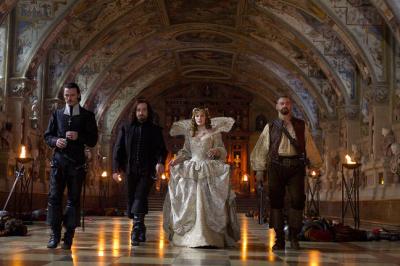
Here we hit a snag in the case of a writer-director like Paul WS Anderson. Sarris was writing during the late studio era, hoping to promote directors who stood out under the mass production conditions then at play, where the director had relatively little control over the various other crafts involved in the production of a motion picture (though that can be overstated: Hitchcock, Hawks and Ford, for example, were very rarely directors for hire with no say in the construction of the scripts they filmed). But 50 years later, the studio system seems an aberration, a mere blip in the history of cinema. In the modern era, films are assembled from the ground up, with the director often involved in every step of the process. This is not always the case, of course, but typically a director has more power over the total shape of a film now than they did then. With a director who writes their own films, one can hardly separate the script from an evaluation of their work as a potential auteur. And in Anderson’s case, his scripts are uniformly weak. While their very genericness may be spun as a virtue, or at least seen neutrally as an elegant structure allowing a wide latitude for cinematic play, it’s harder to justify his dialogue, which is functional at best and at worst, as in his Three Musketeers adaptation, sounds like a greatest hits mix of 80s action movie clichés. Additionally, his Resident Evil films are plagued by long stretches of exposition, growing longer with each successive film, most notoriously a ten minute break in the action of the fifth movie, which, following a spectacular opening shot and beautifully styled action sequence, brings the film’s momentum to a crashing halt. So, while his technical skill as a visual director is impressive, the fact that he is unable to create convincing dialogue puts into question whether or not he meets this requirement.
Sarris’s second criterion of value is the distinguishable personality of the director. It is this premise that tends to be conflated with the theory as a whole, and as well is often the most misunderstood. To put it simply: all other things being equal, the personal film is the better film. Given the choice between two equally terrible (or mediocre, or great) movies, the film that expresses something personal to its creator is the superior work, because personal expression is a value in art in and of itself. Auteurism as a method is an attempt to discover an auteur’s personality by looking at as much of their work as possible, and in as many different ways, sifting through the influences of studio, genre and collaborators to find the auteur’s core vision of the world. It is always in search of more evidence, and this is its most noble attribute: Auteurism is always open-minded.
Again, however, Sarris conceives of this personal core in visual terms due to the production standards of his time: “Because so much of the American cinema is commissioned, a director is forced to express his personality through the visual treatment of the material rather than the literary content of the material.” This partly serves as a justification for examining “vulgar” content: if it’s only the visual form that the Auteurist is interested in, the quality of the subject or its verbal and narrative expression is irrelevant. But it also serves the polemical purpose of forcing the critic to examine a film in visual terms, to look at the totality of the cinematic product rather than focus on its more literary aspects. Americans, even professional film critics, are reasonably well-trained at analyzing plots and themes and subjects, while often lacking much more than a rudimentary understanding of visual aesthetics. In conceiving of directorial personality as primarily a visual expression, Auteurism seeks to redress that imbalance, to create a criticism of the totality of a film. It is somewhat disheartening, then, to see auteur status so often defined as simply coming from the repeated exploration of certain themes and subjects. For this reason, the Vulgar Auteurist’s focus on form over content is a welcome addition to the critical discourse. But, as Sarris wrote “Auteur criticism is a reaction against sociological criticism that enthroned the what against the how. However, it would be equally fallacious to enthrone the howagainst the what. The whole point of a meaningful style is that it unifies the whatand the how into a personal statement.”
It is unclear to me, at this time, if Paul WS Anderson meets this second criterion of value. There are recurrent visual schemes in his work, specifically in the cleanliness of his action editing and his placement of individuals within spaces both vast and small, each conveying a sense of entrapment. However, his Death Racemovie has none of the visual charm of his other 2000s movies, exchanging bright whites and vibrant colors for a dingy sepia-gray. As a writer, he consistently shows a suspicion of power figures, with a paranoid vision of corporations run amok pulling the strings of his victim protagonists. And he also evinces an unusual interest in mixing his generic forebearers, as in the way his Resident Evil films each seem to have a model in a previous example of action cinema, or the way he grafts steampunk onto Dumas, or modern conspiracy theories about Egyptian and Central American religious architecture onto the mythology of a pair of 80s sci-fi series. But these preoccupations lie only on the surface of his films. They are nods to meaning rather than explorations of ideas. Anderson skillfully reflects the shiny surface of post-modernity, but doesn’t seem interested, as yet, in diving into its depths. The last Resident Evil movie, however, which twists the series upon itself in new and unusual ways, shows that he may be preparing to plunge.
The third criterion of value Sarris delineates is the most mysterious and the most troublesome. He calls it “interior meaning” which is vague enough, but then ascribes to it the even vaguer concept of mise-en-scène, which he unhelpfully defines as the indefinable quality a great director gives to their picture, the “Lubitsch Touch” as a critical concept. As best as I can figure, the third premise is a relational one. Sarris talks about it lying in the tension between a filmmaker and their subject, which opens up a few possibilities. Interior meaning could be described as the difference between a kung fu movie directed by Chang Cheh and a kung fu movie directed by Lau Kar-leung: find the differences and you find the special something each director brought to their otherwise generic, vulgar material. I don’t think Anderson meets this standard, because I don’t see much tension between him and his material. He has at times approached a transcendent visual artistry (the opening sequences of the fifth Resident Evil film come to mind), but too often his film evince little more than above-average action filmmaking. His paranoia is relatively common in science-fiction and so rather than creating a unique and personal vision of the world, Anderson’s films can more rightly be described as competent treading of well-worn terrain. His last few movies, however, show potential, and so I’m unwilling to write Anderson off as an impersonal filmmaker. Perhaps he has it in him to perform the auteurial jujitsu necessary to turn the generic qualities of his movies into virtues, into a truly compelling and original statement about the world and/or the cinema itself, merging the blankness and fungibility of his characters with the schematic structures of their worlds and the interchangeability of their dialogue to say something truly meaningful. But I don’t think he’s made that complete a filmic statement yet.
And so we are led back to the question of evaluation. Is Paul WS Anderson an auteur, and are his movies any good and are these questions related? My answers are not quite, sometimes, and yes and no. A more formalist critic than me might have different answers to those questions, but I remain unconvinced that the flaws in Anderson’s approach to story, dialogue and character can be compensated for by a facility for coherent action and cleanliness of visual space. In two separate reviews, Ignatiy Vishnevetsky refers to Anderson as “unpretentious” (of Resident Evil 5 at Mubi and of Soldier at the AV Club), which is both true and another way of saying his movies aren’t very deep because he isn’t trying to be deep. There’s nothing wrong with that as far as it goes, the problem is that it doesn’t go very far. But Auteurism isn’t a binary system, where a director either has “it” or doesn’t. Sarris’s conception of film history in The American Cinema is of an auteurial spectrum, with the greatest directors, the ones who have most fulfilled the premises of the auteur theory, in the Pantheon at the top with a descending series of lesser categories below them (the categories are loosely designed, more an organizing principle than anything else, but still a useful construct for elucidating differences between types of filmmakers). If Anderson’s chief virtue is that his films are enjoyable and unpretentious, then he belongs in the Lightly Likable category, the denizens of which Sarris describes as “talented but uneven directors with the saving grace of being unpretentious.” Some of the directors in this category include Henry Hathaway, George Sidney, Mitchell Leisen, Mervyn LeRoy, Busby Berkeley, Michael Curtiz and Delmer Daves. Not bad company at all (some of them I’d place even higher, naturally) and certainly a group held in greater esteem than Anderson is, with his routine Rotten Tomatoes scores in the 30% range.
I’d like to end with a postscript on Sarris’s final criteria. It seems to me that interior meaning can more tantalizingly be conceived as lying in the relation between a critic and a film, in the ways that certain films affect certain people in undefinable ways. The task of the critic is to find some way to communicate that indefinable experience. The auteur theory is not a theory of film, it is a theory of film criticism. It is a method for understanding what we value, why we value it and a means of expressing those values. In 1977, Sarris wrote:

[…]interior meaning, a term that gave me a great deal of trouble at the time, but one that has since come to define what all serious film criticism seeks to discover. Auteurism has less to do with the way movies are made than with the way they are elucidated and evaluated, It is more a critical instrument than a creative inspiration. Peter Wollen has suggested the hypothetical nature of the enterprise and I will go along with that. The cinema is a deep, dark mystery that we auteurists are attempting to solve.
Summer of Sammo: Encounters of the Spooky Kind

Sammo Hung plays a regular guy whose reputation as the boldest man in town makes him susceptible to all kinds of dares, leading him to an escalating series of encounters with the dead in this smash hit, one of the first major films to combine kung fu, horror and comedy. A Mr. Tam, a leading citizen of the town, is sleeping with Sammo’s wife and decides to get rid of him to cover his tracks. So he hires a renegade Taoist priest who has the ability to control the dead to kill him (by daring Sammo to spend the night in a temple holding a coffin). A fellow priest hears about this violation of Taoist beliefs and helps Sammo out, giving him instructions to counteract the killer corpses.

The first night, Sammo tries to hide from the corpse, which hops around like a bunny, unable to bend at the knees or elbows, it’s arms held out straight like a parody of Frankenstein’s monster. The second night, Sammo tries to keep the corpse in its coffin by throwing eggs at it when it tries to pop out. But he’s double crossed (some of the eggs are duck instead of chicken) and has to fight the corpse. This is the first real kung fu fight in the movie and it’s hilarious: the corpse’s stiffness making it look like a breakdancing robot. The third corpse Sammo confronts is accidental: after spending the night sleeping next to it (Sammo’s on the run from the cops after being framed for murder), it begins to mirror his movements. The result is a variation on the classic Marx Brothers gag, seen in Duck Soup, with Sammo trying to trick the corpse into beating itself up (“this corpse is too smart for me,” says Sammo.)

The second half of the film finds the priests taking a more direct role, employing a Taoist version of voodoo to take control of unsuspecting humans (this kind of ‘Spiritual Boxing’ was the subject of a 1975 Lau Kar-leung film). A teahouse showdown begins with Sammo losing control of his right hand, a sequence that surely inspired Sam Raimi’s Evil Dead. What follows is a spectacular kung fu fight, with Sammo showing off his otherworldy agility and speed taking on four swordsman armed only with a wooden bench, like an extended, souped up version of the fight from the end of Warriors Two. The fight ends with a Chaplinesque touch: Sammo defeats the swordsmen, twirls the bench around and places it on the ground. He crosses his arms with a satisfied grin and sits proudly on the bench, which immediately collapses, sending Sammo sprawling to the floor. These kind of silent comedy-inspired beats at the end of fights would become a Jackie Chan signature.

The film ends up in a rather disturbing place, evincing Hung’s penchant for mixing moods (as in Eastern Condors). The two priests meet for a final showdown, preparing their respective altars (“when two sides are evenly matched, whoever has the higher altar wins” is the film’s most important life lesson, as the priests position their altars on 30′ platforms) and raising spirits to possess various proxy fighters. Sammo, inhabited for a time by the monkey god, has his showdown with Tam. The good priest incinerates the bad one (in a spectacular, and what looks to have been highly dangerous, fire stunt). As the good priest falls, exhausted and injured from his altar, Sammo rushes to catch him. . . and just misses, an unexpected and darkly funny comic twist and the perfect place to end the movie. But then Sammo’s wife rushes out, pretending to have been a victim of Tam, kidnapped by him and held against her will. But instead of a goofy happy ending, with cuckold and wife reconciled, or even a darkly comic one with Sammo telling her off and sending her away, what we get is truly scary. Sammo grabs her, beats her repeatedly and throws her in the air. The final shot is a freeze frame of her flying, the shouted word “Bitch!” lingering in the air. It’s not funny at all but creepy and more than a little misogynistic. Sure, she cheated on him, but the punishment seems far in excess of her crime. Like the ending of Jackie Chan’s Police Story, where the nice guy cop, finally pushed to far, beats the crap out of an unarmed, surrendering criminal, the movie exposes a real aggression, a violent core to these martial artists. There is a darkness in Sammo Hung.

This Week in Rankings

This week I went to see my first-ever movie at the Seattle International Film Festival after 15 years living in the Seattle area. Johnnie To’s Drug War was as good as I’d hoped it would be, I’m hoping to write about it at some point in the near future. The SIFF experience was pretty mediocre. The last time I looked at their website, the Drug War page spelled To’s name three different ways (“Johnnie”, “Johnny” and “Jonny”) and for some reason there were over 15 minutes of trailers before the movie. Trailers are fun and all, but if you were trying to keep to a tight festival schedule they’d be extremely annoying. On the other hand, the SIFF venues are so spread out it’d be pretty hard to move quickly from one location to another anyway. Here’s hoping Vancouver works out a deal with a centrally-located multiplex this year after the Granville 7 closed.

Inspired by how much I enjoyed his Eastern Condors last week, I’ve started a new series of Sammo Hung movies I’m calling Summer of Sammo. Along with that, I’m watching some Tsui Hark films. So far I’ve managed to review Zu Warriors, Warriors Two and The Butterfly Murders.

Noah Baumbach’s Frances Ha added another theatre this week, playing at the former Metro Cinemas. That’s easily my pick as the film to see in the Seattle area this week and I’m hoping to make it out there.

These are the movies I’ve watched and rewatched over the last week, along with where they place on my year-by-year rankings. Links are to my comments at letterboxd. And with Drug War‘s move into my Top 5, I’ve updated my letterboxd Best of 2012 list as well.

The Three Musketeers (Richard Lester) – 10, 1973
The Four Musketeers (Richard Lester) – 16, 1974
Warriors Two (Sammo Hung) – 8, 1978

The Butterfly Murders (Tsui Hark) – 11, 1979
Wheels on Meals (Sammo Hung) – 5, 1984
Iron Monkey (Yuen Woo-ping) – 11, 1993

Cruel Intentions (Roger Kumble) – 45, 1999
Zu Warriors (Tsui Hark) – 22, 2001
Drug War (Johnnie To) – 5, 2012

Summer of Sammo Bonus: On Tsui Hark’s The Butterfly Murders

Tsui Hark’s audacious debut film is a horror mystery about killer butterflies that has more in common with Roger Corman or Dario Argento than the Shaw Brothers. It begins with a lengthy narration, describing how the world came to an end in two battles where most of the martial arts masters were killed (100,000 people died at the foot of Wu Tang Mountain). Now, 60 years later (a 36 year quiet period, followed by 24 years of the New Era, the numbers mean. . . something) the world is divided into 72 clans at war, jockeying for position amongst each other as kung fu magic begins to reappear on the outskirts of society. The narrator is a famous scribe named Fong, and he’ll tell us the story of how he briefly became a part of a story about this wuxia world.
Various people are brought and/or lured to a recently abandoned castle belonging to a Mr. and Mrs. Shum. There’s Fong himself, the leader of the Tien clan along with several of his soldiers (they’re all numbered: the leader is No. 1 and the groups with him are a white unit led by No. 3 and a red one led by No. 10, a woman), and the female adventurer Green Shadow, who dresses and swings through trees like Robin Hood. They find the Shums, along with their deaf mute servant Chee, in the castle’s catacombs, apparently hiding out from a deadly butterfly attack that killed all the other residents. What follows is a kind of haunted house movie, with hidden passageways, mysterious rooms and doppelgangers to be found. The mystery is compounded when Shum is killed (by the butterflies) and a letter is sent to three martial artists, who arrive and begin fighting each other and everyone else, apparently in search of some even deeper secret.
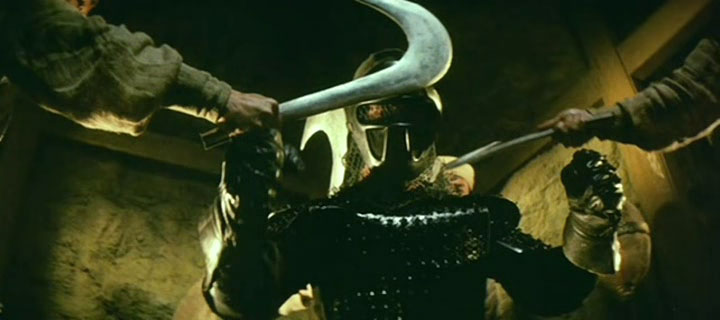
Tsui’s visual approach is highly unusual for a kung fu film of the 1970s. Eschewing the long-shot, longer take style of most Shaw Brothers productions, Tsui instead rapidly cuts between closer shots, especially in the beginning of the film, filled with nature shots of butterflies in the wild. The inevitable fight scenes are spatially coherent, though, and the editing is not all that quick by the standards of modern Hollywood. At times the montage evokes the impressionistic editing Nicolas Roeg used in the late 60s and early 70s. Tsui’s modernism extends to his compositions as well. One scene shows No. 1 and Green Shadow talking one behind the other, her facing to the side while he faces the camera, focus shifting between them as each character talks rather than cutting between them (an instance of Tsui choosing mise-en-scene over montage). A shot like this wouldn’t be out of place in a Bergman or Antonioni film, but I’ve never seen anything like it in a Hong Kong from this era. Tsui often has Green Shadow popping out of unexpected places in the frame. In her early conversations with No. 1, he never seems to know where she is, and neither do we. Right from the beginning, Tsui primes us to expect the unexpected. And as with any great horror movie, archetypically scary images abound: butterflies gathering in the branches above grave robbers like Hitchcock’s ravens, a man seeing the silhouettes of hundreds of butterflies through the paper walls of his room, a villain clad head to toe in black armor, impregnable and killing everyone in his path.
With about 15 minutes left in the film, Fong has solved the mystery and explains it to the audience. It won’t spoil anything to say that he’s pleased the Art of Controlling Butterflies has come back into the world. After the apocalypse, Fong gets to see the return of magic and is tickled at the role he gets to play in describing it in words. At that point, Fong leaves the castle: the whodunnit and why is solved and he isn’t particularly interested in how the final battle will play out. We see the implosive four-way showdown, but since Fong is our narrator, we can’t be sure if what we’re seeing is ‘real’, or if it’s Fong’s imagining of what happened after he left. Either way, it’s a negating conclusion: both sides destroy each other, the ground collapsing and swallowing them whole. Whether it’s the death of the interregnum, to be replaced by the old magical order, or that old order being defeated by its own contradictions before it can be fully reborn we can’t know. The final image we’re left with is of Fong walking alone in a desert landscape, discovering himself among a battlefield of corpses. He catches a butterfly in his hand and lets it fly away.

Summer of Sammo: Warriors Two

One of Sammo Hung’s first films as a director, this period kung fu film is very much in the Shaw Brothers mold. It most resembles Lau Kar-leung’s masterpiece The 36th Chamber of Shaolin also released in 1978, both in its plot and its middle section, an extended series of training sequences that utilize a variety of ingenious devices to help train the hero (see also: The Karate Kid). But Hung, with his character as the hero’s pudgy sidekick, a bullied dumpling vendor and kung fu-trainee, leavens his film with slapstick and goofy wordplay, whereas Lau’s film is for the most part straight-faced, though certainly not as serious as the darkly violent epics of Chang Cheh (such as Crippled Avengers, the third great kung fu film of 1978). Lau’s later films would follow in the footsteps of Hung and Jackie Chan (and Yuen Woo-ping, whose first two collaborations with Chan, the smash hit comic action films Snake in Eagle’s Shadow and Drunken Master, were also released in 1978) by mixing in low comedy with the spectacular stunts performed by his adopted brother Gordon Liu and never again, at least from what I’ve seen, reaching the spiritual heights of 36th Chamber (though the finale of Eight-Diagram Pole Fighter comes close).
In Warriors Two (it’s not a sequel, the title refers to there being two warriors in the story, like in Lo Wei’s 1970 film Brothers Five), Hung references the central philosophical conflict of 36th Chamber, that the hero is learning kung fu in order to exact revenge on the local gangster/tyrant, but the religious foundation of the martial art preaches disengagement and thus renunciation of vengeance, by having the master (Bryan Leung as Mr. Tsan) refuse to take on the hero (Casanova Wong as Cashier Hua) as a student because his motives are vengeful (“One party must stop seeking revenge or it will be an eye for an eye forever.” he says). The manager of the bank Hua was a cashier at turns out to be a gangster seeking to take over the town and when Hua discovers his scheme, the manager has Hua’s mother killed. Tsan, a respected doctor and renowned martial artist, doesn’t want to get involved, but when one of his students (Sammo Hung) pretends to take Hua on as his student, leading him in a series of hilariously bad exercises, Tsan agrees for the sake of the dignity of his martial art. The issue of the morality of vengeance is never again addressed. Indeed, the film climaxes in just such a nihilistic vengeance quest, though it ultimately ends with a physical comedy gag.
The fight sequences are exceptional, filmed in the Shaw-standard long-shot style, with a special emphasis on displaying the various positions and movements of the Wing Chun style of kung fu in close shots of hands, arms and feet edited together to maximize clarity and continuity of motion. Wing Chun was made world famous by Bruce Lee and is the subject of many movies, including Wong Kar-wai’s upcoming The Grandmaster which is yet another telling of the story of Lee’s teacher, the Wing Chun master Yip Man. Mr. Tsan (aka Leung Jan) is a real 19th century historical figure, and the film begins with a narration chronicling the history of Wing Chun, as it descended from master to student over hundreds of years (Yip Man was a student of one of Mr. Tsan’s students). The attention to detail and focus on hands and arms recalls the technique-display sequences in Robert Bresson’s Pickpocket. As Cashier Hua, Casanova Wong is a bit of a blank, though he acquits himself well in the fight scenes. Sammo Hung is the true star presence in the movie. He plays the buffoon well and in the final battle sequences, he shows off a remarkable range of skills, peaking with a shocking display of speed and leaping acrobatics as he defeats a pair of evil swordsman. The final battle is somewhat deflated by Hung’s comic duel with the evil bank manager’s sniveling pipe cleaner of a henchman played by Dean Shek, which isn’t all that funny and is anticlimactic coming right after the sword battle. But the final showdown, as Hung and Wong join forces to defeat the bank manager (who is now revealed as an expert in Mantis Style kung fu, seen in yet another 1978 film, Lau Kar-leung’s Shaolin Mantis) is suitably intense. One final note: nearly stealing the show in an early sequence, doing a Monkey Style kung fu in defense of the town’s mayor, is Lau Kar-wing, brother of Lau Kar-leung, business partner of Sammo Hung and an accomplished director and choreographer in his own right (Five Fingers of Death, Once Upon a Time in China). Lau Kar-leung himself played a master of Monkey Style a year later in Mad Monkey Kung Fu, which I reviewed last december as part of A Very Shaw Brothers Christmas.

Summer of Sammo: Zu Warriors

Last night I was flipping around hulu and found two movies with similar titles. One is labeled Zu: Warriors from the Magic Mountain, which is the title of Tsui Hark’s 1983 fantasy epic, and the other is called Zu Warriors: the Legend of Zu which is Tsui’s 2001 film based on the same source material. The earlier film is a classic, a hallmark in melding high-tech special effects into the Hong Kong kung fu genre, helping spawn a subgenre of martial arts fantasies and also inspiring John Carpenter’s Big Trouble in Little China. Zu was one of the first kung fu movies I’d ever seen, in either late 1998 or early ’99, at one of the last Hong Kong double features in Seattle.

I moved to the city just at the tail end of Hong Kong cinema’s trendiness: throughout the 90s, the Varsity Theatre (where I later worked) would play weekly double bills of Jet Li, John Woo, Jackie Chan, Chow Yun-fat, Ringo Lam, Tsui Hark and so on. But with the exodus of talent off the island in the wake of the handover to China (all of the above went to Hollywood, at least for awhile), the deterioration of existing prints and the rise in the cost of running repertory, as well as the inevitable change in what counted as fashionable cult cinema, the films disappeared from Seattle screens. Less than ten years later, when we were trying to book Jackie Chan’s Police Story for a little rep series we were running at the Metro, we were told that no one even knew who had the theatrical rights to those movies anymore. Any Chan, Li, or Shaw Brothers movie we could think of was met with shrugged shoulders and a blank stare by Landmark’s film booking department. We ended up playing Bruce Lee’s Enter the Dragon simply because it was owned outright by an American company (Warner Brothers). Anyway, I was excited to revisit Zu after 15 years, after becoming more fluent in Hong Kong and kung fu cinema in the interim and looking to spend this summer exploring the work of Tsui Hark and Sammo Hung in more depth. So seeing it was on hulu, and in a subtitled version no less, was very exciting.

But alas, both films on hulu are the 2001 movie. The one with the title of the ’83 film is the one I watched, it’s the longer, original cut of the 2001 film, running an hour and forty-five minutes. The other version is the Miramax US cut, which removes 20 minutes of exposition and character building, clocking in at less than 90 minutes. I watched the longer version (of course) and it was confusing enough. I can’t imagine the shorter version being the least bit comprehensible. Both versions are subtitled, but the character names don’t match the ones from either imdb or wikipedia, so I guess only a Chinese-speaker knows how many other ways Miramax fucked up this movie. (See my review of Yuen Woo-ping’s Iron Monkey for another rant about Miramax and the subtitling of Hong Kong movies).

Anyway, the 2001 film, which I’m going to call Zu Warriors, is a CGI-driven fantasy epic, with a smattering of kung fu, lots of alien-to-Americans mythology and folklore and a more or less Buddhist allegory. The all-star cast includes Louis Koo, Zhang Ziyi, Sammo Hung, Cecilia Cheung and Ekin Cheng, but the real star is Tsui and his rapid-cutting, no time to breathe approach to story-telling. On top of some floating mountains, a bunch of immortals gather together to defeat Mordo (or Insomnia, or the Blood Demon), the embodiment and source of all evil (greed and jealousy), before he eats them all and infects the Earth below. Characters fly around, shoot spiritual energy out of their hands, get possessed, destroyed, reincarnated, enlightened and destroyed again. An endless cycle of creation and destruction where the only hope is unity: of the various mountain clans; of lightning and thunder; of human and immortal; of male and female; of mind, body and spirit.

The CGI effects have a fun comic book-quality, bright bursts of red and green and orange and blue stabbing across purple and yellow skies, at times recalling Harryhausen (an attack by an army of Mordo’s self-replicatiing minions brings to mind the skeletons of Jason and the Argonauts) or Brakhage (the abstract color explosions of the film’s final battle). They are decidedly not realistic, nor are they state-of-the-art, even for 2001, but surely those aren’t the only standards by which we can measure visual effects.

Both of the most recent Tsui films that I’ve seen, the kung fu whodunnit Detective Dee and the Mystery of the Phantom Flame and Flying Swords of Dragon Gate, his second remake of the 1967 King Hu film Dragon Gate Inn, which remains after 45 years one of great masterpieces of action cinema from anywhere in the world, feature extensive use of CGI, though both are significantly more grounded in reality than Zu Warriors. The use of computers reopens an on-going tension in action cinema between effects and realism. Where does the pleasure in such films come from: the photographic record of remarkable physical displays by immensely skilled human beings, as in the work of the famously unaided Jackie Chan or from cinema’s ability to capture the impossible, whether through judicious use of wires, trampolines and under-cranked cameras (as in the work of Jet Li), or digital effects that have no basis in physical reality whatsoever? Cinema can be a mirror or an illusion, but is one ‘better’ than the other?