 Still trying to decide what to do as an NBA fan: do I become a Trail Blazers fan? try to watch the games without a particular rooting interest? I really don’t know.
Unfaithfully Yours – Rex Harrison plays a conductor who has reason to believe his wife is cheating on him. During a performance, he imagines three possible ways he can deal with her: a carefully planned and perfectly executed murder, a stoic self-sacrificial divorce, a lunatic game of Russian roulette. When the shows over, he puts his plans into action only to be hilariously foiled by the objects and people which fail to conform to his will. Harrison is a perfect match for writer-director Preston Sturges’s rapid-fire, complex screwball dialogue, and the long slapstick sequence as he destroys his uncooperative apartment trying to setup the murder is a masterpiece of the form. The darkness of the middle section of the film was apparently shocking for a comedy at the time, and the film was a flop, but its reputation has grown with time and it is undoubtedly one of Struges’s best films, right up there with his great The Lady Eve, Sullivan’s Travels and The Palm Beach Story. The #6 film of 1948.
Flags Of Our Fathers – The first part of Clint Eastwood’s epic examination of the battle of Iwo Jima focuses on the American soldiers who famously raised a flag (or two) atop that island’s Mt. Surbachi and got their picture taken. The three surviving flag-raisers are whisked off on a promotional tour, trying to raise money for the war bonds necessary to finance the last year of the war. Much more ambitious and abstract than the second part, the film is more about the images of and narratives about war and the ways those narratives contradict the actual experiences of the people who were there than it is about the actual battle. As a denunciation of the myth of heroism, the film isn’t as genre-destroying as Eastwood’s Unforgiven; it tends toward melodrama more than subversive parody. But it’s about as good a denunciation of a film like, say, Saving Private Ryan, as we’re likely to get out of Hollywood. The actors are generally very good, but Adam beach standout as the Pima Indian soldier Ira Hayes, who Johnny Cash sang about. The #11 film of 2006.
Letters From Iwo Jima – A lot of American critics seemed to prefer this second part of Eastwood’s Iwo Jima epic, the story of the battle from the Japanese side, it was the one that got a Best picture Oscar nomination. But I found it much less interesting, while still being very good. The film, but for a couple of flashbacks, is set entirely on the island, a the Japanese forces are slowly destroyed by the American invasion. It does a fine job of bringing human complexity to characters generally caricatured in American World War 2 films, but other than that it doesn’t bring a lot that is new to the genre. The #13 film of 2006.
 Hellboy – Guillermo del Toro’s superhero film is a lot more fun than his depressing, messy and emotionally ugly yet critically-acclaimed Pan’s Labyrinth. The great Ron Perlman brings his customary combination of swagger and vulnerability to the title role as a demon-spawned secret agent. The tight plot makes a reasonable amount of sense, and del Toro does a great job filling out the background of the comic book world, making it all believable. Plus, once again he uses the wipe, a lost art that only he and George Lucas seem to want to keep alive. This is exactly what comic book movies should be. Why more of them can’t manage to be fun and competent is beyond me. The #19 film of 2004.
The Man From Laramie – The fifth and final Western collaboration between Jimmy Stewart and director Anthony Mann has Stewart once again seeking revenge, this time against the sadistic son of a local cattle baron. Arthur Kennedy plays the baron’s right-hand man, possibly the most complex role in the film as he is both ambitious (he wants to get rich and marry Cathy O’Donnell) and reasonably honorable (he does what he can to keep the crazy son in line). When Stewart comes along, he’s threatened with losing everything (both O’Donnell and the baron, the great Donald Crisp seem to recognize Stewart as the better man). His resulting fall gives the film its tragic dimension, pushing it beyond the basic revenge plotline of the Mann-Stewart hero. All five of their films are great, but I guess if I had to rank the Mann-Stewart Westerns, I’d go like this:
1. Winchester ’73
2. The Naked Spur
3. Bend Of The River
4. The Far Country
5. The Man From Laramie
But it seems to me, that’s the order I saw them in, so it probably isn’t right. Anyway, this one is the #18 film of 1955.
Roman Polanski: Wanted & Desired – A fine documentary about the director’s trial for having sex with a 13 year old girl in the late 70s. An awful crime, to be sure, but one for which, had the justice system functioned properly, he would have been punished instead of spending the last 30 years in exile. The film does a great job of demonizing the grandstanding judge who presided over the case and made a mockery of the whole affair. The film combines standard talking heads and archival footage with shots from Polanski’s films that more or less match the actions the talking heads are describing, an interesting technique I hadn’t seen before and one that works reasonably well.
Mamma Roma – The first film by Pier Paolo Pasolini I’ve seen, and though it’s one of his earlier works, I expected something different. Anna Magnani plays an ex-prostitute who’s saved up enough money to quit streetwalking, open a vegetable stand and try raising her teenaged son. Magnani is tremendous in the part, boisterous and heart-breaking. Pasolini uses a by this point antiquated Neo-Realist technique for much of the film, making the film seem a lot closer to Fellini’s Nights Of Cabiria from five years earlier than Godard’s Vivre sa vie made the same year, two pick two other films about prostitutes. This is what I mean by it not being what I expected: Neo-Realism, it seems to be, had largely been abandoned by 1962 (Fellini, for example, had followed Cabiria with La Dolce Vita in ’60 and 8 1/2 in ’63, neither of which is much concerned with filmic reality, neo- or otherwise). The best scenes in the film are the least realistic ones: Magnani walking through the streets at night, surrounded by black and delivering a rapid-fire monologue as she passes or walks with various random people. The #14 film of 1962.
Crossfire – Edward Dymtryk’s film noir about a group of GIs investigating the murder of a Jewish man they met at a party. An excellent example of the classical noir visual style, it’s also a much more biting denouncement of anti-Semitism than the Best Picture Oscar winner from that year, the mediocre Gentlemen’s Agreement. The cast is terrific, with typically great work from Robert Mitchum, Robert Ryan and Gloria Grahame. The #6 film of 1947.

The Gang’s All Here – A joyously hallucinatory musical from Busby Berkeley with a silly plot about a GI in love with a show girl despite being engaged to a society dame. The musical sequences are of course what matters in a Berkeley film, and they’re as weird as ever here, with the great Carmen Miranda dancing with giant bananas, a New York shipyard apparently contained on a small club stage, and the disembodied head’s of all the principal actors singing the final song against fields of pure color. Miranda’s a revelation here: this is the first film I’ve seen her in, and not only are her costumes great, but her machine gun malapropistic spanglish is always hilarious. The Benny Goodman Orchestra plays a prominent role in the film, and Goodman even sings, which i didn’t know he did. The #7 film of 1943.
The Saddest Music In The World – Speaking of crazy musicals, this Guy Maddin film applies the battered silent movie visual style he used in Archangel and The Heart Of The World in a story about a Depression-era music contest in Winnipeg. Legless beer baron Isabella Rosselini organizes an international competition to determine the titular musical style, and the family responsible for her missing limbs comes together to try to win the prize: the father (who cut off her legs in a bit of drunken surgery) representing Canada, his son ((Mark McKinney from The Kids In The Hall) and her former lover, now with the nymphomaniac Maria de Medieros) representing the USA and his other son (mourning his dead son and looking for his lost wife) representing Serbia. Befitting a Maddin film, it’s totally insane and a lot of fun, but it all gets a bit dizzying after awhile. I’ve liked the two short of his I’ve seen more than any of his features thus far, and I wonder if that’s why: does the whimsy get tiresome? The #15 film of 2003.
 WALL-E – Less obviously ambitious than Brad Bird’s great Ratatoille from last year, this latest Pixar film is probably the more perfect film. The plot is the most basic romance imaginable: robot meets robot, robot loses robot, robot gets robot back. The much praised opening third of the film, dialoguelessly set on a trash covered Earth 800 years in the future populated by a lone robot who organizes the junk into massive skyscrapers and collects interesting garbage (Rubik’s cube, spork, Hello, Dolly!) is a wonder of trompe l’oeil computer animation. The Pixar guys have gone a long way towards making animated films cinematic, going so far as to bring in the great cinematographer Roger Deakins as a consultant. The long shots and focus shifts in this film are something never seen before in animation, to say nothing of the palpable sense of reality and weight they were able to give the objects and robots in the Earth sequences. Once WALL-E and his love interest EVE get to space, the animation loses some of that solidity, become a bit more cartoony, but there are still some beautiful sequences (namely a lovely space flight). In all, this is a huge leap forward for director Andrew Stanton after the pretty but pedestrian Finding Nemo. Unlike in Pixar’s Cars, with its similar pro-environment message, WALL-E excels in never letting the theme take over the film to the point of head-drubbing annoyance. Instead, the plight of the overweight humans and their destroyed Earth is always tangential to the actions and interests of the romantic protagonists. The film is a love story with a subplot about the environment, not the other way around. there’s so much to love about the film: the sound design, by Ben Burtt, is incredible adding to the tactile sense of the objects as never before in an animated film; the modernist soundtrack by Thomas Newman, mixed with a wonderful Louis Armstrong version of “La vie en rose” and a couple of songs from Hello, Dolly! that might be terrible in any other context but are magical here is good enough that I bought it and spent two days last week listening to it; the epilogue with hand-drawn recreations of the re-evolution of humanity through the whole history of artistic style is amazing: it’s a crime that so many people get up and leave the theatre in the middle of it; etc etc. I’ve seen this movie twice already and I’m unashamedly in love with it. It is easily the best film I’ve seen from 2008 thus far, and it may very well be my first animated #1 movie of the year.
The Fall Of The Roman Empire – Anthony Mann’s Roman epic is at least a better film the Ridley Scott’s absurd Gladiator. From a period of big, silly Hollywood historical epics, I can’t say it did much to stand out from that mob for me. Alec Guinness is, as always, wonderful as the dying Emperor Marcus Aurelius, but once he’s gone and the power struggle between his degenerate son (Christopher Plummer) and the noble general he’d wanted as his successor gets going, interest quickly fades. Plummer is certainly an improvement on Joaquin Phoenix’s annoying portrayal of Commodus in Scott’s film, but Stephen Boyd is far too much of a blank as the hero. At least he’s got a more realistic name than Russell Crowe was saddled with. The #19 film of 1964.
Monsters, Inc. – After my rapturous experience with WALL-E, I decided to watch the rest of the Pixar films I hadn’t yet seen. Well, this one was a disappointment. It’s more of a kid’s movie than anything I’ve seen from that great studio, with almost nothing for a grown up to hold onto other than the amazing animation of John Goodman’s fur. Goodman actually does a fine voice acting job, but Billy Crystal is obnoxious as his sidekick. There is a nice action sequence towards the end on a delirious assemblage of doors, but that and the fur is about the best that it gets. The #24 film of 2001.
A Bug’s Life – A bit better is Pixar’s version of Seven Samurai with an ant colony threatened by some evil grasshoppers. Actually, it;s probably more of a Three Amigos remake, as the insects the ant Dave Foley recruits to help are circus ants who think they’re being hired to put on a show. The animation is, of course, far cruder than the amazing level Pixar has reached recently, but the film is nonetheless pretty entertaining and I enjoyed it much more than Monster’s, Inc. Perhaps the greatest innovation Pixar has made with their last three films is that none of them have any child characters. They’re starting to make grownup films for grownups. If only the rest of Hollywood would follow suit. The #27 film of 1998.
Mask Of The Avenger – A generic Zorro-type story, set in Italy and starring the quite bland John Derek as a nobleman fighting the evil Anthony Quinn with the help of a disguise. Phil Karlson’s a director I hear a lot of good things about, at least for his noirs. I’ll refrain from judging him until I see some of those rather than this nonsense. The #22 film of 1951.
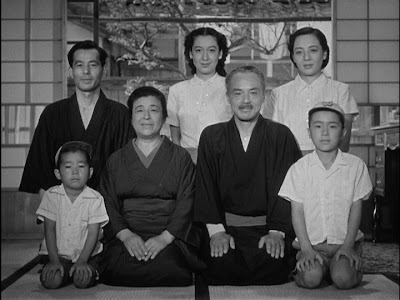
Early Summer – Ho hum, another great Yasujiro Ozu film. Surprisingly, Setsuko Hara’s family wants her to get married, but she isn’t so sure she likes the idea. A wonderful portrait of a family, we get three generations (the little kids here play a larger role than in most of Ozu’s later films, Good Morning excepted) dealing with Hara’s matrimonial issues. The film deals more obviously with the war than Ozu’s other films, one of the family’s sons is missing and presumed dead (the parents, have a heart-breaking scene discussing his fate. One gets the feeling that the war, and this missing brother, are a primary cause of Hara’s hesitation: she repeatedly talks about wanting a man she can trust, presumably one who will stick around and not go off to war like her brother. It’s Ozu’s unique way of bringing realism to a film that allows for such speculations: despite his unusual editing style, tatami-level camera placement and generally fixed camera (though it moves more here than in any Ozu I can recall), everything in an Ozu film feels real: people talk like normal people about normal human issues. One great example: halfway through the film, a new character walks through the door and starts talking to some of the family members. My wife, quite naturally, asked “who is that guy?” We’d never seen him before, and he didn’t announce himself in the kind of awkward expository dialogue we get in Hollywood films. I told her I didn’t know, but to wait and we’d find out. Sure enough, within moments the characters began talking about an anecdote we’d heard reference to earlier, something that seemed a random piece of gossip then, but through the organic conversation of this scene, explained who this new character was and his relation to the main characters. This kind of elegance looks tremendously simple, but is of course exactly what make Ozu great. The new #1 film of 1951, and it’ll probably force me to revise my awards for that year.
Hollywood Hotel – A much more subdued musical from Busby Berkeley, about a former member of the Benny Goodman Orchestra (Dick Powell) who tries to make it as an actor in Hollywood. He gets mixed up in a bizarre charade involving a pain-in-the-ass star and a girl who looks exactly like her (played by sisters Lola and Rosemary Lane). Again, it’s the songs that are interesting, not the plot. The film kicks off with a rocking, extended version of “Hooray For Hollywood” sung by the Orchestra as they see Powell off at the airport. But the best scene in the film is in the middle, as the Orchestra rehearses and drummer Gene Krupa goes nuts. After seeing this I was very excited, but didn’t remember what song it was. I did a little research and I’m pretty sure it was Louis Prima’s “Sing, Sing, Sing” which I then purchased and discovered was, in fact, perhaps the most famous song of the swing era. This made me feel pretty dumb, but it’s a great song. The #13 film of 1937.
Smilin’ Through – Director Frank Borzage has a fine reputation among critics (the folks at “a film by” and davekehr.com absolutely love him) so I’ve been tivoing his films from TCM whenever they show up. I’ve seen four so far, and it’s a motley group. The Spanish Main was a mediocre swashbuckler, The Mortal Storm a fine early anti-Nazi melodrama, A Farewell To Arms a pretty good adaptation of a Hemingway novel I really liked and this one, a thoroughly mediocre musical ghost story. From all I’ve heard, these certainly aren’t considered his best films, so I’m not making any judgements, but I didn’t see anything here all that exciting. Jeanette MacDonald plays a woman raised by her aunt’s widower. Turns out the young man she’s fallen in love with is the son of the man who killed her aunt (also played by MacDonald in flashbacks). Musical melodrama ensues. Hopefully some better Borzage becomes available. The #16 film of 1941.
 Thieves’ Highway – Very good film noir from the late Jules Dassin that stars Richard Conte as a WW2 vet who drives a truckload of apples to San Francisco to get revenge on the wholesaler who duped his dad and indirectly caused the car accident that cost his father his legs. The location shooting, especially the night scenes at the vegetable market in San Francisco is magnificent. Shooting outside the studio was still an innovation in Hollywood at this time, as was the leftist politics of the film itself (Dassin left Hollywood because of McCarthyism not long after this, thanks in part to testimony by Edward Dmytryk, who directed Crossfire). The film’s not exactly anti-capitalist, unless you happen to believe that all capitalists are necessarily corrupt, which I guess you might. Lee J. Cobb gives one of his best snarly performances as the corrupt wholesaler, and Valentina Cortese is mesmerizingly nuanced as a prostitute he hires to distract Conte from his revenge. The great Out Of the Past podcast had a great discussion on this film this month, I highly recommend it to anyone who has seen the film. The #9 film of 1949.
Sinbad The Sailor – Mediocre adventure film with lots of big gestures from Douglas Fairbanks Jr and Anthony Quinn, and a very out of place Maureen O’Hara (!). Fairbanks plays the titular hero with a scene-eating bravado that would make even the most over the top of his father’s contemporaries cringe. There’s some reasonably interesting action, but not enough of it. Alexander Korda’s The Thief Of Bagdad did all this much better seven years earlier, with believable acting and excellent special effects as well. The #13 film of 1947.

 Original Screenplay:
 Original Score:


 The End of Cinema