
Uncategorized
Movie Roundup: Pre-Vacation Backlog Edition (Part One)
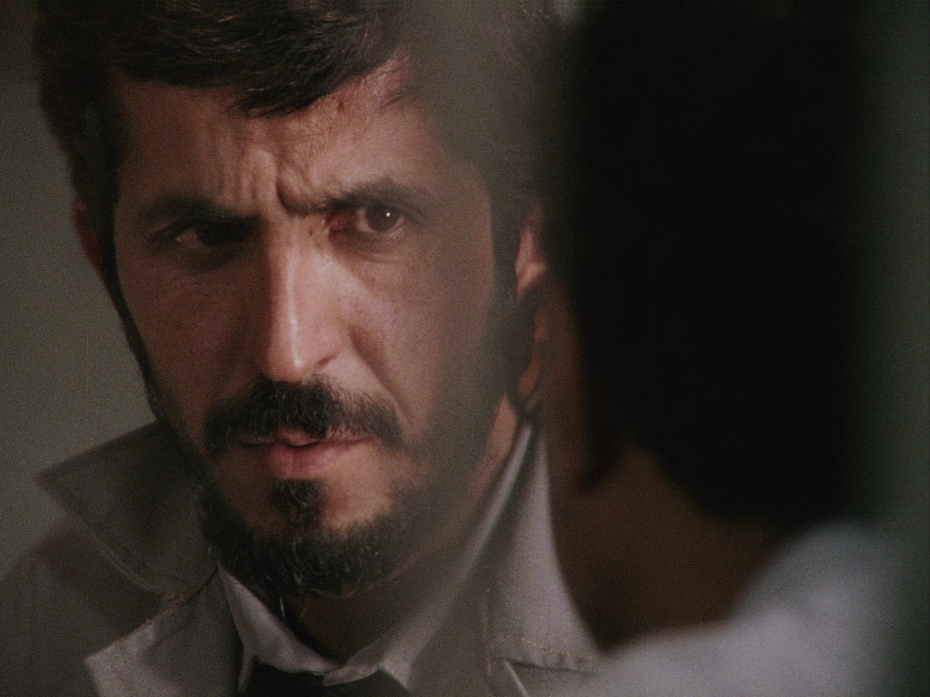
Close-Up – The earliest film by Abbas Kiarostami I’ve seen, it follows the case of a man who claimed to be director Mohsen Makhmalbaf allegedly in order to scam some money out of a family. But the closer we get to the case, the less sense it makes: the guy isn’t likely to get much money, and what kind of weird scheme is that anyway? Add in typical Kiarostami meta-questions like how much of what we’re being shown is real (it’s supposedly based on a real news story) and his own weird disinterest in telling a straight story when watching a reporter kick a can down a street is much more interesting, and you get a fascinating movie to think and talk about, though my first time watching it, albeit fairly late at night, it kinda dragged. There’s a lot to digest here. The #6 film of 1990.

The Spirit of the Beehive – A very pretty film by Spanish director Victor Erice about Frankenstein, fascism and the cruelty of older sisters. A couple of little girls, children we obliquely learn, of former Anti-Francoists, get to see Frankenstein (the setting up of the small town theatre is my favorite part of the film, but that’s the movie theatre geek in me) at some point not too long after the (Spanish) Civil War. The older girl convinces her sister that the Monster is real and that she can communicate with its ghost. The little girl spends the rest of the film looking for it, only to find a fleeing rebel instead. The look of the film has that golden magic hour hue Days of Heaven is so famous for utilizing, and the storytelling is even more abstract, with much of the film dialogue-less and from the children’s point of view. It really is quite stunning, if maybe a little too dark for me (there’s a fake death that’s just plain twisted and wrong). The #13 film of 1973.
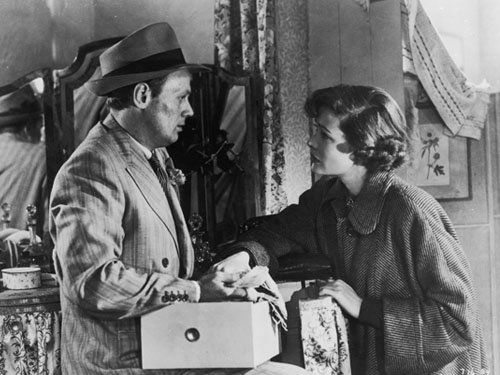
Night and the City – Last of a series of great Jules Dassin films noir from 1947-50, a streak that was broken by his blacklisting (he resurfaced in Europe in 1955 with the equally great, if not better, Rififi). Here, Richard Widmark stars as a small time hustler who dreams of making it big as a wrestling promoter, but the whole world is against him. Not even Gene Tierney is enough to save him from his inevitable fate at the hands of the cruel, cruel city. The milieu has the kind of heightened grotesqueness associated more with the noirs of Orson Welles than the kind of neo-realist procedural Dassin made just two years earlier (The Naked City), but then, noir was developing rapidly through this period, and the darkest corners of Hollywood were well on their way to total derangement (see Sunset Blvd. and In a Lonely Place, also from this year). Widmark’s never seemed more desperate, and the film is nearly stolen by Stanislaus Zbyszko as the former great wrestler Gregorious, who’s so appalled at the rigged theatrics of his son’s version of the sport that he throws in with Widmark. Tierney’s pretty much a non-entity in the film for most of its run, which is its most major flaw. One should never underuse Gene Tierney. The #12 film of 1950.

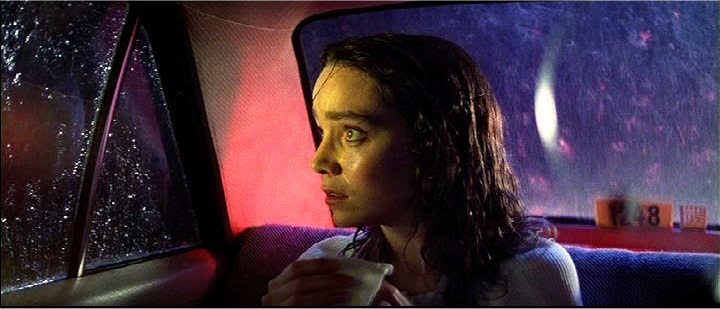
Suspiria – My first Italian horror film and first Dario Argento film, assuming the co-writing he did on Once Upon a Time in the West doesn’t count (it really doesn’t). Jessica Harper plays a young ballerina who joins a school in Germany that just happens to be run by witches. Horrible things then happen in really garish colors (the opening scenes in particular, with brilliantly bold blues, reds and yellows are a marvel, and manage to skirt the line between creepy and campy that the rest of the film doesn’t quite). It is all a lot of fun, but I gotta ask: who keeps a room full of wall to wall razor wire where the only door opens three feet in the air? Even demon witch ballerinas aren’t that nuts. The #8 film of 1977.


Never Let Me Go – No, not that one with Carey Mulligan, but a pleasant little action romance starring Clark Gable as an American journalist who falls for a Soviet ballerina (Gene Tierney, lovely as always and with a comical Russian accent) but finds she can’t emigrate once the Cold War gets going. So he and a British pal (Richard Haydn) who’s also got a Russian wife plan an elaborate naval sneak attack aided in no small way by the ability to drink copious amounts of vodka. Director Delmer Daves keeps things relatively light, though at times the social problem nature of the central conflict is a bit much. Gable and Tierney are an odd pair, this feels like a film that shouldn’t have such big stars, but I guess they were on the downside of their careers at this point. The #25 film of 1953.
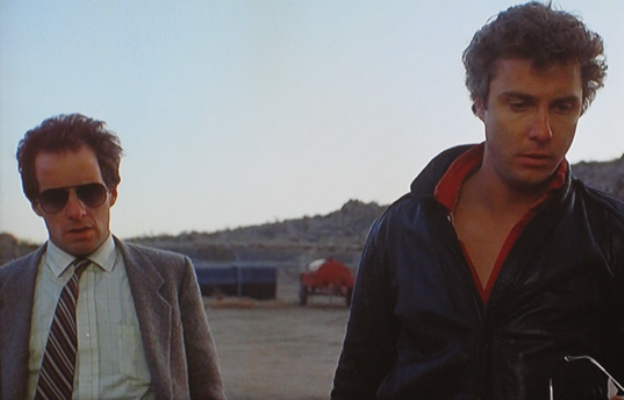
To Live and Die in LA – A couple months ago I rewatched William Friedkin’s The French Connection, a film I’d never particularly cared for before, and absolutely loved it, only partially because the Blu-Ray transfer, which I understand is probably not at all reflective of what the film looked like in 1971, looks absolutely stunning. 1970s American films have generally always looked ugly to me, but Friedkin, amping up the grain and blurring the colors came up with a visual look just as gritty as the hardcore grunginess of his lead character. Well, 15 years later, Friedkin made a cop movie that is even nastier than that one, and it might even be better as well. The setup and structure of the plot is no different from most other cop films of the period, with a psychotic bad guy (a forger played by Willem Dafoe) being chased by a cop (William Petersen, the CSI guy) who doesn’t play by the rules (or “laws” as we call them), out to get him not merely because it’s his job, but because this time it’s personal (seems Dafoe killed Petersen’s partner, mere days before his retirement!). But whereas most cop movies of the 80s played this scenario for laughs, or at least chuckles (48 Hours, Lethal Weapon), Friedkin relentlessly exposes the ugliness in his characters and seems to revel in the kind of sickness and fascism certain critics saw in The French Connection. I don’t know where the film really stands, as a critique of the vigilante cop genre or its ultimate expression, nor do I think it really matters. Either way, it’s a great movie. The #5 film of 1985.

Dragonwyck – Joseph L. Mankiewicz’s first film as a director is this adaptation of a Gothic romance in which a young farm girl (Gene Tierney) marries her rich cousin (Vincent Price) and moves to his fancy Hudson River mansion. Sure enough, things aren’t all that great when she gets there. Seems the house is haunted, Price’s family is all crazy and the local tenant farmers (led by Harry Morgan, Col. Potter himself) want the right to own land for themselves. It’s a decent enough example of its genre, but nowhere near as great as Rebecca or as twisted as The Secret Beyond the Door. The ending’s kind of weak as well. But Walter Huston, as Tierney’s religious farmer father who doesn’t approve at all of Price, mansions, cities or capitalism, is fantastic. The #14 film of 1946.

Where the Sidewalk Ends – Dana Andrews plays a cop who’s famous for roughing up suspects, but once he roughs up a guy a little too much and he dies, he’s got to both cover up and investigate the murder. Gene Tierney plays the dead guy’s ex-wife that Andrews falls in love with, and her general awesomeness is the ray of hope in the film that allows the possibility of Andrews’s redemption. She’s a model (naturally) and when her cab driver father is charged with the murder (seems the dead guy liked to beat up Gene Tierney, a capital offense as far as I’m concerned as well) Andrews has to decide whether to come clean or save himself. While this isn’t as transcendent as the other noir combination of Andrews, Tierney and director Otto Preminger, 1944’s Laura, it’s still pretty good. The #15 film of 1950.

VIFF ’10: Day Nine

Strange Powers: Stephin Merritt and The Magnetic Fields – A conventional but nonetheless engrossing documentary about, well, Stephin Merritt and his band, The Magnetic Fields. Merritt’s notoriously difficult to interview, so the intimacy of this film is rather impressive. Every major member of the band is interviewed, as well as Merritt’s mom herself. It’s mostly a biographical portrait, charting his life from high school until the Distortion album, hitting the high points (the near universal acclaim for 69 Love Songs, for my money one of the greatest works of art of the 20th Century) and the low (the racism accusations by New Yorker critic Sasha Frere-Jones, which proved nothing but the already established fact that Sasha Frere-Jones is a fucking moron. Though he was decent enough to basically admit as much both in print and on camera here). Most of the film though is funny anecdotes about Merritt’s working life, with a special focus on his 25+ year friendship with Claudia Gonson, manager and band member. Particularly cool is Merritt dumping a pile of his old notebooks on the floor and flipping nostalgically through them. (Edited to add: The coolest thing was Merritt talking about his favorite artists, particularly ABBA, who he says created such perfectly worked out songs such that when you first hear them you feel like they’ve always existed, which is exactly what I’ve always thought about Merritt’s best songs, particularly much of the 69 Love Songs). Documentaries like this aren’t generally notable for their filmic qualities, and this one is no exception. But it gets about as close as one can get to an artist like Merritt, and that’s accomplishment enough. Plus the score is really great.
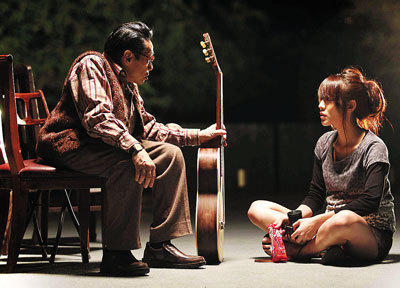
Merry-Go-Round – The second film co-directed by Clement Cheng at this year’s festival (Hong Sangsoo is the only other person with two features at the festival, though as Cheng pointed out during the Q & A, his two halves make one festival film). It’s totally different in visual style from the kung fu comedy Gallants, though it is thematically quite similar. Both film’s approach Hong Kong’s past with reverence, and are about the younger generation learning to respect the older. In this case, its a young woman (the gorgeous Ella Koon), dying of leukemia who goes to HK to find an internet friend who’s been ignoring her. This friend is the nephew of another woman from San Francisco who has recently returned to HK to prevent his sale of the family’s Chinese medicine shop to developers. This older woman is obsessed with her own past: she’s also bringing her grandfather’s body back home to be buried in his home town, and she has a series of flashbacks to a romance she had before leaving for America sometime after the Communist takeover of the mainland. The desire to return a body to one’s home is one of the key motifs in the film, and much of it takes place at a “Coffin Home” where bodies of diasporic Chinese are stored until their families come to claim them. The caretaker of the Coffin Home is played by Teddy Robin (who was so great in Gallants) and he hires the dying girl and he’s got issues with the past of his own to deal with. The setup of the film is needlessly complicated, and the first half hour or so is much more disorienting than it needs to be. But once everyone settles into their places in the narrative and their various histories and interconnections begin to be revealed, the film has a powerful emotional momentum. It’s about the joy and tragedy of leaving and returning. Other than the clunky beginning and an over-reliance on the indie rock score in the latter sections of the film (the use of the standard “After You’ve Gone”, however, is excellent), it really is very good. The cinematography by first-time feature DP Jason Kwan is particularly good, much smoother and more polished than Gallants, though the budget can’t have been much greater.
VIFF ’10: Day Eight
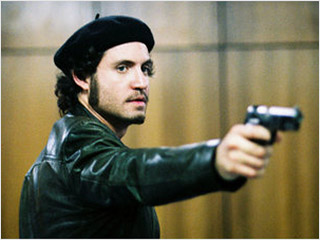
Carlos – One of the most exciting and daunting films of the year is Olivier Assayas’s five-plus hour epic about the life of 1970s terrorist Carlos. The film begins in 1973 when Carlos, a young Marxist with nominal experience (he did spend some time in the USSR but was expelled, later he attended a terrorist training camp) adopts his nom de guerre and becomes the director for English operations for the Popular Front for the Liberation of Palestine (which I’m pretty sure is a Life of Brian reference). The film then follows his career of largely bungled operations, many women and charts in detail the whole underground of international politics for over 20 years, until the end of the Cold War radically realigned everything and left the true believers nowhere to hide. Oscar Ramirez is fantastic in the lead role, though I kept trying to figure out who he looked like, settling on a hybrid of Val Kilmer and Johnny Depp. He brings the necessary multi-lingual charm (easily topping the excellent work of Christoph Waltz in last year’s Inglourious Basterds, if only by the fact that he spends the entire film easily switiching between English, French, Spanish and German whereas Waltz only needed a few lines of Italian) and constant threat of physical violence that must have been what enabled Carlos to last for so long in such a deadly racket and Assayas uses the actor’s body to chart the ups and downs of his career in an unusually explicit way (ie, he’s naked almost as much as the women in the film are, and sometimes he’s fat). The obvious point of comparison with Carlos will be Steven Soderbergh’s Che, another massive film about a famous 20th Century revolutionary. But I can’t think of a way in which Assayas doesn’t better that film. Whereas Soderbergh seemed to be either indifferent to Che’s politics or simply didn’t understand it, Assayas goes out of his way to contextualize Carlos and his compatriots’ ideology and that of the people they are fighting with and against, to the point that he is actually giving us the story of the decline of radical leftism worldwide in the wake of its 1968 high point (and how that relates to ongoing issues in the Middle East where Carlos’s ilk we replaced by a different, and much scarier, form of terrorist) as much as he is telling the story of one man. Soderbergh’s film shies away from anything that might make the hero look less than noble, while Assayas gives us all the warts on what was essentially a hired thug and murderer, he even makes the point that Carlos wasn’t even a particularly good terrorist: he bungled his biggest job (which takes up the heart of the film, his raid on an OPEC summit in 1975 that is a perfect hour and a half suspense film in its own right), got fired from the PFLP and never managed another major task again, even his more minor hired hits usually failed to kill the main target. Soderbergh’s film is self-consciouly arty, with changes of film stock, intercuts stories, a radically different visual style in Part Two from Part One (complete with an aspect ratio change). Assayas keeps the style unobtrusive and fluid, with generally long takes, constant spatial orientation and judicious uses of hand-held cameras. Anyway, it’s a massive and great film, he kind of intelligent action epic that simply doesn’t get made anymore (outside of John Woo’s very good, but not this good Red Cliff, I can’t think of any over the last several years) and it plays great theatrically: the five hours really flies by. It’ll play on TV in the US, but I’d see it in a theatre if you could.

Certified Copy – Maybe I’ve been watching Abbas Kiarostami all wrong, because nothing in Taste of Cherry, The Wind Will Carry Us or Close-Up prepared me for how simply funny this film is. Or maybe those films are exceptions in the career of a world class romantic comedy filmmaker. Anyway, Juliette Binoche (who somehow looks better now than she did 20 years ago, which just isn’t fair) plays a woman who invites a writer out for the afternoon as she liked his book (though parts annoyed her) and presumably because she likes him (William Schimell, he looks almost but not exactly like David Strathairn). His book is about how copies of art objects are just as valuable as the originals, because what gives art value is our relationship to it, what we see in it, and not anything inherit in the object itself. They argue about that for awhile, and eventually start to pretend to be married when they meet other people (the film’s set in Tuscany, and Binoche acts in three languages (French, Italian and English) while Schimel speaks French and English). The arguments they have as a “married” couple achieve enough reality that the audience is invited to wonder if they really are married after all, and their earlier scenes of not knowing each other the pretense. Of course, if we accept the premise of the book, it doesn’t matter: the only thing that’s important is what we as the audience take from it, how we relate it to our own lives. For me, it was funny for most of the time, as the various arguments and rhetorical strategies were not entirely unfamiliar. But that comedy is leavened by more than a little heartbreak. It’s a weird romance, but a pretty much perfect one. If I wanted to be really succinct, I’d say it’s Before Sunset for grownups. But, really it’s even better than that.
VIFF ’10: Day Seven
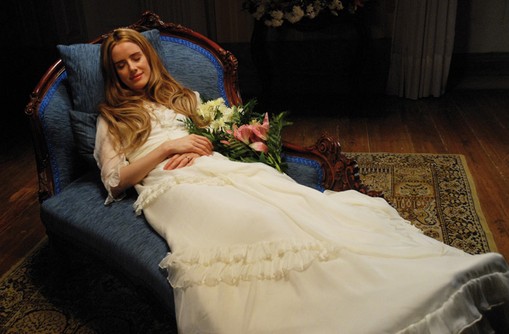
The Strange Case of Angelica – Eccentricities of a Blond-Hair Girl was one of my favorites at last year’s festival, and while this year’s Manoel de Oliveira film isn’t as gemlike as that one, it’s still pretty good. A young man who dabbles in photography is called upon to take the picture of the recently deceased Angelica, who has the unfortunate habit of smiling at him when she’s supposed to be dead. Both her corpse and later her image appear to move, and when she takes a ghostlike form (taking Isaac on a flight more than a little reminiscent of Superman and Lois Lane), Isaac falls in crazy obsessive love with her. In the middle of the film, there’s what appears to be an attempt to explain all of this with quantum physics and antimatter, but it doesn’t make a whole lot of sense. But then again, neither do the religious explanations (Isaac keeps repeating some lines about angels before and after meeting Angelica). While Eccentricities was a perfect little anecdote about love gone wrong, this is a much more mysterious, weird and even goofy film. The best part about it is also one of the best things about Eccentricities: both films seem to exist in technology, environment and social habits in a world that isn’t quite the present, nor is it the past. They’re not so much outside of time, but take place across the span of the whole of the 20th Century at once.

The Tiger Factory – We saw director Woo Ming Jin’s Woman on Fire Looks for Water earlier this year at the San Francisco International Film Festival, and I thought it was promising, a quirky minimalist film with some nice camerawork and a good sense of place. So I was looking forward to this, Woo’s next film. I wasn’t prepared, however, for it to be so totally unlike that other film, with a deadly serious verite-realist style instead of long takes and quasi-mystical goofiness. About all they have in common is the Malaysian setting and long sequences of people at work (catching, sorting and cleaning fish and shellfish in the first, inseminating pigs in this one). Lai Fooi Mun plays Ping, who wants to quit her three jobs (pig farm, restaurant and surrogate mom for her aunt’s baby factory) and get herself smuggling into Japan, apparently so she can advance to the world of foreign prostitution. Her aunt keeps her poor and pregnant, steals her kid and her money and is pretty much the most evil person ever. Ping has a friend and roommate at the beginning of the film, but by the end the friend has made it to Japan and is, for some reason, no longer returning Ping’s phone calls. The girl’s life sucks and there’s no possible way out of it. This would be more moving if Ping had any kind of personality or spark. But by the time the film has begun, her horrible life has already beaten her done to the point of near-mute passivity (when her various money-making plans go awry, she mopes and comes up with even dumber schemes). Basically, it’s like Chop Shop without the charm, energy or hope. The film was paired with a short called Inhalation featuring some of the same actors in a slight variation on the same story by Edmund Yeo, the co-writer and producer of The Tiger Factory. I liked the short a lot better, both for its style (there’s a cool long pan that doubles as a 38 day time jump) and its tone (Ping has a friend, and they talk like real people!). It’d go better at the end of the feature than the beginning (the way it was programmed).

Gallants – A comical kung fu film from the directing team of Clement Cheng and Derek Kwok that unites some elderly Shaw Brothers stars in a funny and moving elegy to old age and the martial arts classics of the 1970s. Skinny and clumsy real estate agent Cheung is sent to a small town to facilitate the sale of a local teahouse that happens also to be a former kung fu gym. The two owners (Dragon and Tiger) are the last surviving disciples of their coma-striken master. Bad guys (who want to buy the teahouse at a deflated price) attack, the master wakes up and everyone learns kung fu for the big local tournament. Dragon is played by Chen Kuan-tai (Crippled Avengers, Executioners from Shaolin) and Tiger by Leung Siu-lung (Legend of the Condor Heroes, Kung Fu Hustle) and both are still outstanding in the action sequences, if not the greatest actors in the world. Teddy Robin, a Hong Kong rock star in the 60s, plays their master as a mix of Yoda and Tracy Morgan, he’s by far the best part of the film (and even did the music as well). The film isn’t nearly as polished as the later Stephen Chow films, though it’s often just as funny and shares the same anarchic spirit. The quickie vibe (if I remember the Q & A correctly, they shot the whole thing in only 18 days, which is ridiculous) only makes it more fun.
VIFF ’10: Day Six

Around a Small Mountain – The latest from Jacques Rivette (and somehow only the second film of his that I’ve seen) feels more like an Eric Rohmer film than anything else I’ve seen in awhile. A traveling Italian meets Jane Birkin, who’s recently returned to her family circus. Sensing emotional turmoil, the Italian hangs out with the circus people solving problems left and right, Quantum Leap style. What elevates it above that kind of Bakulaesque slightness is Rivette’s fluid visual style and focus on performance: some of the best sequences in the film are of the circus people at work. Particular focus is paid to a clown routine, which we see three or four times, going a little bit further into the routine each time, which pays off hilariously at the film’s climax. Birkin’s pretty good as a middle-aged woman with an undealt with trauma in her past, but Julie-Marie Parmentier as her cute redheaded niece pretty much steals every scene she’s in.

Oki’s Movie – If Hahaha (seen here a couple days ago) was the most conventional Hong Sangsoo film I’ve seen to date, with his traditionally split narratives smoothly intercut into one integrated story, this might be his least cohesive. The story isn’t bifurcated: it’s quad-furcated. Four movies (complete with a different title credit sequence for each section of the film, though all four use “Pomp and Circumstance” (of all things) as title music) tell the story of a love triangle involving a film professor and two of his students. Or two professors and four students. Or two professors, one of whom was one of the students in an earlier love triangle (this is my interpretation, I think it makes the most sense). Hong never explicitly spells out what’s happening when, or which stories are “fiction” and which are “fact” (that each of the principals in each story is a filmmaker only makes everything that much more ambiguous). I’d never really thought of Hong as having been influenced by the French New Wave before, but the bulk of the third film is made up of a single-take Q & A between professor and the two students that could have come right out of mid-60s Godard: gnomic and hilarious. It might be my favorite Hong film thus far, in fact, I’m pretty sure I’d rank his films in reverse chronological order. I guess he just keeps getting better and better.
VIFF ’10: Day Five

The Sleeping Beauty – A kind of companion piece to the wife’s favorite film from last year’s festival, Blue Beard, Catherine Brelliat again adapts a Charles Perrault fairy tale, giving it a distinctively modern kink. Unlike last year’s film, which had a framing story in which two girls read the fairy tale that provided both the best and worst parts of the film, this one plays the tale straight through. The difference from the familiar Disney version of the story is mainly that instead of falling asleep at 16 and waking 100 years later, the good fairies (who are also much hotter in this version) fix things such that the princess falls asleep at age 6 and wakes up 100 years later at 16, having experienced a wild dream adventure in the interim. This dream takes up the bulk of the film, as the princess embarks on a quirky quest (a boil-covered ogre, a handsome pubescent prince, a snow queen, a lesbian gypsy queen and a few, but less than seven, dwarfs). When she wakes up, she meets her prince and learns that the fantasies we have in childhood don’t quite work out the way we thought they would. It’s not an especially profound message, but it’s a fun ride getting us there.
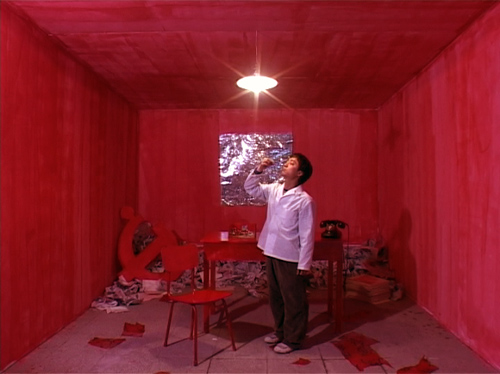
Rumination – Part of the new filmmakers competition this year is this story of the Cultural Revolution, split into ten sections, one for each year from 1966-1976. The early years move by pretty quickly, as a group of young Red Guards talk about how great Mao is and what have you. In later years they attempt to march to Beijing, but end up apparently living in a seemingly abandoned town where they torment both the local crazy homeless guy and their own boss, who demonstrates a counter-revolutionary attraction to a picture of a Hollywood starlet (couldn’t tell if it was Joan Fontaine or Ingrid Bergman or someone else entirely, regardless that makes it certainly not a revolution I’d ever want to be part of). The film has some striking imagery, notably repeated sequences in a kind of confessional, where people recite odes to Mao and the proletariat and that change color with the years. These sequences have the kind of artificial frontally of Sergei Parajanov’s The Color of Pomegranates. Most of the film though, with its almost total lack of character, plot or dialogue can be extremely frustrating. It tries so hard to keep the audience at a distance that all it really ends up saying is “hey, the Cultural Revolution sure sucked!” Which is certainly true, but don’t we already know that?
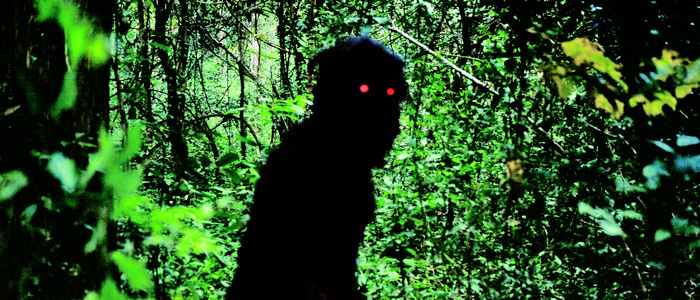
Uncle Boonmee Who Can Recall His Past Lives – Apichatpong Weerasethakul’s Palme D’Or winner from this year is probably his most conventional film yet, though you can be sure it’s plenty weird enough. Boonmee’s dying of kidney disease and his sister-in-law and nephew come to visit him. Arriving shortly thereafter are the ghost of his dead wife and their Sasquatchian son, who disappeared years before when he married a Monkey Ghost and became one himself (“Son, why have you let your hair grow so long?” is the ghost mom’s deadpan question). Boonmee tries to prepare himself and his family for his impending death, which leads to some creepy spelunking (a sequence reminiscent of Picnic at Hanging Rock as well as, musically if nothing else, Kubrick). Somewhere in there as well as a period story about an ugly princess and her memorable encounter with a catfish that may be one of the past lives of the title. Most of Weerasethakul’s films have a dual structure, and there’s a narrative split here as well, but it’s more of a coda than a second half. Like both Tropical Malady and Syndromes and a Century, but even more like Thomas Mao, which we saw a couple days earlier here at VIFF, the second part both undermines and expands the world of the first half, making us question everything that came before in a warmly constructive, humanist way (as opposed to the aggressively cynical deconstruction of many other puzzle films). It’s ultimately not as mysterious or audacious as Tropical Malady, but it might be his best film yet.


 The End of Cinema