Notes on James Cameron’s Terminator Movies

Some notes on the first two films in the series, movies I’ve seen more times than I can remember. The first a surpass hit, a relatively low-budget genre film that exploded both James Cameron and Arnold Schwarzenegger’s career, a staple of my VHS-renting days. The second, released the summer I was 15 years old, I recall as the biggest movie event in the history of cinema.

The Terminator

“Tech-noir”.

The plot isn’t as tight as it should be, with both Reese (the parking garage) and Sarah (calling mom) giving away their position far too easily/stupidly. But that can be forgiven as narrative shorthand: The Terminator (The Beast, Death, The End) is inexorable, he will find you.

I remain heartened by the boldness with which the film accepts the impossible paradox at its heart with no explanation, no timey-wimey mumbo jumbo. Sarah simply accepts the factness of what she has seen, and so gets to work.

The shot, cribbed from Alien, of the robot arm grasping at Sarah’s face might be the most famous, but the early one, of big naked Arnold looking out over the vastness of nighttime Los Angeles, a giant on the eve of conquest, is the most prophetic.


Terminator 2: Judgement Day

At once more juvenile and more pretentious than the first film.

Everything involving Linda Hamilton’s Sarah Conner is exceptional, a normal woman pushed beyond sanity by knowledge of a future she might be able to prevent. Robert Patrick’s villain too is great, though I’m not sure it entirely makes sense (the liquid metal can reform from a thousand shattered pieces into a complex terminating machine, but it can’t make a gun because it has moving parts?) The special effects make up for a lot, with a lunatic vehicle chase, lots of big explosions and a trend-setting orange vs. teal final showdown.

I never thought I’d say this, but Schwarzenegger simply isn’t robotic enough. He’s great in the first film, the embodiment of implacable destruction. But his Frankenstein’s Monster turned Pinocchio here is far too charming, too human, too winkily comic (right from the start too, with the cringe-worthy “Bad to the Bone” needle drop).

In shifting the hero role from the adults to a 10 year old boy, the film is one of the last steps in the transformation of the action blockbuster that began with ET, one that sought to bring its main characters, and, not necessarily but usually, its level of emotional and intellectual insight, to the level of their target audience, namely 10 year old boys. There had always been films about kids, of course, but it was rare in the studio era to have such a high profile action picture with pre-pubescent leads (in fact, there was a whole separate genre for them, the boys adventures (Moonfleet, Captains Courageous and the like) being separate from the grown-up adventures Gunga Din or Stagecoach and so on). The first Terminator, all grown up, was released in the year Indiana Jones added Short Round, the first step in the dumbing down process of that series, which eventually led to Shia LeBouf-Tarzan jokes. (See also the wholly superfluous children of Jurassic Park). Even Michael Bay eventually succumbed to this trend (though his films were always keyed to the young boy mentality, it wasn’t until Transformers that they actually starred one). These films always existed side-by-side with more traditional grown-up films (the Lethal Weapon series, or the Predator movies), but it was the ones with kids that most dominated from the mid 80s to the mid 90s.

Anyway, pretty much everything involving the monster and the boy is awful.

“I know now why you cry.”

This Week in Rankings

Since the last rankings update, I’ve been watching a lot of Running Out of Karma movies, shifting focus a bit from the 80s and 90s films I had been watching, first to more recent Hong Kong films and then further back, to the late 60s and early 70s. I’ve got a couple of Hong Kong They Shot Pictures episodes lined up for this summer, one on Lau Kar-leung and one on King Hu, so I’ll be looking at Johnnie To’s antecedents for awhile, rather than his contemporaries. Eventually I will get back to To himself though, having made it only three films into his career in six months so far. Meanwhile, in the last month or so I have reviews up of: SPL, New Dragon Gate Inn, Wuxia, The Legend is Born: Ip Man, Ip Man: The Final Fight, The Duel, Ten Tigers of Kwangtung, Tai Chi Zero & Tai Chi Hero, Fist of Fury & The Way of the Dragon, and The Assassin.

Also coming up is some coverage of the Seattle International Film Festival. Mike and I will be devoting a couple episodes of The George Sanders Show to the festival, starting the first weekend of June. Our most recent episode covers Under the Skin and Starman (and Only Lovers Left Alive), and coming up next week will be a discussion of Hatari! and White Hunter, Black Heart.

As always, you can check out my letterboxd page for short reviews and list updates.

These are the movies I’ve watched or rewatched over the last few weeks and where they place on my year-by-year rankings.

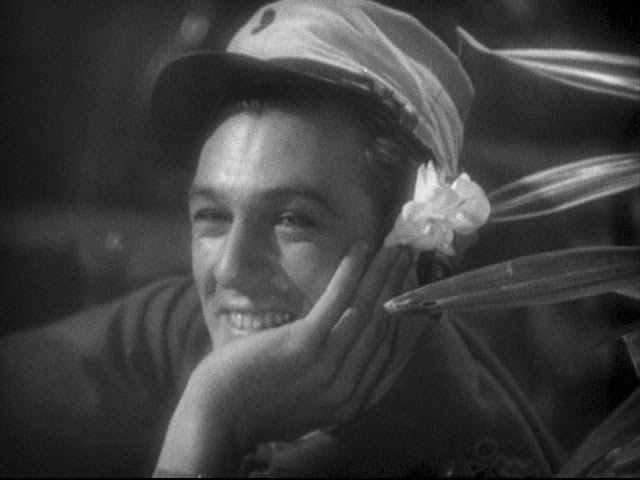
Born to Dance (Roy Del Ruth) – 22, 1936
Dumbo (Ben Sharpsteen, et al) – 19, 1941
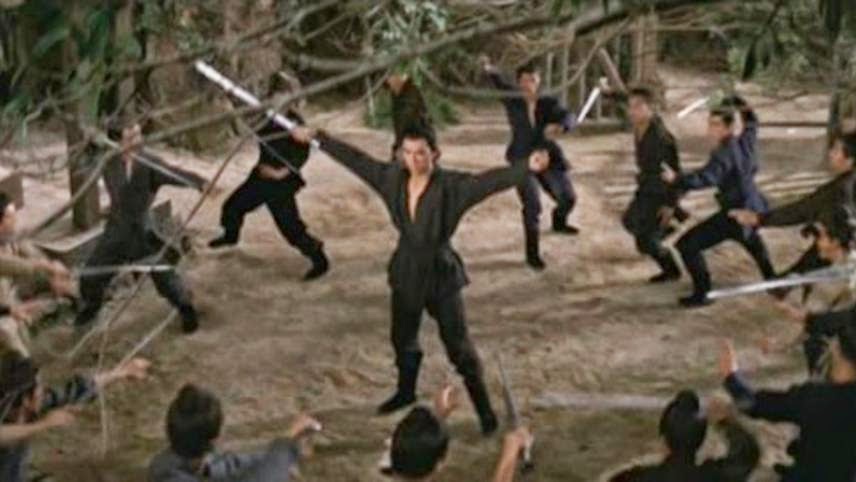
The Assassin (Chang Cheh) – 22, 1967
The Chinese Boxer (Jimmy Wang Yu) – 11, 1970
The Duel (Chang Cheh) – 17, 1971

Way of the Dragon (Bruce Lee) – 9, 1972
The Boxer from Shantung (Chang Cheh) – 12, 1972
Fist of Fury (Lo Wei) – 14, 1972
Ten Tigers of Kwangtung (Chang Cheh) – 23, 1979
The Dead and the Deadly (Wu Ma) – 30, 1982

Starman (John Carpenter) – 12, 1984
Dirty Dancing (Emile Ardolino) – 40, 1987
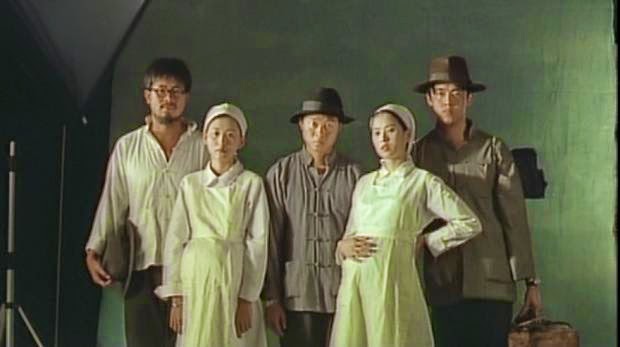
Song of the Exile (Ann Hui) – 15, 1990
New Dragon Gate Inn (Raymond Lee) – 35, 1992
The Crow (Alex Proyas) – 62, 1994

Chinese Odyssey 2002 (Jeffrey Lau) – 9, 2002
Running on Karma (Johnnie To & Wai Ka-fai) – 3, 2003
Perhaps Love (Peter Chan) – 5, 2005
SPL (Sha Po Lang) (Wilson Yip) – 16, 2005
The Sun Also Rises (Jiang Wen) – 9, 2007

The Legend is Born: Ip Man (Herman Yau) – 21, 2010
Detective Dee and the Mystery of the Phantom Flame (Tsui Hark) – 24, 2010
Wuxia (Peter Chan) – 6, 2011
Tai Chi Zero (Stephen Fung) – 27, 2012
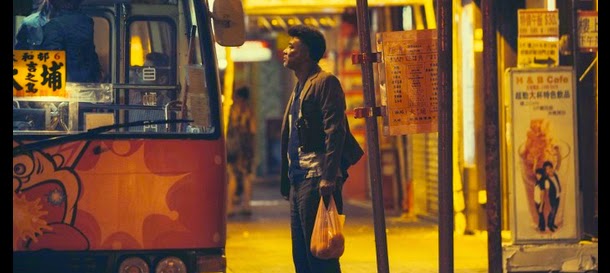
Motorway (Cheang Pou-soi) – 31, 2012
Tai Chi Hero (Stephen Fung) – 45, 2012

La última película (Raya Martin & Mark Peranson) – 1, 2013
Only Lovers Left Alive (Jim Jarmusch) – 3, 2013
Ip Man: The Final Fight (Herman Yau) – 16, 2013
Under the Skin (Jonathan Glazer) – 23, 2013
Boyhood (Richard Linklater) – 3, 2014

Running Out of Karma: Chang Cheh’s The Assassin

Running Out of Karma is my on-going series on Johnnie To and Hong Kong cinema. Here is an index.

Jimmy Wang Yu starred in five films in 1967, three directed by Chang Cheh. The One-Armed Swordsman, of course is a masterpiece, and while this one doesn’t have that film’s wild emotional heights or studio-wrought beauty, it does represent a foundation for a couple of major areas Chang would explore over the next decade.

Set in the Warring States period (the era just before the unification of China under the Qin Dynasty, from around the 400s to 200s BC, the triumph of the Qin occurring just before Hannibal began the Second Punic War by invading Rome through the Alps), the film begins with Wang as a student learning to use the latest in weapons technology, iron (as opposed to bronze) swords. This era is earlier than is typical for Chang, who would spend much of the 70s creating a multi-film history of the Southern Shaolin Temple and its resistance to the Qing Dynasty, almost 2000 years in the future. But student rivalries apparently didn’t change much over that time, and as happens, a bad egg, sexually and professionally jealous, manages to kill Wang’s master and most of his fellow disciples, sending Wang into hiding (after first fulfilling his duty by taking revenge).

Sometime later, a similar betrayal occurs at the highest level of the Han court (Han being one of the warring states). The King’s uncle wants to make a treaty with Qin, while Tien Feng, playing another, smarter advisor, warns him that the Qin are evil. The uncle sends assassins to wipe out Tien’s household, sending Tien into hiding. Tien seeks out Wang (having been lead to him by Wang’s only surviving fellow student) and the two become “brothers”, bonded by the chivalric code.

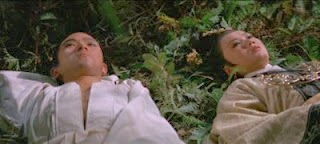
At this point, 45 minutes in, the film slows down dramatically. We know Tien wants Wang to assassinate the evil Han minister, Tien knows it, and Wang knows it, but he can’t yet because he has other responsibilities. (Tien is now Wang’s brother, so Tien’s vengeance becomes Wang’s: he owes it to him not just because Tien has showered him with wealth, but because the family bond (whether blood or “blood”) is the strongest, most basic unit of society. The master-student relationship takes its power from its pseudo-familial quality. Filial piety is the foundation of all these epic revenge sagas). Rather than just skip around to all the bloody high points, Chang lingers on the details of Wang’s new life, and the nature of the code which he and Tien follow. Wang, in addition to being a great warrior, is an exemplar of xia the concept of chivalry that lies at the core of wuxia, both in literature and film (wu meaning war, so wuxia is more or less “martial chivalry”). As such, he cannot just head off to die a glorious death, he first must protect his family (who will be killed if he is captured or recognized). Only years later, after his mother has died and his sister is married, is Wang free to act. But even then, Chang doesn’t let him. Instead he lingers on the lavish lifestyle of the rich (Wang having made his living as a butcher, Tien’s upper class lifestyle (maintained despite his being in hiding, apparently) is exotic and new: fancy wines and concubines. And finally, Wang reconnects with his old sweetheart, still unmarried and pining away for him. The two spend some happy days together lying in the grass and staring at the studio backdrop stars, but inevitably Wang must go. The Code requires that he leave all this behind: family, wealth, love, to take revenge on behalf of his “brother”.

We know it will end bloodily for Wang, as he marches off, clad all in white, the color of death, bestride a white horse, made only slightly ridiculous by wearing what appears to be a crystal duck on his head. As Chang progressed over the next 15 years or so, he would explore endless variations of this chivalric code and how it affected the men that followed it, continually posing and refusing to answer the question of if the glory they achieved was worth the cost. Across time, fashions change but the Code remains the same: Warring States, Ming and Yuan Dynasties, Qing resistance, right up to the gang wars of 1930s Shanghai or among the triads of the present day. All of Chang’s films end in death, usually a lot of deaths. But what deaths!

Running Out of Karma: Bruce Lee’s Fist of Fury and The Way of the Dragon

Running Out of Karma is my on-going series on Johnnie To and Hong Kong cinema. Here is an index.

Fist of Fury

Amazing how simple the plot is in comparison with Gordon Chan’s Jet Li-starring remake Fist of Legend. Bruce Lee’s Chenzhen is nothing more or less than a force of nature, bursting on screen in agonized grief, progressing from there through an agonized murderous rampage (in 1930s Shanghai he returns to find his master has been killed. He learns it was by the Japanese, he kills them). Only occasionally is he allowed to express anything other than agony: when he adopts disguises to spy on the Japanese; in his one romantic scene with Nora Miao. Otherwise he may as well be The Hulk. No depth, no complexity (compare Li’s Chenzhen, torn between two cultures and two families, genuinely mixed in his sympathies), simply the pure muscular expression of violent revolution, of the (racial) underclass rising up against their (apparently motiveless?) oppressors. There are hints at self-awareness, of nuance: the fact that so many of Lee’s fellow Chinese feel the effects of his violence, the collateral damage of his rampage, is felt. And the tortured expressions, often in slow motion, that take over Lee’s face when he administers a killing blow convey not the orgasmic release of violence, but the corruption of the mind and soul that each act of destruction takes on him (compare to the puns and wisecracks that accompany such displays in the 80s films of Schwarzenegger and Stallone). Still, it’s not hard at all to see why it was a hit, despite the acting, screenplay, sets, direction, characters, sound design, etc, all cheap and chintzy relative to the films Shaw Brothers was putting out at the same time. Even another Golden Harvest production like Hapkido, with a very similar Chinese vs. Japanese premise, released six months later in 1972, looks better and had more thought put into it.

The Way of the Dragon

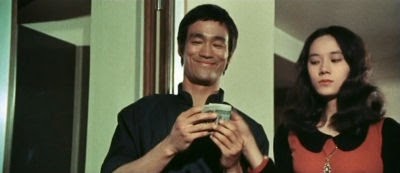
Much more satisfying than Lee’s previous two films, The Big Boss and Fist of Fury. The plot is still deathly simple: Lee is sent by his uncle to Rome to defend a Chinese restaurant against a gang of thugs trying to force a sale. But Lee, this time serving as writer and director in addition to star and choreographer, gets a lot more of interest to do in-between the fights. It may be strange to say, but the opening airport sequence, with Lee’s Tang Lung starred at by an old white lady then attempting to order in a Western restaurant (capped by his showdown with The Five Soups) is one of my favorite sequences in any Bruce Lee film, above and beyond most of his fights. He’s aided immeasurably by Nora Miao as the straight woman in these scenes, exasperatedly showing him around, visibly annoyed to be afflicted with this bumpkin (but watch how the way she looks at Lee changes after she sees him fight: there’s no romance in the film, but plenty of sex in that gaze).

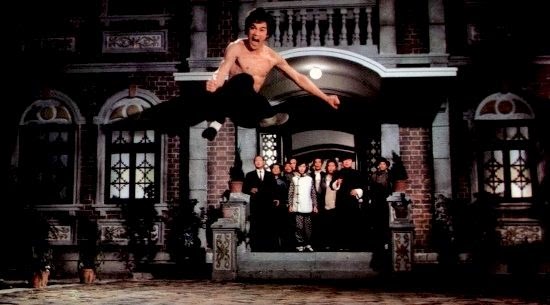
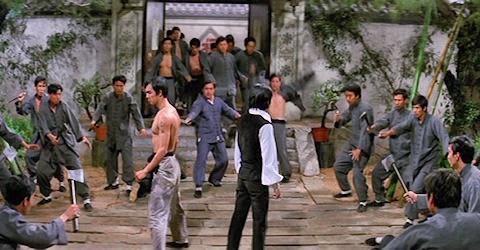
The fights in Bruce Lee’s films are different than what came before and after in good and bad ways. To the good is their realism: much shorter, more violent and more wrenching than the opera-influenced balletic displays or effects driven sword fights of the late 60s wuxia films. But the downside of that is that they never really feel like contests, more like a bunch of guys standing around waiting for Lee to inflict violence upon them (the climactic fight with Chuck Norris here is a rare exception, acknowledged by Lee with a touching grace note of respect). The choreography in a King Hu or Chang Cheh movie is less realistic, but more exciting. The charge you get in a Bruce Lee action scene is different, it comes not from the “bodies in motion” thrill you also find in a great dance sequence, but emanates instead from Lee himself, first from his status as an icon (of Chinese nationalism, of masculinity, of badassery) and only secondarily from the character he’s ostensibly playing. His tragic early death has only heightened this effect: it’s impossible to watch one of his films now outside the context of his star status, separate from the deep and widespread influence he had, not just in Hong Kong, but worldwide.

Lee’s work as a director is a significant step-up from Lo Wei’s work in the previous two films. Lee is less choppy in his editing, adding to the realism of the fights by allowing them to play out in longer, more distanced takes. He does make occasional use of the point of view shots that Lo used as well, with Lee kicking or punching directly at the camera, an effect that would be more terrifying if it didn’t feel slightly silly. The comedy in the first half of the film is charming, Lee’s fish out of water much more interesting in Rome than he was in The Big Boss‘s Thailand. I can’t help but wonder where he would have gone from here. He died in 1973, two years before Lau Kar-leung’s directorial debut and five years before Sammo Hung’s. How would he have fared with those guys? Would Lee’s idiosyncratic street fights have meshed with Lau’s traditionalist Southern Shaolin styles or Hung’s acrobatics? Would he have pushed the comedy in his films along the lines Jackie Chan and Yuen Woo-ping would explore? How would he have fared in a showdown with equally skilled and accomplished martial artists like the Five Venoms, rather than an endless succession of ugly white guys? Would he have found a second life in the heroic bloodshed cop/Triad films of the 80s and 90s (like Ti Lung in A Better Tomorrow), or been reduced to smaller cameo roles (like Ti Lung in Tiger on Beat or David Chiang in Election)? Or would he have simply crossed over to Hollywood, leaving the nationalism of his Hong Kong films a faint memory, a blip on the road to riches playing Conans, Predators and Rockys?

Running Out of Karma: Stephen Fung’s Tai Chi Zero and Tai Chi Hero

Running Out of Karma is my on-going series on Johnnie To and Hong Kong cinema. Here is an index.

It hooked me from the prologue, flashing back in time to the birth of the main character (not yet the “hero”) Lu Chen. Told silent-movie style, it rushes through the early stages of his life with a mix of narration and captions and title cards at breakneck pace, which only slightly slows down when we’re thrown back into the present. The best captions breathlessly reinvent an old Shaw Brothers convention, where an actor’s first appearance on screen is accompanied by a caption with their name (“Ti Lung as Shi Jingsi” and the like). Director Stephen Fung does the same thing, introducing each actor, but with the excitement of a true movie fan. The cards are exclaimed: “It’s Shu Qi as The Freak’s mother!” and sometimes accompanied by parenthetical bits of trivia “It’s Leung Siu-lung (70s kung fu star)” or “It’s Jayden Yuan as The Freak! (2008 Wushu National Champion)!”. Then the title sequences comes along and it’s an animated comic book. Swoon.

Lu Chen is born with a freakish growth on his forehead. When hit, it turns him into a scary kung fu demon that can defeat anyone in his path, but drains his life force away. To counter this, he’s sent to Chen village to learn their kung fu style, which can reverse the damage. Unfortunately, Chen village doesn’t share their kung fu with outsiders, so Lu hangs around and gets beaten up a lot. Eventually he’s helped by The Other Tony Leung, a mysterious tinkerer and joins Angelababy (weird name, cute girl, solid actress) as she tries to save the town from a demonic railroad-machine operated by her ex-boyfriend. Because this all takes place in a steampunk 19th century, as the Qing Dynasty is desperately trying to hold out against the modernizing forces of Western Imperialism. This is just the first half of the story. In part two, we see how Lu Chen goes from zero to hero.

Picking up right where Tai Chi Zero left off, we find the railroad company defeated (for now) and Lu Chen and Angelababy married so that he can learn the Chen-style kung fu and reverse the dangerous effects of the weird growth on his forehead. A mysterious stranger arrives in town who turns out to be The Other Tony Leung’s eldest son, Angelababy’s brother. He, like the ex-boyfriend in the first film, is more interested in technology than kung fu, building elaborate steampunk devices packed with neat gears and levers to mimic fighting techniques, and even a stylized airplane contraption.

The central emotional conflict of this film thus mirrors that of the first one. In both movies, the villain is turned villainous after being ostracized by the Chens: the community as a whole in the first one (the ex-boyfriend is an outsider and thus not allowed to learn the kung fu, and Angelababy is the only one that actually likes the poor guy anyway, though she really does like him); the (nuclear) family in the second (The Other Tony Leung never approved of his son’s scientific interests, shaming him for his failures to learn kung fu and appalled when the boy used machines to make up for his athletic deficiencies).

Similarly, the plots structures are inverted. The first film follows a conventional structure: hastily explained backstory leading to a long development section that slowly builds to an explosive climax followed by a brief epilogue. The second starts with the development and builds to the big battle scene (Qing troops invade the village). But this climax comes less than two-thirds into the film. The remaining forty minutes is a slow dissipation of the action, as Leung reaches one kind of epiphany and Lu Chen another. That’s not to say there are no further fight scenes. There is one big one, but where you’d expect bombs and machines, building upon the expectations set by the battle halfway through, instead we get a one-on-one showdown. And it isn’t even a particularly violent one at that.

In order to enlist the Qing governor’s help, Angelababy and Lu Chen have to defeat the reigning Ba Gua kung fu champion (the reason why isn’t really important). So Lu Chen fights him, in the governor’s kitchen, as his meal is being prepared. The kitchen is subdivided by a bunch of iron railings forming cubicles, so naturally the two men fight on top of them, in time-honored kung fu movie tradition (see Fong Sai Yuk or Iron Monkey). Oh, and the Ba Gua champion is none other than Yuen Biao, the only person in either film seemingly who doesn’t get a caption (if he did, I missed it). Of course, Yuen Biao doesn’t need an introduction.

The fight is a thoroughly friendly affair (choreographed as all the action in the two films is, by Sammo Hung), and ends with the governor giving Chen-style kung fu a new name (“Tai Chi”). And with that, the movie comes to an end. Most kung fu films follow a normal, linear structure, quest or training narratives that slowly build to a big finale. But every once in a while, one takes a different path. The A Touch of Zen-model, where the action becomes increasingly abstract, with a corresponding change in story structure, mimicking the character’s increasing enlightenment. Tai Chi Hero loses much of the fun of the first film, the captions aren’t as crazy, the action not as ridiculous, the emotional beats played more seriously. It becomes more grown up, deeper, more profound. The two films, twin halves of a single work, start with a breathless exclamation mark and end with a deep exhalation.

Running Out of Karma: Herman Yau’s Ip Man: The Final Fight

Running Out of Karma is my on-going series on Johnnie To and Hong Kong cinema. Here is an index.

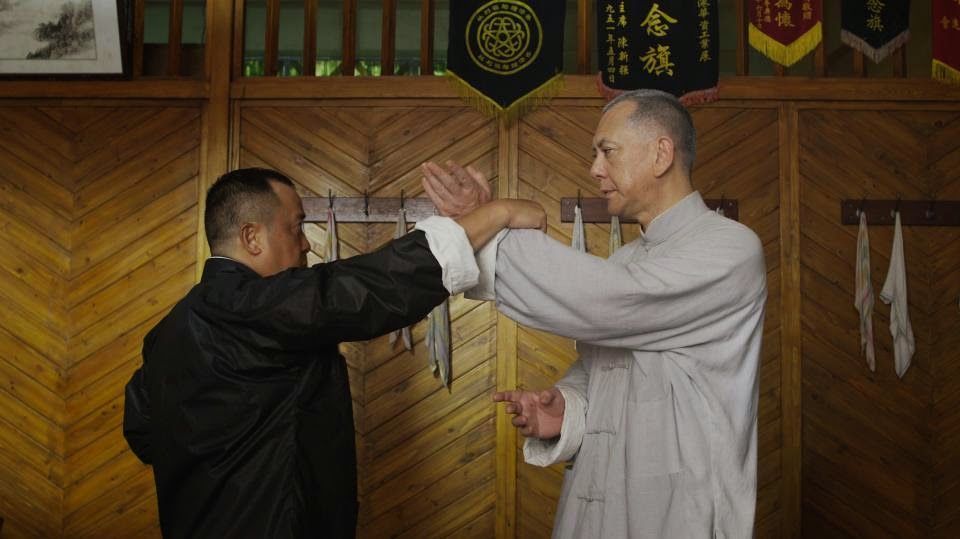
If Herman Yau’s first Ip Man film distinguished itself from the other recent movies about the man by focusing intensely on the intricacies of the Wing Chun style, this one does so in the detail historical backdrop it creates for its main character. The opening shot, a long digital zoom from high over Hong Kong down to a CGI-scrubbed period street as Ip arrives in town, a refugee from the Civil War, and asks for directions to what will be his first residence/school, hints at Yau’s approach throughout the film. 15 years or so of post-war Hong Kong is chronicled: vicious labor wars, the corruption of the police force, a vast influx of immigrants, dire poverty, gang wars, economic recovery and expansion, the hellish lawlessness of the Kowloon Walled City, a place beyond the jurisdiction of government, police and garbage collectors. Through it all stands Ip, quietly going about his business, not looking to pick a fight, or even have students (they come to him, he doesn’t have to advertise, in fact, he refuses to advertise). He doesn’t preach, he’s not a guru, he never tells people what to do. But they follow him nonetheless.

This Ip seems older than the other ones, though Anthony Wong is actually a couple of months younger than Tony Leung and only a few months older than Donnie Yen. Racked by bouts of stomach pain, he seems more frail. Maybe its just the awkward way Wong rolls and smokes his little cigarettes. I don’t know: acting. Ip is surrounded by a surrogate family of students, his first disciples There’s a hint of an early Christian vibe to their meal scenes together, which might be creepy in less sympathetic hands, or with a more demonstrative and forceful leader at the center. The story is narrated by two characters: Ip’s first student and sponsor in Hong Kong, a restaurant worker named Leung Sheung, and Ip’s oldest son, Ip Chun. Chun himself played a role in the first Yau film, and he returns in a much smaller, but much more poignant part. He plays the shopkeeper who tells Man he has a phone call, which turns out to be from Ip Chun. We see Man talk to the character Chun on the phone while the real Chun watches in the background. The phone call is the one where Chun tells his father that his wife, Chun’s mother, has died.

Like Yau’s first film, this one ends in an obligatory action-movie climax, albeit Yau seems to resist this genre tendency as much as he can. There’s less fighting in this one that in any of the other Ip Man films. Which is probably a good thing because unlike Dennis To, Yuen Biao and Sammo Hung in the first film (to say nothing of Donnie Yen in his films) Anthony Wong isn’t really much of a fighter (he told the Singapore New Paper that he was drunk when he accepted the part). As such, Yau makes more use of camera trickery here than he had to in the first film, most noticeably in a friendly sparring match between Wong and Eric Tsang, a rival grandmaster (you can very clearly see the image digitally sped up). The final showdown doesn’t have the absurd premise of the spy activities in the first film, but it’s fairly ridiculous nonetheless. Ip and his disciples, one of them pregnant, walk into the Walled City, beat up a bunch of dudes and bring a notorious gangster to justice. All of this happens in the midst of a typhoon, as these thing do.

But what sticks with this film is Wong’s Ip, in the quiet scenes watering his plants, racked with stomach pains, or visiting with his young girlfriend, an illiterate singer he off-handedly rescues from a couple of toughs, and his underplayed heartbreak at his students’ inability to accept her as part of their “family”. The true climax of the film comes, as is usual, with Bruce Lee’s appearance. This is played as triumphant in the other Ip stories, with Lee the reason we are supposed to care about Ip in the first place (“Yeah, this guy is neat and all but so what? Oh, he taught Bruce Lee, well now I’m interested”). But the Lee we see here, rich, sunglassed, Hollywoodized, is opposite our understanding of Ip and what he stands for. He’s much too loud. But Ip doesn’t express any disgust or disapproval of Lee. He doesn’t correct him, or instruct him in the virtues of simplicity. He simply wanders off to do his own thing and lets Lee decide for himself if he wants to follow.

Running Out of Karma: Chang Cheh’s Ten Tigers of Kwangtung

Running Out of Karma is my on-going series on Johnnie To and Hong Kong cinema. Here is an index.

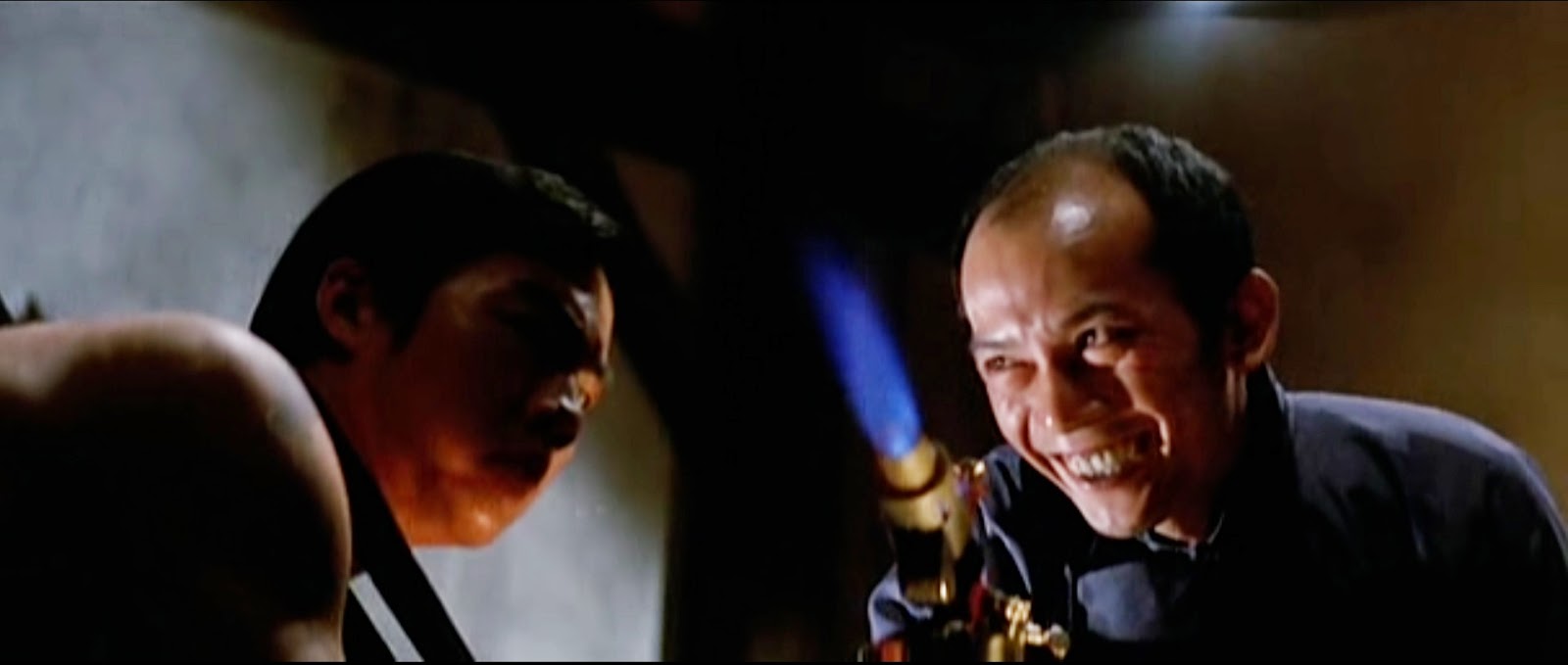
Well, there’s actually 15, if you count the five descendants of the Ten Tigers. Which could make this a bit confusing, but Chang Cheh gives us some friendly faces and nicely spaced exposition to emphasize that this is actually a very simple story. In the present, a guy and his uncle kill a man in a gambling hall out of revenge for the guy’s dead father. The dead guy’s four friends gather together to try to figure out why. This triggers a series of flashbacks as first one friend then another recount the story of the Ten Tigers of Kwangtung (or Guangdong, or Canton). During a rebellion against the Qing, various martial artists, descendants of the survivors of the destruction of the Shaolin Temple, come together to protect an anti-Qing activist from the authorities. We meet each of the men in turn, and patiently wait for them to join together (four of them are tricked, for awhile, into supporting the Manchu side. These more foolish heroes include Beggar So, better known as Wong fei-hung’s instructor in Drunken Master. Wong’s father, Wong Kei-ying is one of the Tigers, but he doesn’t have much to do here. You can see more of his adventures in Yuen Woo-ping’s Iron Monkey. So is played by Philip Kwok, best known today for his performance as Mad Dog in John Woo’s Hard-Boiled.

The final third of the flashback is recounted by one of the villains, in a neat little narrative shift that unfortunately doesn’t follow through with a change in perspective (how cool would it be for this section to depict the heroes as villains, the way the Manchus would have seen them? Alas, such experimentation seems beyond the purview of the classy Shaw Brothers period-epic.). Then we come back to the present for some gruesome fighting, led by a guy I thought looked a lot like, but was pretty sure couldn’t be, Yuen Biao. Turns out he is Chin Siu-ho, who played Jet Li’s brother/enemy in The Tai Chi Master.

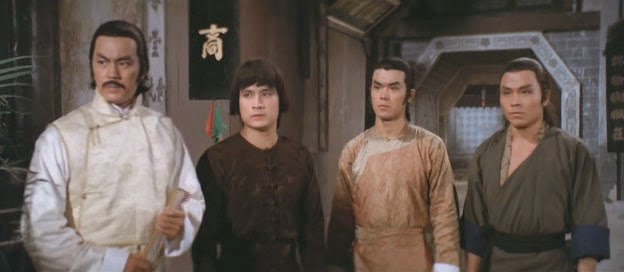
This is one of the later (1980) films in Chang Cheh’s Shaolin Temple saga, chronicling the resistance against the Manchurians by various pro-Ming martial arts sects (Shaolin Temple, Five Shaolin Masters, Heroes Two, Shaolin Avengers etc). They’re all kind of the same: stoic warriors being tricked by craftier opponents, dying glorious deaths but ultimately losing the war, with flat Shaw studio lighting, percussive and lengthy hand to hand combat, and many repeated actors and sets. This one distinguishes itself with the breadth of its cast, which includes Ti Lung, Alexander Fu Sheng and perennial Chang villain Wang Lung-wei along with the Venom Mob and its various associates. But that’s about it. There are too many characters for any of them to really stand out, and the scenario’s too rote and simplistic to be of much interest. A minor piece of the panoply that is Chang’s vast reconstruction of Chinese history through the lens of its warrior-heroes. But it is the only movie in which I’ve seen a big golden mermaid statue/figurehead used as a weapon, so it’s got that going for it.

Running Out of Karma: Chang Cheh’s The Duel

Running Out of Karma is my on-going series on Johnnie To and Hong Kong cinema. Here is an index.

Every time someone talks about David Chiang in The Duel (aka The Duel of the Iron Fist), they use (at least the subtitles do), his full name: Jiang Nan, “The Rambler”. The film’s other star, Ti Lung (paired with Chiang again and again through the early 1970s) finds himself caught up in an overly complicated series of triad betrayals. Honestly I had no idea what the particulars of the plot were, the exposition in the first few scenes flew by so quickly I simply contented myself with knowing that there were bad guys and Ti was going to kill a lot of them. He does.

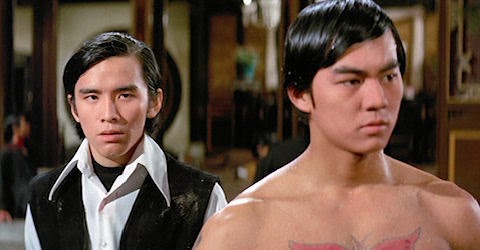
Halfway through the film he learns he’s been betrayed and returns home to kill a bunch more people. But first he finds his girlfriend, the woman who inspired him to get a giant butterfly tattooed across his chest. She’s spent the intervening years forced into prostitution (the villains apparently run some kind of scheme where they force-sell factory-working women into sexual slavery). At first, Ti is outraged by her sluttiness and slaps her. Then he quickly comes to his senses. The two embrace and as she tells him of all the horrible things that happened to her, he calmly tells her how much he loves her and calls her his wife. This generosity of spirit proves too much for her to take and at the first opportunity she kills herself. Tough world.

The duel of the title isn’t between Ti and the army of betrayers he must kill (and, spoiler alert: he kills them), but rather between him and Chiang, as Jiang Nan, “The Rambler”. Always preceded by a tubercular cough, Jiang Nan, “The Rambler” is every bit the accomplished killer Ti Lung’s character is. Tricked by the villains into murdering Ti’s godfather, the two find themselves on the same side for awhile, but their shared Code demands that Ti eventually seek revenge. The cough gives away the secret: underneath all the kung fu trappings this is actually a version of The Gunfight at the OK Corral, with the added twist that after the famous showdown, Wyatt Earp and Doc Holliday must face off against each other.

Released in 1971, the film was made in the midst of a remarkably productive stretch for star Shaw Brothers director Chang Cheh. Following 1968’s Golden Swallow, he directed six films in 1969, four in 1970, six in 1971, eight in 1972, six in 1973, eight in 1974, five in 1975 and five in 1976. That’s 48 films in eight years. Such a ridiculous pace would only be sustainable under the factory-like studio conditions of Shaws at the time, and as is usually the case, quality suffers during such a prodigious output. Mistakes will be made. In this case, it comes down to the screenplay, needlessly convoluted while at the same time wholly unoriginal. Particularly egregious is the desperate way in which the writer(s) contrive(s) reasons for the head gangster to let Ti go after they’ve captured and tortured him.

Similarly a symptom of mass production is the soundtrack, like many Hong Kong films of the period cobbled together from the scores of other films, either directly or in slightly altered form (Ennio Morricone usually being the favored source). Perhaps the most memorable thing about this for 21st Century viewers will be the film’s several uses of Richard Strauss’s “Thus Spake Zarathustra” fanfare, made famous by 2001: A Space Odyssey. It’s tempting to treat this as some kind of intertextual reference, as though Chang wants us to draw some parallel between his proto-heroic bloodshed saga and The Dawn of Man, but that would almost certainly be ahistorical. The much more likely explanation is that someone in the Shaw music department thought the theme sounded badass and so stuck it into the film as a character motif.

This poses an interesting dilemma for critics. The musical choice was almost certainly not intended to “mean” something in the sense movie homages and references are used to create meaning in post-modern cinema. Yet when watching the film, we can’t help but interpret the musical cue as an invitation to draw a connection between the two works (or between the Strauss original or even the Nietzsche work the Strauss is inspired by). Such a train of thought might lead us to see the bloody triad struggle in terms of human evolution, as the kind of violence that is the first result of humanity’s mastering of tools (too we might see a visual connection between the long bones used in 2001 and the long daggers used by Ti Lung). We might then interpret the friendship between Ti Lung and David Chiang’s Jiang Nan, “The Rambler” as the next stage in human evolution, where abstract ideals like friendship and honor serve to pull us out of the bloody muck to some higher plane of existence, while at the same time the just-as-abstract ideal of duty and loyalty drags us back down in a never-ending cycle of revenge-killing. This we might frame in the wider context of Chang Cheh’s career, referencing other films like Blood Brothers, Duels of Fists, The Heroic Ones or Vengeance! to see the pattern of Chang’s thoughts on violence, honor and friendship between men and the push-pull contradictions of the Chinese Confucian and Buddhist/Taoist traditions. The evolution angle gives us a new way of reading a recurring theme, with the potential for new and revealing insights about Chang as an artist. At that point, the question of who put the musical cue in the movie and for what intended reason doesn’t matter for the work of criticism. If we were ever able to find out who did it and why, it would certainly be an interesting point of history, a matter of trivia, and possibly an entraining and revealing anecdote, but it would nonetheless be irrelevant to the value of the criticism as criticism. This is, I think, an overlooked matter in Kent Jones’s call for more historicity in auteurism (to close “the gap between artistic practice and criticism”). At a certain point, the details of artistic practice are simply irrelevant to the reception of the finished film. The job of the critic and the job of the historian are often overlapping, but they are not the same.

Running Out of Karma: Herman Yau’s The Legend is Born: Ip Man

Running Out of Karma is my on-going series on Johnnie To and Hong Kong cinema. Here is an index.

Oh yeah, another movie about Ip Man. This one covers his early years, growing up in a kung fu school, his first romance, years in college and such. The emphasis, more than in any of the others, is on the specifics of the Wing Chun technique itself, with a whole plot line built around the issue of whether or not a high kick is authentic enough. To this end, the film is aided immeasurably by the presence of Sammo Hung and Yuen Biao. The two old pros play the young Ip’s teachers, and the film begins with a beautiful blindfolded sparring sequence between the two. The early scenes in the school are reminiscent of some scenes from Painted Faces, the Hung-starring 1988 film that chronicles his own youth in a Peking Opera school, growing up with Yuen Biao, Jackie Chan, Corey Yeun etc.

Even more delightful is a quest-starring turn by Ip Chun, Ip Man’s oldest son. Still teaching his father’s style, Ip served as a consultant for most of this cycle of Ip Man films. Here he plays a Leung Bik, a breakaway disciple who has added controversial innovations to the form and thus been ostracized from his family and the broader Wing Chun community. But he has a deep influence on Ip Man, opening him up to innovation in his martial art just as his time at an English college in Hong Kong is opening him up to the possibilities of the wider world (one of the primary themes of Wong Kar-wai’s film). All of these early scenes stick pretty closely to the historical record and are much more interested in the specifics of the Wing Chun art than they are any kind of personal or historical drama. This is what distinguishes this from the other Ip Man films. The Wilson Yip films, starring Donnie Yen, follow a more conventional historical biopic structure with the great man caught in the sweep of historic events leading to triumph and tragedy; while Wong Kar-wai’s The Grandmaster uses Ip as a conduit to explore the passing of one age of China’s history into another, with martial arts serving a metaphorical purpose. All of the Ip Man films explore the uniqueness of the Wing Chun style, but none with the dedication of this one.

However, the film’s factuality falls apart in the final third. In this story, Ip has an adopted brother, Ip Tin-chi and a friend from school, a woman named Mei-wai. She loves Man, and Tin-chi loves her, but Man is oblivious (he pursues instead his future wife, the daughter of the wealthy deputy mayor played by Lam Suet). None of this love triangle stuff works, mostly because Rose Chan, playing Mei-wai, plays every emotion so broadly. Dennis To’s Ip is what we come to expect from the character: reserved, calm, steely. Chan’s highly emotional melodramatic performance contrasts poorly with To’s underplaying. Louis Fan, as Tin-chi, doesn’t fare much better, but as his plot line becomes increasingly ridiculous (to lead us to the inevitable all-out battle extravaganza) there’s not much he can do to make it work. To’s performance is actually pretty good, the first starring role for the wushu champion. He actually reminded me a lot of the young Donnie Yen.

As the film’s plot reaches its absurd conclusion, the fight scenes become the only really interesting thing (although I guess the idea of an army Japanese sleeper agent children at work in 1920s Foshan is interesting). Fortunately, the fights are pretty great, beautifully shot by Yau (who worked as a cinematographer on Tsui Hark’s Time and Tide and Seven Swords, with an emphasis on realism in the movements and actions. There are a few leaps aided by digital wires, but otherwise the action is clean and crisp and highly legible, with a judicious uses of overhead shots, slow motion and close-ups used to highlight particularly unusual or innovative actions. With this approach, the deliberateness with which Yau explores the intricacies of the Wing Chun style and demonstrates those nuances on-screen, this is the closest I’ve seen a 21st Century kung fu film follow in the Lau Kar-leung tradition.

Running Out of Karma: Peter Chan’s Wuxia

Running Out of Karma is my on-going series on Johnnie To and Hong Kong cinema. Here is an index.

Known in the US as Dragon, the actual title of Peter Chan’s 2011 film is Wuxia, the name of a genre of both film and literature, a word that, if I understand correctly, is a compound of “wu” (military) and “xia” (chivalry, more or less). Wuxia stories are stories of warrior heroes, knights-errant, and wandering swordsman who walk the earth behaving nobly, following their code of honor above all else. They tend to inhabit a world outside the normal bounds of society called “jianghu” (literally “rivers and lakes”), filled with martial artists of various clans and sects that are perpetually at war.

Chan, director of the great 1996 romance Comrades, Almost a Love Story sets his film in 1917, the early Republican era in China, one of intense modernization between the demise of the Empire and the war with Japan. Takeshi Kaneshiro is a rationalist detective who, investigating the clearly-in-self-defense killing of a couple of thugs, begins to suspect that the hero, Donnie Yen, is more than a mere paper-maker. Yen, Kaneshiro believes, is a highly developed martial artist, and someone like that, with those skills, can only be an outlaw, an escaped killer (the setup is somewhat akin to David Cronenberg’s A History of Violence, but what follows is (mostly) its own thing).

Kaneshiro’s investigation is fascinating. The fight sequence that kicks the plot into motion comes shortly after the film begins. We see it play out as Yen fights with apparent desperation and lack of skill, a normal guy flailing about, lucking into defeating two more powerful adversaries. But as Kaneshiro looks into it, we get the scene replayed, Chan shifting camera angles to reveal the subtleties of Yen’s technique, digitally freezing and zooming the frame for a closer look, even using CGI to follow nerve points through the body, showing the scientific, physiological basis for the apparently magical fighting techniques.

The film repeatedly questions the utility of Kaneshiro’s pursuit. Yen, regardless of his past, is clearly now a good man. A husband (married to Tang Wei, most known here as the star of Ang Lee’s Lust, Caution) and father and pillar of his community (his paper mill has even led to an economic revival of his village). He is liked and respected by everyone in town. But Kaneshiro’s sense of duty has led him to repress his sense of empathy (literally, with acupuncture). He has made himself into a coldly rational detective, black and white only, consequences be damned. It’s no surprise that Kaneshiro is right that Yen is concealing a dark past, the question is how can he atone for it?

One answer is by going to jail for his crimes. That is society’s answer, and it is Kaneshiro’s as he breaks a promise to Yen and reports his suspicions to the proper authorities. But that way leads to disaster, as corrupt officials tip off Yen’s former gang as to his whereabouts, leading to bloody chaos in the formerly peaceful village and a striking homage to Chang Cheh’s The One-Armed Swordsman (hint: someone loses an arm). Yen directs some tremendous fight sequences here, featuring older stars like Kara Hui and Jimmy Wang Yu (the One-Armed Swordsman himself).

The question remains of who is the more chivalrous: the detective who follows the code of law despite all opposition and consequence, humane or otherwise; or the crook who searches for personal reformation outside the designated legal channels? Kaneshiro’s ostensibly normal and respectable world, the world of law and government and society is corrupt, passionless and unfeeling, for all its scientific advancement and insight. Can Yen’s jianghu, for all its superstition, backwardness and ruthless, bloody horror somehow be the more humane world, in that it also allows the space and freedom necessary for redemption? There’s no easy answer and Chan doesn’t give us one. He leaves us, like Cronenberg did, with the family at the breakfast table, a replay of the film’s opening sequence. Same motions, same family, irrevocably changed.