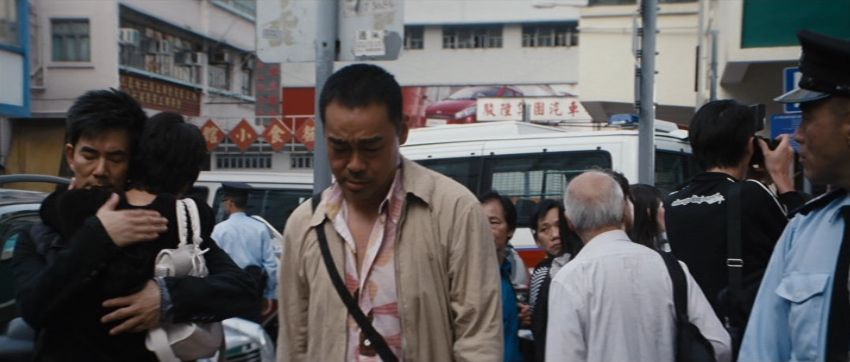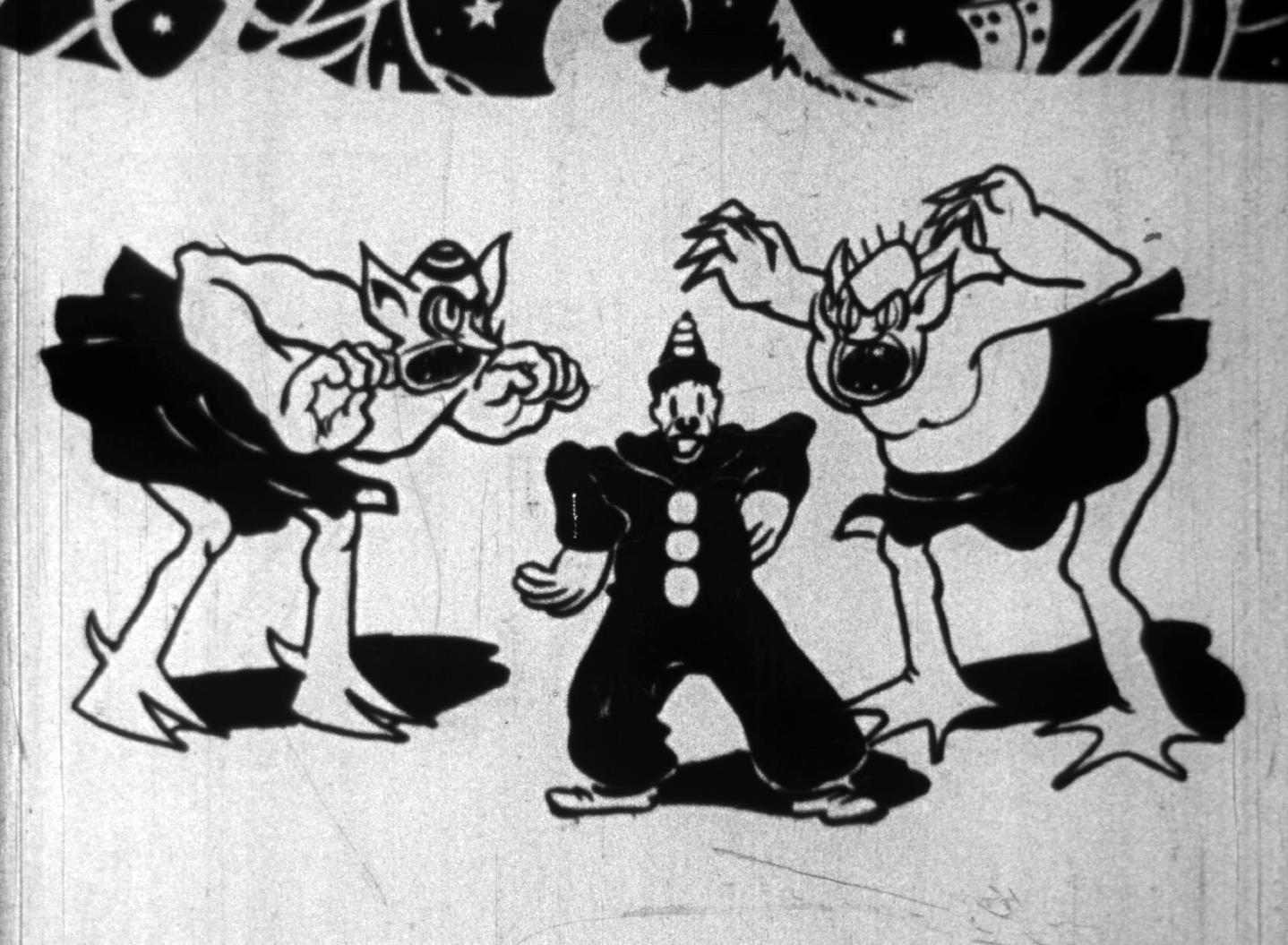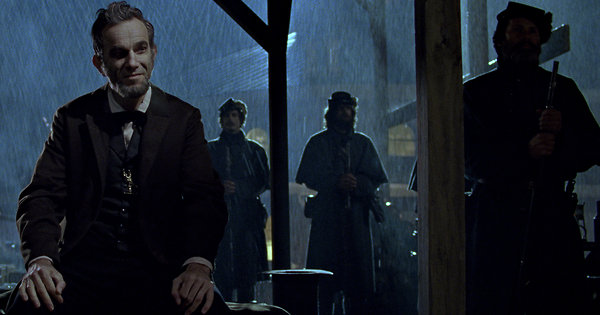
A Very Shaw Brothers Christmas: The Flying Guillotine

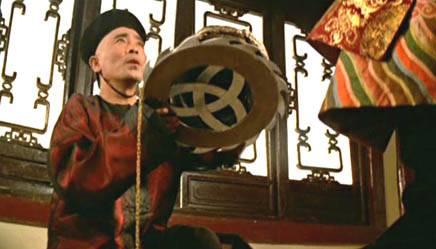
A crazed Qing Emperor suspects everyone around him of disloyalty, and when two well-respected advisors dare to suggest that maybe he shouldn’t have killed a bunch of innocent teachers and intellectuals, he decides to kill them, along with anyone else who might be disloyal.  He tasks another advisor with developing a hit squad of a dozen assassins utilizing that advisor’s newly developed super-weapon, the flying guillotine, a combination of razor-sharp frisbee and basket on a chain that in trained hands can decapitate a person from 100 yards and occasionally, inexplicably, explode.

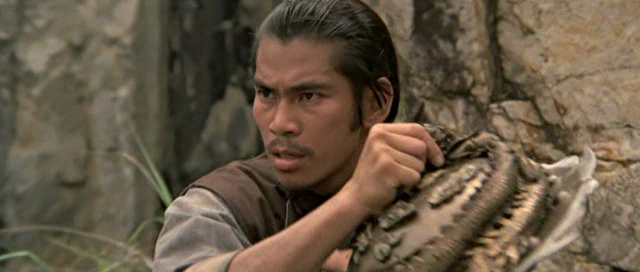
Inevitably, certain members of the squad, though initially chosen for their martial arts skill and loyalty to the Emperor, begin to have second thoughts when they realize the nature of the people they’re assigned to brutally murder. This leads to the revolt and escape of the group’s most talented member, Ma Teng, played by Chen Kuan Tai (one of the villains in Crippled Avengers and one of the aged stars of Clement Cheng’s Gallants).  The multi-year hunt for Ma, combined with the self-serving schemes of the most evil member of the squad (Ah Kun, played by Wai Wang), tears the group apart and eventually kills them all.  The Emperor, of course, survives unscathed.

Director Ho Meng Hua is one of the lesser-known Shaw Brothers directors, though he was one of their most prolific.  He started there in the mid-50s, working in all kinds of genres before the kung fu boom of the late 60s and 70s.  I’ve seen a few of his other movies (The Lady Hermit, Vengeance is a Golden Blade and Shaolin Handlock) and while they’re all fine, he hasn’t really stood out to me, this is easily the most creative visually (lots of Lo Wei-style overhead shots to go along with the expected excellence in action editing) and interesting politically.  Lots of kung fu movies are set during the early years of the Qing dynasty, when the northern Manchu took over the country from the Ming Dynasty, leaving the nation’s dominant ethnic group, the Han, powerless for the first time in 2000 years or so (not counting the few hundred years of Mongol rule).  The situation is ripe for allegorical interpretation.  Whether you’re a Maoist celebrating the struggle against first the sclerotic Qing, then the invading Japanese and finally the Nationalist Kuomintang or an anti-communist refugee fled to British-ruled Hong Kong, you can see yourself on the side of right in the Ming-Qing battle.  Even Chinese gangsters (triads) like to see themselves as descendants of the secret pro-Ming societies that fought the Qing (see Johnnie To’s Election for the triads’ view of themselves as historical actors).
What we get with The Flying Guillotine comes at the tail end of the Cultural Revolution on mainland China, a decade of government-sponsered internal terrorism, with intellectuals, teachers, and just about anyone else being purged for lack of loyalty to the regime and/or ideological incorrectness.  In the film, we see the inner-workings of an assassination squad, under the thumb of an Ivan the Terrible-like emperor and armed with an unstoppable weapon.  Even under these circumstances, though, basic human decency shines through, as Ma Teng (and a couple other assassins) see the light and do their best to escape (the Emperor is far too powerful to actually be defeated).  On the run, Ma starts a family and lives a noble, peaceful life as a farmer, his drive to quiet domesticity contrasted with Ah Kun’s deceitfulness and backstabbing ambition that leads to the disintegration of the hit squad.  So, the film is therefore a neat allegory for the strife caused by the tyrannical PRC over the previous decade, with subjects encouraged to fight amongst themselves or simply hide-out, unable and unwilling to challenge the dominant power structure.  Or, conversely, the life of a peasant farmer was idealized during the Cultural Revolution: those intellectuals who survived got themselves corrected by being sentenced to the country to work on collective farms.  Thus, the film is about the struggle of the decent, communist farmer against the destructive ambitions unleashed by modern capitalism, with the Emperor standing in for the KMT’s dictator Chiang Kai-shek and Ah Kun, I don’t know, Nixon or somebody.  Or maybe it’s about the revolution in general, about how radical revolutions always decay into petty in-fighting over ideological purity leading to mass execution as happened in Russia, China and France (“guillotine!”).  Such are the perils of political allegory in Chinese film.  It is, after all, a nation that allows Taiwan to be its own country as long as everyone pretends it’s actually part of China.

Also, lots of people get their heads cut off.  That flying guillotine really is a horrific sight, and Ho does well to match it with the sound of it spinning through the air, such that by the end of the film, all it takes is that distinctive whir to set us on edge, unconsciously shrink our heads into our shoulders and wish we had ourselves a steel umbrella.

VIFF 2012: East Meets West

Jeffrey Lau’s 1994 film The Eagle Shooting Heroes stands out among the weird and wacky world of Hong Kong comedies as possibly the weirdest and wackiest, at least in my fairly small sampling. A parody of the same source material that formed the basis for Wong Kar-wai’s Ashes of Time, and featuring most of the same cast (it was shot either concurrently or just after that film, in an attempt to recoup some of the epic’s cost overruns), it sticks mainly in my memory as the film in which the great Tony Leung spends much of his screen-time impersonating a duck. Lau also directed the two-part Stephen Chow epic A Chinese Odyssey, which is weird even for Stephen Chow.

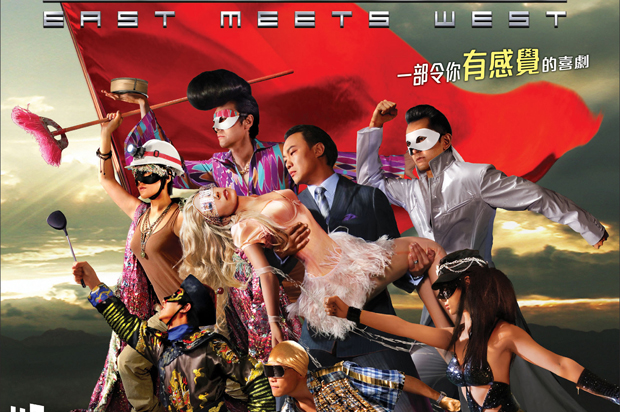
So it was with much excitement that I rushed from the screening of People’s Park to see East Meets West, which may or may not be a sequel to The Eagle Shooting Heroes (I didn’t think it was at all, but a comment at imdb says so, and they’re usually right, right?). I was not disappointed.

It starts with a lightning fast 30 minutes or so, when a whole bunch of characters are introduced, and back stories given, while jokes fly by faster than edits. One character, played by Karen Mok, finds her father, a former major pop star played by former major pop star Kenny Bee working in a haunted house: “being a zombie is a perfectly respectable profession!” They set off to find her hated step-mother (“It’s God’s will that I go to Guangzhou to chop the bitch!”) who has gotten them into trouble over some debts.  They hook up with a rich girl musician, her bodyguard, a single dad and his son and a wannabe actor/cab driver as they flee from hordes of homeless musicians (“Don’t drive so Donnie Yen!”) and reunite Bee’s band (“The Wynners”) to hold a fund-raising concert.

I saw Kenny Bee for the first time earlier this year in one of Hou Hsiao-hsien’s first movies, the mediocre romantic comedy Play While You Play (aka Cheerful Wind), so it was a treat seeing him here, 30 years later. He’s not as charismatic or funny as Teddy Robin, another 70s pop-star was in his hopefully career-reviving performances in 2010’s Gallants, Merry-Go-Round and Detective Dee and the Mystery of the Phantom Flame, but he’s a lot better here than he was in that Hou movie.

Anyway, it turns out these people are all reincarnations of a group of gods that have been fighting a multi-millennia struggle against the eighth of their group, who became twisted and evil and defeats them in every lifetime. Lau has a lot of fun with the superheroes in the modern world conceit (their makeshift costumes are terrific: a bicycle hemet, a face covered with flour, single-lensed sunglasses, etc), a pleasant contrast with the bleak and miserable worlds of Hollywood films like Kick-Ass or Christopher Nolan’s Batman movies. And while the special effects are merely OK compared to the state-of-the-art, giving the films a kind of plastic, phony sheen found also in recent films from Tsui Hark, Lau manages to create some nice, memorable images (though he doesn’t quite have Tsui’s skill as a visual filmmaker). The film loses some narrative steam towards the end, but it never stops being fun and clever. Even when Lau goes for sap, it goes for the biggest, gooiest, cheesiest love-conquers-all-even-a-heart-ten-sizes-too-small sap it can muster.

VIFF 2012: People’s Park

A few thoughts I jotted down while watching People’s Park, a single-take documentary set in a park in the city of Chengdu, Sichuan by directors JP Sniadecki and Libbie Cohn:

  • So this is a lot like Russian Ark, the single-take trip through the Hermitage directed by Alexander Sokurov, except that film was fictional and moved freely through time as it compressed and stretched hundreds of years of history into its one shot, whereas this film is a real-rime documentary, and therefore rooted in the present. A present which is now past, but that’s beside the point.
  • There’s no subtitles and no story. Nothing appears to have been staged for the camera. But we’re narrative-creating beings and not even the simple act of people-watching can stop us from making up little stories about the faces we see. That kid is sad, that man is hungry, those people are in love, those people can barely stand to talk to each other, etc.
  • As the camera tracks along a bend in a small stream, the next film that comes to mind is Renoir’s A Day in the Country. And also People on Sunday. Great films from the thirties about middle class Europeans hanging out in a public park on a sunny afternoon. 
  • Also the city symphony genre (À propos de Nice, Man with a Movie Camera). Why did they stop making those? 
  • These middle class Chinese folk are no different. In fact, they seem thoroughly Westernized. One guy flashes a peace sign at the camera. Almost everyone wears Western clothes. I see: jeans, T-shirts, slacks, print dresses, polo shirts, cargo shorts, sneakers, capri pants, cowboy hats. I wonder if these clothes have been adopted because they’re ‘evolutionarily’ better than traditional Eastern clothing, or is it cultural, Hollywood, imperialism, like the way Clark Gable killed the undershirt industry with It Happened One Night, or James Dean caused a boom in blue jeans?
  • Is there a specific term for fashion historians? What are their internal disputes like? Are there competing models of fashion history? Are there leftist factions that rail against the imperialist machine? Do they advocate a revolutionary fashion as a consciousness-raising measure? Do they assert that you can’t fight the fashion hegemony while wearing the clothing style of the elites?
  • That said, there is one big difference between their clothes and what you’d see in any given US city park: an almost total lack of logos, either corporate or team sports-related. In general there are just a lot fewer shirts with writing on them.
  • There’s so much music in this park. A band decked out in orange and white polo shirts leading a sing-along. People dancing in a square, not quite in time to the music coming from a loudspeaker. A long arcade is home to a band playing traditional Chinese instruments, as well as a group of people doing karaoke.
  • The sounds in the arcade clash, reverberating against its columns creating an atonal distortion much like that Charles Ives recreated in Central Park in the Dark, which captures the sonic experience of walking through the park as sounds fade in and out, inspired by his father’s habit of sending two marching bands in opposite directions around a square, smashing their sounds together and breaking them apart.
  • After cruising through the cacophonous arcade, suddenly we break back outside where we see: couples dancing a waltz. A breath of classical air after the oppressively fuzzy modernity.
  • Near yet another band playing, there’s a man doing calligraphy in water on the stone walkway. Nearby is a kebab stand selling hot dogs on sticks. Meats on sticks is a universal human value.
  • In the end we’re back where we started: a group of people dancing to pop music (Michael Jackson is a universal human value) in a large plaza. These dancers are more professional than the out-of-time folks that started the film though. They seem like a descendant of Jia Zhangke’s breakdancing troupe from Platform. Except for the old man who dances with a chicken. I have no idea where that comes from.

This Week in Rankings

The Haunted Hotel – 4, 1907
Lightning Sketches – 5, 1907
The Artist’s Dreams – 2, 1913
Down on the Phoney Farm – 6, 1915
Bobby Bumps Starts for School – 5, 1917
Firemen Save My Child – 8, 1919
The Bomb Idea – 10, 1920
Springtime – 6, 1923
A Trip to Mars – 8, 1924
Scents & Nonsense – 9, 1926

Broadway Melody of 1936 – 12, 1935
Rosalie – 22, 1937
Broadway Melody of 1938 – 26, 1937
Broadway Melody of 1940 – 14, 1940

The Tell-Tale Heart – 23, 1953
Ben-Hur -23, 1959

On Lincoln

Steven Spielberg’s Lincoln begins with the President talking to a pair of black soldiers after a battle, one praising him for being such a swell President, the other insisting he do something about the inequality in pay between black and white servicemen.  The threesome is joined by a pair of white soldiers, one of whom compliments Lincoln on, and then begins to recite, his Gettysburg Address.  He trails off, forgetting the ending, but as the four soldiers turn to leave, the one who’d been berating him turns, looks Lincoln in the eye, and finishes the speech:

 It is rather for us to be here dedicated to the great task remaining before us—that from these honored dead we take increased devotion to that cause for which they gave the last full measure of devotion—that we here highly resolve that these dead shall not have died in vain—that this nation, under God, shall have a new birth of freedom—and that government of the people, by the people, for the people, shall not perish from the earth.

Thus are the terms of the conflict we are about to watch set in motion.  Not a hagiographical biopic about a national saint, but a gritty, detailed look at the machinations required to turn rhetoric into action, and about the gulf that lies between the ideals we hold and express in words and the reality of what we are actually able to achieve in our debased, messy world.

The bulk of the film plays much like an extended, 19th Century-set episode of The West Wing (it’s got the same highly entertaining mix of political seriousness and fast-talking humor, though instead of the TV series’s famed “walk and talk” steadicam sequences, we get a lot of “sit and talks”), as Lincoln and his cabinet try, in January of 1865, to round up the necessary 20 Democratic votes to pass the 13th Amendment (abolishing slavery) in the House of Representatives.  The first section of the film is an expositional wonder, as not only are the main characters (including Secretary of State William Seward (David Strathairn), Republican poobah Preston Blair (Hal Holbrook), radical abolitionist Thaddeus Stevens (Tommy Lee Jones) and various members of the White House-hold, among others) introduced and motivated, but the political issues involved are explained with a detail, clarity and respect for the audience’s intelligence that’s extremely rare in a Hollywood film.  All credit should go to playwright Tony Kushner’s screenplay, based on Doris Kearns Goodwin’s fascinating and engrossing book Team of Rivals.  It’s as good if not better than anything I’ve seen from Kushner, and that’s saying a lot for the author of Angels in America.  Lincoln’s explanation of the complex tangle that is the suspect legality of the Emancipation Proclamation, and why it must be superseded by a Constitutional Amendment before the war ends is a wonder of relatable wonkery.  After this exposition, the film settles in as a classic race against time: the President’s men must get the necessary votes before a peace expedition from the South arrives in Washington to surrender.  If the South is willing to surrender, then no one but the most radical Republicans will vote for Abolition and slavery will continue, conceivably forever.  A trio of fixers (James Spader, John Hawkes and Tim Blake Nelson) is assigned to the task of persuading the Democrats (Walton Goggins and Michael Stuhlbarg, among others) without bribing them, while Lincoln stays on the sidelines, coping with his home life (manic depressive wife Mary (Sally Field) and his two sons, the oldest of whom, Robert (Joseph Gordon-Levitt) wants to enlist) while trying to keep the various factions within his own party and cabinet from undermining his efforts.

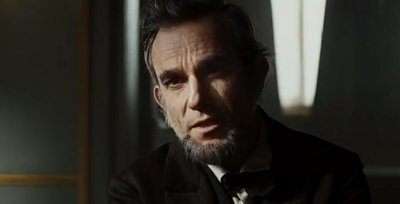
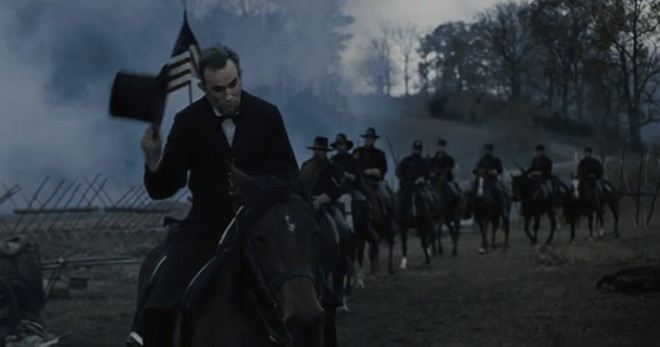
The heart of the film is Daniel Day-Lewis’s performance as Lincoln, which will very possibly win him a well-deserved third Academy Award.  Beyond the superficial elements (his resemblance to Lincoln, his remarkable voicework), Day-Lewis captures the heart of our most melancholy president, tall and gangly with a shuffling, stooped walk and the manner of someone who doesn’t quite seem to occupy the same space as those around him and yet has such an easy, disaffecting way with story and anecdote that he’s instantly relatable.  This Lincoln has a fascinating kind of tangentiality: his preferred mode of persuasion is telling a story, the meaning of which is often rather ambiguous.  When pressed to make his point more clearly, he manages to summon an anger and eloquence unseen by American audiences since Martin Sheen cursed God in Latin.  Day-Lewis captures the fire and the sadness in Lincoln, he presents him as a man almost destroyed by personal tragedy, an unrivaled national calamity and the unendurable burden of history, for he is fully aware that his is the most important job in the history of his nation, and that if he fails it will mean lifetimes of suffering for untold millions.  He is a man who is consciously prolonging a war for the sake of passing a piece of legislation, knowing as he tours the battlefields full of dead that they died because of his belief in the greater, future good.  The most remarkable thing about Lincoln is that he endured.

Which brings us back to words and actions.  The nature of politics is to lie in the gap between ideals and reality, and Lincoln dramatizes this like no film I know.  The plot of the film follows an attempt to actualize a part of the ideal enunciated at Gettysburg.  The film’s most fully-realized subplot revolves around Thaddeus Stevens, a thunderous opponent of slavery noted for his fiery speeches on the floor of the house and his unwillingness to compromise.  But in order for the Amendment to pass, Stevens must moderate his rhetoric so as to blunt the argument that abolishing slavery is merely the first step on the road to full racial equality.  Everyone knows that’s what Stevens believes, but if he says it in the debate, his side will lose necessary swing votes.  And so, in order to achieve his desired action, Stevens must stand mute and refuse to articulate his true beliefs.  How he threads this needle and outwits his interlocutor with an inspired burst of invective is one of the film’s many joyful turns.  Other subplots revolve around rhetoric as well: Lincoln’s attempt to persuade one representative culminating in said Congressman’s joyous cry on the House floor when he finally makes up his mind (a nifty little performance from Stuhlbarg); a semantical error a Democrat makes on the nature of the peace expedition that nearly undoes the whole project but for Lincoln’s lawyerly sophistry; even the final resolution between Lincoln and Mary, as she finally understands the enormity of the responsibility and grief he suffers under only because he had until then refused to articulate it in words, preferring to allow himself to be silently crushed under its weight for the good of the nation.

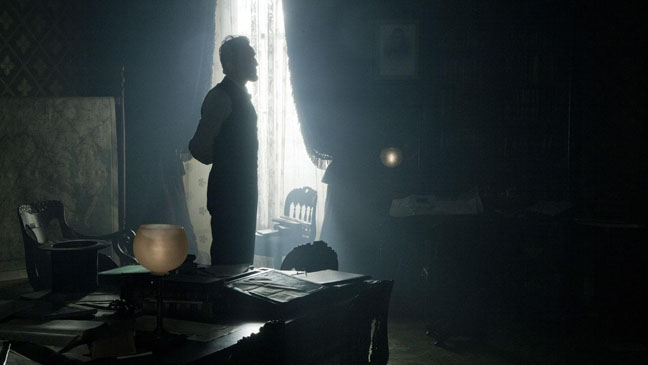
Ultimately, of course, the Amendment passes and the film might have ended there, ten weeks before the assassination.  But Spielberg isn’t quite finished: instead we jump to Lincoln’s last night where we see him leave the White House for the final time, receding into silhouette as his butler looks back at him like he’s had one of those movie premonitions that cause double takes.  The sequence has a cloyingness that the film for the most part avoids: for much of the film Spielberg restrains his natural schmaltziness in favor of a pared-down visual style to match the film’s dingy, drained, Eastwood-grey color palate.  When the assassination does come, we don’t see the action at Ford’s Theatre, rather we see Lincoln’s youngest son hearing the news at a different theatre across town (thus Spielberg manages needlessly to drag a child into a film that is otherwise entirely about adults, as he’s done in pretty much every one of his films for the last 30 years).  Why this should be is not entirely clear (surely there are far more interesting ways of dramatizing Lincoln’s last night, with its triple assassination attempts, and so on; at least they made a call on Stanton’s pronouncement after Lincoln’s death: he belongs to the ages, not the angels) but it does lead to an interesting postscript.

After Lincoln’s death, we cut to a scene set a few days earlier, the end of his Second Inaugural Address.  Paralleling the film’s open, we’re given a profound rhetorical statement which does not (yet, 150 years later) match our nation’s reality.  But now, we don’t have a Lincoln to struggle to actualize these beliefs on our behalf.  The film thus ends with an exhortation, a challenge.  It doesn’t have the volcanic fire of War Horse‘s final scene, a family reunion in the midst of a destroyed world.  Like in most of the rest of the film, Spielberg’s aesthetic showmanship is subordinated to the words. It’s just a man giving a speech to a crowd. . . unless it becomes something else.

Fondly do we hope, fervently do we pray, that this mighty scourge of war may speedily pass away. Yet, if God wills that it continue until all the wealth piled by the bondsman’s two hundred and fifty years of unrequited toil shall be sunk, and until every drop of blood drawn with the lash shall be paid by another drawn with the sword, as was said three thousand years ago, so still it must be said “the judgments of the Lord are true and righteous altogether.”
With malice toward none, with charity for all, with firmness in the right as God gives us to see the right, let us strive on to finish the work we are in, to bind up the nation’s wounds, to care for him who shall have borne the battle and for his widow and his orphan, to do all which may achieve and cherish a just and lasting peace among ourselves and with all nations.