On Lincoln

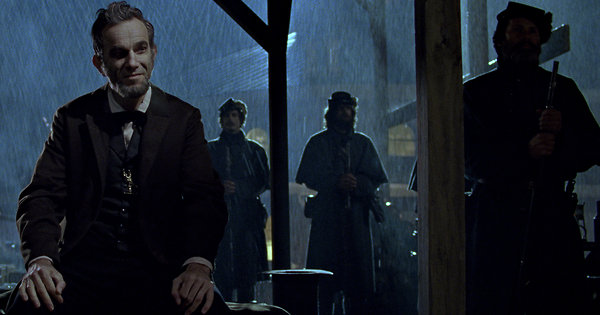
Steven Spielberg’s Lincoln begins with the President talking to a pair of black soldiers after a battle, one praising him for being such a swell President, the other insisting he do something about the inequality in pay between black and white servicemen.  The threesome is joined by a pair of white soldiers, one of whom compliments Lincoln on, and then begins to recite, his Gettysburg Address.  He trails off, forgetting the ending, but as the four soldiers turn to leave, the one who’d been berating him turns, looks Lincoln in the eye, and finishes the speech:

 It is rather for us to be here dedicated to the great task remaining before us—that from these honored dead we take increased devotion to that cause for which they gave the last full measure of devotion—that we here highly resolve that these dead shall not have died in vain—that this nation, under God, shall have a new birth of freedom—and that government of the people, by the people, for the people, shall not perish from the earth.

Thus are the terms of the conflict we are about to watch set in motion.  Not a hagiographical biopic about a national saint, but a gritty, detailed look at the machinations required to turn rhetoric into action, and about the gulf that lies between the ideals we hold and express in words and the reality of what we are actually able to achieve in our debased, messy world.

The bulk of the film plays much like an extended, 19th Century-set episode of The West Wing (it’s got the same highly entertaining mix of political seriousness and fast-talking humor, though instead of the TV series’s famed “walk and talk” steadicam sequences, we get a lot of “sit and talks”), as Lincoln and his cabinet try, in January of 1865, to round up the necessary 20 Democratic votes to pass the 13th Amendment (abolishing slavery) in the House of Representatives.  The first section of the film is an expositional wonder, as not only are the main characters (including Secretary of State William Seward (David Strathairn), Republican poobah Preston Blair (Hal Holbrook), radical abolitionist Thaddeus Stevens (Tommy Lee Jones) and various members of the White House-hold, among others) introduced and motivated, but the political issues involved are explained with a detail, clarity and respect for the audience’s intelligence that’s extremely rare in a Hollywood film.  All credit should go to playwright Tony Kushner’s screenplay, based on Doris Kearns Goodwin’s fascinating and engrossing book Team of Rivals.  It’s as good if not better than anything I’ve seen from Kushner, and that’s saying a lot for the author of Angels in America.  Lincoln’s explanation of the complex tangle that is the suspect legality of the Emancipation Proclamation, and why it must be superseded by a Constitutional Amendment before the war ends is a wonder of relatable wonkery.  After this exposition, the film settles in as a classic race against time: the President’s men must get the necessary votes before a peace expedition from the South arrives in Washington to surrender.  If the South is willing to surrender, then no one but the most radical Republicans will vote for Abolition and slavery will continue, conceivably forever.  A trio of fixers (James Spader, John Hawkes and Tim Blake Nelson) is assigned to the task of persuading the Democrats (Walton Goggins and Michael Stuhlbarg, among others) without bribing them, while Lincoln stays on the sidelines, coping with his home life (manic depressive wife Mary (Sally Field) and his two sons, the oldest of whom, Robert (Joseph Gordon-Levitt) wants to enlist) while trying to keep the various factions within his own party and cabinet from undermining his efforts.
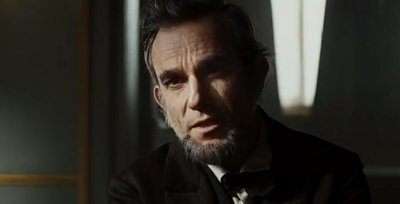
The heart of the film is Daniel Day-Lewis’s performance as Lincoln, which will very possibly win him a well-deserved third Academy Award.  Beyond the superficial elements (his resemblance to Lincoln, his remarkable voicework), Day-Lewis captures the heart of our most melancholy president, tall and gangly with a shuffling, stooped walk and the manner of someone who doesn’t quite seem to occupy the same space as those around him and yet has such an easy, disaffecting way with story and anecdote that he’s instantly relatable.  This Lincoln has a fascinating kind of tangentiality: his preferred mode of persuasion is telling a story, the meaning of which is often rather ambiguous.  When pressed to make his point more clearly, he manages to summon an anger and eloquence unseen by American audiences since Martin Sheen cursed God in Latin.  Day-Lewis captures the fire and the sadness in Lincoln, he presents him as a man almost destroyed by personal tragedy, an unrivaled national calamity and the unendurable burden of history, for he is fully aware that his is the most important job in the history of his nation, and that if he fails it will mean lifetimes of suffering for untold millions.  He is a man who is consciously prolonging a war for the sake of passing a piece of legislation, knowing as he tours the battlefields full of dead that they died because of his belief in the greater, future good.  The most remarkable thing about Lincoln is that he endured.

Which brings us back to words and actions.  The nature of politics is to lie in the gap between ideals and reality, and Lincoln dramatizes this like no film I know.  The plot of the film follows an attempt to actualize a part of the ideal enunciated at Gettysburg.  The film’s most fully-realized subplot revolves around Thaddeus Stevens, a thunderous opponent of slavery noted for his fiery speeches on the floor of the house and his unwillingness to compromise.  But in order for the Amendment to pass, Stevens must moderate his rhetoric so as to blunt the argument that abolishing slavery is merely the first step on the road to full racial equality.  Everyone knows that’s what Stevens believes, but if he says it in the debate, his side will lose necessary swing votes.  And so, in order to achieve his desired action, Stevens must stand mute and refuse to articulate his true beliefs.  How he threads this needle and outwits his interlocutor with an inspired burst of invective is one of the film’s many joyful turns.  Other subplots revolve around rhetoric as well: Lincoln’s attempt to persuade one representative culminating in said Congressman’s joyous cry on the House floor when he finally makes up his mind (a nifty little performance from Stuhlbarg); a semantical error a Democrat makes on the nature of the peace expedition that nearly undoes the whole project but for Lincoln’s lawyerly sophistry; even the final resolution between Lincoln and Mary, as she finally understands the enormity of the responsibility and grief he suffers under only because he had until then refused to articulate it in words, preferring to allow himself to be silently crushed under its weight for the good of the nation.
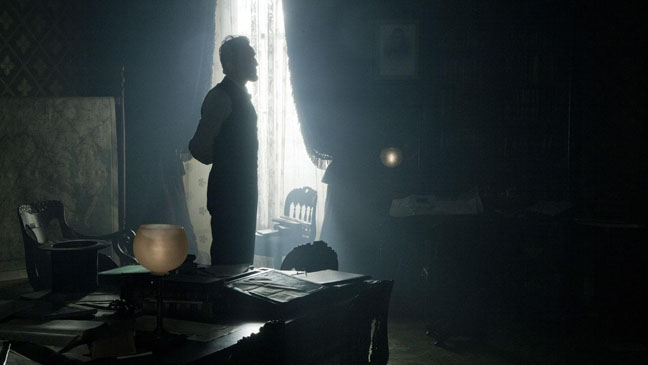
Ultimately, of course, the Amendment passes and the film might have ended there, ten weeks before the assassination.  But Spielberg isn’t quite finished: instead we jump to Lincoln’s last night where we see him leave the White House for the final time, receding into silhouette as his butler looks back at him like he’s had one of those movie premonitions that cause double takes.  The sequence has a cloyingness that the film for the most part avoids: for much of the film Spielberg restrains his natural schmaltziness in favor of a pared-down visual style to match the film’s dingy, drained, Eastwood-grey color palate.  When the assassination does come, we don’t see the action at Ford’s Theatre, rather we see Lincoln’s youngest son hearing the news at a different theatre across town (thus Spielberg manages needlessly to drag a child into a film that is otherwise entirely about adults, as he’s done in pretty much every one of his films for the last 30 years).  Why this should be is not entirely clear (surely there are far more interesting ways of dramatizing Lincoln’s last night, with its triple assassination attempts, and so on; at least they made a call on Stanton’s pronouncement after Lincoln’s death: he belongs to the ages, not the angels) but it does lead to an interesting postscript.

After Lincoln’s death, we cut to a scene set a few days earlier, the end of his Second Inaugural Address.  Paralleling the film’s open, we’re given a profound rhetorical statement which does not (yet, 150 years later) match our nation’s reality.  But now, we don’t have a Lincoln to struggle to actualize these beliefs on our behalf.  The film thus ends with an exhortation, a challenge.  It doesn’t have the volcanic fire of War Horse‘s final scene, a family reunion in the midst of a destroyed world.  Like in most of the rest of the film, Spielberg’s aesthetic showmanship is subordinated to the words. It’s just a man giving a speech to a crowd. . . unless it becomes something else.

Fondly do we hope, fervently do we pray, that this mighty scourge of war may speedily pass away. Yet, if God wills that it continue until all the wealth piled by the bondsman’s two hundred and fifty years of unrequited toil shall be sunk, and until every drop of blood drawn with the lash shall be paid by another drawn with the sword, as was said three thousand years ago, so still it must be said “the judgments of the Lord are true and righteous altogether.”
With malice toward none, with charity for all, with firmness in the right as God gives us to see the right, let us strive on to finish the work we are in, to bind up the nation’s wounds, to care for him who shall have borne the battle and for his widow and his orphan, to do all which may achieve and cherish a just and lasting peace among ourselves and with all nations.
 

VIFF 2012: Memories Look at Me

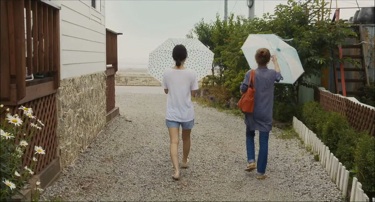
After several days of festival movies filled with storytelling gimmicks and dazzling displays of artistic virtuosity, I was utterly unprepared late on my fifth day at VIFF for the hyper-mellowness of Song Fang’s debut film about visiting her family as an unmarried adult.  It’s a fuzzy blanket of a movie, a fuzzy blanket of death.  You’ll recognize Song as the Chinese student in Paris in Hou Hsiao-hsien’s Flight of the Red Balloon, and she plays herself here beside her real-life parents as they discuss mundane family events and history in dialogue that is largely scripted but feels improvised.  The movie is thus a lot like a Liu Jiayin film, but where Liu foregrounds her formal playfulness Song seems to be trying to erase any sense of artificiality from her filmmaking.  Her takes are long but not ostentatiously so and in some scenes she even uses traditional analytical editing where the demands of minimalism would require a long take.  She cuts axially out of and into a frame and sometimes the camera moves, but never for its own sake.  Much of the film is confined to a single set, her parents’ apartment, and Song uses different set-ups in the same locations to give a sense of variety to what could otherwise be a very static, boring space.

The plot is structured around a series of conversations between Song, her parents, her brother and an aunt and uncle.  The conversations invariably turn out to be roundabout ways of nagging Song to answer one simple question, finally posed halfway through the film: “How long will you go on living alone?”  There’s a cautionary tale about a great uncle who remained single and ending up staying up all night and sleeping all day, a long talk about taking care of a family friend sick with cancer, long shots of family members cutting each other’s finger nails and so on.  It’s a question Song is clearly asking herself: the more she stays, the more nostalgic she gets for her youth, when she lived at home and had people to take care of and who would take care of her.  Family as a bulwark against the solitude of death.

The high point in the film is when Song’s brother comes to visit and promptly falls asleep.  Soon, everyone else is napping too.  I love when people take naps in movies (see for example, Chungking Express) and this has got to be the purest depiction of the joys of the warm afternoon nap ever committed to film.  But as Song watches her parents sleeping, first her father, alone in closeup, then her mother bedside him, the film’s melancholy heart breaks.

VIFF 2012: Moksha: the World or I, How Does That Work?

The longest, most unwieldy title of the festival belongs to this film by Korean director Koo Sungzoo.  It opens with a closeup of a man screaming, shouting for help as he finds himself chained to the ground in the middle of an empty, frozen playground.  How and why he got there is never really explained: he’s a man trapped in a metaphor, and the only way for the film to end is for him to figure out what it all means.  Throughout the film various people walk by and talk to him.  A woman slaps him repeatedly, he chats with a passing drunk, a priest dances for him to achieve “supreme perfect wisdom” (“Don’t dance, call the police!” the man desperately pleads).  He gets yelled at by a crazy bride on her way to a wedding, he shouts angrily at a phantom “crazy filmmaker”, he has a conversation with Edgar Allen Poe (apparently, I missed this but Koo and Tony Rayns discussed it in the post-film Q & A), at some point comes the realization that “the afterlife is awful but you can’t kill yourself because you’re already dead.”

This is all suitably weird, but the film is necessarily limited to its central metaphor.  There’s not a lot of mystery about what it all means, and in a Dragons & Tigers series dominated by films about death (I saw five of the eight films in the competition, this one along with A Mere Life, Memories Look at Me, A Fish and the eventual winner, Emperor Visits the Hell and they are all more or less explicitly about death and/or the afterlife) this is probably the least subtle and the least resonant.  It plays as more of a thought experiment than a dramatization.  Still, it’s pleasantly off-beat and the central performance by Jang Hyeokjin is impressive considering how central he is to nearly every frame of the film.  The fact that this was probably my least favorite of the films I saw at VIFF this year says less about its quality than it does the quality of the festival as a whole.

VIFF 2012: Something in the Air

The latest film from Olivier Assayas has apparently been retitled After May (a direct translation of its French title, Après mai) for its US release, but I do like this festival title better (though the classic Thunderclap Newman song does not appear in the film).  The original title’s reference is most likely lost on the American audience, which isn’t likely to be familiar with the protests and riots, both political and cinephilic, that rocked Paris in the spring of 1968, but the details aren’t particularly relevant to the story, which fits neatly into the semi-autobiographical coming-of-age-in-the-70s category with films like Almost Famous or Dazed and Confused.  It also, somewhat unexpectedly, makes a neat companion piece to Assayas’s last film, the epic Carlos.

Where that film chronicled the eclipse of ideology by the sheer enjoyment its hero found in acts of destruction, in this one we see the idealism of the leftist political movements of the 1960s dissipate as its teenage protagonists grow up.  The story focuses on Gilles (played by Clément Métayer), an apparent Assayas stand-in, a bookish type who partakes in some (ineffectual) protests, argues the finer points of ideology but is increasingly more interested in girls and art (he’s a painter).  After a bit of vandalism backfires, Gilles and his friends go into hiding, cleverly disguised as a rich kids’ summer vacation in picturesque Italy.  He begins a romance with Lola Créton’s character Christine, a more committed, and very cute, activist while Gilles’s best friend Alain hooks up with a redheaded American (she “studies sacred dance. In the Orient, they still dance for the Gods”).  Meeting up with a radical film crew provides some of the film’s best lines: interested in filmmaking, Gilles asks if he can borrow their equipment sometime and is told “We only do agitprop, we don’t lend for fiction.”  Later, after the filmmaking collective shows one of their documentaries they lead an Q & A, which leads to a priceless encapsulation of the cul-de-sac that is radical politics as different factions of audience and filmmaker argue over whether a “revolutionary cinema requires a revolutionary syntax”, or if revolutionary syntax is simply the “individualistic style of the petit bourgeoisie” and that what they need to do is “enlighten, not shock the proletariat”.  Gilles sums them up later as “boring films with primitive politics”.
The second half of the film, as the kids return home and go their separate ways, is a delicate balance of disillusion and hope for the future, as Gilles becomes less interested in politics and more in love with art and filmmaking in particular.  While Gilles gets a job working for his dad at a TV studio and watches and reads about movies in his free time, along with putting together trippy light show for rock bands, Christine remains a committed lefty while Alain and the redhead drift.  The requisite “decadent 70s” sequence is set at a house similar to the one in Assayas’s Summer Hours.  But where the party that ends that film is all golden sunlight, cheery kids, innocence and beauty, this one is a druggy, fiery haze ending in chaos, death and Captain Beefheart.
In Carlos, Assayas chronicled the descent of 60s radicalism into the kind of nihilistic violence we call terrorism today.  With this film, he tackles the flip side of that same subject, as leftist idealism fragments both in the face of bourgeois temptation (drugs, money, art) and under the weight of its own radicalism.  All radical movements crumble for the same reason: purity becomes more important than reality and the radicals cannibalize themselves (see what’s going on in the GOP right now).  That’s why we’re a little sad to see Christine still helping the collective schlep their boring films around to increasingly small audiences of like-minded radicals, though she alone has remained true to their youthful ideals.  She seems happy, and certainly admirable as a person, but somehow diminished.  Gilles on the other hand is open and expansive, absorbing politics as he absorbs everything else he encounters before eventually moving on to the next discovery, the next world.  We leave him working on a B movie set at Pinewood Studios surrounded by Nazis and dinosaurs, an artist on the ground floor, looking up.

VIFF 2012 Ranking and Links

Here’s a preliminary ranking of the 31 movies I saw this year at the Vancouver International Film Festival, with links to the write-ups I’ve done for them so far.  I’ll be writing about the rest of these over the next few weeks; the pace has slowed lately due to first a cold then parental responsibilities. Hopefully I’ll be able to finish these by the end of the year.
6. Walker
8. Tabu
17. Mystery
18. A Fish
19. The Unlikely Girl
20. East Meets West
21. People’s Park
22. Amour
23. In Search of Haydn
24. 10 + 10
25. Mother
26. Antiviral
27. The Angels’ Share
28. A Mere Life
29. Everybody in Our Family
30. Beautiful 2012
31. Moksha: the World, or I, How Does that Work?Updated Feb. 1, 2013: Rankings updated. Obviously I didn’t finish by the end of the year, but with only six movies left to write about, I hope to finish soon.

Updated July 18, 2015: Only one left. I will finish it someday.

VIFF 2012: Neighboring Sounds

Kleber Mendonça Filho directs the fourth film in what turned out to be a surprisingly strong showing for the Portuguese language at this year’s festival, along with Reconversão, Tabu and The Last Time I Saw Macao.  Three of those focus on the remnants of the Portuguese colonial experience on other continents (Tabu in Mozambique, Macao in China and this one set in Recife, one of the largest cities in Brazil).  In many ways, this is the most conventional film of the bunch, a familiar-seeming network narrative of a few weeks in the lives of the residents of a particular street in a relatively affluent area of town.  As usual, there’s a multitude of tensions bubbling under the placid surface, along class and racial lines as well as the requisite secrets from the past haunting certain folks.  For most of the film’s running time, that tension remains constant but unrelieved, it’s only in the final scenes that some actual violence bursts forth, unfortunately in a bit of an anti-climax.

The most interesting thing about the film is explicitly stated right there in the title: the sound design.  Though the film is set in a few houses and an apartment building on what appears to be a single street, we never get a clear layout of the neighborhood.  It’s disorienting visually, but the sound design knits the space together.  Sounds from one area are constantly bleeding into another, kids playing, dogs parking, cars passing by, the on-screen space is always filled with off-screen sounds.  This is how the neighborhood is experienced: not as a community where everybody knows everybody (all the community gatherings end in disaster, first a hilariously petty condo board meeting, later a birthday party) but as an occupied space that is forever invaded by outsiders’ noise (this is literalized in a zombie-invasion like dream sequence).  The two characters we spend the most time with, a handsome, charming rich guy named João who lives in the high rise and a housewife who buys pot from the water delivery guy, has an affair with her washing machine’s spin cycle and is tormented by the barking dog next door never actually meet.  Their storylines merge somewhat at the end, but only aurally, never visually.

The individual characters do have storylines of their own, but they aren’t quite as conventional as in a network film like Magnolia or Short Cuts, which follow the series of short stories model.  João’s story is my favorite: he falls in love with a woman, they hang out together, they take a trip out of town (the only time we leave the neighborhood) and wander around his grandfather’s estate and its village, walking through the ruins and hearing the sounds of the past (people chattering, a movie-projector humming).  But Mendonça Filho even trips us up there, as the romance plot is resolved entirely off-screen, leaving João to briefly tell another character how it ended.  The film is full of these little bits of rug-pulling that keep the viewer perpetually off-balance.  If the film had left is in that state it would have been great.  Instead, the film wraps things up with a bang in a more or less neat bit of narrative balance.  I want it to end just slightly earlier, just before the crescendo peaks, leaving us forever on the edge of the crash.

VIFF 2012: Three Sisters

By nine o’clock on Tuesday, October 5th, my VIFF experience was four days and fifteen movies old.  I trepidatiously settled in for movie #16, a two and a half hour verite-style documentary about three poor kids in China by acclaimed director Wang Bing (his nine hour documentary West of the Tracks recently tied for 202nd place in the Sight & Sound poll with Manhattan, Cleo from 5 to 7, The Shop Around the Corner, WALL-E, Badlands and There Will Be Blood, among others), wondering if the onslaught of reality, old age and festival-induced sleep deprivation would knock me out.  I armed myself with a “litre” of Mountain Dew and a pack of gummi bears, and when Wang himself, there for a post-show Q & A that would push the night into the morning, wished us all luck in staying awake for his movie, I had a feeling things would work out alright.

The experience of watching the film is much the same as that of any other so-called “Asian minimalist” movie, like something by Tsai Ming-Liang or Jia Zhangke.  The pace is very slow, not a whole lot happens in the long, single-take scenes, and enjoyment of the film depends on one’s interest in watching other people do normal boring things (basic tasks like making soup or cleaning shoes) and also in the willingness to let one’s mind wander.  These types of films are meditative not because they make you think but because in their opiated snail’s pace, they allow you to think.

Various more or less coherent things I thought of while watching this film: what this country needs is a rural electrification project like the one that lifted much of America out of exactly this kind of poverty in the mid-20th Century, Mao’s mid-century reforms had exactly the opposite effect (later in the film, they do appear to have electricity and television, and I may be exaggerating the effects of the New Deal in the US, but still); How do you document the lives of the poor without being exploitative or dilettantish? Is that  just a First World Problem?; The best way to tell if a country is developing economically is if they start making documentaries about poor people; The village is situated high in the mountains near what appear to be run down and out-of-use terraces, I wonder if those terraces are ancient ones that were abandoned in misguided communist land reforms (that led to mass deforestation and erosion), or if they are themselves the misguided reforms.  Either way, they’re being used as sheep food on a wind-scorched landscape now; If this film were sub-titled The Shit Collectors of Yunnan, would that increase its box office?; Can a film be beyond criticism? Does talking about a film like this as a film trivialize its very serious subject, or is the act of making a film about such a subject necessarily trivializing?; Does Truffaut’s assertion that it’s impossible to make an anti-war film apply to anti-poverty films?  Does filmmaking in some ways glamorize poverty?

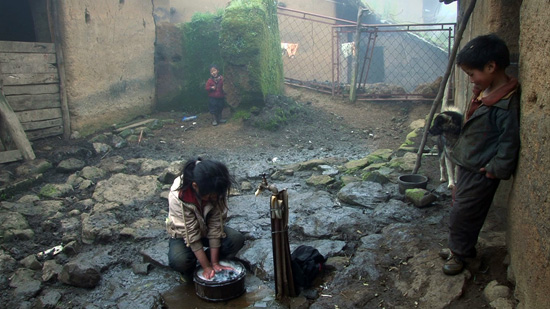
Three Sisters is about three very poor girls who live in a remote mountain village in Yunnan province.  The environment is perpetually damp and foggy, but the kids don’t seem to mind too much (when they’re gathered around a fire drying one of their mud-encrusted shoes, one of them cheerfully exclaims “today we’ll dry your shoes, tomorrow mine!”  Similarly, when checking each other for infestations in what appears to be a nightly ritual, we hear the joyous shout “I found more lice!”).  Their father is away, looking for work in the nearest city, the kids are staying with their grandfather in the village (the mother appears to have run off? I don’t really remember).  We follow them through their various rural tasks (one of them greets another working child in a pasture with a matter of fact “everyone’s out collecting dung today”).  They don’t seem especially miserable, but neither do they seem particularly happy.  They live in a half-modernized world: they have TV and locks on their doors, but little of the labor-saving comforts of the 21st century.  Missing from most of the film are the communal aspects of village life: festivals, religious ceremonies, weddings, funerals, birthday parties, games, storytelling, all those things we lament as lost and celebrate in John Ford films.  Near the end there is an autumn feast at the girls’ uncle’s place in a neighboring village that packs dozens of people into a tiny house for tons of (delicious looking) food and an impromptu political meeting.  It’s not especially cheerful, but at least it looks warm.  

The oldest sister, ten-year old Ying Ying, comes across as a truly heroic figure.  She appears to do most of the farm work (sheep and pig herding, milking, dung-gathering, potato-planting, etc) and takes care of her younger sisters (cooking, cleaning, etc).  She simply does what she has to do.  On the rare occasions she gets to attend school she leans far forward over her desk, straining to take in all she can from her teacher, unable to prevent her desperation to learn from taking physical form.  Wang encourages us not to look at the film as a political statement (“oh isn’t poverty so awful“) but as a story of Ying Ying’s heroism (not that that will get his movie shown in China, but his point is a good one regardless).  She does it all but she doesn’t suffer, she inspires.

VIFF 2012: In Search of Haydn

The third of director Phil Grabsky’s biographical documentaries of famous composers is about as good a film about Joseph Haydn as you’re likely to see.  Unlike the subjects of his first two films in the series, Mozart and Beethoven, Haydn doesn’t have a particularly interesting biography, nor does his music have as ubiquitous a presence in modern life. In fact, his life can be downright dull at times: he seems like a basically decent guy, though not exceptionally so, who was well-employed for most of his life and achieved great success and renown for his work.  Basically the opposite of our ideal tortured artist.  Musically, he appears to be more respected by professionals than loved by the general populace; his name is probably more famous than any of his tunes.

The great strength of Grabsky’s Beethoven film (I haven’t seen the Mozart film yet) was its emphasis as much on the music as on the biography: he has a knack for getting inside the music and showing what is really unique, interesting and powerful about it.  To that end, Haydn presents a bit of a dilemma in that he just wrote so much music: over 100 symphonies and string quartets each, along with operas and keyboard music and more.  Trying to cover it all in the film’s less than two hour running time is next to impossible.  Still, Grabsky does get some fine commenters (Emmanuel Ax and Marc-Andre Hamelin in particular) to explain in lay terms just how experimental and unusual Haydn was, and why he was to be such a huge influence on every composer that followed him, Mozart and Beethoven first among them.

Words and phrases used in the film to describe Haydn’s music: sparkle, spirit, burst of life, surprise, humor, overt, modest, entertaining, great intelligence and seriousness, eloquent, rhetorical, inspirational, spirit, spiritual, exploring, pleasant, music for everybody, democratic, repetitive with long long phrases, not very difficult – but difficult to make beautiful.

The best parts of the movie are the performances.  Not just for the music itself (by the Orchestra of the 18th Century and the Endillion String Quartet, among others) but for the way the film captures them.  There are the standard, Great Performances-style long shots, of course, but Grabsky also frequently intercuts extreme close-ups of the musicians at work: say, the fingerboard of a cello or the strings of a violin.  The performance is broken down to its most basic elements, made physical and tactile.  Music can be so ephemeral, so abstract that grounding it in this way reminds us of its tangible reality, that it is created and performed by people on instruments.  To often music, classical music in particular, is treated as if it were an emanation from on high, divinely inspired by “genius” as a gift to all humanity.  Grabsky’s project is to fight that rarefying impulse, to root the music in the people who wrote it and, just as importantly, in the people who perform it.