A Very Shaw Brothers Christmas: Executioners from Shaolin

Much like the anti-Qing struggle referenced in the first night of A Very Shaw Brothers Christmas, the legend of the destruction of the Shaolin Temple is a common narrative backdrop in kung fu movies.  Respectively they’re kind of akin to the role the Civil War and Little Big Horn play in American Westerns.  The Temple story is also a subset of the larger Qing-Ming war, as in addition to being a Buddhist monastery with a sideline in innovative kung fu techniques, the Temple was also, according to legend, a center for anti-Qing activism in the decades after they took over the country (late 1600s-early 1700s).  Central to the story is the character of Pai Mei (or Bak Mei), one of the five elders who survived the burning of the Temple and in some versions of the story brought about its destruction by collaborating with the Qing (he’s the Shaolin Judas or Benedict Arnold).  You might recognize the name from Kill BIll Vol. 2, where Pai Mei is the white-robed kung fu master who instructs all of David Carradine’s assassins, including Uma Thurman.  In that film, Pai Mei is played by the great Shaw Brothers star Gordon Liu, made up with a long white beard and eyebrows (“Pai Mei” apparently means “white eyebrows”).

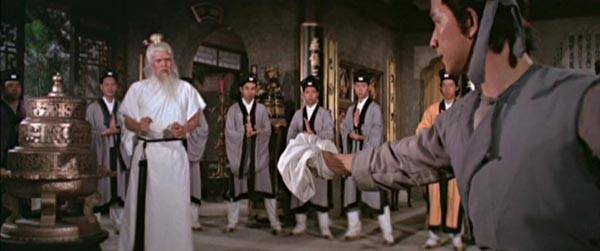
Gordon Liu plays a small but notable role in Executioners of Shaolin, directed by his adopted brother Lau Kar-leung.  The two would of course make several great films together over the next decade, the greatest of which was made the next year, 1978’s The 36th Chamber of Shaolin, which takes place earlier in the Temple’s history and chronicles its entrance into the wider political struggle.  Executioners starts at the end of the battle for the Temple, with a fight between Pai Mai (played by Lo Lieh) and one of the temple masters played out before an abstract red backdrop as the credits roll, a Lau trademark.  After Pai Mai kills him, we cut to various monks fleeing the destruction and Gordon Liu gets his standout scene as he takes on the Qing forces so his brothers can escape.  From then, the film follows the life of Hung Hsi-kuan, played by The Flying  Guillotine star Chen Kuan-tai as he practices for 20 years or so to avenge his master’s death.

But here’s where the film gets weird.  Instead of simply training and working out the various martial tactics he’ll need, as in many another kung fu film (Shaolin Mantis, say, or in the best case, The 36th Chamber of Shaolin) or the search for a kind of spiritual enlightenment that’ll provide him with untold power (The Tai Chi Master or 8 Diagram Pole Fighter), Hung meets a nice girl, gets married and has a son.  The whole middle section of the film is in fact a marital comedy.  Hung meets Ying Chun, played by Lily Li, when he and his fellow fugitive monks are posing as street performers and keep interrupting her own performances.  They argue over whose kung fu is superior: his Tiger Style or her Crane Style and end up falling in love.  Over the next decade, while she does the laundry and raises their son and he trains to defeat Pai Mai, he repeatedly rejects her suggestion that he learn some of her Crane Style too.  When ten years have gone by, he challenges Pai Mai and loses, but escapes.  Pai Mai’s secret is that he can move his vital points (attacking said points are the key to defeating him) from his groin to his head at will, such that when Hung (and his master before him) kick Pai Mai there, their foot gets stuck in the empty space where his testicles should be.  Hung goes back to the drawing board (in this case, a copper statue filled with marbles, I’m unclear how this works) and figures out that he needs to attack Pai Mai only at certain times of day.  He trains for seven more years, again refusing to adopt elements of his wife’s Crane Style, challenges him again and loses.

Here the son, Wen-ding, enters the picture.  By his father’s orders, he’s only been trained in his mother’s kung fu style.  But the two of them find an old moth-eaten Tiger Style manual and Wen-ding trains for a year to take on Pai Mai.  By using a combination of both his parents’ styles, Wen-ding is able to defeat Pai Mai.  So, the unstoppable villain is a man who can willfully castrate himself.  A man alone is unable to defeat him, no matter his skill at the manly (Tiger) style of fighting.  Only through the combination of male and female (Crane) styles can he be bested.  Yin or Yang alone cannot defeat the void, the absence of Yin or Yang, it needs to be a balance of both together.
I’m not sure how much of the Hung story is original and how much based in legend.  It sounds very similar to the stories about Fong Sai-yuk, whose mother trained him in kung fu (she was the daughter of one of the Five Master of the Shaolin Temple who survived its destruction) while his father was active in anti-Qing resistance.  In one version of the legend, Fong Sai-yuk is killed by Pai Mai.  Jet Li played Fong in a pair of excellent films from the early 90s, but neither of them make reference to Pai Mai or the Temple, as far I as can remember.

Lau would return to the martial arts as marital comedy style of film to great effect a few years later in Heroes of the East (aka Shaolin vs. Ninja) in which a married couple argue over which nation’s martial arts are superior, his Chinese or her Japanese.  But I don’t think I’ve seen anything like the transgressive view of gender on display here from Lau before, or in any other kung fu film, for that matter.  Not until the gender-bending of Ching Siu-tung’s Swordsman II at least, and even that film is pretty misogynistic.
A Very Shaw Brothers Christmas: The Flying Guillotine

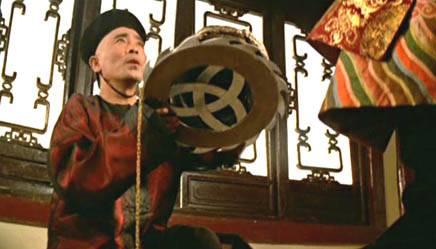
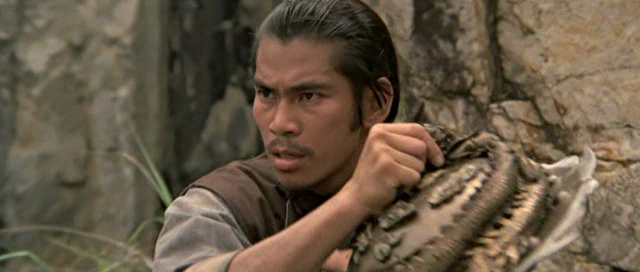
A crazed Qing Emperor suspects everyone around him of disloyalty, and when two well-respected advisors dare to suggest that maybe he shouldn’t have killed a bunch of innocent teachers and intellectuals, he decides to kill them, along with anyone else who might be disloyal.  He tasks another advisor with developing a hit squad of a dozen assassins utilizing that advisor’s newly developed super-weapon, the flying guillotine, a combination of razor-sharp frisbee and basket on a chain that in trained hands can decapitate a person from 100 yards and occasionally, inexplicably, explode.

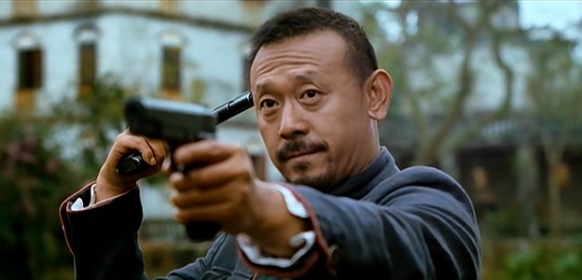
Inevitably, certain members of the squad, though initially chosen for their martial arts skill and loyalty to the Emperor, begin to have second thoughts when they realize the nature of the people they’re assigned to brutally murder. This leads to the revolt and escape of the group’s most talented member, Ma Teng, played by Chen Kuan Tai (one of the villains in Crippled Avengers and one of the aged stars of Clement Cheng’s Gallants).  The multi-year hunt for Ma, combined with the self-serving schemes of the most evil member of the squad (Ah Kun, played by Wai Wang), tears the group apart and eventually kills them all.  The Emperor, of course, survives unscathed.

Director Ho Meng Hua is one of the lesser-known Shaw Brothers directors, though he was one of their most prolific.  He started there in the mid-50s, working in all kinds of genres before the kung fu boom of the late 60s and 70s.  I’ve seen a few of his other movies (The Lady Hermit, Vengeance is a Golden Blade and Shaolin Handlock) and while they’re all fine, he hasn’t really stood out to me, this is easily the most creative visually (lots of Lo Wei-style overhead shots to go along with the expected excellence in action editing) and interesting politically.  Lots of kung fu movies are set during the early years of the Qing dynasty, when the northern Manchu took over the country from the Ming Dynasty, leaving the nation’s dominant ethnic group, the Han, powerless for the first time in 2000 years or so (not counting the few hundred years of Mongol rule).  The situation is ripe for allegorical interpretation.  Whether you’re a Maoist celebrating the struggle against first the sclerotic Qing, then the invading Japanese and finally the Nationalist Kuomintang or an anti-communist refugee fled to British-ruled Hong Kong, you can see yourself on the side of right in the Ming-Qing battle.  Even Chinese gangsters (triads) like to see themselves as descendants of the secret pro-Ming societies that fought the Qing (see Johnnie To’s Election for the triads’ view of themselves as historical actors).

What we get with The Flying Guillotine comes at the tail end of the Cultural Revolution on mainland China, a decade of government-sponsered internal terrorism, with intellectuals, teachers, and just about anyone else being purged for lack of loyalty to the regime and/or ideological incorrectness.  In the film, we see the inner-workings of an assassination squad, under the thumb of an Ivan the Terrible-like emperor and armed with an unstoppable weapon.  Even under these circumstances, though, basic human decency shines through, as Ma Teng (and a couple other assassins) see the light and do their best to escape (the Emperor is far too powerful to actually be defeated).  On the run, Ma starts a family and lives a noble, peaceful life as a farmer, his drive to quiet domesticity contrasted with Ah Kun’s deceitfulness and backstabbing ambition that leads to the disintegration of the hit squad.  So, the film is therefore a neat allegory for the strife caused by the tyrannical PRC over the previous decade, with subjects encouraged to fight amongst themselves or simply hide-out, unable and unwilling to challenge the dominant power structure.  Or, conversely, the life of a peasant farmer was idealized during the Cultural Revolution: those intellectuals who survived got themselves corrected by being sentenced to the country to work on collective farms.  Thus, the film is about the struggle of the decent, communist farmer against the destructive ambitions unleashed by modern capitalism, with the Emperor standing in for the KMT’s dictator Chiang Kai-shek and Ah Kun, I don’t know, Nixon or somebody.  Or maybe it’s about the revolution in general, about how radical revolutions always decay into petty in-fighting over ideological purity leading to mass execution as happened in Russia, China and France (“guillotine!”).  Such are the perils of political allegory in Chinese film.  It is, after all, a nation that allows Taiwan to be its own country as long as everyone pretends it’s actually part of China.

Also, lots of people get their heads cut off.  That flying guillotine really is a horrific sight, and Ho does well to match it with the sound of it spinning through the air, such that by the end of the film, all it takes is that distinctive whir to set us on edge, unconsciously shrink our heads into our shoulders and wish we had ourselves a steel umbrella.

VIFF 2012: East Meets West

Jeffrey Lau’s 1994 film The Eagle Shooting Heroes stands out among the weird and wacky world of Hong Kong comedies as possibly the weirdest and wackiest, at least in my fairly small sampling. A parody of the same source material that formed the basis for Wong Kar-wai’s Ashes of Time, and featuring most of the same cast (it was shot either concurrently or just after that film, in an attempt to recoup some of the epic’s cost overruns), it sticks mainly in my memory as the film in which the great Tony Leung spends much of his screen-time impersonating a duck. Lau also directed the two-part Stephen Chow epic A Chinese Odyssey, which is weird even for Stephen Chow.

So it was with much excitement that I rushed from the screening of People’s Park to see East Meets West, which may or may not be a sequel to The Eagle Shooting Heroes (I didn’t think it was at all, but a comment at imdb says so, and they’re usually right, right?). I was not disappointed.

It starts with a lightning fast 30 minutes or so, when a whole bunch of characters are introduced, and back stories given, while jokes fly by faster than edits. One character, played by Karen Mok, finds her father, a former major pop star played by former major pop star Kenny Bee working in a haunted house: “being a zombie is a perfectly respectable profession!” They set off to find her hated step-mother (“It’s God’s will that I go to Guangzhou to chop the bitch!”) who has gotten them into trouble over some debts.  They hook up with a rich girl musician, her bodyguard, a single dad and his son and a wannabe actor/cab driver as they flee from hordes of homeless musicians (“Don’t drive so Donnie Yen!”) and reunite Bee’s band (“The Wynners”) to hold a fund-raising concert.

I saw Kenny Bee for the first time earlier this year in one of Hou Hsiao-hsien’s first movies, the mediocre romantic comedy Play While You Play (aka Cheerful Wind), so it was a treat seeing him here, 30 years later. He’s not as charismatic or funny as Teddy Robin, another 70s pop-star was in his hopefully career-reviving performances in 2010’s Gallants, Merry-Go-Round and Detective Dee and the Mystery of the Phantom Flame, but he’s a lot better here than he was in that Hou movie.

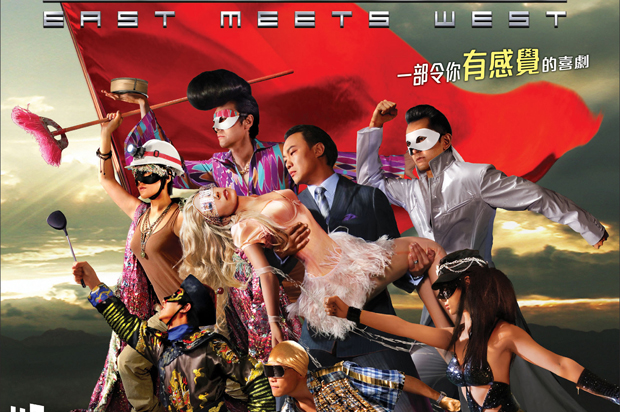
Anyway, it turns out these people are all reincarnations of a group of gods that have been fighting a multi-millennia struggle against the eighth of their group, who became twisted and evil and defeats them in every lifetime. Lau has a lot of fun with the superheroes in the modern world conceit (their makeshift costumes are terrific: a bicycle hemet, a face covered with flour, single-lensed sunglasses, etc), a pleasant contrast with the bleak and miserable worlds of Hollywood films like Kick-Ass or Christopher Nolan’s Batman movies. And while the special effects are merely OK compared to the state-of-the-art, giving the films a kind of plastic, phony sheen found also in recent films from Tsui Hark, Lau manages to create some nice, memorable images (though he doesn’t quite have Tsui’s skill as a visual filmmaker). The film loses some narrative steam towards the end, but it never stops being fun and clever. Even when Lau goes for sap, it goes for the biggest, gooiest, cheesiest love-conquers-all-even-a-heart-ten-sizes-too-small sap it can muster.

VIFF 2012: People’s Park

A few thoughts I jotted down while watching People’s Park, a single-take documentary set in a park in the city of Chengdu, Sichuan by directors JP Sniadecki and Libbie Cohn:

  • So this is a lot like Russian Ark, the single-take trip through the Hermitage directed by Alexander Sokurov, except that film was fictional and moved freely through time as it compressed and stretched hundreds of years of history into its one shot, whereas this film is a real-rime documentary, and therefore rooted in the present. A present which is now past, but that’s beside the point.
  • There’s no subtitles and no story. Nothing appears to have been staged for the camera. But we’re narrative-creating beings and not even the simple act of people-watching can stop us from making up little stories about the faces we see. That kid is sad, that man is hungry, those people are in love, those people can barely stand to talk to each other, etc.
  • As the camera tracks along a bend in a small stream, the next film that comes to mind is Renoir’s A Day in the Country. And also People on Sunday. Great films from the thirties about middle class Europeans hanging out in a public park on a sunny afternoon. 
  • Also the city symphony genre (À propos de Nice, Man with a Movie Camera). Why did they stop making those? 
  • These middle class Chinese folk are no different. In fact, they seem thoroughly Westernized. One guy flashes a peace sign at the camera. Almost everyone wears Western clothes. I see: jeans, T-shirts, slacks, print dresses, polo shirts, cargo shorts, sneakers, capri pants, cowboy hats. I wonder if these clothes have been adopted because they’re ‘evolutionarily’ better than traditional Eastern clothing, or is it cultural, Hollywood, imperialism, like the way Clark Gable killed the undershirt industry with It Happened One Night, or James Dean caused a boom in blue jeans?
  • Is there a specific term for fashion historians? What are their internal disputes like? Are there competing models of fashion history? Are there leftist factions that rail against the imperialist machine? Do they advocate a revolutionary fashion as a consciousness-raising measure? Do they assert that you can’t fight the fashion hegemony while wearing the clothing style of the elites?
  • That said, there is one big difference between their clothes and what you’d see in any given US city park: an almost total lack of logos, either corporate or team sports-related. In general there are just a lot fewer shirts with writing on them.
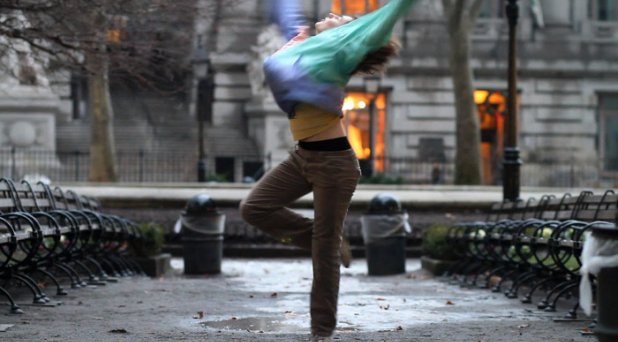
  • There’s so much music in this park. A band decked out in orange and white polo shirts leading a sing-along. People dancing in a square, not quite in time to the music coming from a loudspeaker. A long arcade is home to a band playing traditional Chinese instruments, as well as a group of people doing karaoke.
  • The sounds in the arcade clash, reverberating against its columns creating an atonal distortion much like that Charles Ives recreated in Central Park in the Dark, which captures the sonic experience of walking through the park as sounds fade in and out, inspired by his father’s habit of sending two marching bands in opposite directions around a square, smashing their sounds together and breaking them apart.
  • After cruising through the cacophonous arcade, suddenly we break back outside where we see: couples dancing a waltz. A breath of classical air after the oppressively fuzzy modernity.
  • Near yet another band playing, there’s a man doing calligraphy in water on the stone walkway. Nearby is a kebab stand selling hot dogs on sticks. Meats on sticks is a universal human value.
  • In the end we’re back where we started: a group of people dancing to pop music (Michael Jackson is a universal human value) in a large plaza. These dancers are more professional than the out-of-time folks that started the film though. They seem like a descendant of Jia Zhangke’s breakdancing troupe from Platform. Except for the old man who dances with a chicken. I have no idea where that comes from.

This Week in Rankings

The Haunted Hotel – 4, 1907
Lightning Sketches – 5, 1907
The Artist’s Dreams – 2, 1913
Down on the Phoney Farm – 6, 1915
Bobby Bumps Starts for School – 5, 1917
Firemen Save My Child – 8, 1919
The Bomb Idea – 10, 1920
Springtime – 6, 1923
A Trip to Mars – 8, 1924
Scents & Nonsense – 9, 1926

Broadway Melody of 1936 – 12, 1935
Rosalie – 22, 1937
Broadway Melody of 1938 – 26, 1937
Broadway Melody of 1940 – 14, 1940

The Tell-Tale Heart – 23, 1953
Ben-Hur -23, 1959