They Shot Pictures #17: Sammo Hung

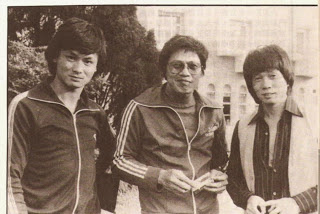
While Seema is out of town, Jhon Hernandez of Cinema on the Road and I snagged the keys to They Shot Pictures and recorded an episode all about Sammo Hung. We cover his Magnificent Butcher, Wheels on Meals and Pedicab Driver, and a bunch of other kung fu movie topics as well, including: Jackie Chan, Yuen Biao, Yuen Woo-ping, Tsui Hark, Jet Li, Lau Kar-leung, Wong Fei-hung, the tastelessness of certain Hong Kong comedies and how Wong Jing is to blame for all of it. Jhon’s mic is pretty bad, sorry about that. It does get better around the 15 minute mark.

You can find the episode over on the They Shot Pictures website, or by subscribing in iTunes. Next up on the show will be Seema talking Abbas Kiarostami. Next up for me around the end of this month will be the first of our shows on John Ford, covering his Westerns Stagecoach, She Wore a Yellow Ribbon and Two Rode Together. Details can be found on the Upcoming Episodes page.

Summer of Sammo: Intimate Confessions of a Chinese Courtesan


I’ve declared this the summer of 2013 to be the Summer of Sammo. Throughout these months I’ve been writing about films starring or directed by Sammo Hung, as well as other Hong Kong genre films of the Sammo Hung era. Here’s an index.


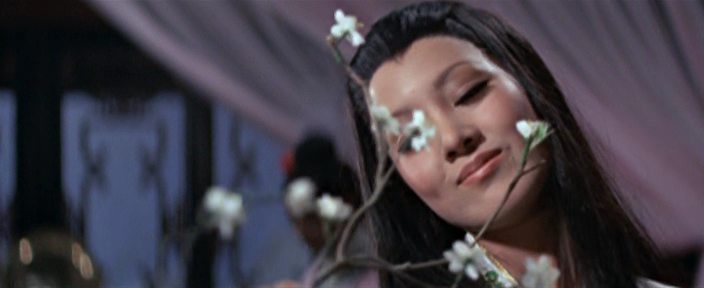
As angry and passionate an attack on institutional prostitution as anything you’ll see from Mizoguchi or anywhere else, director Chor Yuen uses all the opulent romanticism of the Shaw Brothers style at its peak to expose the twisted black heart of the brothels that casually make up the background of so many adventure films. Kidnapped and enslaved to a whorehouse, the hero Ainu is beaten and raped (by the leading citizens of the town) into submission. The one man who tries to help her is a servant at the brothel who knows that what is happening is evil but pretends to be mute. When eventually he attempts to save her, he proves too weak. Later, as she begins taking her revenge, killing all the men who abused her one by one, the local police officer tries to stop her. Though he’s not unsympathetic to her cause, the law prosecutes murderers and is not interested in what goes on behind whorehouse doors. As one of his fellow cops tells him, “Whores have no history. They are either forced or they volunteer.” The tautology of that second sentence sticks with me: of course those are the only two options. The state is willfully ignorant. Ainu can only protect herself, and she does so by twisting the lust of her tormentors against themselves, not just her ‘clients’ but also the madam who loves her. “You deserve to die, you horny bastard.” Ainu tells one of her victims, and its hard for us to disagree with her.

This idea of revenge lies at the heart of so many kung fu films, and many action films in general. Not just in Hong Kong, but also in the vigilante cycle of American action films that popped up also in the early 1970s (Death Wish, the Dirty Harry movies and so on), as well as the series of rape/revenge horror movies that Courtesan could be more specifically identified with. In talking about his 1986 film Righting Wrongs (aka Above the Law), in which he plays a prosecutor who begins killing the gangsters he can’t legally convict, Yuen Biao specifically identifies this as a Western theme, as something they’re borrowing from American action films. I don’t know that the theme becomes substantially different when filtered through Confucian/Buddhist ethics instead of Judeo-Christian ethics. These things are universal.

What differentiates this film from the typical Shaw revenge fantasy is the sexual nature of the crimes (at this point Shaws was a pretty chaste studio, though that changed as the 70s progressed, with competition from the more graphic Golden Harvest studio) and the identification of the audience with the victim. In many a kung fu film, the hero is taking revenge for crimes committed against his family, his master, and only occasionally himself (usually he gets beaten up by the villains). For example, in Sammo Hung’s directorial debut The Iron-Fisted Monk, the hero comes to the aid of a friend, a dye-worker who’s wife, mother and sister have been raped and murdered by local thugs. The revenge motive is there, but the audience is somewhat distanced from the experience, though Hung depicts the rapes more explicitly. Director Chor, however, locks us into Ainu’s point-of-view from the beginning of the film and we stay there for the first 20 minutes or so as she’s abused (though he tastefully freezes the frame rather than graphically depict the rapes, not that that decreases the horror). As such, we in the audience find ourselves greatly looking forward to her revenge. It’s here that Chor slows the pace for the last hour, giving us space to think about the consequences and meanings of her, and our, blood lust. Yes, we’ll get the catharsis of seeing the villains punished, but the mise-en-scene complicates that satisfaction.

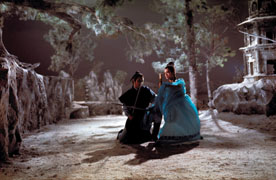
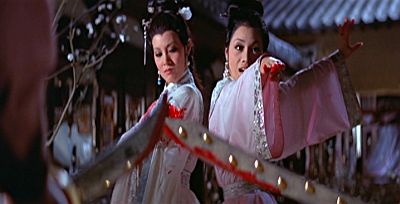
This might be the most pictorially beautiful Shaw Brothers film I’ve ever seen, opposing the ugliness of the subject matter with lushly romantic environments. Typically gorgeous period costumes and sets are blanketed by a layer of snow and moonlight, giving these scenes of horrible vengeance a kind of magical, fairy tale quality. Chor’s staging is never uninteresting, he uses a lot of close-up two shots, with the actors on different plans and looking in different directions, with shallow focus: figures isolated despite a shared space. The beauty of Ainu’s environments is literally other-worldly, a world her trauma has disconnected her from, and that she can never experience or enjoy. The revenge she takes is not triumphant, it can only be tragic.

The George Sanders Show: Episode Two – Dead Man and Ride Lonesome

Rather than talk about thus week’s blockbuster The Lone Ranger, Mike and I decided to chat about another, undoubtedly better, Johnny Depp Western, Jim Jarmusch’s Dead Man. We’ve paired it with Budd Boetticher’s Randolph Scott collaboration Ride Lonesome, from 1959.

Between reviews we spend some time talking about the representations of Native Americans in Hollywood, specifically in Westerns and in relation to my apparently controversial review of the documentary These Amazing Shadows.

We also discuss the career of character actor Lee Van Cleef and our most essential movies about loneliness.

All this can be found at our website, on twitter or you can subscribe on iTunes.

This Week in Rankings

In the two weeks since the last rankings update, I’ve managed to complete more podcasts than written reviews. The Jane Campion episode of They Shot Pictures went up a couple days ago, covering An Angel at My Table, Portrait of a Lady and Top of the Lake. The Sammo Hung episode of TSP will be posted this weekend, discussing Magnificent Butcher, Wheels on Meals and Pedicab Driver. I also started a new podcast with my old Metro Classics compatriot Mike, The George Sanders Show. The first episode posted last weekend, on Fritz Lang’s The Big Heat and Johnnie To’s Drug War. This’ll be a weekly show, with Budd Boetticher’s Ride Lonesome and Jim Jarmsuch’s Dead Man scheduled for this week’s show. You can follow both shows on twitter (@GeoSandersShow and @TSP_Podcast), in addition to following me personally @TheEndofCinema.

The two reviews I did write are for Huang Feng’s Hapkido and Lau Kar-leung’s Dirty Ho, two more entries in the Summer of Sammo. The rest of my reviews related to this dive into Hong Kong genre cinema are now compiled into the Summer of Sammo Index, now conveniently located in the link sidebar on every page. I added a new director list over at Letterboxd, for Fritz Lang, and updated a number of others.

Here are the movies I’ve watched and rewatched over the last week or so, and where they place on my year-by-year rankings with links to my short letterboxd reviews, where applicable:

The Big Heat (Fritz Lang) – 6, 1953
The Big Boss (Lo Wei) – 11, 1971
Hapkido (Huang Feng) – 4, 1972
The Paper Chase (James Bridges) – 11, 1973
Robin and Marian (Richard Lester) – 3, 1976

Dirty Ho (Lau Kar-leung) – 5, 1976
Challenge of the Masters (Lau Kar-leung) – 11, 1976
Magnificent Butcher (Yuen Woo-ping & Sammo Hung) – 12, 1979
Dangerous Encounters – First Kind (Tsui Hark) – 6, 1980
The Buddhist Fist (Yuen Woo-ping) – 17, 1980

Dreadnaught (Yuen Woo-ping) – 11, 1981
The Prodigal Son (Sammo Hung) – 16, 1981
An Exercise in Discipline – Peel (Jane Campion) – 17, 1982
Tiger on Beat (Lau Kar-leung) – 26, 1988
Sweetie (Jane Campion) – 15, 1989

An Angel at My Table (Jane Campion) – 7, 1990
The Piano (Jane Campion) – 9, 1993
Drunken Master II (Lau Kar-leung) – 4, 1994
The Portrait of a Lady (Jane Campion) – 12, 1996
Top of the Lake (Jane Campion) – 2013

Summer of Sammo Bonus: Lau Kar-Leung’s Dirty Ho

A twist on the master-student narrative, where the student, a petty thief and scoundrel (‘Dirty’ Ho Jen, played by Wang Yue) has to be tricked into following the master (Gordon Liu), who himself turns out to be a Manchurian prince. The Manchus are almost always the villains in these stories, standing in for all kinds of enemies of China, from the Japanese, to European colonists to Mao’s Communists. So we have a hero who isn’t very heroic and a master from a reviled class.

Liu’s character grows more complicated still. His brothers are all competing to succeed their father, the Emperor, but he doesn’t want the job. All he enjoys are antiques, art, good wine and practicing kung fu. He seems to have a moral sense, and this is why he tricks Ho into becoming his student (because he wants to set him on the right path and sees the potential for good in him), but issues of social justice, of pursing the best interests of the Empire, are alien to him. He spends the entire film hiding his identity and power, preferring the decadence of the artistic life and the withdrawal of epic kung fu training sessions to political engagement.

The final moments of the film thus prove a stunning display of the power of class and the resilience of the social order. After finally making it to the imperial palace in Beijing, Ho twice asks the general sent to assassinate Liu who is behind him, which of the other princes ordered the hit job. Both times Liu angrily tells Ho to shut up, that that question is between Liu and the other princes and that ‘slaves’ are not allowed to ask such things. There is an unbridgeable gulf between Liu and Ho, despite the closeness of the master-student relationship, the dynamic is truly a master-slave one. The film ends with Ho, after helping Liu quickly get properly dressed to meet his father in the reception hall, being flung out of the palace doors, a freeze frame holding indefinitely his expulsion and exclusion from the inner circle of power.

This being a Lau Kar-leung film, the fight scenes are spectacular. The opening credit sequence provides a neat twist on Lau’s traditional ‘Gordon Liu performs kung fu before a blank screen’ opening by opening with a Busby Berkeley-style overhead shot of some thieves gathered around treasure, with first Wang Yue stealing it and then Gordon Liu coming along and fighting and then joining him, a musical kung fu sequence that wordlessly establishes the basic premise of the film we’re about to see, with a black and white color scheme (white backdrop, black outfits and credits, further emphasizing the old Hollywood influence.

Several other fights scenes are tremendous, some of Lau and Liu’s best work, and Wang gets a couple of group fights, the first a parody-in-advance of Chang Cheh’s masterpiece Crippled Avengers which is pretty funny, the second one in which he gets hypnotized by a gang of creepy losers which is not. While Liu’s solo fights are nifty, always performed as he’s trying to hide the fact that he’s fighting, which makes them hilariously passive aggressive in their small movements, the film’s best sequences are a trio of group fights. The first comes fairly early in the film where Liu uses Kara Hui as a puppet to fight Ho, without letting on that’s he’s behind it, the three actors moving beautifully together. The second an ambush when Ho and a wheelchair-bound Liu are attacked by a horde of assassins in an apocalyptic ghost town, a rush of mass movement in a wild, abstract space. The third the film’s final battle, where Wang and Liu take on the general (played by the always great Lo Lieh) and two of his minions. The coordination of these sequences is impeccable, multiple actors moving as one, finishing each others movements and extending into the next series of motions fluidly, transcending the staccato rhythm of many a Shaw Brothers kung fu sequence. It’s a testament to Lau’s skill and attention to detail as a choreographer, which allows the camera to run for long takes capturing dozens of synchronized movements and interactions between stars and extras alike. The effect is mesmerizing, the frame always filled with more motion than the brain can process, not because of its speed (or the blur of rapid cutting) but because of so much captured intricacy. The takes aren’t nearly as long, or as distant, as in the modernist art film, but there’s something positively Tati-esque in Lau’s approach to filming his action scenes. There’s always something new to see.

Summer of Sammo Index

This is an index of the things I’ve written this summer on Sammo Hung movies:

Podcasts:

They Shot Pictures #17: Sammo Hung – Jul 08, 2013
The George Sanders Show Episode 10: The Grandmaster and A Touch of Zen – Aug 29, 2013

Long Reviews:

Eastern Condors (Hung, 87) – May 24, 2013
Zu Warriors (Tsui, 01) – May 29, 2013
Warriors Two (Hung, 78) – May 30, 2013
Encounters of the Spooky Kind (Hung, 80) – Jun 01, 2013
Winners & Sinners (Hung, 83) – Jun 04, 2013
Pedicab Driver (Hung, 89) – Jun 06, 2013
The Iron-Fisted Monk (Hung, 77) – Jun 08, 2013
Hapkido (Huang, 72) – Jun 20, 2013
Ashes of Time Redux (Wong, 08)Aug 26, 2013

Capsules at Letterboxd:

Wheels on Meals (Hung, 84) – May 24, 2013
Enter the Fat Dragon (Hung, 78) – Jun 14, 2013
Twinkle Twinkle Lucky Stars (Hung, 85) – Jun 17, 2013
The Prodigal Son (Yuen, 81) – Jun 26, 2013
Wheels on Meals (Hung, 84) – Jul 09, 2013
Mr. Vampire (Lau, 85) – Jul 15, 2013

A Touch of Zen (Hu, 71) – Jul 17, 2013

Ip Man 2 (Yip, 10) – Aug 22, 2013

And as the Summer of Sammo has expanded to Hong Kong genre and New Wave cinema in general, here are reviews of some Sammo-less movies:

Long Reviews:

The Butterfly Murders (Tsui, 79) – May 31, 2013
Dirty Ho (Lau, 76) – Jun 30, 2013
Intimate Confessions of a Chinese Courtesan (Chor, 72) – Jul 07, 2013
Come Drink With Me (Hu, 66) – Jul 10, 2013
The One-Armed Swordsman (Chang, 67) – Jul 12, 2013
The Spiritual Boxer (Lau, 75) – Jul 15, 2013
Heroes Shed No Tears (Chor, 80) – Jul 16, 2013
Dragon Gate Inn (Hu, 67) – Jul 17, 2013
Heroes Two (Chang, 74) – Jul 22, 2013
The Sentimental Swordsman (Chor, 77) – Jul 23, 2013
Five Shaolin Masters (Chang 74) and Shaolin Temple (Chang 76) – Jul 24, 2013
Return of the One-Armed Swordsman (Chang, 69) – Jul 25, 2013
Heaven Sword and Dragon Sabre Parts One & Two (Chor, 78) – Jul 25, 2013
Vengeance! (Chang, 70) – Jul 27, 2013
The Heroic Ones (Chang, 70) – Jul 29, 2013
Days of Being Wild (Wong, 90) – Aug 16, 2013
Nomad (Tam, 82) – Aug 20, 2013
Crouching Tiger, Hidden Dragon (Lee, 00) – Aug 28, 2013
My Heart is that Eternal Rose (Tam, 89) – Sep 02, 2013
Boat People (Hui, 82) – Sep 03, 2013

Capsules at Letterboxd:

Iron Monkey (Yuen, 93) – May 25, 2013
The Chinese Feast (Tsui, 95) – Jun 04, 2013
We’re Going to Eat You (Tsui, 80) – Jun 08, 2013
Once Upon a Time in China (Tsui, 91) – Jun 13, 2013
Drunken Master (Yuen, 78) – Jun 13, 2013
Once Upon a Time in China II (Tsui 92) – Jun 14, 2013
Wing Chun (Yuen, 94) – Jun 15, 2013
The Buddhist Fist (Yuen, 80) – Jun 21, 2013
Dreadnaught (Yuen, 81) – Jun 24, 2013
Dangerous Encounters – First Kind (Tsui, 80) – Jun 25, 2013
Drunken Master II (Lau, 94) – Jun 26, 2013
The Big Boss (Lo, 71) – Jun 28, 2013
Challenge of the Masters (Lau, 76) – Jun 29, 2013
Tiger on the Beat (Lau, 88) – Jul 01, 2013
Eight Diagram Pole Fighter (Lau, 84) – Jul 03, 2013
Blood Brothers (Chang, 73) – Jul 04, 2013
Righting Wrongs (Yuen, 86) – Jul 05, 2013
The Miracle Fighters (Yuen, 82) – Jul 08, 2013
Drunken Monkey (Lau, 03) – Jul 08, 2013
The Magic Blade (Chor, 76) – Jul 13, 2013
Boxer Rebellion (Chang, 76) – Jul 20, 2013
The House of 72 Tenants (Chor, 73) – Jul 21, 2013
Shaolin Temple (Chang, 76) – Jul 21, 2013
Heaven Sword and Dragon Sabre (Chor, 78) – Jul 22, 2013
Five Element Ninjas (Chang, 82) – Jul 28, 2013
Raining in the Mountain (Hu, 79) – Aug 04, 2013
Return of the Sentimental Swordsman (Chor, 81) – Aug 12, 2013
Full Contact (Lam, 92) – Aug 18, 2013
Rouge (Kwan, 88) – Aug 20, 2013
He’s a Woman, She’s a Man (Chan, 94) – Aug 24, 2013
The Sword (Tam, 80) – Aug 24, 2013
The Happenings (Yim, 80) – Aug 26, 2013
After This, Our Exile (Tam, 06) – Aug 27, 2013
A Chinese Ghost Story (Ching, 87) – Aug 31, 2013
Cherie (Patrick Tam, 84) – Sep 08, 2013

Podcast:

The George Sanders Show Episode Four: Duel of Fists (Chang, 71) and Tears of the Black Tiger (Sasanatieng, 00) – Jul 20, 2013

And here are the Summer of Sammo movies I’ve seen but not yet written about:

Knockabout (Hung, 79) – Jun 06, 2013
Yes, Madam (Yuen, 85) – Jun 07, 2013
My Lucky Stars (Hung, 85) – Jun 10, 2013
Zu: Warriors from the Magic Mountain (Tsui, 83) – Jun 11, 2013
Snake in the Eagle’s Shadow (Yuen, 78) – Jun 12, 2013
Dragons Forever (Hung, 88) – Jun 16, 2013
Magnificent Butcher (Yuen & Hung, 79) – Jun 17, 2013
Golden Swallow (Chang, 68) – Jul 12, 2013
As Tears Go By (Wong, 88) – Aug 14, 2013
Full Moon in New York (Kwan, 90) – Aug 18, 2013
Sons of the Good Earth (Hu, 65) – Sep 03, 2013

And because why not, here are some older reviews from the last couple of years’ Christmas with the Shaw Brothers:

The Shadow Whip (Lo, 71) – Jan 16, 2011
The Deadly Breaking Sword (Sun, 79) – Jan 16, 2011
Shaolin Intruders (Tang, 83) – Jan 16, 2011
Brave Archer and His Mate (Chang, 82) – Jan 16, 2011
Holy Flame of the Martial World (Lu, 82) – Jan 16, 2011
Journey of the Doomed (Cha, 85) – Jan 16, 2011
The Flying Guillotine (Ho, 75) – Dec 20, 2012
Executioners from Shaolin (Lau, 77) – Dec 21, 2012
Killer Clans (Chor, 76) – Dec 26, 2012
Mad Monkey Kung Fu (Lau, 79) – Dec 27, 2012


And some other old Hong Kong stuff:

Dragon Gate Inn (Hu, 67) – Jan 14, 2010
Ong-Bak 2: The Beginning (Jaa & Rittikrai, 08) – Mar 06, 2010
Red Cliff (Woo, 08) – Apr 04, 2010
Return of the One-Armed Swordsman (Chang, 69) – Jul 27, 2010
Return to the 36th Chamber (Lau, 80) – Aug 21, 2010
The Eight-Diagram Pole Fighter (Lau, 84) – Oct 28, 2010
Crippled Avengers (Chang, 78) – Oct 28, 2010
The Water Margin (Chang, 72) – Oct 28, 2010
Vengeance is a Golden Blade (Ho, 69) – Oct 28, 2010
Have Sword Will Travel (Chang, 69) – Oct 28, 2010
The Wandering Swordsman (Chang, 70) – Oct 28, 2010
All Men Are Brothers (Chang, 75) – Dec 03, 2010
Brothers Five (Lo, 70) – Dec 03, 2010
Disciples of the 36th Chamber (Lau, 85) – Dec 23, 2010
Shaolin Mantis (Lau, 78) – Dec 23, 2010
Swordsman (Hu, 90) – Sep 26, 2012
Swordsman 2 (Ching, 92) – Sep 26, 2012

They Shot Pictures Episode #16: Jane Campion

This week’s episode of They Shot Pictures on director Jane Campion is now available. Seema and I talk about An Angel at My Table, The Portrait of a Lady and Top of the Lake with Melissa Tamminga from A Journal of Film. You can download the show or subscribe to it in iTunes over at the They Shot Pictures website. There as well you can find all our past shows, and you can follow us on twitter @TSP_podcast. Next up this weekend is our Sammo Hung episode (discussing Magnificent Butcher, Wheels on Meals and Pedicab Driver), followed by Abbas Kiarostami and the John Ford to round out July. Check out the Upcoming Episodes page for more information.

And speaking of podcasts, The George Sanders Show is now available on iTunes. Our next episode should be up this weekend, discussing Dead Man and Ride Lonesome.