Running Out of Karma: John Woo’s Red Cliff

Running Out of Karma is my on-going series on Johnnie To and Hong Kong cinema. Here is an index.

Five years after his last American film, 2003’s Philip K. Dick adaptation Paycheck, and a long, troubled and expensive shoot plagued by last minute casting changes, John Woo finally released the first half of his epic two-part film Red Cliff. It proved to be a critical and commercial success (at least in it’s full version, the butchered American release fared less well), breaking box office records across Asia and gathering a plethora of award nominations. To date it’s Woo’s last film, his only other projects in the ten years since his return to Hong Kong being an advisory co-director role for Su Chao-pin’s Reign of Assassins and The Crossing, due to be released sometime in 2014.

Red Cliff was released in two parts, in July, 2008 and then January of 2009, totaling about five hours of running time. The full version is widely available on Blu-Ray (look for the “International Version Part I & Part II” disc) and that’s how I watched it, in two sections over one 24-hour period a couple weeks ago. I’ll split this review into two parts as well.

Red Cliff Part One

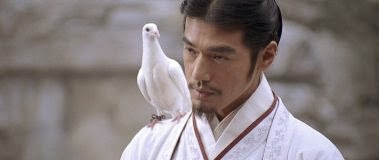
This first half is almost entirely set up, with most of the 2 1/2 hours devoted to Takeshi Kaneshiro’s Zhuge Liang convincing the leaders of the Southern Wu Kingdom (Chang Chen as the King, Sun Quan, and Tony Leung as his top general, Zhou Yu) to join the rebellion against the evil Prime Minister Cao Cao, a brilliant general who has for all intents and purposes usurped the Emperor and declared war on anyone who resists his dictates. Based on the account of late Han Dynasty (circa 200 AD) historical events depicted in the 14th Century Romance of the Three Kingdoms, one of the Four Great Classical Novels of Chinese literature, Woo adds a degree of melodramatic motivation to what in the book (I’ve read the first half, which includes the events surrounding the Battle of Red Cliff, but my memory is a bit hazy, as usual) is more of a straight recitation of action, preceding as it does by several centuries the modern notion of the psychological novel.

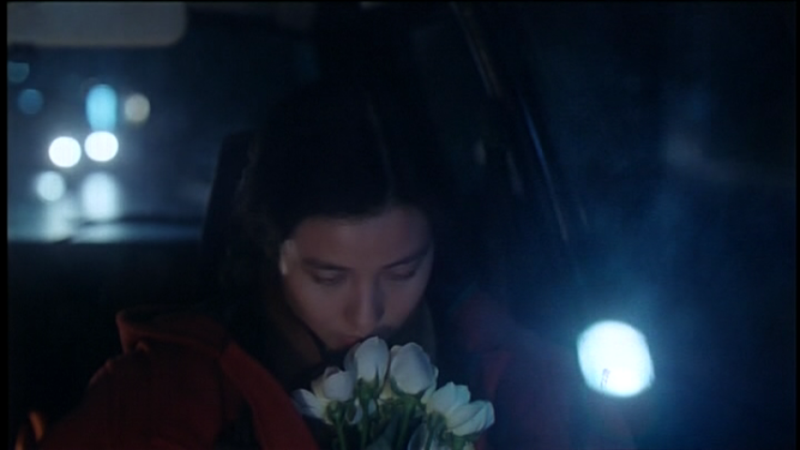
Most bothersome in this re-envisioning is the implication that Cao Cao is fighting this whole war for the sake of a woman, Zhou Yu’s wife Xiaoqiao, played by Taiwanese supermodel Lin Chi-ling in her first film role. Woo lingers on Lin and Leung together, being affectionate and loving and having steamy candlelit sex, as if trying to inspire the same jealousy in the audience that his Cao Cao must be feeling. It’s unclear at this point if this storyline is going to end up being ridiculous, or an interesting Helen of Troy-type addition to the historical narrative. There are a couple interesting scenes with Cao Cao and a prostitute who looks like Xiaoqiao, kind of a Vertigo thing going on there hinting at Cao Cao’s possible madness. Better realized motivations are Sun Quan’s feelings of inadequacy before the memory of his more warlike older brother and father (resolved as all the best emotional crises are, with a tiger hunt) and Zhuge’s fascination with Sun’s sister, the wannabe warrior Sun Shangxiang, played by Zhao Wei. Subtlety of emotion or motivation has never been one of Woo’s strengths, so I don’t know that packing his war movie with so much of it was a wise idea.

Woo’s on surer footing with the relationship between Zhuge and Zhou, two men used to being the smartest in any room in which they find themselves, their relationship is one of deep respect and rivalry. They’re often seem to be the only two guys who actually know what’s going on, and their private jokes and shared wavelength is a far more compelling romance than Cao Cao’s blunted desire. Woo frames Kaneshiro and Leung closely together, his camera roving from one’s side of the screen to other’s, uniting them in their shifting one-upmanship.
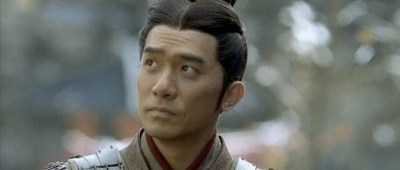
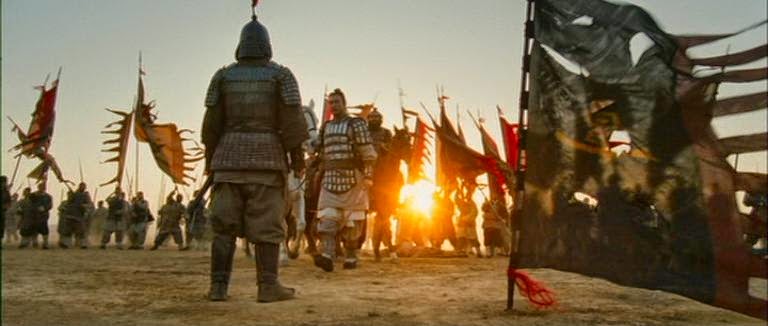
We only get a couple of action scenes in Part One. It opens with the retreat of Zhuge Liang’s boss Liu Bei, the noble anti-Cao Cao leader, which provides a chance for each of his three superheroic generals to cut down dozens of extras. Part One climaxes with the first skirmish of the battle proper, as the Allied forces ambush Cao Cao’s cavalry in a neat demonstration of animal-based tactics as Woo explores the intricacy and violence of 3rd Century warfare. The infantry draw the small cavalry troop into a trap, with intricately coordinated movements of their shield wall isolating the various horsemen, who proceed to be cut down, first by spears, then by the generals (following the tradition of martial arts narratives, where the more powerful the person, the better their fighting skills). In the end, even Zhou takes part, Tony Leung throwing himself into the fray with the enthusiasm of one who actually knows what he’s doing. Only Zhuge Liang doesn’t take part: he’s an intellectual; strictly an advisor, not a fighter.
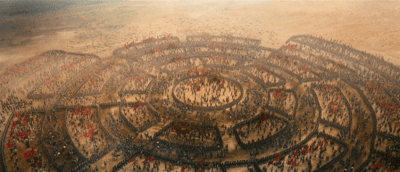
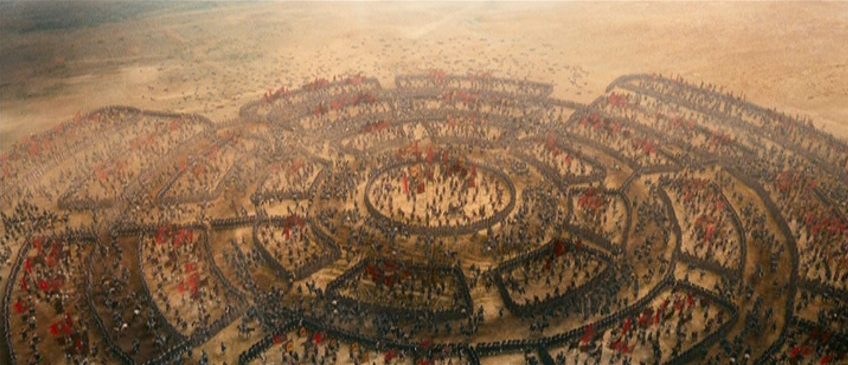
The Battle of Red Cliff took place in the early 200s, roughly contemporaneous with the events in Ridley Scott’s Gladiator and that film, along with Peter Jackson’s Lord of the Rings provides a clear inspiration for the CGI-enabled epic scale of Woo’s production. Long pull-out shots reveal hundreds of artificial ships as Cao Cao’s navy makes its way down the Yangtze; phony (or certainly at least digitally retouched) landscapes emphasize the beauty of the South and the need to preserve it from Northern aggression. Judicious use of digitally slowed and sped up motion (as in Tsui Hark’s 2005 Seven Swords) liven up the action’s long unbroken takes. Here the comparison with Gladiator is important, as Scott smears his action into blurry, swish pan and quick cut nothingness while Woo keeps everything crisp and organized, with overhead shots orienting us spatially while simultaneously making apparent the tactical ideas behind the coordinated troop movements painstakingly designed by Zhuge and Zhou.

Red Cliff Part Two

The second half of the film opens with a quick recap of the first, then throws us right into the action. Cao Cao has brought his army down the Yangtze and taken up position across the river from the Wu fortress at Red Cliff. With the help of two defecting southerners, Cao Cao has assembled a massive navy to supplement his cavalry and infantry. Here the differences between Southern and Northern China and the kinds of wars they fight becomes relevant. Southern China is river country, marshy and lush. Northern China is more desert-like, with vast flat plains between mountain ranges. Sothern transportation is on boats, Northern on horseback. There’s a cliche about the different styles of kung fu that developed in the two haves of the country, with the Northerners favoring a foot-based style with leaps and kicks, designed to dislodge horsemen, while the Southerners came up with a fist-based style, utilizing the strong arm muscles earned through a lifetime of rowing up and down rivers. Cao Cao’s Northern Army is used to cavalry attacks, they have no knowledge of naval tactics and his men are plagued by seasickness (not to mention typhoid and various other illnesses the Northerners have no developed immunity to). But the Southerners are not only literally on their home turf but have the advantage of fighting their kind of battle. Given this, the fact that they are outnumbered approximately 800,000 to 50,000 doesn’t quite concern them as much as you’d think.

Attempting to even the odds even further, as much as they can before the battle begins, Zhuge Liang and Zhou Yu make a wager. Again lost in their own world (Woo closes in very close on Kaneshiro and Leung, facing each other on opposite sides of the screen, their faces unnaturally close with all the other generals and advisors blurred out in the background) they challenge each other with a pair of impossible tasks. Zhuge must produce 100,000 arrows in three days while Zhou must somehow separate Cao Cao from his naval commanders. Failure to deliver means death. They succeed of course, but one’s subterfuge is certainly more clever than the other’s.

While the first half of the film was a lot of ground-laying and relationship building, the second half gets to unfold as a series of action and suspense sequences. There is one new relationship built, as Sun Shangxiang (the younger sister of Sun Quan) realizes her dream of taking part in the action on equal footing with the men by infiltrating Cao Cao’s camp in disguise. On the course of her reconnoitering, she meets a young, slightly goofy, low-ranking officer (played by Tong Dawei) and becomes friends with him (she’s disguised as a man for this adventure, in time-honored Chinese-girls-in-drag fashion). We first meet him as he distinguishes himself in a match of cuju, the most ancient form of soccer (note again the Northerners emphasizing feet, as even their preferred sport involves kicking a ball and not using one’s hands). This is all a pleasant diversion from the main plot, as Zhao Wei makes for a delightfully earnest and capable Sun and Tong is solid as a nice regular guy who just happens to find himself fighting for the wrong side of the war. Of course it will come back around in the final battle, but that predictability doesn’t make it any less sad.

Eventually, the preliminaries done away with and the ceremonial dumplings eaten (shouldn’t everything commence with the eating of ceremonial dumplings?) the Battle itself can begin. For literally hours, Woo has been teasing us with the massive CGI-scale of the assembled combatants, Cao Cao’s thousands of ships (locked together with iron bars to minimize seasickness) spied upon by the camera and Zhuge’s messenger pigeons. Timing proves everything to the final fight, as both sides prepare to set the other’s ships on fire. The difference is that Zhuge Liang, in addition to being a brilliant tactician is also a capable meteorologist. If Zhou Yu is the ideal of the wise, romantic poet warrior, Zhuge Liang is the scholar-as-farmer, the brainiac with his feet firmly on the ground. It’s Zhuge’s practical knowledge, the knowledge of the peasant classes, that allows him to accurately predict a change in the direction of the wind, and thus leads to the incineration of Cao Cao’s inexperienced, poorly led navy.
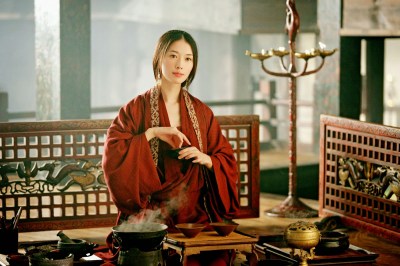
But even that wouldn’t have worked if it wasn’t for the heroic act of Zhou Yu’s wife, Xiaoqiao. Hearing that Cao Cao is apparently obsessed with her, she sneaks into his camp and makes him some tea. That sounds silly, but as performed by Lin Chi-ling the power and sexiness of the tea ceremony is readily apparent, as she corrects Cao Cao on the proper way to sip from his cup, the depths of his obsession become a little understandable. Thus distracted, Cao Cao waits to long to begin his attack, until after the fatal wind has shifted. His navy destroyed, it’s all he can do to marshal his land defenses, but the dazed Cao Cao, so flabbergasted at the awful destruction reaped by the fire, seems incapable of decisive action.

As the battle plays out, through the night and into the day, the rout is on and the drama comes from whether or not Xiaoqiao will be saved in time. The various generals rush into the heart of Cao Cao’s camp, leading to a classic multi-directional John Woo standoff, with swords in place of his traditional pistols. But this isn’t the true climax of the film, just of the Battle. Instead the peak comes in the final scenes further exploring the most fascinating relationship in the film, as Zhuge and Zhou say their goodbyes. Meeting on an impossibly lush hillside, the two friends recognize the fact that their nation, now spilt in three (“Three Kingdoms” you know), is not in a place of perpetual peace, that conflict between their respective rulers is inevitable. But their bond transcends petty politics, and the most moving love story of Woo’s career ends with the heroes locked together, nose-to-nose, the rest of their world irrelevant to the demands of mutual respect and honor and loyalty. To blood brotherhood.

Red Cliff deserves to rank with the great epic war movies of all-time. The battle scenes are intricately designed and beautifully shot, and the characters unique enough within their generic types (helped in no small part by an exceptional cast) to keep the spaces between the action interesting. Whether it’s due to the running time, or the daunting amount of Chinese history that the film builds upon, unknown to Western audiences (which similarly plagues Chang Cheh’s great historical epics The Heroic Ones, Shaolin Temple and The Boxer Rebellion), it seems that despite the film’s favorable notices on release, it has dropped through the cracks, reputation-wise. In an ideal world, it would be our generation’s Lawrence of Arabia.
Running Out of Karma: Two Tsui Hark Romances

Running Out of Karma is my on-going series on Johnnie To and Hong Kong cinema. Here is an index.

Love in the Time of Twilight

This should be seen more. It doesn’t even have a wikipedia page, and the DVD I rented of it is cropped to 4×3, yuck. Anyway, it’s just your typical mashup of Back to the Future, Ghost, Cantonese Opera, Looney Tunes and vomit jokes. It might be the best of Tsui Hark’s four films from 1995. Has any director had a year with so many films that were so different from each other? The Blade is a dark as hell ultra-violent wuxia film, The Chinese Feast a farce about food and community, and this one an effects-driven, period romantic comedy (more on the fourth, The Lovers, a hallucinogenic romantic melodrama, below). What a year.

A variation on the multiple-couple format of his own Shanghai Blues and Peking Opera Blues, where a group of mixed-gender protagonists dance curlicues around each other and the plot with love and sadness, except here the couples are doppelgangers of the two central figures. What begins as a conventional romantic comedy (anti-romantic opening where the leads instantly hate each other and engage in an escalating prank war, in this case unfolding in a marketplace dominated by fortune tellers and religious rituals), turns into a sci-fi mystery when the man, played by Nicky Wu, after instantly falling in love with another woman spends the night with her and the next day finds himself setup and killed by bank-robbing bandits. And then his ghost comes back to take Charlie Yeung, the woman from the opening, back in time to save himself. Complications ensue. As does hilarity, romance, all kinds of liminal spaces (“the time of twilight” indeed!) and, as in the best Tsui films, quiet moments for supporting characters (the woman’s father singing a song for his dead wife) as well as the heroes (a young couple entranced by the ephemerality of fireworks) that are genuinely beautiful.

Much of the action takes place backstage at a theatre troupe, where Yeung performs, mostly unsuccessfully. This is a recurring location for Tsui: you can find such troupes in both the Blues movies as well as in Once Upon a Time in China. These performative space, places where characters engage in make believe and often find themselves remaking their own plots, seem particularly in line with the playfulness of Tsui’s approach to film, his willingness to take his films to unexpected places, places founded on traditionally low forms of entertainment: slapstick comedy, vibrant melodrama, violent, even horrifying action. What distinguishes Tsui’s vaudevillian forays from the work of Wong Jing, or even Johnnie To’s The Eighth Happiness (which ends with a meta-finale on a Cantonese Opera stage) and its derivative works is that no matter how crazy Tsui’s narratives become, they are always grounded in clear (even basic) emotional drives. His people make sense even if their worlds do not.

The Lovers

Starts as your typical guy-falls-in-love-with-girl-dressed-as-a-guy rom-com, then turns into hallucinatory elemental melodrama. Also starring Nicky Wu and Charlie Yeung from Love in the Time of Twilight, Tsui here presents a fairly faithful version of the oft-told legend of The Butterfly Lovers, a story somewhat akin to European legends like Tristan and Isolde, Heloise and Abelard or Romeo and Juliet: star-crossed lovers kept apart by various social constraints, ending in tragedy. Yueng is a young woman from a prominent family of cosmetics merchants circa 200 AD. Trying to sand off her rough edges, her family send her to a local college, with the twist that in order to be educated, she has to pretend to be a boy.

This apparently is not an uncommon ruse, as her mother did the same trick when she was young, and the college’s dean is an understanding and sympathetic woman (undisguised) herself. There is a bit of a gay panic subplot as Nicky Wu meets her and, despite thinking she’s a boy, finds himself falling in love with her. But that subplot is fairly quickly resolved and ignored (as opposed to forming the foundation of the story as in some of the lesser works of Wong Jing or Sammo Hung, or treated with sensitivity and intelligence as in Peter Chan’s He’s a Woman, She’s a Man) as Wu figures out that she’s a girl and the romance proper begins, followed quickly by the unfolding tragedy.

Wu graduates the college and Yeung returns home. Now a minor official (he’s been studying to pass the test that qualifies you for a governmental position), Wu proposes marriage to Yeung’s family. But he’s outdone by a representative of the wealthier and more influential Ma family. Wu and Yeung conspire to elope but are undone by her parents. As the lovers are forcibly kept apart, nature itself seems to take a side. The sky turns nightmarish shades of pink, purple and orange; tears of blood flow; fierce winds and rain batter the unnatural constraints of the social order. Finally, the earth itself swallows the lovers whole, uniting them in a death that would be horrific if it wasn’t so romantic.

Romance and Tsui Hark seem an odd combination. He seems much more at home in wacky comedies and action movies, genre fare that allows him to both explore and update traditional modes of Chinese narrative while at the same time giving them a subtly subversive twist. Wong Kar-wai’s brand of earnest wistfulness seems anathema to Tsui, and his best romances follow the sidelong, game-playing pattern that also marks Johnnie To’s romances.

Running Out of Karma: Two by Woo


Running Out of Karma is my on-going series on Johnnie To and Hong Kong cinema. Here is an index.

Here are reviews of a couple of lesser, but worthwhile nonetheless, John Woo movies.

Heroes Shed No Tears (1986)

Sharing a title and nothing else with Chor Yuen’s 1980 wuxia epic, this was John Woo’s project immediately preceding his breakthrough A Better Tomorrow and only released after that film’s success. It’s easy to see why Woo had initially decided to leave this unreleased. It’s probably the most ridiculous thing I’ve ever seen from him, the kind of movie people who don’t like Hong Kong movies think all Hong Kong movies are like. That said, it’s still a ton of goofy fun.

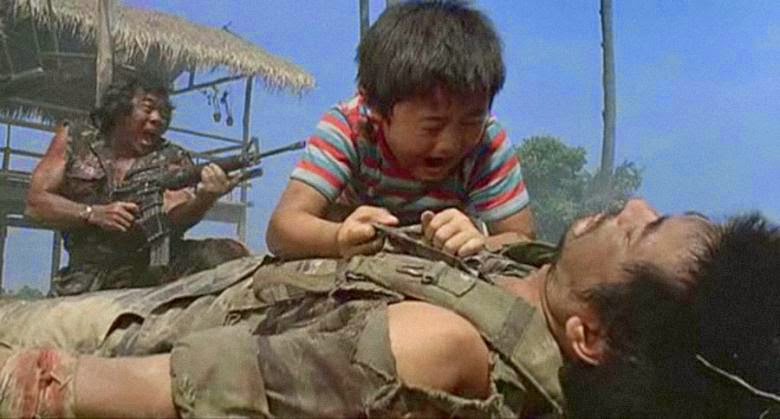
Eddy Ko leads a small commando squad of Chinese mercenaries into the Golden Triangle (the nebulous border region between Burma, Cambodia, Laos and Vietnam that is the source of much of the world’s heroin, or at least was in movies from the 1980s) to arrest a drug kingpin and bring him to justice. They get the guy and escape, chased by his heavily-armed men. At the Vietnamese border, they arouse the ire of the local army outpost (led by the great Lam Ching-ying, probably most well-known as the star of the Mr. Vampire series), who join the chase. The Army then forcibly enlists the assistance of the local hunter-gatherer/ninja tribe. Of course, for some reason Ko has brought on this mission into the most dangerous place on Earth his young son, generally useless sister(?) and elderly father, who must of course be protected (the father doesn’t last long, spoiler!), along with a whiny French woman they rescue from the Army along the way.

So what we have is the makings of a pure chase-through-harsh-terrain movie, along the lines of Cornell Wilde’s The Naked Prey, Powell & Pressburger’s Ill Met By Moonlight or Rambo: First Blood Part II. For better and worse, this is more in the class of that last one than either of the first two. There’s a lot of guys standing around with really heavy machine guns mowing down bad guys who can’t shoot straight and a lot of poorly motivated plot turns. Only the most obvious is the unanswered question of why this guy brought his family along. Did that bit of exposition get cut out and no one noticed or cared? Is it somewhere in the 11 minutes that were in the Hong Kong version that aren’t in the 82 minute international cut, or did Golden Harvest cut it out even before releasing it locally? IMDB says those 11 minutes have an expository scene between Ko’s character and his “sister-in-law”, so I guess that’s how she’s related and maybe that explains it? Who knows.

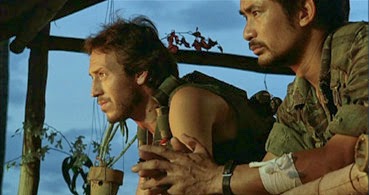
Beyond that is a truly bizarre idyll near the end of the chase. Ko has led his motley crew to a hut  located on stilts in a clearing in the jungle, occupied by a spacey American. The American is an old friend of Ko’s (they saved each others’ lives in the War), and lives in this hut, surrounded by explosives, trip wires and bombs of all kinds, with three women in flowery dresses that never seem to speak. Now, I don’t know what’s stranger: that with three armed bands of killers bearing down on them, our heroes decide that a straw hut packed to the rafters with high explosives is an ideal defensive position, or that on the eve of said attack, rather than preparing for their defense, the American and his lady friends partake in some R-Rated drugs and group sex debauchery. I mean, sure, you don’t have to shed tears, but how about a little common sense?

Once a Thief (1991)


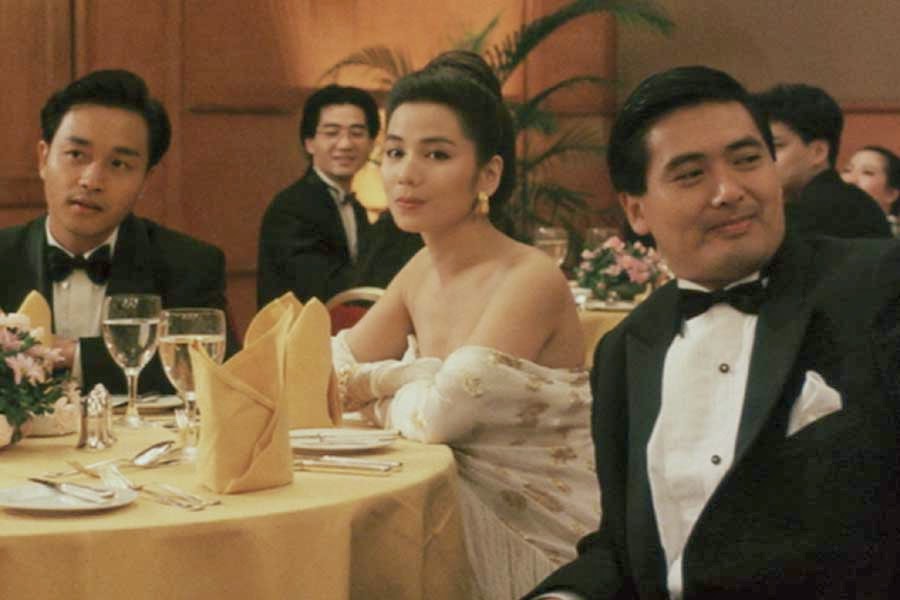
If Cherie Chung hadn’t retired after making this movie, and maybe had gone on to star in some Wong Kar-wai movies, would she be better known today? She was one of the key Hong Kong actresses of the 1980s, beginning with Johnnie To and her debut The Enigmatic Case and including classics like Winners and Sinners, The Story of Woo Viet, The Dead and the Deadly, An Autumn’s Tale, The Eighth Happiness and Peking Opera Blues. Patrick Tam even built a whole movie around her and named it after her (Cherie of course, a bizarre romantic comedy in which lust for the star inspires the men around her (the other Tony Leung and longtime Shaw Brothers director Chor Yuen) to increasingly dangerous and ill-advised behavior). She retired because she got married (something of a trend at the time, this kind of thing also cost us some prime Michelle Yeoh years), but she’s still only 54 years old. Someone should bring her out of retirement (her husband, sadly, died several years ago).

Anyway, she has almost nothing to do in this screwball heist movie, wherein she’s the love object for both Chow Yun-fat (in full-mug comedy mode) and Leslie Cheung. The three of them, orphans, grew up under the tutelage of an evil thief, Fagin-style, and now they’re using their powers against him, sort of. The plot doesn’t make a whole lot of sense. Basically they steal European paintings from elaborately designed defense systems (like the one that hangs in the wine cellar of a castle, behind a secret door in a fog-enshrouded room, because that’s where you want to display your favorite and most valuable oil paintings: in a damp basement behind a rock wall) and the father guy is a jerk. Cheung and Chow do all the thieving, leaving Chung at home (where she belongs!) to worry and do the cooking or something. And pass from one lead to the other (there’s an apparent death, followed by an apparent paralysis), Cherie generally lands with the healthiest hero.

The heists are fun, the action is great (a neat car chase, someone inexplicably featuring a variety of evil security guards driving French station wagons), the comedy occasionally funny and the 1991 fashions exceptional, and did I mention that one of the final villains is a magician who shoots fire out of his hands and throws playing cards to deadly effect?, but this premise is one Woo would revisit a few more times, I think because he never really got it right (he directed a Canadian TV movie remake that was later spun into a series that lasted one season in that country after the Fox network didn’t pick it up in the US.) Compare it to Johnnie To’s caper heist/romantic comedy Yesterday Once More, which is faster, funnier, and cleverer with more emotional depth and visual panache.

Some Notes on George Sidney’s Bye Bye Birdie

You can follow 30 years of the evolution of youth culture and its relation to show business just by following musicals from years that end in ‘3’.

1933: Gold Diggers of 1933, 42nd Street
1943: The Gang’s All Here
1953: The Affairs of Dobie Gillis, Give a Girl a Break
1963: Bye Bye Birdie

As the years go on, the youth get younger: early 20s in the 30s and 40s, college in the 50s, high school in the 60s. At the same time, the performance dream gets more remote: the 30s and 40s stars are performers, albeit not particularly successful ones (yet), with the war in 1943 making everyone seem more adult than they are (and the musical itself breaking down that facade, Busby Berkeley’s masterpiece ultimately reducing everyone to colored light and singing heads). In the 50s they’re just starting out, in the 60s the stars seem to occupy another planet (Birdie is an object of worship/jealousy rather than an aspirational figure).

The next decades take that estrangement even further, as not only are the characters in the musicals no longer performers, even aspirationally, with their soundtracks (usually) removed from the filmic space to the non-diegetic ether, but the movies themselves are no longer even set in the present. Rather than engage with the youth culture of today, their directors revisit their own youth (either lived or experienced on-screen).

1973: American Graffitti
1983: The Outsiders
1993: Dazed and Confused
2003: Down with Love
2013: Inside Llewyn Davis

(This is partly a result of the arbitrary year-end choice. Fast Times at Ridgemont High, Pump Up the Volume, Clueless and Guy and Madeline on a Park Bench would be examples of attempts to document contemporary youth culture within the musical form, albeit still with the music removed from the performances on-screen. See also studio-era films that celebrated the filmmakers’ youths, like Meet Me in St. Louis or The Strawberry Blonde). Still I think the general trend toward nostalgia is worth noting.)

Anyway, Bye Bye Birdie seems to me to be an inflection point, a last gasp of the lower-budget studio musical (big budget musicals were increasingly dominant, before they too would crash, dragging the whole system with them by the end of the decade) before The Beatles arrived the next year and blew everything to hell. As an attempt for studios to grapple with the rock and roll phenomenon it’s a lesser version of Frank Tashlin’s The Girl Can’t Help It, and as a film it could have used more Tashlin-style surrealism. As it is, the director, George Sidney, was always at his best a more conventional Tashlin anyway, a steady hand with adaptations like Show Boat or Kiss Me Kate with a tendency to vulgar excess when let loose with Esther Williams in films like Jupiter’s Darling. His patience and skill in utilizing the full-length of the Cinemascope frame with long, lengthy shots in the big group dance sequences goes to show that if they stick around long enough, even the weirdest directors become classicists.

As for the stars, well, Ann-Margaret. To go back to where I started, take a look at the evolution of the female heroes of those films: Ruby Keeler, Alice Faye and Debbie Reynolds are all of a type: cute, girls next door, pretty but unthreatening. Ann-Margaret though sings a whole song about how awesome it is to be young and hot. The film isn’t about her becoming a star (though it is certainly a star-making performance), but rather about her learning to take control of her own life. As the film begins she’s obsessed with Elvis-clone Conrad Birdie (whose sexual charisma is such that he inspires every woman in town to either faint or have a seizure in the film’s first big group number) and in love with local boy Hugo (gladly submitting to future wife-hood through the pin-placement (pointedly not pin-exchange) ceremony). Through various plot machinations, she learns to take control of her own desires, break Birdie’s spell and reunite with Hugo on her own terms. Though she’s still aspiring to wifeliness, at least its because that’s what she’s decided she wants. Viewed another way, the film can be seen as a tragedy in that this poor girl can’t really imagine any other role for herself: either sexual object or homemaker.

Janet Leigh’s story somewhat parallel’s Ann-Margaret’s, in that ultimately she has to use her sexuality to inspire some jealousy in Dick Van Dyke’s songwriter/scientist. That she does so at a Shriner’s convention, and has to work really hard to get those men to notice her is kind of hilarious. 36 year old Janet Leigh still looks fantastic, and once the men finally see that they become a tidal wave. Leigh seems shocked by what she’s unleashed in them, as though it was mere social mores that kept them from pawing after her, but once pushed so far they could no longer be restrained. Thus are the dangers of rampant female sexuality: better keep it locked down in wifehood!

And then there’s the fact that Dick Van Dyke really wants to be a chemist, and his big career move in conjunction with Ann-Margaret’s father, Paul Lynde(!) is to start selling amphetamines to animals (they dope a turtle) and humans (they dope a ballet conductor). I have no idea what to do with that.

This Week in Rankings

Over the last few weeks, as I’ve been preparing for an upcoming episode (or two) of They Shot Pictures on Vincente Minnelli, I’ve been watching a lot of musicals. I wrote about Seven Brides for Seven Brothers and Oklahoma!, along with a couple more Tsui Hark movies for Running Out of Karma (which at this point has more about Tsui’s movies than Johnnie To’s but whatever), Seven Swords and The Blade. I also wrote about a couple of excellent 2014 films: Tsai Ming-liang’s Journey to the West and Wes Anderson’s The Grand Budapest Hotel.

In podcast news, we’ve had two episodes of The George Sanders Show since the last update, on Paul WS Anderson’s The Three Musketeers and the Ray Harreyhausen Jason and the Argonauts and a baseball episode on Pride of the Yankees and The Bingo Long Traveling All-Stars and Motor Kings. Also there’s our super-sized They Shot Pictures episode covering Hayao Miyazaki, Isao Takahata and Studio Ghibli. And I handed out the Endy Awards for 2006.

These are the movies I’ve watched and rewatched over the last few weeks, and where they place on my year-by-year rankings. You can find short reviews of most of them on my letterboxd page.

You Were Never Lovelier (William A. Seiter) – 22, 1942
The Pride of the Yankees (Sam Wood) – 27, 1942
The Gang’s All Here (Busby Berkeley) – 3, 1943
Cabin in the Sky (Vincente Minnelli) – 9, 1943
Thousands Cheer (George Sidney) – 21, 1943

Cover Girl (Charles Vidor) – 18, 1944
The Clock (Vincente Minnelli) – 9, 1945
Ziegfeld Follies (Vincente Minnelli) – 30, 1945
Easter Parade (Charles Walters) – 15, 1948
Take Me Out to the Ballgame (Busby Berkeley) – 30, 1949

Lovely to Look At (Mervyn LeRoy) – 28, 1952
A Star is Born (George Cukor) – 8, 1954
Seven Brides for Seven Brothers (Stanley Donen) – 16, 1954
Oklahoma! (Fred Zinnemann) – 48, 1955
Jason and the Argonauts (Don Chaffey) – 15, 1963

The Thomas Crown Affair (Norman Jewison) – 18, 1968
The Sugarland Express (Steven Spielberg) – 29, 1974
The Bingo Long Traveling All-Stars and Motor Kings (John Badham) – 6, 1976
Bugsy Malone (Alan Parker) – 31, 1976
Sorcerer (William Friedkin) – 7, 1977

Caddyshack (Harold Ramis) – 10, 1980
Boy Meets Girl (Leos Carax) – 11, 1984
They Live (John Carpenter) – 4, 1988
The Blade (Tsui Hark) – 6, 1995
Seven Swords (Tsui Hark) – 16, 2005

Forgetting Sarah Marshall (Nicholas Stoller) – 34, 2008
The Three Musketeers (Paul WS Anderson) – 17, 2011
The Grand Budapest Hotel (Wes Anderson) – 1, 2014
Journey to the West (Tsai Ming-liang) – 2, 2014
Veronica Mars (Rob Thomas) – 4, 2014

Running Out of Karma: Tsui Hark’s The Blade

Running Out of Karma is my on-going series on Johnnie To and Hong Kong cinema. Here is an index.

The Hong Kong New Wave burst onto the scene in the late 1970s with a radical new approach to the genres that had dominated the local cinema scene for the previous decade or so, specifically for our purposes here, the martial arts film. Countering the elaborate costume epics of Shaw Brothers auteurs like Chang Cheh and Chor Yuen were grungy, darkly violent fantasies of swordplay like Patrick Tam’s The Sword and Johnnie To’s The Enigmatic Case (To is not generally lumped in with this first New Wave batch, but I think he meets all the arcane requirements). Tsui Hark’s first feature, The Butterfly Murders brought a modern visual aesthetic to the genres, with lighting and shadows creating depths and obscurations where the Shaw’s studio kept even the bleakest scenes bright and colorful. These films, along with modern day stories like Ann Hui’s Boat People and harrowing tales of angsty teenage violence like Yim Ho’s The Happening, Tam’s Nomad and Tsui’s Dangerous Encounters – First Kind, were critically lauded, and some even managed to find an audience (as well as help launch the movie careers of icons like Andy Lau, Leslie Cheung and Chow Yun-fat), but fairly quickly most of these New Wave directors were absorbed into Hong Kong’s mainstream.

Tsui imported Hollywood technicians to make his effects-driven wuxia spectacular Zu: Warriors from the Magic Mountain and hung around the Cinema City studio making goofy comedies with the wags there (Working Class, Aces Go Places III). He also made a pair of genre-bending masterpieces, Shanghai Blues and Peking Opera Blues. As well he branched into producing, helping revitalize John Woo’s career with A Better Tomorrow and continued his experiments with effects-driven wuxia with Ching Siu-tung and A Chinese Ghost Story and the Swordsman series. Then, with one of the five films he made in 1991, Tsui revived the kung fu film with his epic Once Upon a Time in China, firmly establishing Jet Li as a superstar and launching a renaissance in period fighting films. A renaissance which, with the warp speed of Hong Kong generic cycles, had largely played itself out by the mid-1990s.

Then, in 1994, Wong Kar-wai, like To excluded from official New Wave status on a technicality (he didn’t start in movies until it was too late), finally released Ashes of Time, his reinvention of the wuxia film, after a shoot so long and grueling it spawned not one but two masterpieces during its creation (Chungking Express and eventually that film’s spin-off Fallen Angels) as well as a hilarious parody of the same source material, featuring mostly the same cast (Jeffrey Lau’s The Eagle-Shooting Heroes). Ashes harkens back to the New Wave projects of modernizing the martial arts genre, with a convoluted plot structure (made somewhat clearer in the recent Redux version, the only version currently available, though there is a DVD of the original somewhere, I saw it 15 years ago), narration in Wong’s idiosyncratic fashion and a story that focuses more on Wongian themes of lost love and memory that it does on fighting. The fights themselves (choreographed by Sammo Hung, another director with an argument for being considered New Wave) are modernized as well, shot in a grainy, up-close, constantly moving style, smearing the action into a blur of dust and costume and blood. Ashes of Time, of course, failed to do much business and Wong didn’t return to the genre until this past year’s more traditional but still impressive for sure, The Grandmaster.

So that brings us to 1995 and back to Tsui Hark. The Blade, one of the three movies Tsui directed that year, probably inspired by Ashes of Time, is also a New Wave modernized wuxia. But where Wong infused the traditional swordplay story with lush visuals and swoony spirals of wistful longing, Tsui exposes the dark violent core of the genre, remaking Chang Cheh’s classic The One-Armed Swordsman with the gory glee of his 1980 kung fu cannibal film We’re Going to Eat You and the nihilistic heart of Dangerous Encounters – First Kind. He does for wuxia what Chang’s The One-Armed Swordsman did for the state of the genre at the time of its release in 1967. Chang’s film began an apparently inexhaustible cycle of films about violent men with elaborate honor codes torn between the demand for revenge and the desire for peace. Echoes of Chang’s films can be found throughout the martial arts films of the 70s, the ‘heroic bloodshed’ policiers of the 80s, the kung fu revival of the 90s and the cop-triad films of the 21st century. What he brought to The One-Armed Swordsman was a new kind of violence to the genre, both graphically physical and torturously psychological. In contrast to King Hu’s more stately, abstract wuxia vision, which was revising the traditional form (say Kwan Tak-hing’s Wong Fei-hung kung fu serials of the 1950s) in a different direction at the same time. The differences between the two directors can be seen in a sampling of the titles: Come Drink With Me, A Touch of Zen, Raining in the Mountains vs. Vengeance!, The Blood Brothers, Crippled Avengers. Chang’s heroes lead short, bloody lives, but they die standing up, finding a kind of transcendent heroism in their sacrifices for the sake of their honor codes, while at the same time implying the nullity at the heart of those same codes. The New Wave revisions to this tradition excised the heroism and emphasized the nihilism, the films of a generation raised by refugees in a densely-packed laissez-faire oasis trapped between two violently opposed worlds. Extremely bloody, jarringly (as opposed to gracefully) violent films of deep shadows and jagged cuts, where every character is venal and ugly, our heroes only slightly less so.

To The Blade, Tsai adds a narration in Wong Kar-wai’s style, the voice of the master’s daughter. A sociopath in both films, manipulating two of her father’s pupils into a competition for her affection; in Chang’s film it is she, in a burst of anger, who slices off the hero’s arm. In this remake, though she’s no less unpleasant, she’s as much a victim as anyone, and a fitting narrator for our film, a tale told by a lunatic. The arm is lost defending her from bandits, positioning even the crazy daughter as one of the good guys in this world. These bandits menace the town, trapping and decapitating a monk and inspiring fear and loathing wherever they go. We’re introduced to them at the start of the film, as they entertain themselves by capturing a dog in a bear trap, shades of the opening to another nihilist classic, Sam Peckinpah’s The Wild Bunch. The hero, Ding-On, and his friend, Iron Head, work in a foundry, making swords. Iron Head attempts to organize a resistance to the bandits while Ding-On doesn’t want to get involved. Ding-On leaves, the daughter chases after him, bandits attack, he loses his arm.

As in Chang’s film, Ding-On is rescued by a farm girl (covered in dirt and illiterate, barely verbal even) and nursed back to health. They in turn are menaced by the bandits, and eventually he learns some one-armed kung fu. Meanwhile, Iron head and the daughter search for Ding-On, and Iron Head becomes obsessed with a local prostitute. In the bleakest inversion of every inn scene from every Shaw Brothers movie, where see the loud and lascivious revelers slap her around and have their way with her, as Iron Head watches, seething from the balcony above. Finally he acts and rescues the girl in an orgy of destruction. But, because everyone in this world is the worst, he finds he has to tie her up to keep her from going back to her old life. It wasn’t a romantic heroism that drove him to save her, but the lustful drive to possess. As she watches Iron Head’s degeneration, herself tied up as well, the last shreds of the daughter’s sanity surely shatter.

The various factions come together, as they always do, in the finale. Ding-On realizes that the bandit chief is the same magically-tattooed assassin who murdered his father, and revenge is exacted; a whirl of spins and leaps, everyone wearing black, everyone getting sliced open. The villains are defeated, but there’s no chance everyone lives happily ever after. The world is too far gone for that. The best they can hope for is a little while to rest a bit before the horrors begin anew.

Not surprisingly, the film failed to find an audience at the box office, as the many of the bleaker New Wave efforts failed 15 years earlier. (Blame for this is often laid at the feet of the cast, with no names and a lead, Vincent Zhao, who is not the iconic star Jimmy Wang Yu was in the original. I think the cast is just fine, though. It’s hard to be charming under a pile of muck.) Shortly thereafter, the exodus of talent from Hong Kong to Hollywood accelerated: Jackie Chan, Jet Li, Sammo Hung, John Woo, Corey Yuen, and in 1997, Tsui himself. The martial arts film was seemingly played out, with Johnnie To and Milkyway Image’s triad sagas, along with fellow travelers like the Young & Dangerous and Infernal Affairs series, capturing the Hong Kong action audience. The opening of the Chinese market led to some spectacular wuxia arthouse films, stately productions like Ang Lee’s Crouching Tiger, Hidden Dragon, Zhang Yimou’s trilogy of Hero, House of Flying Daggers and Curse of the Golden Flower, John Woo’s epic Red Cliff and Tsui’s own Detective Dee films and a variety of films about Ip Man (five in the last three years, I believe, including Wong Kar-wai’s), while new effects technology has lent a glossy sheen to even the lowest budget productions. But as far as I’ve seen, no one has yet taken up the black mantle of the New Wave wuxia film.

On Tsai Ming-liang’s Journey to the West

When I was young, in the first half of the 1980s, my punishment for whatever childhood infractions I committed was being made to stand facing a wall for some indeterminate amount of time (probably ten minutes, but which felt like and hour or two to an eight-year old). I committed a lot of infractions, so I became quite used to this, in fact I learned to enjoy it. I’d stare at the wood-paneling (1980s), count the small nail holes, follow the flow and swirl of the knots and the minute contours of the wood. Forced to stare at the same thing for a long time, I learned that if you look at it long enough, anything can become interesting, I learned that boredom is something that can be overcome.

Little did I know this experience was training me to watch Tsai Ming-liang films. This hour-long short (available free this week only here), a continuation of his shorter 2012 film Walker, observes Lee Kang-sheng as he walks, dressed as a monk in flowing red robes, through a city. This time it’s Marseille, and there appears to somewhat of a plot, hinted at in the title and clarified in an accompanying note from Tsai:

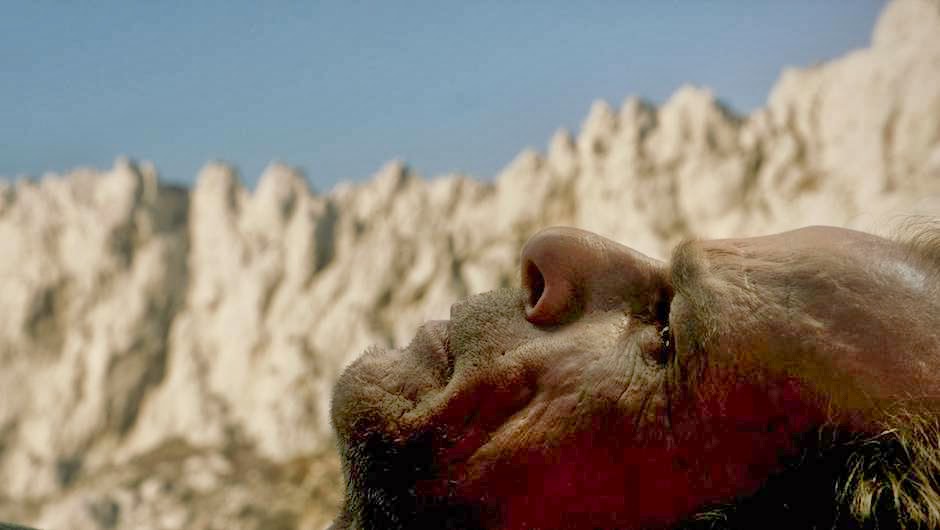
“His walking, so special and so slow, in all the four corners of the world recalls that of Xuanzang, the holy monk of the Tang dynasty, who traveled thousands of kilometers seeking the holy scriptures. In the classical Chinese novel “The Journey to the West”, Xuanzang frees the Monkey king from his prison at the foot of a mountain. In Marseilles, there is a rock that resembles the face of a monkey: in the bay of monkeys. Fashioned by the effects of time, Denis Lavant’s face is like these rocky shapes and I am irresistibly attracted to it. That was how I started to think of Lee Kang-sheng walking on his face…”

The film opens with its longest shot, an extreme closeup of Denis Levant’s face, lying on a diagonal, half in shadow. As Tsai forces us to stare at it at seemingly interminable length, the face becomes something else, an alien landscape of valleys and mountains and rivers and crevasses; every pore, every grey a story, every fold of Levant’s now 50+ year old face containing multitudes. We’ll revisit this face at the seaside, I assume at the Bay of Monkeys Tsai refers to, making literal the transformation from face to landscape.

Most of the film though chronicles the monk’s journey through the city. These shots come with a fun, Where’s Waldo-esque challenge as you try to pick him out in the crowd (hint: he’s the thing that’s not moving). But they also seem to be allegories for Xuanzang’s journey. A pungent red wall becomes perhaps the scene of a mighty battle the monk witnesses, a long staircase a descent into the underworld. The monk begins to appear in reflections, the mirror in a man’s apartment, a glossy wall overlooking a plaza packed with travelers and people at play (a crowd gathers around a man playing the piano, another man sets adrift giant bubbles). Are the mirrors indicative of his journey to “the other side”? In one of the film’s final shots, the monk is being followed by what looks to me like Denis Levant, also walking very slowly past a sidewalk cafe, following a patch of sunlight. The Monkey King, freed at last, being led back to the East?

Tsai leaves us with this postscript, from the Diamond Sutra:

All composed things are like a dream,
A phantom, a drop of dew, or a flash of lightning,
That is how to meditate on them,
That is how to observe them.

On Wes Anderson’s Grand Budapest Hotel

The Andersonian hero makes his own world. Not exactly a fantasist, he (and it’s almost always a he) is a man out of time. An aspiring thief (Bottle Rocket), a master thief (Fantastic Mr. Fox), wildly impractical teenagers (Rushmore, Moonrise Kingdom), a discoverer of hidden worlds (Life Aquatic), families of prodigies (Royal Tenenbaums, Darjeeling Limited). Their opponents are the depressing realities of everyday life, the warn-down depressions of middle-age (Moonrise Kingdom, Rushmore), the accumulated disappointments of unrealized dreams (Life Aquatic, Darjeeling Limited, Royal Tenenbaums), or simply friends and family who lack their creative ambition and would rather settle down for a quiet life (Fantastic Mr. Fox, Bottle Rocket, Life Aquatic).
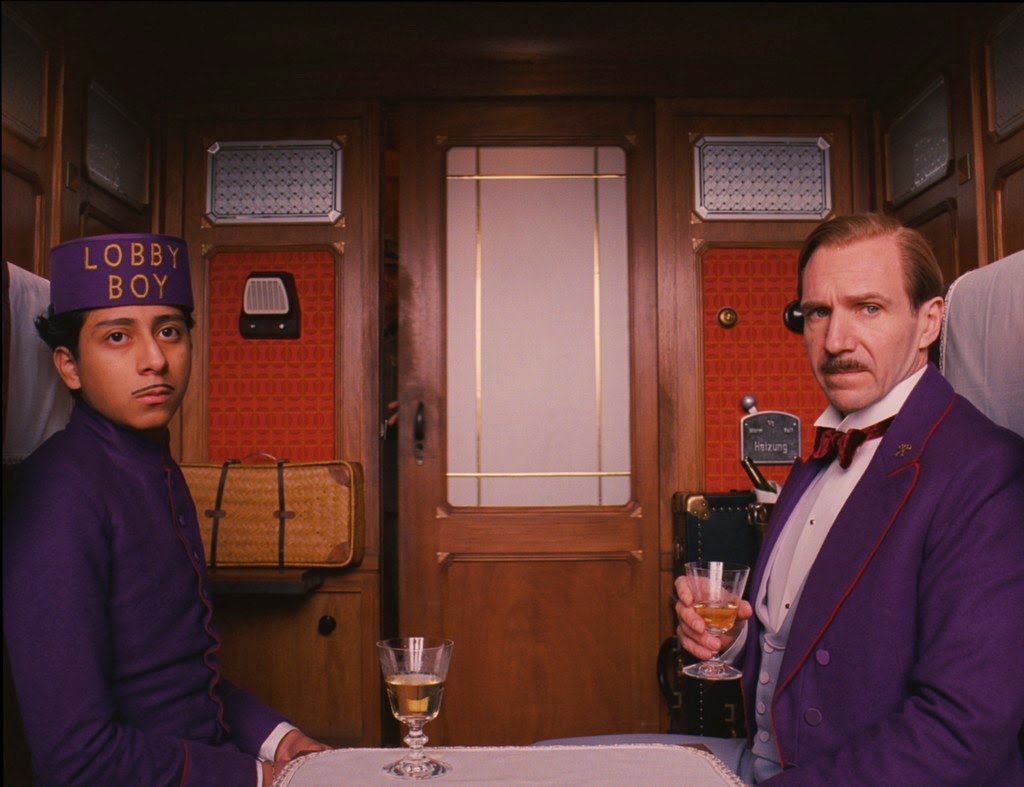
Ralph Fiennes’s M. Gustave is The Grand Budapest Hotel‘s explicitly designated man out of time. A lone patch of civilization in the barbarous world of a fictionalized inter-war Central Europe. Dandyish and perfumed, prissy and effete, he swears like a drunken Marine and is very committed to his duties as concierge, going so far to please his guests as to sleep with all the rich, elderly ladies who come to stay at the palatial hotel (for he is their holding action against the inevitable declines of age). Against him stands not merely a personification of the real world or a more practical counterpart, but rather the systemic decline of civilization itself, murderous greed and the rise of fascism. Set against not merely the greedy inheritors of one of Gustave’s lover’s fortunes, but the increasingly menacing martial forces of a Nazi-like state, Grand Budapest Hotel is, I think, the first Anderson film to acknowledge an outside political reality whatsoever (rather than simply politics as family and personal relationships). That it deals with a phony version of an 80+ year old movement should come as no surprise.
You can divide Anderson’s heroes into the young and the middle aged. The kids seem like they’d be out of place at any time, their interests are not contemporary (playwriting, saving Latin, Benjamin Britten, Jacques Cousteau and young adult novels that don’t revolve around vampires), their diction unusually formal (a device that afflicts all Anderson characters, but is especially jarring coming from the young), a convoluted mix of ten cent words, out-dated slang and contemporary bluntness. The middle-aged look back on their youth as a lost golden age as they find themselves set adrift from the family and friends that supported their dreams in their youth (it’s not hard to see Max Fischer in Royal Tenenbaum, Sam Shakusky in Steve Zissou). The young seem old and the old seem young. These heroes are occasionally arranged in (surrogate) father-son relationships: Rushmore, Life Aquatic, Moonrise Kingdom. Such is the case in Grand Budapest with Gustave serving as mentor-hero to war orphan Lobby Boy Zero (and further relationships which cascade down the decades to the present day).
Not exactly nostalgia, but a longing for and a burning desire to resurrect the past is the guiding spirit of Anderson’s mise-en-scene. Dollhouse diorama worlds of right angles, 90 degree pans, stop-motion animation, obsessions with books and the readers of books. It’s a dynamically two-dimensional cinema, colorful and bright and flat, so resolutely idiosyncratic that it’s damn near impossible to find a review of one of his films that doesn’t utilize the world “stylized”. His cinematic references tend to be more spiritual than specific lines or images, the Lubitsch of the 1930s infects every scene of Grand Budapest Hotel without citation, as the essence of Night of the Hunter snuck its way into Moonrise Kingdom. The artificiality of his world is compounded by an ever-expanding repertory of character actors, recognizable faces in outlandish make-up and costumes populate the edges of his stories, while the central roles are as often played by unknowns as knowns. These are ultra-modern approaches to an ancient filmmaking form: the repertory of actors recalling the studio era heyday when each new film promised a Guy Kibbe or Lee Tracy or Frank Morgan or any number of other character actors grown familiar and lovable through repetition. The visual style moves even further back, to the flat staging of the silent era, and of course even beyond that to theatre and literature. But rather than Guy Maddin-style attempts at recreating the earlier, imperfections and all, Anderson updates the old forms with the latest technology, breathing new life into abandoned forms.
Idealistic and innocent, but certainly not naïve, M. Gustave is more like Anderson’s young heroes than his burned-out contemporaries (Mr. Fox as well is a grown-up idealist). But as a remnant of an earlier age, he shares with the older heroes a nostalgic worldview, a looking-back at a lost golden age, though the mechanics of that looking is more convoluted than ever, with a nesting doll flashback structure (each era with its own aspect ratio) that recalls Passage to Marseille, among other things. Gustave is already out of place in 1932, yet we see him thrice more removed: in a story the aged Zero recalls in 1968, recounted by the Author in 1985, read by a young girl in 2014. In 1932 we see the end of M. Gustave’s era, the death of one of his lovers, the war that takes over his hotel and then his world. In 1968, the hotel is falling apart, kept barely alive as a crumbling shadow of itself by Zero (though pointedly not as a link to Gustave, but to his wife, to the time he was happiest:, for 1968 Zero is himself a man out of time). In 1968 the triumph of barbarism is assured and by 1985 it’s victory is almost total: even the children brandish weapons as a young boy interrupts the Author’s address to the camera with a (toy) gunshot (he apologizes shortly thereafter, a slender thread of civility). In the present, even the author is gone, like Zero, like Gustave, he can only be found in a snowy cemetery, civilization kept alive in his book. The girl is alone, but the grave is not abandoned. Keys hang from his tombstone as at a concierge’s desk, left by admirers, despite the degradations of history, there are still some who believe in M. Gustave’s lost world.

Running Out of Karma: Tsui Hark’s Seven Swords


Running Out of Karma is my on-going series on Johnnie To and Hong Kong cinema. Here is an index
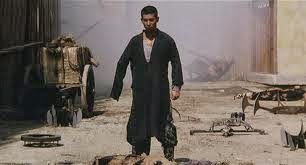
Tsui Hark’s next major film after a CGI-driven remake of his own Zu: Warriors from the Magic Mountain in 2001, this is a less effects-driven wuxia epic, a riff on Seven Samurai with a Chang Cheh influence (the Northern Chinese medieval warfare of The Heroic Ones comes to mind). A gang of Ching bounty hunters has an Imperial command to kill anyone who knows martial arts, a former Ming minister tries to stop them from wiping out a village (they kill indiscriminately to collect more reward: old people and children too). He goes to a mountain a gets a bunch of swordsmen and fancy swords and they all go to defend the people.

The initial version of the film was apparently four hours long, cut down to two and a half for release, and it feels like it. Most of the characters remain undeveloped or uninteresting, getting by mostly on the charms of the lead actors (who are, to be fair, an impressive group: Donnie Yen, Leon Lai, Charlie Yeung, Sun Honglei and Lau Kar-leung (in his last imdb credit as action director and actor) among them) and Tsui’s feel for color and composition. Sun, most known now for his masterful performance in Drug War, is terrifically demented as the primary villain, but most of the other characters though feel like they had their personality-building scenes removed in favor of pushing the plot along, their histories aren’t particularly compelling and a pair of love triangles seems woefully underdeveloped.

But it’s a beautiful looking movie, if perhaps a little overdone with the flickering firelight. The villains have a great medieval biker gang look to them (black leather and painted faces) and they employ an impressive array of head-snatching weaponry (including what appears to be a giant umbrella). The fights are solid, the highlight being a climactic showdown between Donnie and Sun in a narrow hallway, choreographed and shot well, if a bit limited by the lack of serious fighters in the cast (Tsui covers for Sun and Lai fairly well).

The main problem with the film is its seriousness. Even at his darkest, there’s a streak of subversive wit in Tsui Hark, but this is all straight epic melodrama. The closest the film gets to reflecting Tsui’s impish streak is near the end when quick flashbacks suddenly reveal much of the connective backstory of the various characters’ relationships, things that would have dragged the forward momentum of the action down but made the characters more intelligible. Whether that’s by design (a rejection of Hollywood story-telling convention in favor of straight-ahead plot movement, not unusual at all for Tsui or Hong Kong in general) or by necessity, a by-product of cutting out 90 minutes of the film’s initial running time, is hard to say.

The film was conceived as the first of a six-part series, and though the film did moderately well (it was a big pan-Asian co-production, and it looks like it was filmed on the Mainland to me, with some fantastic locations, purple sunrises and orange steppes and all that) there appears to be little interest in continuing the story (there were a number of spin-offs, a cartoon, a TV series, comic books and such). Tsui seems much more at home in the two Detective Dee films his made over the last few years.

On Stanley Donen’s Seven Brides for Seven Brothers

I had underrated this before. Sure, the ballet at the barn-raising is arguably the greatest group dance in Hollywood history (the only other real contenders are probably from West Side Story), building a traditional minuet ever faster into a gymnastic competition, but it’s immediately followed by a very well-choreographed (for Hollywood at the time) fight sequence. Director Stanley Donen fills the Cinemascope frame with professional dancers, long takes and long shots that display both the skill of the performers (how fast and in sync they are!) and the intricacy of Michael Kidd’s choreography. I long for the days when dancing like this is again valued in Hollywood filmmaking, when the Rob Marshalls of the world are no longer allowed to pass off quick cuts of incompetent body parts as musical numbers. This middle section of the film concludes with a kind of slow-motion dance, as the six brothers sing about loneliness on the farm while listlessly doing their chores (the axe chops and wood saws of which provide rhythmic punctuation to the song, “Lonesome Polecat”). All that is pretty much perfect. It’s the first and final third I’d never cared for in the past.

Howard Keel, I’ve decided, is an acquired taste. His chest-first, hands on his hips acting is the very definition of pompous, and his singing strikes modern ears as overly formal, a resonant bass-baritone that says “Listen To Me! I Am Singing!”. I’d always found him to be absurd, especially as a kid when my mom would try and make me watch his movies. But look closer and you see that again and again, his musicals are built around the puncturing of that very pomposity, that he is meant to be a ridiculous figure, a parody of masculinity (see for example, George Sidney’s film of Cole Porter’s sublime Shakespeare inversion Kiss Me Kate). So it is here, as he plays the backwoodsman come to town to find a wife, which he does in a single afternoon (Jane Powell). Only on their arrival at his remote ranch does she begin to understand his regressive view of marriage, as he introduces her to his six brothers and announces that she is expected to do the cooking and cleaning and sewing and everything else for them all (not a wife, but a housekeeper).

Powell, though, quickly undermines him. First by kicking him out of her bedroom (though she later relents, for she is allowed to desire him: in fact, the men in the film are as much if not more objectified than the women), and then by civilizing his brothers. She makes them shave and wash and wear clean, brightly colored clothes (a different color for every brother, to help us keep them straight). She bans physical violence and teaches them to dance and court ladies. Which they do at the barn-raising (note how the townswomen are immediately attracted to them, so much taller and prettier than the gray and earth-tone clad townsmen).

It is here that Keel reasserts his backwards mentality, inciting the brothers to violence which leads to their dismissal from the community and separation from the women they are all by now deeply in love with. Then, in a demented perversion of Powell’s civilizing influence (she’s been exposing him to literature, specifically Plutarch’s Lives), he inspires them to reenact the Rape of the Sabine Women (albeit without the rape of course) and kidnap the girls. For this, Keel is soundly admonished by Powell and rather than submit to her will, he exiles himself from the home. The girls in turn exile the boys to the barn for the winter and turn the home into a haven for feminine domesticity (they sing songs and dance in their underwear, as we all know girls do whenever they get together). As the winter months wear on, the girls’ rage diminishes thanks to the demands of simple lust, and by the time spring arrives they’re willing to marry the boys.

What to make of this? It’s telling that Keel is twice removed, both from the town (a rugged individualist, he lives far away from civilization) and then from his wife and family (his stupid disregard for women’s rights gets him banned from the domestic sphere). It is only after Powell gives birth to a daughter than Keel returns home, pointedly not at Powell’s request, but on his own. His ideas are simply not acceptable, either in society or the home. And it’s only the draw of fatherhood that “tames” him and brings him to submit to domestic order.

As for the kidnapping, there is a certain element of Stockholm Syndrome to the girls’ deciding to forgive the boys, but I think the more interesting angle is that the women are driven by physical desire for the men, while the men (Keel the hyper-masculine especially) are driven by the material comfort provided by women, an inversion of the usual dynamic whereby women are valued for their attractiveness and men for the security they can provide. I’d still hesitate to call it a progressive film, because of the ultimately limited agency the women are allowed (though that may as much be a reflection of society than an endorsement of it), but this is a much more tangled, much richer film than I’d ever noticed before.