This Week in Rankings

We’re coming down the the end of what has been six weeks or so of Johnnie To movies to the exclusion of almost everything else. In between Milkyway films, I managed to answer the Springtime Movie Quiz from Sergio Leone & the Infield Fly Rule, create the Johnnie To Whimsicality Index and write about Infernal Affairs, The Departed and Johnnie To.

Here are the movies I watched and rewatched over the past week, and where they place on my year-by-year rankings. I’ve linked to my Letterboxd notes where applicable.

Loving You – 28, 1995
The Odd One Dies – 14, 1997
Expect the Unexpected – 11, 1998
A Hero Never Dies – 27, 1998
The Mission – 1, 1999
Infernal Affairs – 7, 2002

PTU – 1, 2003
Love for All Seasons – 15, 2003
Breaking News – 7, 2004
Sparrow – 2, 2008
Written By – 6, 2009
Vengeance – 20, 2009

On Infernal Affairs, The Departed and Johnnie To

In the midst of a lengthy binge on Johnnie To movies, preparing for a They Shot Pictures episode we hope to record this weekend, I’ve tried to fit in a few other Hong Kong films that I thought might have influenced, or been influenced by To’s work. I rewatched Ringo Lam’s City on Fire and John Woo’s 1986 A Better Tomorrow, two of the first Hong Kong movies I ever saw way back in the late 90s and the latter of which I’m now convinced is not only one of the most influential movies of the last 25 years, but also one of the best. I also watched the one major Woo film that had previously eluded me, his Vietnam epic Bullet in the Head, featuring a star-making turn from future To regular Simon Yam. Additionally I finally watched Peter Chan’s acclaimed romance Comrades, Almost a Love Story, a movie that doesn’t appear to have had much impact on To: his romances are almost always more tongue-in-cheek (with the notable exception of Linger, which might be the most inert film he’s ever made), though his 2003 film Turn Left, Turn Right is a kind of variation on the last 20 minutes or so of Chan’s film. The least interesting film I watched was The Heroic Duo, by Benny Chan, a To-knockoff with Ekin Cheng and Leon Lai playing a cat and mouse cops and robbers game (think Running Out of Time) with a silly supernatural gimmick (Lai can hypnotize people just by staring into their eyes and asking them highly personal questions).

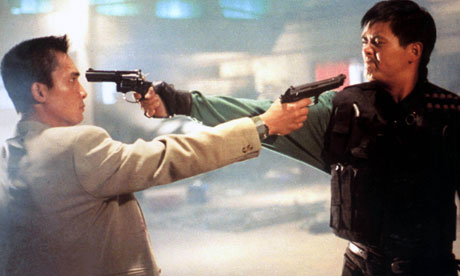
The last film I watched is Andrew Lau and Alan Mak’s smash 2002 hit Infernal Affairs, a film impossible to imagine without Johnnie To’s Milkway Image cops and gangsters movies (The Mission, The Longest Nite, Expect the Unexpected) that nonetheless proved far more financially successful than any of To’s films had been to that point. The first time I saw it was shortly before Martin Scorsese’s remake The Departed was released in the fall of 2006 and it was weird coming back to it almost a decade later, having seen Scorsese’s version a few times since its release. The plot, if you’re not familiar, follows two undercover agents: Tony Leung (Leonardo Di Caprio in the remake) plays a cop who has infiltrated a Triad gang and Andy Lau (Matt Damon) is a gangster who has infiltrated the police. Both characters rise to a trusted position and are each ultimately tasked with uncovering the other as both sides become aware that there’s a mole within their group. Infernal Affairsclocks in at a mere 100 minutes, lightning-fast by the standards of contemporary American film, where even the slightest of romantic comedies regularly slog past the two hour mark, which I think reveals something interesting about the ways the two industries (Hong Kong and Hollywood) work.
The running time difference is not merely the result of the remake having added more story. Though it does integrate some elements of Infernal Affairs’s two sequels, this amounts to maybe fifteen minutes or so of the extra time. The only major transformation of the narrative The Departed makes to the original (one which has no real major effect on the running time) is to combine the two female characters into one person. Instead of Andy Lau having a girlfriend (Sammi Cheng) and Tony Leung having a therapist (Kelly Chen) with whom he has a platonic friendship, Scorsese gives us only one character: Vera Farmiga as both Damon’s girlfriend and Leo’s therapist. This adds an element of wild metaphysical coincidence, as if there’s only room for one woman in this hyper-masculine gangster world. In this respect, an improbable coincidence that reinforces the doubling between the hero and villain, the Scorsese movie is actually more Johnnie To-like than the original, as many of To’s films are built around chance and fate. Scorsese gives the material a further complication by having DiCaprio sleep with Farmiga (something Leung does not do in the original), the professional rivalry between the two men thus becomes a sexual one as it’s implied that Damon is impotent while Leo is. . .the opposite. Scorsese films are littered with sexual insecurities and rivalries between men, so this addition thus makes the film even more his own.
So it’s not story changes that account for the difference in length between the two films. Rather it is the approach to characterization, genre and action. The kind of ruthlessly efficient filmmaking on display in Infernal Affairs is typical of the output of a genre-based studio system that relies on familiarity, both with character types and the various actors’ star personae, to do a lot of the narrative background work, much like Hollywood’s pre-Code gangster or ‘good-bad woman’ cycle, the films of which rarely clock in at more than 75 minutes. Scorsese’s film, by comparison, has to take its time developing its characters, because every Leonardo DiCaprio performance is different and this particular type of cop movie is fairly rare in modern Hollywood, where crime films are built more around action set-pieces (Michael Mann’s Heator Michael Bay’s Bad Boys, to take examples from two extremes, though it should be noted that hero-villain doubling is an essential part of Mann’s film) or gruesome bits of horror (David Fincher’s Se7en, or Jonathan Demme’s Silence of the Lambs).
Hong Kong fans can just look at a massive star like Andy Lau and know that he’s a cool, charming striver who might be a bit stiff, a bit amoral, but is probably a decent guy, while Tony Leung always looks anguished and his goatee tells you he’s done bad things he regrets (he also played almost the exact same role in John Woo’s Hard-Boiledten years earlier: a cop who’s been undercover too long) but is almost assuredly the hero (a notable exception is in Johnnie To’s The Longest Nite, where Leung plays a very dirty cop who somehow manages to still elicit audience sympathy by the end of the film, partially because he’s Tony Leung and he’s a great actor and partially because he isn’t quite as bad as the gangsters trapping him). Similarly, Sammi Cheng’s character is given almost no dialogue or character, but she is also major pop and movie star in Hong Kong who we know well from her other work, especially her prior films with Andy Lau, like Johnnie To’s Needing You and Love on a Diet.
Additionally, Infernal Affairs was merely the latest in a long string of so called ‘heroic bloodshed’ films, inspired by A Better Tomorrowand City on Fire: films about cops and triads with elaborate codes of honor and where the mirroring identification of hero and villain is a recurrent trope (see also Woo’s The Killer and Hard-Boiled, To’s The Big Heat, The Longest Niteand Running Out of Time among many others). These films in turn are a continuation of older traditions, such as the Shaw Brothers films of the late 60s and 70s, especially those directed by Chang Cheh (One-Armed Swordsman, Crippled Avengers) and the samurai movies of the 50s and 60s, especially those of Akira Kurosawa (Seven Samurai, Yojimbo). The audience for Infernal Affairs was likely familiar with many of these antecedents, even if they weren’t conversant with the films that had originally inspired them (American gangster films and film noir, Spaghetti Westerns, Jean-Pierre Melville’s crime movies, the whole history of action-adventure literature in Japan and China, American hard-boiled fiction and so on). A filmmaking culture with a strong genre- and star-based system is able to cut narrative corners based on the assumption that the audience will be able to follow along simply because they’ve seen this kind of thing, by these actors (or actors much like them) before. The Departed is almost an hour longer than Infernal Affairs, and much of that difference is in giving character-defining speeches and actions to the performers, as well as in the Hollywood-mandated repetition of key plot points in order to create the relatively unique generic world.
(It’s apparently some kind of rule in mainstream American film that you have to state everything three times in order to make sure everyone in the audience always knows what’s going on (or in case they got up for popcorn or something). Infernal Affairs in this respect is much closer to the way Johnnie To works. In a film like Sparrow, for example, To only relays a bit of information once. If you miss it the first time, you’re just going to have to figure it out on your own. This has the affect of making the audience both more attentive (don’t want to miss anything) and less (once you’ve missed something, you’re forced to take in other, non-story elements of the film, compositions, editing, music, etc, until you catch up again). In either case, its very rare in a Johnnie To film to feel like you’ve been pummeled, something all-too-common in contemporary Hollywood.)

The other big difference is in the approach to the violent sequences. Infernal Affairs is very matter-of-fact in its depiction of violence: it erupts suddenly and is over quickly. Scorsese though follows a build-and-release model, where suspense and tension accumulates over the course of a scene (often while Jack Nicholson is making a crazy speech) before being capped by an act of graphic violence. Take for example the breaking of Leung/DiCaprio’s cast. In both films, the undercover cop is wearing a hard cast on their forearm when the top gangster begins to suspect there’s a mole in his group. We’re shown before the scene begins that the cop will be wearing a wire, the implication being that it will be located in the cast. In Infernal Affairs, the gangster, with no lead up, simply grabs Leung’s arm and smashes it on the table just as their criminal scheme has been foiled. The violence is shocking, and the fear that Leung has been exposed is quickly felt and just as quickly resolved as no wire appears. In The Departed, the action takes place sometime after the scheme has been foiled. DiCaprio meets Nicholson in a bar and listens to him talk. They go to a back room where Nicholson talks some more (the tension here is all verbal: Nicholson can explode at any time (something we know well from his star persona) and we’re in a constant state of anticipation/dread). Ray Winstone, playing Nicholson’s enforcer calmly walks up, takes DiCaprio’s arm, and smashes the cast on a pool table. Nicholson then hammers his hand a few times with a boot, in case he (or we) didn’t get the message (Nicholson is angry with DiCaprio and doesn’t entirely trust him). Again, the wire is not there and DiCaprio’s cop remains safe, if rattled. It takes four minutes for Scorsese to cover the same story terrain Infernal Affairs accomplished in 15 seconds.
(Here’s where I explain that I don’t think this is a flaw of The Departed, merely a different approach to filmmaking. Yes, those speeches don’t advance the story much, but much of the pleasure of the film comes from the delightfully profane dialogue, spoken with relish in broad Boston accents by the film’s remarkable actors.)

The difference here is simply one of approach. Infernal Affairs is all quick, punctuating violence, violence that appears and disappears with no warning, no time to prepare. The Departed, on the other hand, creates a palpable dread. It very much wants to put us inside the mind of DiCaprio, to feel the kind of paranoia and pressure he has to deal with every day in his life as the only good guy in a world of very scary men. The Departed is as much about the psychology of violence as it is anything else and it creates a world dominated by this kind of pathological fear. Infernal Affairs is about tracing an intricate web and much of our enjoyment comes from watching the ways it plays on and varies its generic forebearers. To drastically simplify: in The Departed, we identify with the characters, in Infernal Affairs, we admire the filmmaking craft.
The success of Infernal Affairs certainly inspired a burst of creativity from Johnnie To, as he followed it up with his greatest cops and gangsters films, movies that challenged and critiqued the genre more successfully than he ever had before. Where his 1999 The Mission is a perfect expression of the heroic bloodshed genre, later films broke down and analyzed the genre’s ideals, codes, and psychology from within both the cops (PTU, Breaking News, Mad Detective) and the gangsters (Exiled, Vengeance, the Election films). None of these films managed to be as popular as Lau and Mok’s film, though they did win To critical acclaim both in Hong Kong and around the world. As yet, none of them have been remade in Hollywood.

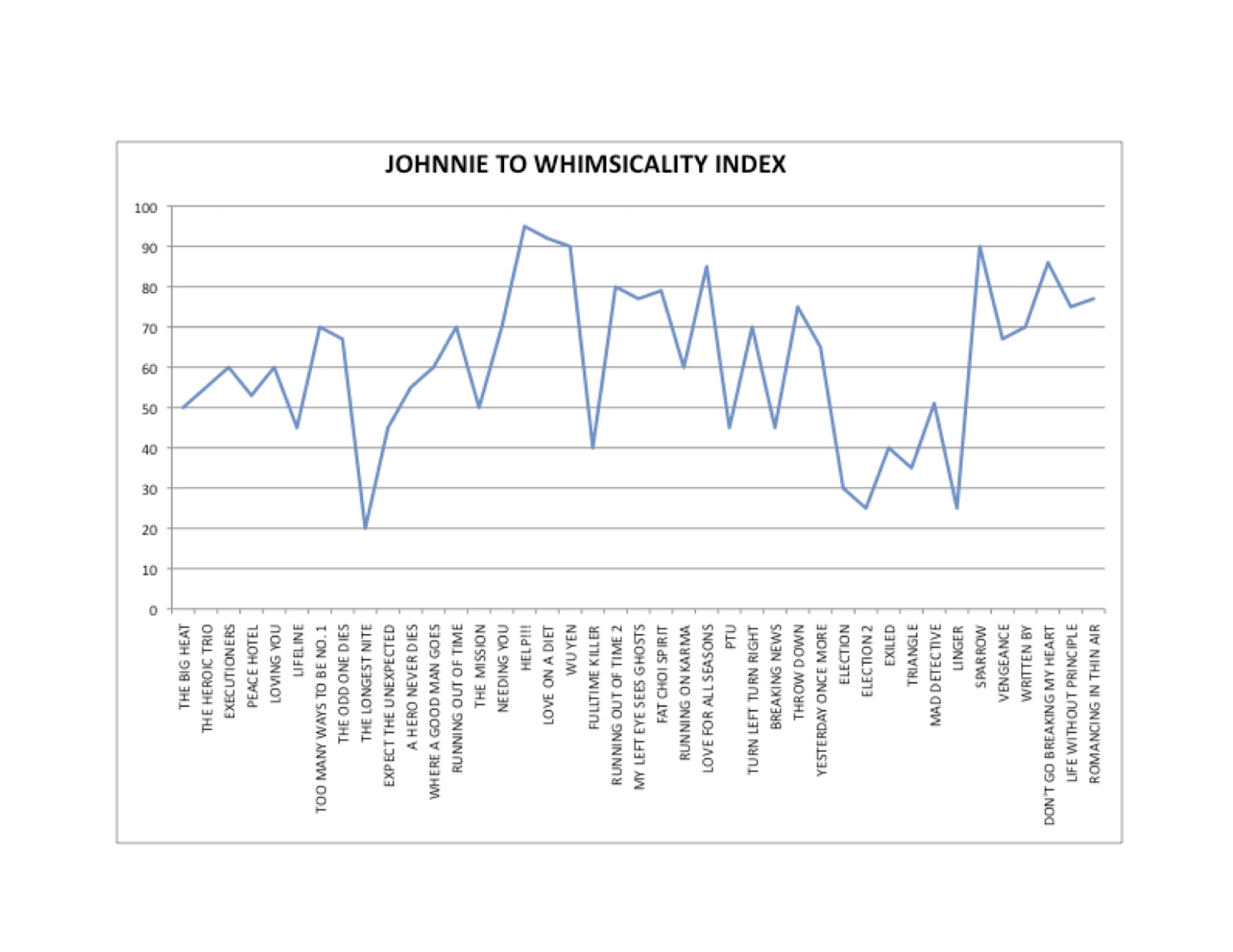
The Johnnie To Whimsicality Index

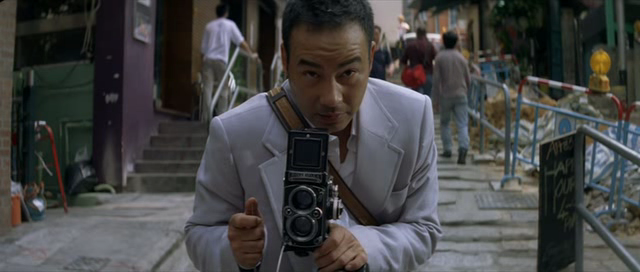
All 41 of the films by Johnnie To and/or Wai Ka-fai that I’ve seen, by Whimsicality Score over time. Whimsicality Score is how whimsical I think the film is on a scale of 0-100. The recent film with the lowest Whimsicality Score I can think of right now is Dear Zachary, which I’d give a 5, whereas Duck Amuck would approach a Whimsicality Score of 100.

The SLIFR Springtime Movie Quiz, Answered

It’s been years since I answered one of Dennis Cozzalio’s quizzes at Sergio Leone and the Infield Fly Rule, but here we go with Miss Jean Brodie’s Modestly Magnificent, Matriarchally Manipulative Springtime-for-Mussolini Movie Quiz:

1)     The classic movie moment everyone loves except me is:
It’s only 15 years old, but I think it might be considered a classic already, so I’ll go with the Normandy Beach sequence from Saving Private Ryan. Give me the recreations of the same events in The Big Red One or The Longest Day instead.
       
2)     Favorite line of dialogue from a film noir
“He was some kind of a man. What does it matter what you say about people?” – Tanya in Touch of Evil
       
3)     Second favorite Hal Ashby film
The Last Detail
       
4)      Describe the moment when you first realized movies were directed as opposed to simply pieced together anonymously.
I think when I learned that Raiders of the Lost Ark and ET were made by the same person.
       
5)     Favorite film book
Truffaut’s The Films in My Life was the first real film book I ever read, so it occupies a special place, and there are so many books I love by Sarris, Rosenbaum, Wood, Richie, Bordwell, Haskell, Naremore, and so on. But for favorite, I’ll have to go with James Harvey and Movie Love in the Fifties.

6)     Diana Sands or Vonetta McGee?

     
Vonetta McGee was in Shaft in Africa. Case closed.  
       
7)     Most egregious gap in your viewing of films made in the past 10 years

I’ve only seen one Steven Soderberg film since 2001’s Ocean’s Eleven remake (which was Che).

       
8)     Favorite line of dialogue from a comedy

“We need the eggs.” – Alvy in Annie Hall

       
9)     Second favorite Lloyd Bacon film

Footlight Parade

       
10)   Richard Burton or Roger Livesey?

Richard Burton never had the good fortune to star in a Powell & Pressburger film.

       
11)   Is there a movie you staunchly refuse to consider seeing? If so, why?

Not really. There’s plenty I’d refuse to watch, but I’d consider anything.

       
12)   Favorite filmmaker collaboration

Michael Powell & Emeric Pressburger were perfect.

       
13)   Most recently viewed movie on DVD/Blu-ray/theatrical?

DVD: Linger (Johnnie To, 2008)
Blu-Ray: Mad Detective (Johnnie To & Wai Ka-fai, 2007)
Theatrical: Porco Rosso (Hayao Miyazaki, 1992)

       
14)   Favorite line of dialogue from a horror movie

“We all go a little mad sometimes.” – Norman in Psycho

        
15)   Second favorite Oliver Stone film

Platoon

       
16)   Eva Mendes or Raquel Welch?

Eva Mendes in Holy Motors is greater than anything Raquel Welch has ever done (at least as far as I know). And she was also in Bad Lieutenant: Port of Call New Orleans.

       
17)   Favorite religious satire

Life of Brian is the obvious choice, but I’m going with Guru Dutt’s Pyaasa, about an obscure writer who becomes a cult phenomenon after he’s reported dead Upon returning and seeing how lame followers are, rejects them all to wander the earth with the cute hooker who loves him.

       
18)   Best Internet movie argument? (question contributed by Tom Block)

All the arguments for The New World and Miami Vice on The House Next Door many years ago.

       
19)   Most pointless Internet movie argument? (question contributed by Tom Block)

Most of them, probably. But every time the argument over aspect ratios for late 50s movies comes up, my eyes glaze over.

       
20)   Charles McGraw or Robert Ryan?

Robert Ryan is one of my favorites. I’ve seen a number of Charles McGraw films, but still had to look him up.

         
21)   Favorite line of dialogue from a western

“You know what? If I was you, I’d go down there and give those boys a drink. Can’t imagine how happy it makes a man to see a woman like you. Just to look at her. And if one of them should pat your behind, just make believe it’s nothing. They earned it.” – Cheyenne in Once Upon a Time in the West

       
22)   Second favorite Roy Del Ruth film

Broadway Melody of 1938. Eleanor Powell’s third-best Broadway Melody movie.

23)   Relatively unknown film or filmmaker you’d most eagerly proselytize for

Johnnie To. If he’s not obscure enough, then Liu Jiayin, whose Oxhide II is one of the best films of the past 10 years.

       
24)   Ewan McGregor or Gerard Butler?

Big fan of Ewan McGregor. Not a fan of Gerard Butler.

      
25)   Is there such a thing as a perfect movie?

Oh yeah. There are tons of them.

       
26)   Favorite movie location you’ve most recently had the occasion to actually visit

I have no idea. Probably some random street in Seattle or Vancouver.

       
27)   Second favorite Delmer Daves film

Never Let Me Go

        
28)   Name the one DVD commentary you wish you could hear that, for whatever reason, doesn’t actually exist

Yasujiro Ozu on his final film, An Autumn Afternoon

       
29)   Gloria Grahame or Marie Windsor?

Crazy doesn’t get any better than Gloria Grahame

       
30)   Name a filmmaker who never really lived up to the potential suggested by their early acclaim or success

We only got about 10 years worth of great films out of Buster Keaton and Josef von Sternberg, and that should be enough, but I want more.

31)   Is there a movie-based disagreement serious enough that it might cause you to reevaluate the  basis of a romantic relationship or a friendship?

Nope.


This Week in Rankings

This week I wrote a thing on auteurism and created a bunch of They Shot Pictures-related lists in Letterboxd, ones for the directors we’ve discussed thus far (Josef von Sternberg, Yasujiro Ozu, Hou Hsiao-hsien and Mikio Naruse) as well as ones for upcoming episodes (Johnnie To, Akira Kurosawa, John Ford, FW Murnau). I’ll keep these updated as I watch more films from these directors. The Johnnie To list has been in a constant state of flux as I watch more and more of his movies, which inevitably leads to re-evaluation of the previously seen ones (that’s auteurism at work).

Here are the movies I watched and rewatched this week and where they place on my year-by-year rankings. (Yes, they are all Johnnie To movies). I’ve linked to my full review of The Big Heat, the rest are linked to shorter reviews I wrote for each movie at Letterboxd.

The Big Heat – 13, 1988
The Heroic Trio – 23, 1993
Executioners – 24, 1993
Help!!! – 12, 2000

Turn Left, Turn Right – 10, 2003
Election – 5, 2005
Election 2 – 5, 2006
Triangle – 22, 2007
Linger – 29, 2008

On Johnnie To’s The Big Heat

Johnnie To’s first crime movie and his fifth feature, following a period action film made eight years earlier (The Enigmatic Case, 1980), several years of work in television and a trio of romantic comedies (Happy Ghost 3 (1986) (co-directed with Raymond Wong, I think, imdb credits it to Ringo Lam with To as assistant director) and Seven Years Itch (1987)). Produced by Tsui Hark (who has a funny cameo at the end as a “long-haired weirdo”), it feels more like one of his films than anything else, with super-graphic slow motion violence that’s less elegant and more shocking than anything To would do later in his career.

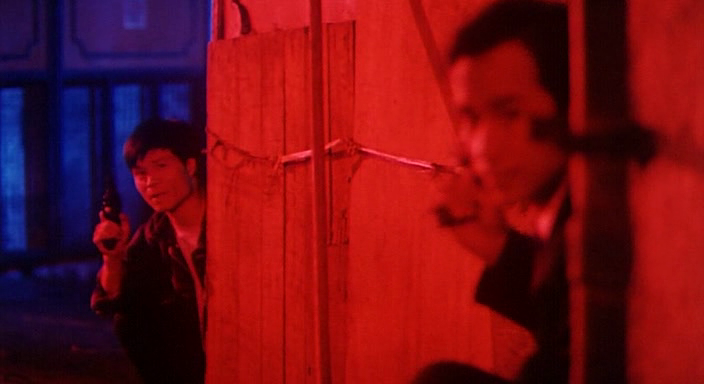
The film was apparently a very troubled production, going through a number of directors (see this interview with its screenwriter, Gordon Chan, who wrote and directed one of Jet Li’s greatest films, Fist of Legend, in 1994. Thanks to They Shot Pictures‘s Seema for the link) But there are certain visual touches that distinguish the film from the other crime movies of its time (Ringo Lam’s City on Fire or the Hark-produced John Woo films like A Better Tomorrow or The Killer) and point to what would prove to be one of To’s unique qualities as an auteur. Most obviously, there’s shootout between cops suffused in fire engine-red light, alternating with deep blue in reverse shots (much like the blue in the opening of To’s 1999 film Where a Good Man Goes), which abstracts the action into pure the image that Tsui’s graphic violence works so hard to make nauseatingly ‘realistic’. Later, there’s a magical bit of release as the cops, rejecting a bribe from the film’s villain, throw piles of cash into the air, watching it blow in the breeze, that recalls moments of childlike freedom snatched from darker realities in Throw Down (as when the plot is temporarily suspended so the three main characters can collaborate to free a red balloon from a tree) or the whole of Sparrow or the Running Out of Time films, which take what are ostensibly dark and violent gangster movie settings and turn them into spaces for play and possibility. Given the film’s convoluted production history, it’s impossible for me to say whether or not To was actually involved in the shooting of these scenes. But they’re nonetheless evocative of his later work, as is the characterization of the film’s hero.

Waise Lee, the heel from A Better Tomorrow and Bullet in the Head, plays the lead, a cop with nerve damage in his hand who is on the verge of retirement, but who must solve one last case, the murder of his old partner (shades of Beverly Hills Cop). Lee is yet another To hero with a disability, see also: Throw Down, Mad Detective, Running on Karma, Running Out of Time, Vengeance, Yesterday Once More, Love on a Diet, Wu Yen, and if being dead counts as a handicap, A Hero Never Dies and My Left Eye Sees Ghosts. But where most of those other films use the disability as a launching point for the character’s transcendence of physical limitations, either spiritually or through an existential stand in the name of honor, loyalty, friendship, and/or love, The Big Heat remains thoroughly materialist, grounded in the world of Hong Kong’s cops and gangsters before the fall. The sense of vague dread, of millennial fatalism that hangs over much of To’s later work is present here, but it’s given a more explicit and specific, and (therefore) rather less interesting, name: the gangsters openly discuss their plans to cash in while they can before the ’97 handover of Hong Kong to China. The end is a plot motivation, rather than a mood. The result of these compromises is a very solid action movie that at times seems like its going to burst free of its genre, but is missing that last little twist that would become the hallmark of To’s Milkway Image films beginning a decade later.

Watch for Philip Kwok playing one of Lee’s partners. Kwok has done just about everything you can do in movies: direct, star, write (he was one of the writers on Once Upon a Time in China and America, the sixth(!) in the series started by Jet Li (who took the fourth and fifth films off) and Tsui Hark and the one which was ripped off by Jackie Chan for the big international hit Shanghai Noon (AKA, the kung fu movie that my mom likes)), choreograph, produce, he even has an art direction credit (for Wilson Yip’s 2004 film Leaving Me, Loving You, starring Leon Lai and Faye Wong and which I now desperately want to see). He was one of Chang Cheh’s Five Deadly Venoms (he was the lizard), but is probably most recognizable as the bad guy with the eye patch in Hard-Boiled. He gets a fun, meaty part here as part of the team of cops (which also includes a callow rookie and an aviator-shades-wearing Malaysian detective).

This Week in Rankings

They Shot Pictures research continued this week, as I watched a half dozen more Johnnie To and/or Wai Ka-fai movies. I’ve a list of the 32 movies I’ve seen of theirs so far over at letterboxd, keeping in mind that ranking these movies is even more difficult tan usual for me. The order of much of that list changes every time I update it. Suffice it to say that To and Wai are responsible for an abnormally large number of really good movies.

In addition to watching these this week, I also handed out a bunch of fake awards (for the years 1932, 1964, 1957 and 1994) and reviewed Everybody in Our Family, a film I saw at the Vancouver International Film Festival last October. I have three more VIFF reviews to write (Emperor Visits the Hell, Amour & The Unlikely Girl) and I hope to get them done in the next couple of weeks, before baby #2 arrives.

These are the movies I’ve watched or rewatched in the last week or so, and where they place in my year-by-year rankings. I’ve linked to my brief comments about them on letterboxd where applicable.

Stage Door – 9, 1937
Bullet in the Head – 7, 1990
Peace Hotel – 33, 1995

Wu Yen – 15, 2001
Love on a Diet – 22, 2001
Fat Choi Spirit – 10, 2002
My Left Eye Sees Ghosts – 14, 2002

VIFF 2012: Everybody in Our Family

Maybe this is just one of the many strange things about me, but I happen to think that every Romanian film I’ve ever seen is a hilarious black comedy. The Death of Mr. Lazarescu, about a dying man shuttled from hospital to hospital by an indefatigable nurse struggling against an absurd bureaucracy, Roger Ebert compares to the Dardenne Brothers and United 93, and has generally been perceived as both a trenchant attack on health care bureaucracy and a tedious slog (though some reviewers (eg J. Hoberman) did pick up on its peculiar humor). 4 Months, 3 Weeks and 2 Days. . ., about a woman who helps her friend get an abortion despite the communist ban on the procedure, is a textbook suspense-horror film (think the prolonged dinner sequence and the classical “Lewton bus” late in the film) capped by a brilliant, audacious joke in its final scene. But in the US, commentary about the film revolved around the issue of abortion, and the film’s deadpan realism was perceived as a political statement (“The frigid stoicism. . . barely contains the filmmaker’s fury.” – David Edelstein). Even The Rest is Silence, a generally genial period film about the production of the first Romanian feature film, climaxes with a moment of comic horror, as a malfunctioning stage leads to an incineration.

This may be a facet of the American reception of Eastern European film in general. The least ironic of Polish director Krzysztof Kieslowski’s Decalogue, the episode about the death penalty that was expended into A Short Film About Killing, seems to be the most popular one here. Similarly the expansively humanist Red is the most popular of the Three Colors films over the darker, more twisted Blue and White. As well, the Hungarian Béla Tarr is much-noted for the austerity and extreme length of his films, while the comedy (which Sátántangó, a satire of life under collectivism, most definitely qualifies as) is often missed or at least de-emphasized. It seems to me that these film’s comic aspects are overlooked in favor of discussion of their subjects, which just happen to be vitally important political issues in the United States. Thus Lazarescu is viewed through the same lens as Michael Moore’s Sicko (a much less funny film from an ostensibly comic filmmaker) and 4 Months becomes “the Romanian abortion movie”  through which we can learn (ie teach people who don’t agree with us) about the dangers of making abortion illegal. The hot-button subject matter distorts our view of the film, preventing the appreciation of its true, comical, nature. This is a subject for further study. I haven’t seen nearly enough Romanian or Eastern European film to generalize about them, or American reactions to them. But it does seem, thus far, to be a bit of a trend.

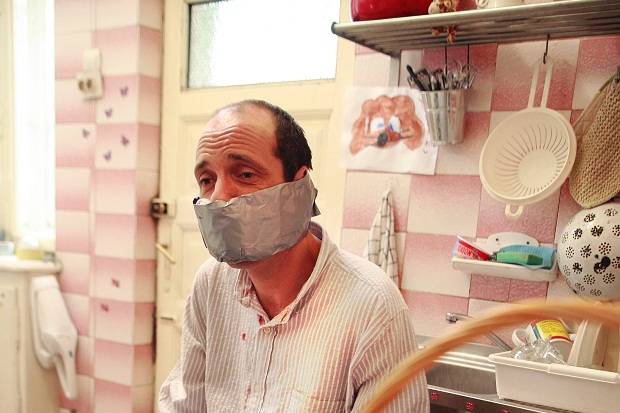
Which brings me to Everybody in Our Family, a film by Radu Jude, about a degenerate man with anger issues who takes his ex-wife’s family hostage so that he can kidnap their daughter. The film hasn’t had much of a release yet in this country, so I’m not sure everyone else sees it as the comedy I do, or if this will prove to be another case of the subject of the film trumping its actual content. I guess time will tell. Anyway, it is, like those other Romanian films, shot in a dead-pan, realist style with hand-held camera-work and improvisational-seeming acting. But rather than follow the horror film template of 4 Months, the film is a classic example of comic escalation, a film form that dates back to Laurel & Hardy and beyond. Şerban Pavlu plays the father, Marius, and he looks a bit like a pudgier Robert Benigni. Disheveled and slovenly, he first visits his parents, who berate him for generally being a failure. Then he goes to pick up his daughter for a planned trip to the seaside. Opposed in sequence by his ex-mother-in-law, his ex-wife’s new husband and his ex-wife, he grows increasingly exasperated and violent as the day progresses, eventually beating up the guy and tying everyone up so they’ll be quiet and pretend no one is home when the police are finally called. Pavlu, followed by Jude’s camera, stalks through the overstuffed apartment like a caged animal, but more hamster than bear: his ferocity is mitigated by his and the family’s hyper-verbosity: everybody in this family talks way too much, too loud and all at the same time (some favorite lines of dialogue: Marius to his daughter Sofia, played by Sofia Nicolaescu, who in her wild, unpredictable swings from loving to frightened to playing cheerfully perfectly captures the capriciousness of small children: “I love you my beloved seal”; Marius to Sophia again, a bit later: “Listen carefully. . . Your mom is a bloody whore”; a neighbor lady to Marius as he makes his escape: “May the devil fuck with your lungs.”)

In the film’s most radical move, the stand-off ends not with a bang, but a whimper as Marius gives up and sneaks away, evading the cops and setting out in search of first aid for a bloody cut, the only real injury anyone suffers over the course of the day (at least physically). Jude spends the run of the film slowly escalating the tension to more and more absurd heights, but rather than deliver the punch-line, the final house falling on Buster, he simply lets the tension dissipate into the air as Marius dissolves back into the city streets and the world moves on.

This Week in Rankings

These are the movies I’ve watched or rewatched over the last week or so, along with where they place in my year-by-year rankings. I’ve linked each to my short reviews on letterboxd as well. As you can see, I’ve been watching a lot of Johnnie To-related movies in preparation for a new episode of They Shot Pictures (check out the recently posted episode on Mikio Naruse). I also revived the Endy Awards (2011 and 2012), look for more of that kind of thing in the coming weeks.

A Better Tomorrow – 1, 1986
City on Fire – 9, 1987
Porco Rosso – 6, 1992
Pom Poko – 8, 1994
Comrades: Almost a Love Story – 1, 1996
Too Many Ways to Be No. 1 – 7, 1997

Where a Good Man Goes – 15, 1999
Needing You – 10, 2000
Fulltime Killer – 14, 2001
The Heroic Duo – 26, 2003
Moonrise Kingdom – 1, 2012
Argo – 50, 2012