Running Out of Karma: John Woo’s The Crossing

Here are reviews of the two separately released parts of The Crossing. We talked about John Woo’s career in general on They Shot Pictures a few months ago.

maxresdefault

The Crossing – reviewed August 13, 2015

The first part of John Woo’s latest epic (the second part was recently released in China to little fanfare, but isn’t available here yet) is a romantic war movie in the style of The Big Parade or Doctor Zhivago, with a half dozen characters caught up in the Chinese civil war following the defeat of the Japanese in 1945. The most direct connection is probably Cai Chusheng and Zheng Junli’s 1947 film The Spring River Flows East which follows the ups and downs of a family awash in the same history, and was also released separately in two parts.

Leaving the nautical disaster that’s led the project to be dubbed “John Woo’s Titanic” for the second half, this first part follows the three major stars and their satellite characters through the civil war: Zhang Ziyi as an illiterate nurse trying to get by while searching for the man she loves (a soldier), Takeshi Kaneshiro as a Taiwanese doctor who has lost the woman he loves (a Japanese girl), and Huang Xiaoming as a Nationalist general who falls in love with and marries a young woman before shipping her to safety in Taiwan (where she lives in Kaneshiro’s girlfriend’s old house). It’s lush and romantic (a quite pretty score by Taro Iwashiro, who also did the stirring and lovely music for Woo’s Red Cliff), with golden hues, wind blowing through grasslands, pointed freeze frames and slow motion (yes, and doves), balanced by the horrors of war: starving children, students and dancing girls beaten in the streets, freezing trenches and explosive heroism. Nobody mixes action and melodrama with more seriousness than John Woo.

One person’s old fashioned and sappy is another person’s classical and heartfelt. And I am nothing if not a sucker.

20150801190257

The Crossing II – reviewed December 2, 2015

Such a strange movie, less a continuation of the story of Part One than a partial remake of it (pointedly perhaps its title is “The Crossing II” and not “The Crossing Part II“), as the first half hour not only recapitulates what went before, but completely replays whole scenes with slightly different editing and a few extra scenes added in. The next hour or so continues the rhythm of the first film, intercutting between the various leads as they all slowly make their way to the doomed boat (a title card at the opening gives us all the details of the impending disaster, with some of this information to be repeated verbatim at the end of the film). The emphasis is on Takeshi Kaneshiro’s doctor, first in his friendship with Song Hye-kyo (the wife of Nationalist general Huang Xiaoming), then with his family (ostensibly his younger brother who wants to run off from Taiwan to Shanghai to become a prostitute, but as it plays the relationship is more with his mother and sister-in-law (his older brother’s widow), who is played by Woo’s daughter Angeles), and finally, on the boat, with Zhang Ziyi, the idealistic young woman willing to do anything up to and including prostitution in her quest to survive long enough to find the army man she loves (“When I believe someone, I believe him whole-heartedly. Shouldn’t it be that way?” she says, in a line that does much to summarize Woo’s entire career).

Recentering the film in this manner makes it less an ensemble piece about love in a time of war, as the first one is, than a film about the endurance of women in the face of tragedy. Perhaps this is the influence of Tsui Hark, brought in at the last minute to help assemble the final cut of this film. The whole thing feels like it was hastily assembled in response to the box office failure of the first film. I’m very curious how the second half was to play out in its initial conception, as I quite liked Part One, it had the sweep and loveliness of a great historical melodrama, like Woo’s version of the great 1947 Shanghai film The Spring River Flows East. The second part though would probably play better, or at least just as well, as a single film, in isolation from the first. The jumbling repetitions of the first film irreparably break the rhythm, we’re left wondering why we’re seeing these scenes again, and why the new scenes were deleted from the first film, rather than being caught up in the emotions on-screen.

For all its billing, this is not “John Woo’s Titanic“. In its loveliness, deep anxiety about the past and the horrors of history (one of the many fascinating things about it’s look at the Civil War is that both sides are pretty much equally terrible, while good people populate the ranks of both armies), breathtaking romanticism and flights of digital expressionism, this is nothing less (and nothing more) than John Woo’s War Horse.

Tsui Hark

Tsui Hark

Reviews:

The Butterfly Murders (Tsui, 79) – May 31, 2013
Shanghai Blues (Tsui, 84) – Aug 28, 2014
Working Class (Tsui, 85) – Dec 07, 2013
Peking Opera Blues (Tsui, 86) – Nov 22, 2013
A Better Tomorrow (Woo, 86) – Jun 26, 2015
A Better Tomorrow II (Woo, 87) – Nov 21, 2013

The Big Heat (To et al, 88) – Jan 09, 2015
The Killer (Woo, 89) – Aug 24, 2015
A Better Tomorrow III: Love and Death in Saigon (Tsui, 89) – Oct 21, 2014
Just Heroes (Woo & Ma, 89) – Aug 16, 2015
Swordsman and Swordsman 2
(Ching et al, 90 and Ching, 92) – Sep 26, 2012
Once Upon a Time in China (Tsui, 91) – Jan 16, 2017
Once Upon a Time in China II (Tsui, 92) – Jan 17, 2017

New Dragon Gate Inn (Lee, 92) – Apr 24, 2014
Green Snake (Tsui, 93) – Oct 25, 2013
The Lovers (Tsui, 94) – Apr 04, 2014
The Blade (Tsui, 95) – Mar 19, 2014
Love in the Time of Twilight (Tsui, 95) – Apr 04, 2014
Zu Warriors (Tsui, 01) – May 30, 2013

Seven Swords (Tsui, 05) – Mar 11, 2014
The Flying Swords of Dragon Gate (Tsui, 11) – Oct 29, 2014
Young Detective Dee and the Rise of the Sea Dragon (Tsui, 13) – Feb 27, 2014
The Taking of Tiger Mountain (Tsui, 14) – Jan 14, 2015
Sword Master (Yee, 16) – Dec 9, 2016
Journey to the West: The Demons Strike Back (Tsui, 17) – Feb 7, 2017

Podcasts:

Iron Monkey (Yuen, 93) – Jan 23, 2016

Capsules:

We’re Going to Eat You (Tsui, 80) – Jun 08, 2013
Dangerous Encounters – First Kind (Tsui, 80) – Jun 25, 2013
Dangerous Encounters – First Kind (Tsui, 80) – Jan 20, 2017
All the Wrong Clues for the Right Solution (Tsui, 81) – Nov 27, 2013
Aces Go Places III: Our Man from Bond Street (Tsui, 84) – Dec 04, 2013
The Banquet (Tsui et al, 91) – Dec 13, 2013

Twin Dragons (Tsui & Lam, 92) – Apr 14, 2015
The East is Red (Ching & Lee, 93) – Jun 22, 2015
Once Upon a Time in China III (Tsui, 93) – Jan 18, 2017
Burning Paradise in Hell (Lam, 94) – Nov 22, 2016
The Chinese Feast (Tsui, 95) – Jun 04, 2013
Black Mask (Lee, 96) – Mar 22, 2016
Shanghai Grand (Poon, 96) – Mar 20, 2016

Double Team (Tsui, 97) – Apr 04, 2014
Knock Off (Tsui, 98) – Apr 07, 2014
Time and Tide (Tsui, 00) – Mar 25, 2014
Time and Tide (Tsui, 00) – Sep 05, 2016
Triangle (Lam, Tsui & To, 07) – Mar 09, 2013
Missing (Tsui, 08) – Jan 25, 2017
Detective Dee and the Mystery of the Phantom Flame (Tsui, 2010) – Apr 24, 2014

List:

Tsui Hark Movies

VIFF 2010: Day Four


607 – Before getting to Day Four’s films, I wanted to mention this short by Liu Jiayin that played before Day Three’s showing of Thomas Mao. Liu made my favorite film from last year’s festival, Oxhide II, which also happens to be the highest rated film directed by a woman on my recent Top 600 Films of All-Time list. This 17 minute short consists mostly of one shot of a bathtub in a hotel room (the hotel apparently commissioned the film). A plastic fish, manipulated by Liu’s father, with only his hands visible, swims in the water and encounters some mushrooms, a cloudy sky and a fish hook. The mushrooms are played by Liu’s mother and Liu herself is the sky and hook. It’s a marvelous bit of silliness that conveys all the warmth of a family at play.

Hahaha – The first of two films directed by Hong Sangsoo at this year’s festival, it begins, unsurprisingly for Hong, with two old friends drinking and telling stories about women. The film proper is comprised of these two stories, which end up being about the same woman, though neither knows it, while the frame is played in black and white stills with voiceover (and lots of “Cheers!” as the two drink quite a lot). The Hong films I’ve seen all have a split structure, with the second half of the film telling a new story with some of the same characters in a way that mirrors and comments upon the events of the first story. This film has that same structure, but the stories are intercut instead of segregated. This makes the film a lot easier to watch, and this is definitely the film I’d recommend to anyone who hasn’t seen a Hong Sangsoo film yet. As for the stories themselves, they’re Hong’s traditional terrain of romantic misadventures and misunderstandings and lots and lots of drinking. Again there’s a character who’s a film director, this time he falls for a tour guide who’s dating a poet who is best friends with a guy who’s on vacation from his wife with his girlfriend. It’s this last guy and the director who are the two narrators of the film. It’s as funny as Like You Know It All, one of my favorites at last year’s festival, if not quite as weird and certainly not as insidery about film festival life.

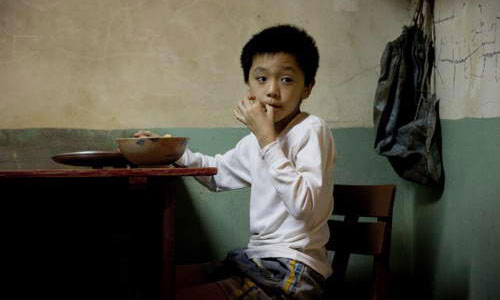
The Fourth Portrait – This Taiwanese film is about a precocious young boy named Xiang whose father dies, sending him first into the helpful hands of the school janitor, and then back to his mom, a prostitute (naturally) and step-father (who’s pretty much pure evil). Director Chung Mong-hong keeps this dire material much lighter than one would expect.  Though the kid’s situation is rough and potentially terrifying, there’s enough humor and visual style (there are traces of both the Taiwanese New Wave and Wong Kar-wai, the latter especially in the scenes at the mom’s “lounge”) that things never get as horribly depressing as they might in a lesser film. There’s even a musical bit that sounds like a Chinese version of the Carl Orff song used in Badlands and True Romance). Xiang is surrounded by helpful adults, from the elderly janitor to a small time hustler to a concerned teacher. Even his mom is a decent sort. We never get the sense that Xiang’s situation is hopeless, instead, we can be sure that he’ll survive and thrive. The title comes from a series of drawings Xiang makes throughout the film: the first is his father, the second his friend the hustler, the third his older brother who may be haunting him and the fourth, more than a little cheesily, is the film itself.

I Wish I Knew – After last year’s excellent 24 City, I wasn’t quite prepared for this latest film from Jia Zhangke. While that film was a documentary that mixed scripted and acted interviews with real-life talking heads in a way that made one question the nature of documentary realism, this film is pretty much a straight and conventional film. It’s an epic collection of stories about Shanghai, told by the people who lived there and the children of the people who lived there. Shanghai was the epicenter for the most important developments in China over the 20th Century, from the European occupations to the Japanese invasion to the Civil War between the Communists and Chaing Kai-Shek’s KMT to the Cultural Revolution to the embrace of capitalism in the late 1980s. Even the Chinese film industry was based there for much of the century. Jia’s 18 interviews tell these stories in detail, with communists and KMT generals and movie stars and directors. Wei Wei appears, which marks two days in a row that we saw a film featuring this 88 year old actress, after The Drunkard. Also interviewed are Hou Hsiao-hsein (who’s actually the only person who doesn’t share a personal anecdote, he just talks about his film Flowers of Shanghai, though like many people in the film, his parents came to Taiwan from Shanghai ahead of the Communist victory). The film is very loosely structured, with the interviews coming not in chronological order of their stories, but rather the geographical order of where they have spread out. The Shanghai diaspora mainly went to Taiwan and Hong Kong, and so Jia goes to each of those places to seek out their stories. But these interviews are interspersed with scenes of present-day Shanghai, where frequent Jia star Zhao Tao wanders mutely around the sites of the old stories, neatly tying the old and new, the diasporic and the homeland together. It’s a beautiful film, about as good as a straight documentary can be.

Short Celebrity Addendum: Jia was there last night for a Q & A (he’s serving on the jury at the festival this year for the award for new Asian filmmakers that they’ve given out for 17 years or so, having previously won the award for his own first film Xiao Wu). I don’t know that I’ve ever been so giddy in a movie theatre. And then this morning, waiting in line for Catherine Breillat’s Sleeping Beauty, I’m pretty sure we were standing behind a very confused Wallace Shawn (the screening was delayed for projection reasons and the staff were giving confusing directions to the old people). I attempted to help the maybe-Shawn through the line, but he either couldn’t hear me or was too confused to pay attention to a much taller man.