Running Out of Karma: Drug War

Taking a big leap out of chronological order, I want to write a bit about Drug War, Johnnie To’s second most-recent film, one that should be showing up on a lot of end of the year Best Of lists right around now. Running Out of Karma is my on-going series on Johnnie To and Hong Kong cinema. Here is an index.

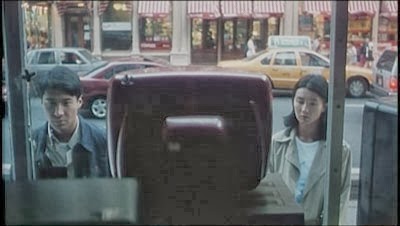
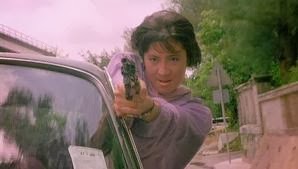
From the beginning, it explains that this is not your typical heroic bloodshed Triad film, concerned more with codes of honor and brotherhood and the mirroring of good and evil than anything else. No, instead this is going to be a straight police procedural, with no metaphysical mumbo jumbo: “You’re a drug dealer, I’m a cop. I didn’t betray you, I busted you,” explains Sun Honglei’s Captain Zhang, and with that 25 years (at least) of Hong Kong genre convention, from John Woo’s A Better Tomorrow and The Killer to To’s own cop/Triad movies (Breaking News, PTU, Mad Detective, etc) is summarily dismissed.

What follows are the details of Zhang’s investigation of captured drug manufacturer Timmy and his gang, with Timmy as an apparently cooperating turncoat. He arranges a series of meetings between Zhang and his connections (the port-controlling Haha and the nephew of a drug lord), providing Sun with the opportunity to first play the spaced-out, taciturn junkie nephew in the meeting with Haha followed quickly by a Haha impersonation with the real nephew. Sun’s performance, as well as To’s coordination of a near miss in the lobby between the real and fake Hahas, is impeccable.

This sequence ends in the first, and least successful, of a series of climaxes. The film has a pulsating rhythm, slowly building tension through dialogue scenes, involving one character attempting to convince another that he is being genuine. This is the film’s Tarantinian inheritance: like Inglourious Basterds, Reservoir Dogs or Django Unchained it is structured as a series of conversations wherein one person attempts to convince another that he is who he says he is (even though we know he’s not). That tension builds to the point of eruption: first as Zhang has a bad reaction to some drugs he’s forced to take (in the film’s least plausible scene, but then I’m not an expert in heroin overdoses), then a tense yet comical roadside confrontation between Timmy and his subordinate truck drivers, then a shootout at a drug warehouse and then finally the film’s final sequence. To sticks doggedly to this structure, leaving no time for backstory or character development. This extends even to the visual style of the film: it flows and it’s lovely, but there are few self-consciously stunning or flashy shots. To has pared down his visual aesthetic in the same way he’s cut down the screenplay: only the essential. We learn about Zhang and his team through their actions: their relentless commitment to their jobs despite the almost total lack of sleep over several days (the cops who follow a suspect truck for 24 hours at the spur of the moment, the way no one wants to sleep when Zhang orders them to get some rest). There are no romances, no past traumas in need of working out, no wondering “if it’s all worth it”, just professionals doing a job.

The moral implications of that job are left to the viewer to tease out. Filming in China, under the restrictions of government censorship, prevents To from being straightforwardly political. Not that he would if he could, as he’s always been more interested in tension and contradiction than polemic or advocacy. But the power of the cops on display here, both in determination and technological prowess (manpower, firepower, tiny cameras and bugs and computers and more: they manage to take over an entire port in a matter of hours!) is impressive, surely enough to satisfy any authoritarian. Perhaps too much: it seems designed to unnerve rather than valorize. As with the 2007 Milkway Image film Eye in the Sky, the film often mixes in images captured from surveillance cameras. This visual trope seems to be growing in popularity as a conventional shorthand for the Big Brother-ness of the PRC government: it’s always watching. (Vivian Qu’s recent film Trap Street explores this metaphor more explicitly.)

In To’s 2011 Life Without Principle, the Triads are beginning to look a bit desperate in the wake of the latest global financial crisis. While they come off slightly more organized here, their grasp on power has certainly been shaken since the late-90s Handover days of The Mission or Exiled. It’s no coincidence that all the cops are played by Mainland actors while all the crooks are Hong Kongers. It’s not just the censor-passifying implication that the criminal element are “outsiders” but also a complication of audience sympathies, especially for those who recognize Lam Suet and Lam Ka-tung and Lo Hoi-pang from previous To films. Beyond that is the performance of Louis Koo, hero of many of To’s films, usually as a romantic lead, the Election films being notable as the only other time he’s played a crook for To. Like those two films, Koo, despite his criminality, plays a sympathetic figure. He’s the only character in Drug War who hints at a past, the only one to ever show any kind of emotion (a very moving scene where his gang mourns the death of Koo’s wife and her brothers, where they are so desperate to show their respect for the departed that they burn real money (the burning of fake money being a traditional mourning activity: it gives the dead some cash for the afterlife)). Even at the end, we can’t help but admire Timmy’s desperate gasps at self-preservation. He orchestrates the finale, bringing cops and crooks together on a city street for a bloody shootout, and does all he can to intensify the chaos, killing cop and criminal alike. It’s only in confusion that he can hope to escape. He has no loyalty to either side: his will to live supersedes any sense of order. Face to face with human desperation, both structures: the seemingly omnipotent power of the state and the criminal gang from capitalist Hong Kong, crumble.

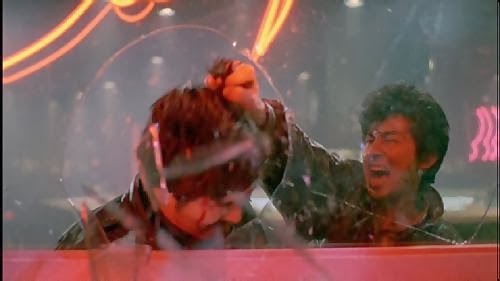
But of course, Timmy doesn’t get away. Zhang, the agent of the state, handcuffs himself to him in his final moments and Timmy, frantically clawing against him like a rat in a cage, dragging Zhang’s body around as he’s surrounded by the military units of the Chinese police, stands as a potent symbol of both the useless, inevitably self-destroying violence of the criminal life and the helplessness of the single individual against the power of the state. The film’s coda, Timmy’s execution as he babbles everything he knows about China’s criminal underworld in a final attempt at freedom, is terrifying in its clinical matter-of-factness. In the end, there’s no escape for him, but even in those last moments, he’s not allowed a kind of human or even spiritual understanding. All he is is a repository of criminal knowledge. All he is is a job.

Running Out of Karma: Tsui Hark’s Working Class

Running Out of Karma is my on-going series on Johnnie To and Hong Kong cinema. Here is an index

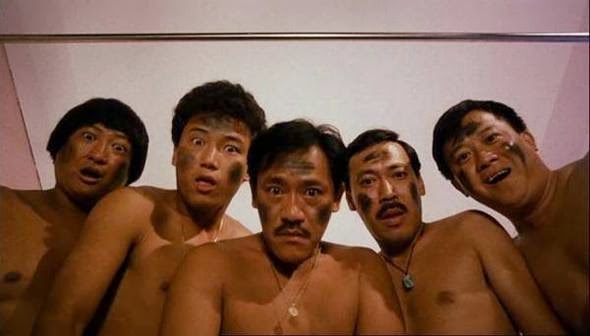
A Cinema City film in all but name, as Tsui Hark directs for his own production company, Film Workshop, this comedy with pop star Sam Hui (of the Hui Brothers and Aces Go Places) and rock star Teddy Robin (of Tsui’s own All the Wrong Clues. Tsui himself rounds out the trio of workers trying to get by in the world of benevolent old owners and evil middle managers (none other than Ng Man Tat – it’s going to be weird seeing him as Stephen Chow’s sidekick again after he’s so great in these 80s villain roles (A Better Tomorrow II, My Heart is that Eternal Rose)). The three work in an instant noodle factory (is there a Cantonese word for ‘ramen’?) and play a variety of pranks to undermine the bosses. Much to the irritation of Tsui’s wife (Leung Wan-yui), Tsui brings the homeless Teddy home to live with them. Tsui and Teddy make a great comic pair: tall and thin with, as Bordwell puts it “an intimidating goatee” and short and squat and almost always wearing sunglasses. Sam falls in love with the boss’s daughter, Joey Wang, but she hides the fact that she’s rich from him (Sam wonders why a fancy Rolls Royce is always following them everywhere they go on their neon-lit dates through the city at night). Then everyone plays soccer and everyone cheats.

Rather than grafting a Socially Important Message onto an essentially silly comedy (the example that comes to mind is Eddie Murphy’s The Distinguished Gentleman, one of the worst movies I’ve ever seen), Tsui comes at it from the other direction. He takes what could be, in less interesting hands, a serious scenario about worker exploitation and the lives of the poor in a booming economy where the rich keep getting richer and makes a farce of it. The humor comes organically out of the heroes’ anarchic rejection of the social codes that enforce fealty to the bosses, no matter how treacherous they are. Every prank becomes an act of protest. Even the love story plays backwards: it is Joey’s superfluous wealthiness that is shameful, not the tiny apartment Sam shares with his mother. The politics isn’t the least bit profound, but it is a little revolutionary.

I was disappointed that Tsui’s breakthrough hit All the Wrong Clues (…For the Right Solution), lacked the oppositional elements that made his first three films so exciting, opting instead for pure farce and parody. His entry in the Aces Go Places series followed in that vein, privileging goofy special effects over not only politics but quality stunt construction (I much preferred the second film in that series, directed by Eric Tsang). Working Class I think gets closer to the heart of what makes Tsui a great filmmaker: the mixing of New Wave politics with popular genre filmmaking. It’s not the commodification or assimilation of leftist ideals into a corporate mainstream, but the repackaging of them as a shiny, goofy treat, a cookie full of arsenic for the exploitative middle managers of the world.

Running Out of Karma: Seven Years Itch

Running Out of Karma is my on-going series on Johnnie To and Hong Kong cinema. Here is an index

After finding success in his return to filmmaking with 1986’s Happy Ghost III, Johnnie To re-teamed with actor-writer-producer-Cinema City studio head Raymond Wong for a more conventional romantic comedy, loosely inspired by Billy Wilder’s popular 1955 Marilyn Monroe vehicle The Seven-Year Itch. Wilder’s film is an adaptation of the play by George Axelrod, who worked as a screenwriter and director as well as playwright. It’s one of my least favorite of Wilder’s films, and also my least favorite of Axelrod’s works (he wrote The Manchurian Candidate, Will Success Spoil Rock Hunter and Breakfast at Tiffany’s, and also directed the sublimely weird Lord Love a Duck). By reputation this remake might also be the least of all Johnnie To’s 50-plus films but, while it certainly isn’t great, it’s not without interest. That’s one of the nice side benefits of being an auteurist: even an artist’s worst films can be interesting and enjoyable because of what hints or insights they might provide about the greater works. As a sidenote: this is actually one of Pauline Kael’s more interesting objections to the Theory in her essay Circles and Squares: why is the mere act of recognizing an earlier, usually worse, use of a certain technique or trope interesting? Why should that be a critical value? I don’t really have a good answer for that, but I think it might simply be an attraction for a certain kind of person, one who enjoys putting puzzles together. Finding an earlier example of a later line of dialogue or character type or whatever is like discovering a new piece, perhaps revealing not only more about the whole, but a fresh way of seeing the already-assembled pieces. It may not make the movie better, but it might make watching it more fun. But anyway, even Seven Years Itch isn’t a particularly bad film, it’s just not all that funny.

Raymond Wong, tall and skinny, bespectacled and awkward, cursed with a giant head (I say this with affection as a tall, skinny, bespectacled, awkward, giant-headed man myself) plays a mediocre salaryman living with but not technically married to Sylvia Chang (who sparkled as a tough as nails cop in the first half of the first Aces Go Places movie). His mother-in-law constantly berates him for not throwing the expensive wedding party that would make their union official, while his brother-in-law, the omni-present Eric Tsang, is constantly trying to borrow money and/or tempt him with prostitutes. Bored with his life and irritated at the way Chang always sings Chinese Opera with her gay cousin (this is literally how he’s referred to throughout the film, if the subtitles are too be believed: either “Gay Cousin” or “Cousin Gay”) and makes him the same boring breakfast, Wong begins daydreaming about infidelity. On a business trip to Singapore, he carries on a lengthy, montage-filled flirtation with a pretty girl in red stockings, who of course turns out to be a jewelry smuggler using him as an unwitting mule. Then things start getting weird.


Back home, Wong tries to reignite things with Chang. So he takes her to Singapore and tries to get her to dress and act exactly like the other girl. There are shades of Vertigo in these scenes, which are the best in the film. To playfully repeats the same camera set-ups and movements from the earlier sequence, but to comic effect as Chang plays the scenes all wrong, falls asleep out of boredom and Wong becomes increasingly frustrated. The role-play fails and Chang strikes up a flirtation with an older Chinese-American businessman (apparently named “Mr. Money”). Eventually Chang catches Wong with the other girl (she’s come back to retrieve a smuggled ring she’d misplaced in Wong’s bag which he’d then accidentally given to Chang as an apparent engagement ring, naturally) and leaves him for Mr. Money once they return to Hong Kong. A car chase ensues (with Wong getting sidetracked at a “couples only” hotel, where Chang catches him paying a prostitute so he can enter, as happens). Eventually Wong makes a big scene at the airport, which apparently fails to work and then it all ends happily.

It’s that ending that’s most relevant to To’s later work, as the concept of the Grand Gesture will become a fundamental part of his romantic comedies. Needing You, in fact, follows much the same trajectory in its final third, with Andy Lau chasing after Sammi Cheng and trying to prove his love as she tries to leave Hong Kong with another, much richer, man (via boat this time rather than airplane, boats being both more cinematic and more final). Don’t Go Breaking My Heart consists almost entirely of Grand Gestures, as Louis Koo and Daniel Wu compete for the love of Gao Yuanyuan with a series of increasingly elaborate creations, from Post-Its on office windows to massive skyscrapers. Most of the other romantic comedies feature them as well (the movie Koo makes in Romancing in Thin Air, the ghost’s actions in My Left Eye Sees Ghosts, the final theft in Yesterday Once More). In To’s films, the lover, almost always the man, has to prove himself worthy of the woman’s affection. He has made some mistake that has kept them apart, and he must atone in as elaborate and as public a way as possible. In the later films, the heroine is unconventional, a prankster sort who doesn’t fit in well with straight society. By making his grand gesture, the hero proves that he is willing to play the game with her, that he too cares little for the rules of social decorum.


The romantic comedies are told from the perspective of the woman, or at least it’s her with whom we most identify. But that’s not the case with Seven Years Itch. But for a few scenes of Sylvia Chang in cooking class (where she hears gossip from her married friends), almost every scene is built around Raymond Wong’s character, and he’s not a particularly likable one. Despite a few attempts at critiquing the kind of patriarchal ethos that attempts to justify infidelity (articulated by Tsang and Wong’s male co-workers), the script wants us to root for him, to see his lying and conniving lustfulness as quaint and charming, or at best benignly ridiculous. To gives us a montage of lady parts, close-ups of breasts and legs and asses walking the streets of Hong Kong as they’re ogled by men at every turn (including a recreation of the famous Marilyn Monroe subway grate upskirt-shot from Wilder’s film, one that lingers for quite awhile on the unfortunate woman’s improbably complex lingerie) that is somewhat reminiscent of a similar scene in Orson Welles’s F for Fake, but it doesn’t seem like that’s nearly enough to defuse the boorishness of every male character in the film (Gay Cousin excepted). At times it seems like Wong and To very much want us to dislike the main character (while Chang plays the most emotionally coherent and likable person in the film), but the generic demands of Cinema City-style goofy slapstick prevent them from going all the way with it. Given a darker turn, they might have produced a cogent critique of Wilder and Axelrod’s source material. Instead the film just gets lost in its ambivalence, while giving us a glimpse of better things to come.

Next Up: The Eighth Happiness

This Week in Rankings

Since the last rankings update, I launched a new review series on Johnnie To and Hong Kong Cinema that I’m calling Running Out of Karma because I couldn’t come up with a snappier title. So far I’ve covered his debut film The Enigmatic Case, John Woo’s A Better Tomorrow II, Tsui Hark’s Peking Opera Blues, Ringo Lam’s Prison on Fire as well as the Happy Ghost series, of which To directed the third installment. Those reviews and more can all be found in the Index.

I’ve also recorded some more podcasts, four episodes of The George Sanders Show (The Big Parade and The Red & The WhiteBill & Ted’s Excellent Adventure and Three Ages; Monsieur Verdoux and Bonfire of the Vanities; and Computer Chess and The Chess Players) and a new episode of They Shot Pictures on Claire Denis, focusing on Beau travail, L’intrus and 35 Shots of Rum.

These are the movies I’ve watched and rewatched over the last few weeks, and where they place on my year-by-year rankings.

Three Ages (Buster Keaton) – 3, 1923
Monsieur Verdoux (Charles Chaplin) – 4, 1947
The Red and The White (Miklós Jancsó) – 2, 1967
The Chess Players (Satyajit Ray) – 4, 1977
The Contract (Michael Hui) – 7, 1978

All the Wrong Clues (…For the Right Solution) (Tsui Hark) – 29, 1981
Aces Go Places (Eric Tsang) – 25, 1982
Aces Go Places II (Eric Tsang) – 15, 1983
The Happy Ghost (Clifton Ko) – 21, 1984
Happy Ghost II (Clifton Ko) – 35, 1985

Peking Opera Blues (Tsui Hark) – 4, 1986
Happy Ghost III (Johnnie To) – 23, 1986
Prison on Fire (Ringo Lam) – 25, 1987
A Better Tomorrow II (John Woo) – 35, 1987
Seven Years Itch (Johnnie To) – 40, 1987
The Eighth Happiness (Johnnie To) – 29, 1988

Bill & Ted’s Excellent Adventure (Stephen Herek) – 16, 1989
The Bonfire of the Vanities (Brian DePalma) – 41, 1990
Only Yesterday (Isao Takahata) – 8, 1991
Whisper of the Heart (Yoshifumi Kondo) – 5, 1995
Computer Chess (Andrew Bujalski) – 7, 2013

Running Out of Karma: Ringo Lam’s Prison on Fire

Running Out of Karma is my on-going series on Johnnie To and Hong Kong cinema. Here is an index

A conventional yet effective prison drama from director Ringo Lam, who appears to have cornered the market on “on Fire” movies with this and City on Fire, also from 1987, along with the next year’s School on Fire. All three were made at the Cinema City studio, where Lam was quickly distinguishing himself from his occasional collaborator, Johnnie To (the two more or less co-directed Happy Ghost III and twenty years later accounted for two of the three parts of Triangle, with the third being by Tsui Hark). The ‘On Fire” films were big hits, capitalizing on Chow Yun-fat’s superstardom, and Lam even attracted a following in the US (he spent some time making Jean-Claude Van Damme movies in the 90s, along with John Woo and Tsui Hark), most famously with City on Fire serving as an inspiration for Reservoir Dogs.

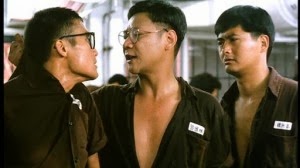
In Prison on Fire, The Other Tony Leung plays the new guy, sentenced to three years for accidentally getting a jerk who had skipped out on the check at his father’s restaurant run over by a bus. Leung is great, tall and skinny with oversized glasses and a look of constant, terrified bewilderment, but his character is unrealistically naive, if not outright stupid. Chow Yun-fat, a veteran prisoner with a happy-go-lucky attitude attempts to show him the ropes (generally leading to Chow slowly shaking his head in resigned disgust as Leung ignores his wise advice). At one point, Chow explains that they’re in the jungle: Chow’s the monkey and Leung’s the lamb, but Leung doesn’t seem to get the point, he keeps trying to impose outside standards of honesty and forthrightness to the prison world. The two run afoul of the local tough guy as well as an evil prison guard (Ho Ka-kui and Roy Cheung, respectively, both of whom are fantastic and menacing, Cheung with teeth-gritting, bug-eyed intensity and Ho with glasses, a slight paunch and utterly conscienceless), leading to some intense and violent confrontations. Both stars get to flip out in slow motion, it’s pretty great.

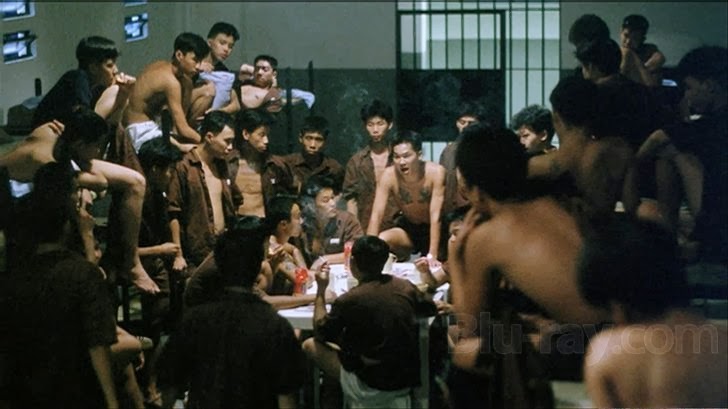
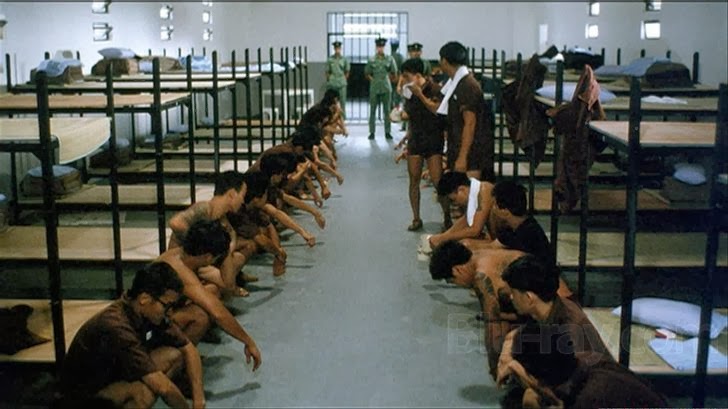
Prison movies generally function as microcosms of society, providing opportunities for critiques of capitalism or the state or both. Those elements are here in force as well, most explicitly when the prisoners go on a hunger strike because the prison has raised prices for things like cigarettes beyond what they can afford with their meager pay. The prison functions as a pre-union style corporation (workers can only buy from the company store) and as an instrument of state terror, enforcing its arcane rules with the threat of violence while the guards manipulate the prisoners against each other to save their bureaucratic faces. The system explodes for one brief shining moment that recalls an ultra-violent Zéro de conduite, doused in water and blood, but it will quickly reassert control. Leung’s innocent never really wises up, nor does he effectively change anything. The best he can do is get out when his time is up.

Running Out of Karma: The Happy Ghost Series

Running Out of Karma is my on-going series on Johnnie To and Hong Kong cinema. Here is an index

After the failure of his debut film, The Enigmatic Case, Johnnie To went back to television for several years (where he directed an acclaimed adaptation of Louis Cha’s Legend of the Condor Heroes), not returning to film until 1986, when Raymond Wong hired him to direct the third film in his Cinema City studio’s successful Happy Ghost comedy series. In the west, even today, To is known primarily as a director of hard-hitting, violent gangster dramas starring taciturn men who find themselves trapped in the inexorable machinations of fate, the state or the ancient honor codes governing cops and crooks alike. But that description only comes close to describing about half the 50+ films he’s directed to date. His filmography is vast and diverse and we do it a disservice when we privilege the darker part over the brighter. This is one of the main goals of Running Out of Karma: to reach a fuller understanding of the man’s career by looking at all of his work, not just those that fit with our understanding of what counts as “serious” genre cinema. It’s one of the fundamental tenets of auteurism that the critic must look at all of a filmmaker’s work, or at least as much as they can. That it isn’t merely in the prestige films that an auteur shows their artistry, that it can be found in the most humble of program pictures as well. And indeed, Happy Ghost III shows exactly that, especially when seen in comparison with the first two films in the series, helmed by Clifton Ko.

But first, a note about authorship. As with most, if not all, of Johnnie To’s films in this period, it’s impossible for an outsider like me to assert with any confidence who exactly was responsible for any given element in a film. Especially given the communal working conditions at a studio like Cinema City, where the star of the film, Raymond Wong, is also the writer and the studio co-founder and where Tsui Hark, as dominant a force as there was in 1980s Hong Kong film (exceeded perhaps only by Jackie Chan) is in charge of the visual effects. The imdb doesn’t even credit Johnnie To as director on the film, giving Ringo Lam that title and relegating To to Assistant Director (which is just weird, To talks about it in an interview in Stephen Teo’s indispensable book on To as if he directed it, though he does make a special point of saying how happy he was to just be the working director on the film, and not be responsible for writing the screenplay as well. Wikipedia and Hong Kong Cinemagic credit Lam and To as co-directors). The on-screen credit lists To as “Acting Director” which is somewhat ambiguous: did he just direct the actors while another person was in charge of camera placement, shot construction, etc, or was he merely filling in for the real director? But the simple fact is that none of that really matters. It’s fascinating (at least to me) as historical background trivia, but when looking at the film through the auteurist lens, when trying to see glimpses of the Johnnie To to come in this early film, it doesn’t so much matter who was responsible for what. If there are qualities of To-ness in Happy Ghost III, elements of the film that would become distinctive traits of his later work, then it doesn’t really matter if the initial creation of those elements was the idea of Lam, Wong, Tsui, Maggie Cheung, a particularly skilled gaffer or anybody else. In fact, I assume that at this relatively early stage in his career, To was still soaking up influences wherever he found them. Throughout the next decade, a hallmark of To’s career would be his willingness to collaborate, his ability to work with other, often dominant personalities (like Tsui Hark, Stephen Chow and Ching Siu-tung). Indeed, his collaborations with Wai Ka-fai continue to account for some of his best work. Auteurism isn’t about assigning credit, it’s an inductive process whereby looking at a vast number of films we can begin to tease out the particular elements that a certain artist brings to their work. We can’t fully understand what makes a Johnnie To film just by watching the films for which he was the sole, or at least most dominant, creative force, because we’d have nothing with which to compare them. We would have no way of knowing which elements are peculiar to the genre he’s working in, which are culturally specific to the nation he’s from and which are uniquely his own contributions. And still we wouldn’t be able to assign credit anyway because we have no way of knowing what actually goes on on his film sets (maybe Milkway Image is an elaborate conspiracy set up by To to steal credit for other directors’ work, I don’t know, I suppose it’s possible). The best we can do is gather evidence, make comparisons and propose hypotheses.

The Happy Ghost was released in 1984 as a vehicle for studio head Raymond Wong, a comic actor and writer (note that Raymond Wong Bak-Ming is a different person from Raymond Wong Ho-yin, a much younger actor who appears in many later Johnnie To films beginning with 1997’s Lifeline and also Raymond Wong Ying-wah, a composer who scored several To films as well as many of Stephen Chow’s, including Kung Fu Hustle). It’s part of a cycle of horror-comedy hybrids that swept Hong Kong in the early 1980s, influenced by Sammo Hung’s Encounters of the Spooky Kind and Tsui Hark’s films (his early genre hybrids as well as his pioneering importation of Hollywood-style effects with Zu: Warriors from the Magic Mountain). These films play off Western horror movie conventions, but place them within the Chinese religious tradition of Buddhist and/or Taoist folk tales (see for example the Mr. Vampire series, Ching Siu-Tung’s A Chinese Ghost Story and even Tsui’s Green Snake). Like Encounters, The Happy Ghost provides an intriguing blend of moods: not just horror and slapstick comedy, but also a surprisingly dark portrait of Hong Kong youth. Beginning with a prologue ripped straight out of any given Hollywood slasher film: a group of teenagers on a camping trip find themselves in a temple ruin, haunted by the eponymous specter. The film then becomes, for the most part, a teen drama as the Ghost is brought back by one of the girls to their boarding school, where he has a series of adventures (basically he makes things worse and then better and then is threatened and then saves the day). It’s the unsettlingly realistic depiction of the girls’ lives that is most memorable: one sleeps with her boyfriend for the first time, gets pregnant and is abandoned by him; another is severely stressed out by a test, gets caught cheating and tries to kill herself. These aren’t sitcom kids along for a goofy ride, they’re recognizably of the same cohort as the nihilistic youths of New Wave films like Yim Ho’s The Happening or the hopeless rich kids of Patrick Tam’s Nomad. It’s like Scream but with the characters from Kids. The Ghost himself, despite his moniker and outward appearance, conceals a dark past: he killed himself after repeated failures both professional and marital. This mixing of moods, wild, unpredictable swings from farce to melodrama to action movie and back again, are one of the more intriguing features of Hong Kong cinema, the best of them deftly avoiding the feeling of calculated sentimentality that can plague similarly blended Hollywood films.

Following the success of the first film, Happy Ghost II was released in 1985, again with Clifton Ko directing and Raymond Wong serving as star and co-writer. Set at a different girls’ school, Wong this time plays a dual role as the Ghost and his reincarnation, a clumsy teacher named Sam Hong. Sam has been plagued his whole life by an unwelcome super power bequeathed him by his ancestor, which tends to magnify his clumsiness (it’s basically a telekinesis type thing). He arrives at the school after a cadre of mean girls has run off their latest victim (Sam is their eighth teacher, if I remember correctly). Leading the girls is Fennie Yuen, in her first role (she went on to play Blue Phoenix in the Swordsman movies, among other things), playing “the Chairman” with an air of disaffected maliciousness. The girls spend most of the film making life miserable for Sam, despite his using his powers to help them cheat at sports (which the Ghost did in the first film as well). Eventually he gets fired, gives up his powers and gets them back (a plotline not unlike that of Superman II) and everyone has a party on the beach. This sequel is much brighter than the original, with Wong playing up the slapstick (a scene where he destroys the classroom of his love interest teacher is particularly impressive) while any trace of the series’ horror roots is lost.

The third Happy Ghost film was released in 1986 and though it still starred and was written and produced by Raymond Wong, it has a distinctly different look to it. Partially this is the result of the special effects, much more elaborate and modern than in the first two films, utilizing computer graphics and supervised by Tsui Hark (who also has a small role in the film as The Godfather, the gatekeeper of the afterlife). But also the film is simply more composed visually than the first two, which are rather perfunctory in style. Whether To or Lam is responsible for that I can’t say, as both have shown keen eyes as directors. But there are a couple images or motifs that will recur in To’s later work. The most obvious is the use of colored light, electric reds and blues that suffuse and dominate the screen, especially in night scenes (the blues) and interiors (the reds). This trope is by no means unique to To (Ching Siu-tung, who choreographed the action in Happy Ghost III, uses it in Swordsman II, to name one example) and I’d actually taken it as an 80s Hong Kong, or at least Cinema City, trademark. But then in watching A Better Tomorrow II I realized that John Woo’s films are almost always realistically lit, so maybe it’s a To-specific contribution? A subject for further research. To will continue to use this kind of color abstraction throughout his career, most especially in the late 90s with Milkway films like A Hero Never Dies (red), Where A Good Mans Goes (blue) or The Odd Ones Dies (orange). Less obvious, but perhaps no less indicative of an artist at work is a very simple, very brief shot, an establishing shot of the school. Shot from enough of a distance that the white, four-story building fills the frame, doors and windows fronted by open balconies running the breadth of the structure, we see the girls waking between classes. It’s an elegant image, one that captures the unique architecture of the building (and perhaps implies something about the rigid, ant farm-like qualities of the school environment), the kind of throwaway transitional shot you don’t think much of at all. Except we never saw it in the second film, though it uses the same building, the same walkways and classrooms. It may not be the shot of a great artist, but it is evidence that someone was paying attention. This kind of detail, of care in framing and composition is striking when watching the second and third films back-to-back: Ko and Wong are good at setting up gags and sustaining a variety of tonal moods, but Lam and/or To have a better sense of where to put the camera and what to put in front of it.

But the most striking thing about Happy Ghost III is the performance of Maggie Cheung. We know her now as one of the great stars of the last 30 years, with a string of brilliant performances in art house classics (In the Mood for Love, Irma Vep, Centre Stage, Hero, Comrades Almost a Love Story and so on). But in 1986 she was a former Miss Hong Kong runner-up most known for playing Jackie Chan’s cute girlfriend in 1985’s Police Story. But she gets the central role here, as the ghost of a failed singer in search of reincarnation who is continually stymied by Wong’s clumsiness (here reprising his role as the teacher Sam, as well as the Happy Ghost). After two failed reincarnations, she vows revenge on Sam and begins making his life miserable, terrorizing his classroom and possessing his students. The students have undergone another change as well: from the barely getting by strivers of the first film, to the arrogant and entitled mean kids of the second to well-behaved and rather dull kids this time around. This is most evident in the transformation of Fennie Yuen’s character, from a bad girl in dark glasses to a perfect class prefect, the only time she shows the spark the character had the the previous film is when she’s possessed by Maggie Cheung (literally) and gives the famed Kubrick stare: chin down, eyes up, maniacal grin. The first half of the film is a series of tricks Maggie mischievously plays on Sam (the spirit is always playful here, no darkness to be found). In the second half they become friends (including a magical music video sequence as they frolic around the city at night) and eventually end up saving the prefect from a gang of pimps.

There is a tonal mixture to the film, but it’s of a different flavor than that of the first film. Instead of horror and comedy, it’s a blend of comedy and melodrama, and melodrama of a surprising depth and resonance. In this respect it fits in very well with Johnnie To’s later romantic comedies, many of which blend an anarchic style of body humor (either with slapstick or makeup effects, for example the use of fat suits on Andy Lau and Sammi Cheng in Love on a Diet) with an almost tangible sadness and sense of loss (My Left Eye Sees Ghosts, Romancing in Thin Air). This film doesn’t reach anything like those heights, and I’m inclined to give most of the credit for the film’s emotional ambivalence to Maggie Cheung, who is of course adorably spunky yet also reveals her character’s sadness (she too committed suicide, but also her heartbreak when Sam kicks her out as well as late in the film, when she’s convinced she’ll never be reincarnated (which is also a cool visual effect where Maggie fades to black and white)) and joy. The movie is better at the joy: the profound kind when Maggie hears that people have discovered her lovely pop song 20 years after her death for sure, but more importantly the sheer glee with which she toys with poor Sam. She’s the first incarnation of a character that more than any other typifies and unifies Johnnie To’s cinema: the game player. From crime epics to romantic comedies; in cops, gangsters, bankers, gamblers, thieves, musicians, actors, wrestlers, and pickpockets, what marks a Johnnie To character is the spirit of play, the complex interweaving of chance and fate and the pleasure they take in competition, in performance.

Next Up: Seven Years Itch

Running Out of Karma: Tsui Hark’s Peking Opera Blues

Running Out of Karma is my on-going series on Johnnie To and Hong Kong cinema. Here is an index.

I first saw this eight months ago, on my first night home after the birth of my second kid (I had rented it from Scarecrow Video and needed to watch it before returning it the next day). Needless to say, exhausted and occasionally interrupted, I remembered very little of the experience, other than that I liked the film quite a bit. Happily, a more clear-headed rewatch confirms that initial vague impression: this is a great movie, perhaps the best melding of director Tsui Hark’s twin impulses toward subversion and entertainment I’ve seen yet.

The setup follows two plotlines that will come together and intertwine with a third, each focused on a female protagonist. Brigitte Lin plays the daughter of a local warlord. She dresses like a man (having spent time studying in the West, and also because she’s Brigitte Lin) and is secretly a revolutionary. She and fellow revolutionary Mark Cheng (memorable as Louis Koo’s able assistant in Johnnie To’s Election 2) have to steal some MacGuffins from the general’s safe. Cherie Chung (from The Enigmatic Case) plays a musician who stole a box of jewelry from a soldier (Tung Man, played by Cheung Kwok Keung) in the chaos after the previous general was run out of town. Through a series of complications, the box ends up at a local theatre troupe, where Sally Yeh, daughter of the director (played by film director, actor, clock Wu Ma), wants very much to go on-stage but can’t because women aren’t allowed to perform. Lin and Cheng also find themselves at the troupe, as it’s the favored entertainment for the most powerful people in town, including the local police commander/gangster Liu, who becomes infatuated with the star actor, Fa.

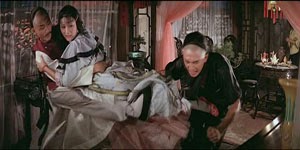
That covers the first 20 minutes or so of the film, what follows is an elegantly structured twisting and deepening of the characters and their relations as the film progresses through a variety of suspense and comic set pieces. Ching Siu-tung choreographs some exceptional action scenes, usually featuring Mark Cheng jumping into or shooting a bunch of bad guys (the sequences at the theatre make ingenious use of the space’s multi-leveled design, with Cheng diving under and jumping over tables and benches, then on the main stage and up to the stage above it before swinging across the rafters and finally onto the rooftops), but there are also cunningly designed short sequences like the one David Bordwell describes early in Planet Hong Kong, where Mark and Cheung and Cherie hide in Sally’s bed from her father. The two father-daughter relationships are especially poignant, with Lin’s eyes exploring every aspect of her self-hatred for destroying the father she loves while opposing everything he stands for politically. It’s most remarkable to see her usually implacable image break down in anguish near the end of the film and even in happiness in a brief middle section where she gets drunk with the other girls. As well Wu Ma brings a note of knowing sadness to the theatre director father, a man who we took as a stock type gains nuance when we realize exactly why he so strictly keeps his daughter away from the stage: because if she catches the eye of the powerful, she’ll be forced to prostitute herself for the sake of the company (as Liu attempts with Fa). Complex as well are the film’s romantic relationships. Not so much the main one between Mark and Brigitte (if that even is a romance given Lin’s ambiguous orientation), but the all but unspoken one between Cheung (whose soldier I don’t think is even named in the screenplay) and Cherie, which exists almost entirely in the subtle looks he gives her of longing and disappointment at her more venal moments. That soldier, in fact, is one of the more fascinating characters in the film: a hapless guy, bullied by his fellows, who joins the revolutionaries by chance, falls in love with a girl and ends up saving the life of the heroine in a spectacular last minute rescue. There are few martial arts films I know of that have so many richly developed characters and relationships. The only one that even comes to mind in Tsui’s own epic Once Upon a Time in China.

The Peking Opera setting provides Tsui a world full of potential meaning, and he plays it up beautifully. The gender reversals required of the all-male stage echo the real-life reversals of Lin’s character, as she not only dresses like a man but takes on the traditional hero role (note that it’s the women who rescue the men time and again). When the other two women make it on stage, they become women impersonating men impersonating women, just as they more or less unwillingly take on the roles of revolutionaries. Eventually, the politics that undergirds the plot comes to be seen as a form of performance, with one general shuffling on stage as the other exits, the rebels scheme amounting to a lifting of a curtain (exposing certain warlords as conspiring with foreigners) all while the real power lurks behind the scenes, in the form of the black clad local police force. That the local commander is both bluntly evil and homosexual (as well as the ultra-effeminate depictions of the male actors) might be a cause for concern were it not for the sincere warmth with which Tsui depicts the homoerotic relations between the three women (Sally in particular seems infatuated with Brigitte). Instead, what we see is sexuality, with politics, as another kind of performance that serves to either mask our baser urges (the violence of the commander, the greed of Cherie) and/or complicate our nobler ones (the father-daughter relations, the multiple instances of self-sacrifice throughout the film, as each hero in turn faces death to save the others).

The result is a film not too far in spirit from the anarchic nihilism of Tsui’s earliest films, the burn-it-all youth drama Dangerous Encounters – First Kind or the cannibal comedy We’re Going to Eat You. But instead of merely exposing the world, politics, and human relations as a sham, Tsui instead finds a humane warmth at our core, while simultaneously celebrating the artistry of that disguising performance itself: Mark’s ultra-cool secret agent and Lin’s resolute stoicism, as well as the athleticism of the opera performers. The film opens with a series of close up shots of Peking Opera costumes and props and actors, scored to a traditional sounding song with a modern synthesizer beat. And it ends with a close-up from that same series of a performer in full make-up, laughing maniacally at us, or maybe with us.

Running Out of Karma: Cinema City and A Better Tomorrow 2

Running Out of Karma is my on-going series on Johnnie To and Hong Kong cinema. Here is an index.

After its formation in 1980 by actors Dean Shek, Karl Maka and Raymond Wong, the first film released by Hong Kong studio Cinema City & Films Co. was 1981’s Laughing Times, a comedy starring Shek as “the Chinese Charlie Chaplin” that appears to be some kind of mash-up of The Kid and City Lights (I haven’t seen it yet). It was directed by a young director who had spent the previous decade wandering from studio to studio with modest success with both action movies and comedies, John Woo. Also in 1981, Cinema City produced the fourth film, and the first hit, from director Tsui Hark, whose previous three features had helped launch the Hong Kong New Wave with their anarchic punk attitude and mixture of Western techniques, genres and themes with more traditional Hong Kong genres. All the Wrong Clues for the Right Solution was a clean break from all that, a comedy starring Karl Maka and Teddy Robin that Tsui called a “silly movie. All the movies I’ve done before were very serious and very depressing.” (That’s what it sounds like at least, I haven’t seen this one yet either. I have a lot of movies to watch and this project is growing bigger by the day.) For the next decade Cinema City provided a home for some of the best directors working in Hong Kong. Not just Woo and Tsui, but Ringo Lam, Eric Tsang (who launched the Aces Go Places series, some of the most popular films of the decade), Ronny Yu, Corey Yuen, Yuen Woo-ping, Lau Kar-leung, Clifton Ko and, of course, Johnnie To.

After Laughing Times, Woo made a few more comedies I also haven’t seen: the promising-looking if dubiously titled Plain Jane 3: Plain Jane to the Rescue, starring Josephine Siao and Ricky Hui; Run, Tiger Run, scripted by Raymond Wong and starring Teddy Robin and Bin Bin as characters named “Teddy Shit” and “Benny Shit” (Bin Bin also starred in the Andy Lau/Cynthia Rothrock film The Magic Crystal, a Wong Jing phenomenon that recently played at Scarecrow Video in Seattle); and The Time You Need A Friend, which is apparently a remake of The Sunshine Boys co-written with Raymond Wong. The last two of those were also produced by Cinema City. He also made an action film called Heroes Shed No Tears at Golden Harvest, which he was reportedly unhappy with and had shelved (it shares a title with an epic Chor Yuen fantasy film). Then, seemingly out of nowhere, Woo directed one of the greatest action films of all-time. A smash hit that made Chow Yun-fat a superstar and whose visual style revolutionized action cinema the world over while all but inventing a new genre, which I guess we’ve decided to call the “heroic bloodshed” film.

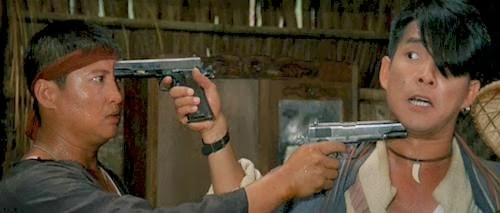
A Better Tomorrow is a wonder. Working on themes inherited from a variety of sources, including but not limited to the crime films of Jean-Pierre Melville, American gangster and noir films, Westerns and the wuxia films of Chang Cheh, with whom Woo had worked as an assistant director in the early 70s (and which are on display in an early form in his own Shaw Brothers swordplay film Last Hurrah for Chivalry from 1979), the story focuses on a gangster (played by Ti Lung, star of many a film by Chang and Chor) and his three “brothers”. The youngest is literally his brother, played by Leslie Cheung, who is training to become a cop and is unaware of Ti’s criminal life. The other two are his Triad brothers: Chow Yun-fat as Mark, a badass with cool sunglasses and an iconic jacket and Waise Lee as Shing, a new member of the gang. The film explores the shifting demands of loyalty and the warrior code, as Ti attempts to go straight and Mark becomes a laughing-stock after he is severely injured in a gun fight, leaving him with an awkward limp. This is contrasted with the unraveling familial bond between Cheung and Ti, cop and crook. Loyalty and honor, and evil as the lack of respect for those ideals (as Shing betrays his brothers for personal gain) is a thematic hallmark of the genre, as is the mirroring of hero and villain, the creation of equivalencies between characters on opposite sides of the law. Beyond the film’s contributions to fashion and visual style (which are considerable) it is this thematic scheme that forms the foundation for most of the crime films that follow in Hong Kong cinema, and in particular the work of Johnnie To, who continued to explore the genre’s complexities after Woo left for Hollywood in 1993.

A Better Tomorrow was a massive hit for Cinema City, Woo and the film’s producer and co-writer, Tsui Hark. As such, a sequel was inevitable. But almost immediately problems began. Chow Yun-fat’s character had died at the end of the first film, but a sequel without the man who’d become the biggest star in Hong Kong was unthinkable. So, of course, they decided Mark had a twin brother that nobody bothered to mention in the first film. The film is most horribly marred by a new character, a former Triad gone straight named Lung and played by Dean Shek. After Lung is betrayed by one of his underlings, Shek goes crazy and ends up in an insane asylum, where he is found by Mark’s twin brother Ken who nurses him back to health in tedious and endless scenes where Shek refuses to eat. Shek’s performance in these scenes is abysmally broad, so much so that it out-balances his later scenes, when he’s returned to his apparently bad motherfucker real self. The film’s most bizarre food-related scene, though, is a notorious one in which Ken, a restauranteur in New York, is shaken down by some mafia hoods and harangues them in badly dubbed English, with Chow giving his loudest DeNiro impression while the dubber channels Pacino. (The best part of the scene is at the end, where a cop shows up, sees Ken trying to force the mafia guys to eat some rice at gunpoint and tells the hoods, “You’d better eat it!”)

Woo and Tsui bitterly fought over the final cut of the film, though as far as I know many of the stories circulating about the film’s production are merely apocryphal, including this one from wikipedia that claims Cinema City’s editors cut each reel individually, with no supervision by Woo or Tsui or communication with each other. Tsui reportedly wanted the film to focus more on Shek, my only guess as to the reason for that is that he was trying to make a parody of the first film, while Woo wanted to play it as a straight epic. The first film is incredibly tight, its melodrama flowing logically from the restrictions imposed on the characters by their code, with the result that all the death and destruction seems to inevitably and tragically spring from one initial act of betrayal, from one code-violation. But the second film is meandering and unfocused, with bizarre twists of logic and character (especially almost every scene involving Leslie Cheung), with no flow or momentum to the story (multiple times a suspense scene will cut away to a 90 second scene with Cheung’s pregnant wife crying about something dumb, only to cut right back to another bit of suspense). My favorite bit of nonsense is the insertion of an unexplained character who makes what appear to be comic book or storyboard characters out of the people and events from the first film. Is this a thing? How does this guy know all that? And how exactly is he the (only) one who knows Mark has a twin brother?

Reportedly Woo has all but disowned the film, excepting its final shoot-out sequence, a spectacular showdown in which the three heroes take on a house full of bad guys that truly is something to be proud of. The action choreographer on the film was none other than Ching Siu-tung. I’m inclined to give Woo auteurial credit for the sequence, however, as it’s more in keeping with his approach to action than Ching or Tsui’s. Ching and Tsui are of the fast-cutting, impressionist school, well-adapted to fantasy films like Zu: Warriors from the Magic Mountain or Swordsman II, whereas Woo’s films are notable for their precise compositions, smoothness of motion and occasionally strikingly long-takes (best exemplified in what I still think is his finest film, 1992’s Hard-Boiled). Ching is always in rapid motion, with bits of movement cut together to create a dizzying effect where Woo is most known for his extensive use of slow-motion, not an abstraction of the body as it moves through space but a reification of it, lending his figures a quasi-religious significance. The final fight of A Better Tomorrow II leans more toward that Woo style than anything else. It’s capped by a beautiful showdown between Chow and a silent assassin (you know he’s a super-bad guy because he never says anything) that is perhaps the only scene in the film to depict anything like the moral complexity of the honor codes that drive the first film.

Ching Siu-tung would have a massive hit of his own in 1987 starring Leslie Cheung with A Chinese Ghost Story, produced by Tsui Hark for Cinema City and his own company, Film Workshop. Ching would continue to work with Tsui (as well as Johnnie To, a longtime friend going back to their time working in television) throughout the late 80s and early 90s. But Tsui and Woo, after making 1989’s The Killer, Woo’s breakthrough film in the West, split over the next A Better Tomorrow movie, a prequel which Tsui  took over and directed as A Better Tomorrow III: Love and Death in Saigon and Woo adapted into one of his greatest films, 1990’s Bullet in the Head with Tony Leung, Jacky Cheung and Simon Yam. Both Woo and Tsui moved to Hollywood in the early 90s, in anticipation of the colony’s handover to China. There they both directed films starring Jean-Claude Van Damme and found moderate success. Both are back working in Hong Kong, where Tsui has had a renaissance with CGI-fueled fantasy films like the Detective Dee series, while Woo’s last completed (solo) feature is the massive (and stunning) epic Red Cliff. Cinema City has produced only two films since 1991.

Running Out of Karma: The Enigmatic Case

Running Out of Karma is my on-going series on Johnnie To and Hong Kong cinema. Here is an index.

After getting his start working in television at Hong Kong’s TVB studio in the mid-1970s, Johnnie To made his feature debut in 1980 with a dark, stylish martial arts film made on the cheap for a small, leftist studio. Though quite similar in tone and style to the debut films of other Hong Kong New Wave directors made around this time, especially Tsui Hark’s The Butterfly Murders and Patrick Tam’s The Sword, The Enigmatic Case failed to find an audience and To retreated to television for another six years. To was a mere 25 years old when he made it (in 1980 Tsui was 29, Tam 32, Sammo Hung 28, Yuen Woo-ping 35, Jackie Chan 26, John Woo 34 , Ching Siu-tung 27 and Ann Hui 33. To is the same age as Ringo Lam, two years older than Stanley Kwan and three years older than Wong-Kar-wai) and it does seem like the film of an inexperienced director. Like a child learning to crawl, To in his debut demonstrates all the individual technical skills necessary to make an excellent film, but can’t quite coordinate them enough to send the film off in the proper direction.

Like The Butterfly Murders, The Enigmatic Case is a genre mashup of noir mystery tropes with the traditional Chinese wuxia film. Wuxia films typically revolve around “knight errant” figures, wandering swordsmen who don’t quite fit into the societies they defend and whose values they uphold. The genre traces its roots to classical Chinese literature, but in film form, at least, was heavily influenced by international action cinema, in particular the Hollywood Western (and its Italian variations) and the Japanese samurai film (particularly the work of Akira Kurosawa, with Yojimbo as the launch point for next fifty-plus years of action film). To’s film follows an adventure of a wandering swordsman named Lu Tien-chun, who becomes caught up in the theft of government gold and the murder of its thieves. Framed for the murders, he must find the real villain in order to clear his name. Told with a convoluted flashback structure, the narrative always seems less intelligible than it really is, as characters routinely appear before their backstory is made clear and occasionally are never really explained (after seeing it twice I’m still unsure of the nature of the man who helps Lu escape from prison, then returns near the end only to disappear again – just another wandering swordsman?)

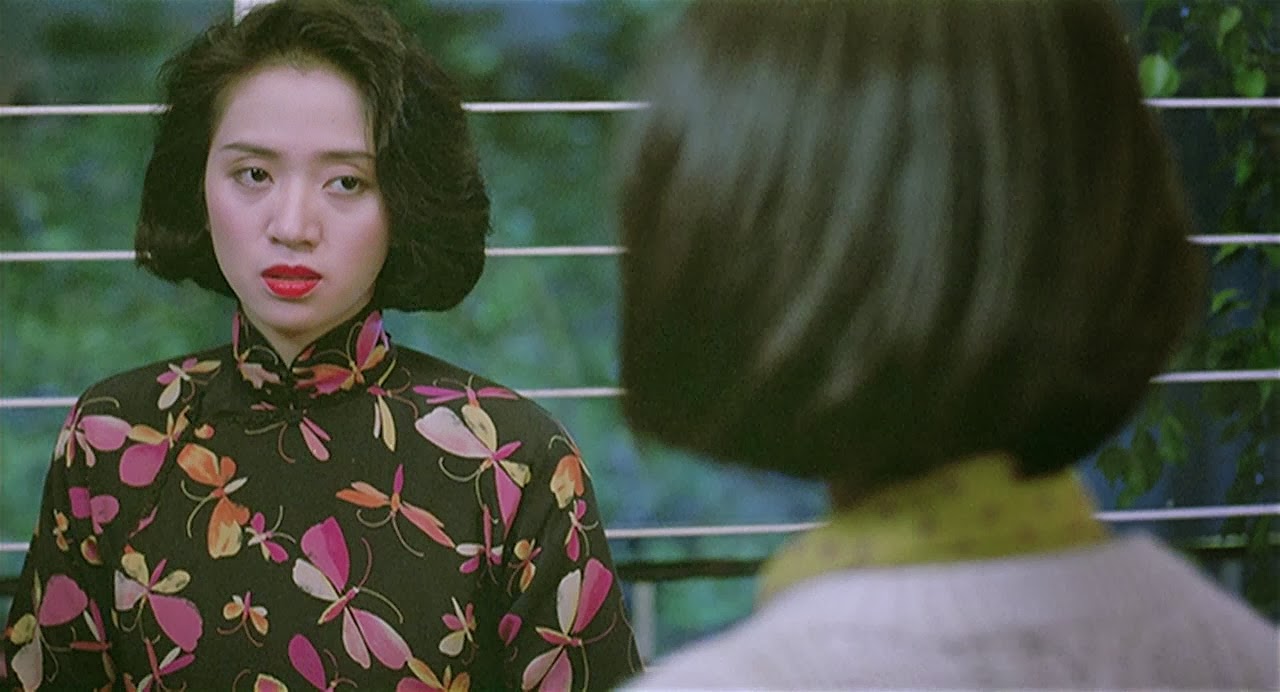
Cherie Chung, in the first screen credit for one of the brighter Hong Kong stars of the 80s (Sammo Hung’s Winners & Sinners, Patrick Tam’s Cherie and To’s own The Eighth Happiness), plays a young woman Lu meets on his quest. They have a falling out when she discovers he’s the man wanted for killing her father, whom she is out to avenge. Lu protests his innocence and the two oscillate a few times: she likes him, she suspects him, and back again, with little rhyme or reason. Unlike most subsequent To heroines, Chung’s character lacks much of an internal life. She mostly just functions as a plot device, something for Lu to agonize over as he stares blankly into space (To really doesn’t get much out of star Damian Lau, who I recall as unremarkable in John Woo’s Last Hurrah for Chivalry and Tsui’s Zu: Warriors From the Magic Mountain). While the film begins with an extensive credit sequence music video, of a scarred Lu wandering the countryside looking mournful, getting into spectacular swordfights and seeing images of Cherie, the film itself never again captures that kind of romanticism. Aside from their meet cute, a cunningly staged sequence in a rainstorm that ends with them realizing they’ve been sheltering under the same tree (a visual trope To will revisit much later in his career: it’s the foundation of Turn Left, Turn Right, for example), their relationship remains almost entirely unexplored.

In To’s later films, the plots often have an air of inevitability, a clockwork precision founded in the nature of his characters and the whims of the universe. An intriguing nesting of chance with predestination, with the heroes in constant struggle against their fate, often to the point of rewriting the rules of reality itself. That’s not the case here, as Lu the protagonist is essentially a passive figure: he more or less wanders around aimlessly until the plot is revealed to him. (Compare to The Butterfly Murders, whose scholar-investigator hero is often on the sidelines of the action, but is always pushing forward to solve the mystery. When he solves it, he leaves and takes us with him, letting the resolution of the climactic fight scene play out entirely off-screen). When Lu does take action, he is always ineffective: the people he tries to protect tend to end up dead. This is what happens in the film’s final fight, and what I’d bet was the biggest reason for the film’s box office failure. The (final) villain holds Cherie with a sword to her throat, telling Lu to stand down or she’ll get it. Lu doesn’t believe him (“You ain’t that mean, ” he says) and the bad guy kills her. This darkness is very much in line with other New Wave wuxias (Tam’s The Sword is similarly nihilistic, as are some of Sammo Hung’s darker moments), and also To’s later films, especially the first series of gangster movies he produced at his Milkyway Image studio (Expect the Unexpected, The Longest Night, The Odd One Dies). But To at this point doesn’t have the visual artistry on display in Tam’s film (sub-Tarkovskian modernism melded with spectacular Ching Siu-tung co-ordinated stuntwork) or the charismatic and athletic superstars of Hung’s films. And those dark late-90s films very nearly bankrupted Milkyway anyway.

What The Enigmatic Case does show is that Johnnie To always had a keen eye for composition, as the most consistent thing about the film is that it’s almost always lovely to look at. He also shows a flair for innovation in the film’s finale, which features an extended, probably too-extended, experiment with step-printed slow motion, as Cherie attempts to get in-between Lu and her father as they duel. There are similarly choreographed fight scenes in earlier Hong Kong films (one in Lau Kar-leung’s Dirty Ho comes immediately to mind), but To’s slow-motion has an unusual abstracting effect on the action, an aesthetic approach that Wong Kar-wai would fully realize in Ashes of Time 15 years later. As well it shows a filmmaker very much in line with the sensibilities of his contemporaries. As the Hong Kong New Wave would mutate throughout the 1980s, with Tsui Hark softening his punkier edges for special effects and moguldom, John Woo moving from Shaw Brothers swordplay films to reinvent the gangster genre with his cycle of so-called “heroic bloodshed” films and Tam and Hui pursuing more traditionally high-class fare like Nomad or Boat People, Johnnie To would spend the first half of the 1980s working in television. When he returned to features, it would be as a director for hire, working for Tsui Hark helming the Maggie Cheung – Raymond Wong vehicle Happy Ghost III, a film which has almost nothing in common with The Enigmatic Case. But pairing these first two films together gives us a glimpse of the two Tos to come: the director of dark, edgy, violent thrillers and the maker of bright, warm and wild romantic comedies. They’re the same guy.

Next Up: Happy Ghost III

Running Out of Karma: Index

Update: All this now lives at a site dedicated to the project: The Chinese Cinema.

This is an index to Running Out of Karma, my writing on Johnnie To and his contemporaries, predecessors and influences in Hong Kong and Chinese-language cinema.

Chronological Johnnie To:

Introduction – Nov 13, 2013
The Enigmatic Case (Johnnie To, 1980) – Nov 14, 2013
The Happy Ghost Series (Clifton Ko, Johnnie To & Ringo Lam, 84-86) – Nov 26, 2013
Seven Years Itch (Johnnie To, 87) – Dec 02, 2013
The Eighth Happiness (Johnnie To, 88) – Nov 21, 2014

The Big Heat (Johnnie To, 88) – Jan 09, 2015
All About Ah-Long (Johnnie To, 89) – Feb 01, 2016
The Fun, the Luck and the Tycoon (Johnnie To, 90) – Feb 08, 2016
The Heroic Trio (Johnnie To, 93) – Aug 01, 2015
A Moment of Romance III (Johnnie To, 96) – Mar 30, 2016
Drug War (Johnnie To, 12) – Dec 11, 2013

Blind Detective (Johnnie To, 13) – Oct 11, 2014
Don’t Go Breaking My Heart 2 (Johnnie To, 14) – Nov 15, 2014
Three (Johnnie To, 16) – June 23, 2016

Previously produced works:

The Big Heat (Johnnie To, 88) – Mar 07, 2013
The Johnnie To Whimsicality Index – Mar 17, 2013
Infernal Affairs, The Departed and Johnnie To – Mar 19, 2013
They Shot Pictures #13: Johnnie To – Mar 26, 2013

The George Sanders Show Episode One: The Big Heat and Drug War – Jun 29, 2013
The Summer of Sammo Index – July 01, 2013
Blind Detective (Johnnie To, 13) – Sep 26, 2013
Green Snake (Tsui Hark, 93) – Oct 25, 2013

Running Out of Karma:

Introduction – Nov 13, 2013
The Enigmatic Case (Johnnie To, 1980) – Nov 14, 2013
Cinema City and A Better Tomorrow II (John Woo, 1987) – Nov 21, 2013
Peking Opera Blues (Tsui Hark, 86) – Nov 22, 2013
The Happy Ghost Series (Clifton Ko, Johnnie To & Ringo Lam, 84-86) – Nov 26, 2013

Prison on Fire (Ringo Lam, 87) – Nov 27, 2013
Seven Years Itch (Johnnie To, 87) – Dec 02, 2013
Working Class (Tsui Hark, 85) – Dec 07, 2013
Drug War (Johnnie To, 12) – Dec 11, 2013
Royal Warriors (David Chung, 86) – Dec 19, 2013

She Shoots Straight (Corey Yuen, 90) – Dec 22, 2013
Comrades, Almost a Love Story (Peter Chan, 96) – Jan 01, 2014
Young Detective Dee and the Rise of the Sea Dragon (Tsui Hark, 13) – Feb 27, 2014
Shanghai Blues (Tsui Hark, 84) – Mar 03, 2014
Seven Swords (Tsui Hark, 05) – Mar 11, 2014

The Blade (Tsui Hark, 95) – Mar 19, 2014
Heroes Shed No Tears (John Woo, 86) – Mar 28, 2014
Once a Thief (John Woo, 91) – Mar 28, 2014
Journey to the West: Conquering the Demons (Stephen Chow & Derek Kwok, 13) – Apr 03, 2014
Love in the Time of Twilight (Tsui Hark, 95) – Apr 04, 2014

The Lovers (Tsui Hark, 95) – Apr 04, 2014
Red Cliff (John Woo, 08) – Apr 04, 2014
Zodiac Killers (Ann Hui, 91) – Apr 09, 2014
SPL: Sha Po Lang (Wilson Yip, 05) –  Apr 23, 2014
New Dragon Gate Inn (Raymond Lee, 92) –  Apr 24, 2014

Wuxia (Peter Chan, 11) – Apr 25, 2014
The Legend is Born: Ip Man (Herman Yau, 10) – Apr 27, 2014
The Duel (Chang Cheh, 71) – Apr 28, 2014
Ten Tigers of Kwangtung (Chang Cheh, 80) – Apr 29, 2014
Ip Man: The Final Fight (Herman Yau, 13) – Apr 29, 2014

Tai Chi Zero/Tai Chi Hero (Stephen Fung, 12-13) – May 01, 2014
The Way of the Dragon (Bruce Lee, 71) – May 02, 2014
The Assassin (Chang Cheh, 67) – May 12, 2014
The Midnight After (Fruit Chan, 14) – May 25, 2014
Martial Club (Lau Kar-leung, 81) – Jun 11, 2014

The Bride with White Hair (Ronny Yu, 93) – Jun 25, 2014
Three Hong Kong Romantic Comedies – Jul 29, 2014
He Ain’t Heavy, He’s My Father (Peter Chan, 93) – Jul 29, 2014
Isabella (Edmund Pang Ho-cheung, 06) – Aug 01, 2014
Painted Faces (Alex Law, 88) – Aug 02, 2014

Golden Chicken 2 (Samson Chiu, 03) – Aug 03, 2014
Painted Skin (King Hu, 93) – Aug 03, 2014
Oxhide (Liu Jiayin, 05) – Aug 04, 2014
Legend of the Mountain (King Hu, 79) – Aug 07, 2014
Shanghai Blues (Tsui Hark, 84) – Aug 27, 2014

Accident (Soi Cheang, 09) – Sep 23, 2014
Blind Detective (Johnnie To, 13) – Oct 11, 2014
A Better Tomorrow III: Love and Death in Saigon (Tsui Hark, 89) – Oct 21, 2014
Flying Swords of Dragon Gate (Tsui Hark, 11) – Oct 29, 2014
My Lucky Star (Dennie Gordon, 13) – Nov 07, 2014

Don’t Go Breaking My Heart 2 (Johnnie To, 14) – Nov 15, 2014
The Eighth Happiness (Johnnie To, 88) – Nov 21, 2014
Aberdeen (Pang Ho-cheung, 14) – Dec 04, 2014
The Taking of Tiger Mountain (Tsui Hark, 14) – Jan 05, 2015
The True Story of Wong Fei-hung: Whiplash Snuffs the Candle Flame (Wu Peng, 49) – Jan 07, 2015

The Big Heat (Johnnie To, 88) – Jan 09, 2015
The Boys from Fengkuei (Hou Hsiao-hsien, 83) – Mar 20, 2015
The Time to Live, The Time to Die (Hou Hsiao-hsien, 85) – Mar 21, 2015
Dust in the Wind (Hou Hsiao-hsien, 86) – Mar 22, 2015
Flowers of Shanghai (Hou Hsiao-hsien, 98) – Mar 24, 2015

Millennium Mambo (Hou Hsiao-hsien, 01) – Mar 27, 2015
Masked Avengers (Chang Cheh, 81) – Apr 11, 2015
Kung Fu Jungle (Teddy Chan, 14) – Apr 27, 2015
Temporary Family (Cheuk Wan-chi, 14) – May 14, 2015
A Better Tomorrow (John Woo, 86) – Jun 26, 2015

Yes, Madam (Corey Yuen, 85) – Jul 02, 2015
Wild City (Ringo Lam, 15) – Jul 30, 2015
The Heroic Trio (Johnnie To, 93) – Aug 01, 2015
Project A and Project A 2 (Jackie Chan, 83 & 87) – Aug 02, 2015
Princess Chang Ping (John Woo, 76) – Aug 20, 2015

Go Away Mr. Tumor (Han Yan, 15) – Sep 3, 2015
Port of Call (Philip Yung, 15) – Sep 29, 2015
A Tale of Three Cities (Mabel Cheung, 15) – Sep 29, 2015
The Assassin (Hou Hsiao-hsien, 15) – Oct 09, 2015
Mountains May Depart (Jia Zhangke, 15) – Oct 12, 2015

The Crossing Parts 1 & 2 (John Woo, 14-15) – Dec 02, 2015
Mojin: The Lost Legend (Wu Ershan, 15) – Dec 18, 2015
Mr. Six (Guan Yu, 15) – Jan 4, 2016
Ip Man 3 (Wilson Yip, 15) – Jan 21, 2016
Monster Hunt (Raman Hui, 15) – Jan 21, 2016

The Mermaid (Stephen Chow, 16) – Feb 25, 2016
Sword of Destiny
(Yuen Woo-ping, 16) – Feb 27, 2016
Rise of the Legend (Roy Chow, 14) – Mar 10, 2016
Chongqing Hot Pot (Yang Qing, 16) – Apr 03, 2016
My Beloved Bodyguard (Sammo Hung, 16) – May 30, 2016

Gone with the Bullets (Jiang Wen, 14) – June 15, 2016
Cold War 2 (Longman Leung & Sunny Luk, 16) – July 6, 2016
One Night Only  (Matt Wu, 16) – July 18, 2016
For a Few Bullets (Pan Anzi, 16) – July 23, 2016
A Brighter Summer Day (Edward Yang, 91) – July 27, 2016

Soulmate (Derek Tsang, 16) – Sep 22, 2016
Operation Mekong (Dante Lam, 16) – Oct 1, 2016
Crosscurrent (Yang Chao, 16) – Oct 4, 2016
Yellowing (Chan Tze-woon, 16) – Oct 5, 2016
I am Not Madame Bovary (Feng Xiaogang, 16) – Nov 17, 2016

Sky on Fire (Ringo Lam, 16) – Dec 2, 2016
Old Stone (Johnny Ma, 16) – Dec 3, 2016
Sword Master (Derek Yee, 16) – Dec 9, 2016
The Wasted Times (Cheng Er, 16) – Dec 17, 2016
Railroad Tigers (Ding Sheng, 16) – Jan 5, 2017

Once Upon a Time in China (Tsui Hark, 91) – Jan 16, 2017
Once Upon a Time in China II (Tsui Hark, 92) – Jan 17, 2017
Journey to the West: The Demons Strike Back (Tsui Hark, 17) – Feb 7, 2017
The Great Wall (Zhang Yimou, 16) – Feb 16, 2017

Capsule Reviews:

Aces Go Places (Eric Tsang, 82) – Nov 21, 2013
The Contract (Michael Hui, 78) – Nov 27, 2013
All the Wrong Clues (…For the Right Solution) (Tsui Hark, 81) – Nov 27, 2013
Aces Go Places II (Eric Tsang, 83) – Nov 28, 2013
Love in a Fallen City (Ann Hui, 84) – Dec 01, 2013

The Killer (John Woo, 89) – Dec 01, 2013

An Autumn’s Tale (Mabel Cheung, 87) – Dec 03, 2013
Aces Go Places III: Our Man from Bond Street (Tsui Hark, 84) – Dec 04, 2013
The Private Eyes (Michael Hui, 76) – Dec 05, 2013
All’s Well, Ends Well (Clifton Ko, 92) – Dec 09, 2013

Aces Go Places IV: You Never Die Twice (Ringo Lam, 86) – Dec 11, 2013
Security Unlimited (Michael Hui, 81) – Dec 13, 2013
The Banquet (Tsui Hark et al, 91) – Dec 16, 2013
Aces Go Places V: The Terracotta Hit (Lau Kar-leung, 89) – Dec 19, 2013
Final Justice (Parkman Wong, 88) – Dec 19, 2013

In the Line of Duty 3 (Arthur Wong & Brandy Yuen, 88) – Dec 20, 2013
In the Line of Duty 4 (Yuen Woo-ping, 89) – Dec 20, 2013
Magnificent Warriors (David Chung, 87) – Dec 20, 2013
God of Gamblers (Wong Jing, 89) – Dec 23, 2013
All for the Winner (Jeffrey Lau & Corey Yuen, 90) – Dec 25, 2013

Casino Raiders (Wong Jing, Jimmy Heung & Corey Yuen, 89) – Dec 26, 2013
Tricky Brains (Wong Jing, 91) – Dec 26, 2013
God of Gamblers II (Wong Jing, 90) – Dec 27, 2013
The Romancing Star (Wong Jing, 87) – Dec 28, 2013
Boys are Easy (Wong Jing, 93) – Dec 30, 2013

Ninja in the Dragon’s Den (Corey Yuen, 82) – Dec 30, 2013
Tiger Cage (Yuen Woo-ping, 88) – Jan 02, 2014
The Magic Crystal (Wong Jing, 86) – Jan 02, 2014
No Retreat, No Surrender (Corey Yuen, 86) – Jan 03, 2014
Rich and Famous (Taylor Wong, 88) – Jan 06, 2014

Games Gamblers Play (Michael Hui, 74) – Jan 07, 2014
Time and Tide (Tsui Hark, 00) – Mar 25, 2014
Tri Star (Tsui Hark, 96) – Apr 01, 2014
Chungking Express (Wong Kar-wai, 94) – Apr 01, 2014
Mission: Impossible II (John Woo, 00) – Apr 04, 2014

Double Team (Tsui Hark, 97) – Apr 04, 2014
Knock Off (Tsui Hark, 98) – Apr 07, 2014
A Moment of Romance (Benny Chan, 90) – Apr 15, 2014
Running on Karma (Johnnie To, 03) – Apr 22, 2014
Detective Dee and the Mystery of the Phantom Flame (Tsui Hark, 10) – Apr 25, 2014

Chinese Odyssey 2002 (Jeffrey Lau, 02) – Apr 25, 2014
Motorway (Cheang Pou-soi, 12) – Apr 25, 2014
Fist of Fury (Lo Wei, 71) – May 02, 2014
The Dead and the Deadly (Wu Ma, 82) – May 02, 2014
The Sun Also Rises (Jiang Wen, 07) – May 05, 2014

Perhaps Love (Peter Chan, 05) – May 06, 2014
The Chinese Boxer (Jimmy Wang Yu, 70) – May 07, 2014
The Boxer from Shantung (Chang Cheh, 72) – May 09, 2014
The Sword (Jimmy Wang Yu, 71) – May 13, 2014

Legend of the Fist: The Return of Chen Zhen (Andrew Lau, 10) – May 13, 2014
Legend of a Fighter (Yuen Woo-ping, 82) – May 13, 2014
Once Upon a Time in Shanghai (Wong Ching-po, 14) – May 28, 2014
The Singing Thief (Chang Cheh, 69) – Jun 01, 2014
Dead End (Chang Cheh, 69) – Jun 03, 2014

The Spiritual Boxer (Lau Kar-leung, 75) – Jun 06, 1014
Black Coal, Thin Ice (Diao Yinan, 14) – Jun 07, 2014
Challenge of the Masters (Lau Kar-leung, 76) – Jun 09, 2014
The Love Eterne (Li Han-hsiang, 63) – Jun 11, 2014
The Shadow Boxing (Lau Kar-leung, 79) – Jun 12, 2014

Cat vs. Rat (Lau Kar-leung, 82) – Jun 14, 2014
Heroes of the East (Lau Kar-leung, 78) – Jun 15, 2014
My Young Auntie (Lau Kar-leung, 81) – Jun 16, 2014
Shaolin Mantis (Lau Kar-leung, 78) – Jun 17, 2014
The Lady is the Boss (Lau Kar-leung, 83) – Jun 17, 2014

Martial Arts of Shaolin (Lau Kar-leung, 86) – Jun 18, 2014
The 36th Chamber of Shaolin (Lau Kar-leung, 78) – Jun 19, 2014
Drunken Master III (Lau Kar-leung, 94) – Jun 20, 2014
Tiger on the Beat 2 (Lau Kar-leung, 90) – Jun 20, 2014
The Dream of the Red Chamber (Li Han-hsiang, 77) – Jun 21, 2014

Eight Diagram Pole Fighter (Lau Kar-leung, 84) – Jun 21, 2014
Dirty Ho (Lau Kar-leung, 79) – Jun 22, 2014
Full Alert (Ringo Lam, 97) – Jul 24, 2014
Golden Chicken (Samson Chiu, 02) – Jul 25, 2014
Devils on the Doorstep (Jiang Wen, 00) – Jul 29, 2014

Summer Palace (Lou Ye, 06) – Jul 29, 2014
Empress Wu Zetian (Fang Peilin, 39) – Jul 29, 2014
The Enchanting Shadow (Li Han-hsiang, 60) – Jul 31, 2014
The Dream of the Red Chamber (Bu Wancang, 44) – Jul 31, 2014
The Story of Sue San (King Hu, 64) – Aug 04, 2014

Sons of the Good Earth (King Hu, 65) – Aug 05, 2014
House of Flying Daggers (Zhang Yimou, 04) – Aug 06, 2014
The Fate of Lee Khan (King Hu, 73) – Aug 07, 2014
The Post-Modern Life of My Aunt (Ann Hui, 06) – Aug 12, 2014
Jade Goddess of Mercy (Ann Hui, 03) – Aug 13, 2014

Kung Fu Hustle (Stephen Chow, 04) – Aug 13, 2014
20 30 40 (Sylvia Chang, 04) – Aug 14, 2014
Tempting Heart (Sylvia Chang, 99) – Aug 14, 2014
The Golden Era (Ann Hui, 14) – Sep 27, 2014
Uncertain Relationships Society (Heiward Mak, 14) – Sep 29, 2014

The Midnight After (Fruit Chan, 14) – Oct 04, 2014
Love Battlefield (Soi Cheang, 04) – Oct 19, 2014
The Shopaholics (Wai Ka-fai, 06) – Oct 20, 2014
So Young (Zhou Wei, 13) – Oct 22, 2014
Beyond the Great Wall (Li Han-hsiang, 64) – Oct 23, 2014

The Death Curse (Soi Cheang, 04) – Oct 24, 2014
King of Comedy (Stephen Chow & Lee Lik-chi, 99) – Oct 25, 2014
Cocktail (Herman Yau & Long Ching, 06) – Oct 26, 2014
Fantasia (Wai Ka-fai, 04) – Oct 27, 2014
High Noon (Heiward Mak, 08) – Oct 27, 2014

Young and Dangerous (Andrew Lau, 96) – Nov 05, 2014
Exodus (Pang Ho-cheung, 07) – Nov 10, 2014
Anna Magdalena (Yee Chung-man, 98) – Nov 10, 2014
Project A (Jackie Chan, 1983) – Nov 11, 2014
Diva (Heiward Mak, 12) – Nov 15, 2014

The Monkey King (Soi Cheang, 14) – Nov 18, 2014
Flash Point (Wilson Yip, 07) – Nov 18, 2014
Unbeatable (Dante Lam, 13) – Nov 21, 2014
Golden Chickensss (Matt Chow, 14) – Dec 11, 2014
Uncertain Relationships Society (Heiward Mak, 14) – Dec 31, 2014

The Spring River Flows East (Cai Chusheng and Zheng Junli, 47) – Jan 13, 2015
From Vegas to Macau (Wong Jing, 14) – Jan 17, 2015
Black Comedy (Wilson Chin, 14) – Feb 15, 2015
Three Times (Hou Hsiao-hsien, 05) – Mar 08, 2015
HHH: A Portrait of Hou Hsiao-hsien (Olivier Assayas, 97) – Mar 12, 2015

The Sandwich Man (Hou Hsiao-hsien, 83) – Mar 13, 2015
Taipei Story (Edward Yang, 85) – Mar 15, 2015
The Terrorizers (Edward Yang, 86) – Mar 15, 2015
A Borrowed Life (Wu Nien-jen, 94) – Mar 16, 2015
Cute Girl (Hou Hsiao-hsien, 80) – Mar 18, 2015

Yes, Madam (Corey Yuen, 85) – Mar 24, 2015
Twin Dragons (Tsui Hark & Ringo Lam, 92) – Apr 14, 2015
Ballistic Kiss (Donnie Yen, 98) – Apr 27, 2015
Overheard (Alan Mak & Felix Chong, 09) – May 06, 2015
Overheard 2 (Alan Mak & Felix Chong, 11) – May 08, 2015

Let the Bullets Fly (Jiang Wen, 10) – May 14, 1015
The Coffin in the Mountain (Xin Yukun, 14) – May 22, 2015
Overheard 3 (Alan Mak & Felix Chong, 14) – May 29, 2015
Dearest (Peter Chan, 14) – May 29, 2015
Cave of the Spider Women (Dan Duyu, 27) – Jun 03, 2015

Cave of the Silken Web (Ho Meng-hua, 67) – Jun 03, 2015
The Chinese Mayor (Zhou Hao, 15) – Jun 07, 2015
Love in a Puff (Pang Ho-cheung, 10) – Jun 22, 2015
The East is Red (Ching Siu-ting & Raymond Lee, 93) – Jun 22, 2015
Temple of the Red Lotus (Hsu Tsung-hung, 65) – Jun 23, 2015

The Story of a Discharged Prisoner (Patrick Lung-kong, 67) – Jul 04, 2015
Broken Arrow (John Woo, 96) – Aug 7, 2015
Hard Target (John Woo, 93) – Aug 9, 2015
Reign of Assassins (Su Chao-pin, 10) – Aug 12, 2015
The Young Dragons (John Woo, 75) – Aug 14, 2015

Laughing Times (John Woo, 80) – Aug 15, 2015
Just Heroes (John Woo & Wu Ma, 89) – Aug 16, 2015
Face/Off (John Woo, 97) – Aug 17, 2015
The Dragon Tamers (John Woo, 75) – Aug 18, 2015
Paycheck (John Woo, 03) – Aug 18, 2015

Windtalkers (John Woo, 02) – Aug 19, 2015
Bullet in the Head (John Woo, 90) – Aug 20, 2015
Last Hurrah for Chivalry (John Woo, 79) – Aug 22, 2015
The Transporter (Corey Yuen, 02) – Aug 31, 2015
The Transporter 2 (Louis Leterrier, 05) – Sep 01, 2015

Dragon Blade (Daniel Lee, 15) – Sep 17, 2015
Office (Johnnie To, 15) – Sep 18, 2015
The Soong Sisters (Mabel Cheung, 97) – Sep 19, 2015
Murmur of the Hearts (Sylvia Chang, 15) – Oct 12, 2015
Kaili Blues (Bi Gan, 15) – Oct 12, 2015

SPL2: A Time for Consequences (Soi Cheang, 15) – Oct 14, 2015
The Assassin (Hou Hsiao-hsien, 15) – Nov 01, 2015
No No Sleep (Tsai Ming-liang, 15) – Jan 11, 2016
Iron Monkey (Yuen Woo-ping, 93) – Jan 20, 2016
Mismatched Couples (Yuen Woo-ping, 85) – Jan 22, 2016

The Monkey King 2 (Soi Cheang, 16) – Feb 04, 2016
From Vegas to Macau II (Wong Jing, 15) – Feb 05, 2016
Office (Johnnie To, 15) – Feb 15, 2016
The God of Cookery (Stephen Chow, 96) – Feb 20, 2016
A Moment of Romance (Benny Chan, 90) – Feb 22, 2016

Ashes of Time (Wong Kar-wai, 94) – Feb 25, 2016
Ashes of Times Redux (Wong Kar-wai, 08) – Feb 26, 2016
Yes, Madam 5 (Lau Shing, 96) – Mar 19, 2016
Shanghai Grand (Poon Man-kit, 96) – Mar 20, 2016
Big Bullet (Benny Chan, 96) – Mar 20, 2016

Dr. Wai in ‘The Scripture with No Words’ (Ching Siu-tung, 96) – Mar 21, 2016
Black Mask (Daniel Lee, 96) – Mar 22, 2016
Beyond Hypothermia (Patrick Leung, 96) – Mar 22, 2016
Twinkle Twinkle Lucky Star (Wong Jing, 96) – Mar 23, 2016
Viva Erotica (Derek Yee & Lo Chi-leung, 96) – Mar 23, 2016

Ebola Syndrome (Herman Yau, 96) – Mar 24, 2016
Mahjong (Edward Yang, 96) – Mar 26, 2016
The Stunt Woman (Ann  Hui, 96) – Mar 26, 2016
Stage Door (Shu Kei, 96) – Mar 27, 2016
The Final Master (Xu Haofeng, 16) – May 25, 2016

The Big Road (Sun Yu, 35) – May 31, 2016
Trivisa (Jevons Au, Vicky Wong & Frank Hui, 16) – Jun 5, 2016
The Mobfathers (Herman Yau, 16) – Jun 6, 2016
Dragon Gate Inn (King Hu, 1967) – Jun 8, 2016
Ten Years (Various, 15) – Jun 10, 2016

Cold War (Longman Leung & Sunny Luk, 12) – Jul 4, 2016
Young and Dangerous (Andrew Lau, 96) – Aug 1, 2016
Young and Dangerous 2 (Andrew Lau, 96) – Aug 4, 2016
Shaolin Soccer (Stephen Chow, 01) – Sep 4, 2016
Time and Tide (Tsui Hark, 00) – Sep 5, 2016

Young and Dangerous 3 (Andrew Lau, 96) – Sep 6, 2016
Finding Mr. Right (Xue Xiaolu, 13) – Sep 16, 2016
From Vegas to Macau III (Wong Jing, 16) – Sep 17, 2016
Burning Paradise in Hell (Ringo Lam, 94) – Nov 22, 2016
Looking for Mr. Perfect (Ringo Lam, 03) – Nov 23, 2016

City on Fire (Ringo Lam, 87) – Nov 24, 2016
Wild Search (Ringo Lam, 89) – Nov 25, 2016
School on Fire (Ringo Lam, 88) – Nov 26, 2016
Touch and Go (Ringo Lam, 91) – Nov 26, 2016
The Victim (Ringo Lam, 99) – Nov 27, 2016

The Suspect (Ringo Lam, 98) – Nov 28, 2016
The Adventurers (Ringo Lam, 95) – Nov 29, 2016
Prison on Fire II (Ringo Lam, 91) – Nov 29, 2016
Call of Heroes (Benny Chan, 16) – Dec 3, 2016

Once Upon a Time in China III (Tsui Hark, 93) – Jan 18, 2017
Dangerous Encounters – First Kind (Tsui Hark, 80) – Jan 20, 2017
Missing (Tsui Hark, 08) – Jan 25, 2017
Once Upon a Time in China IV (Yuen Bun, 1993) – Feb 12, 2017
Once Upon a Time in China V (Tsui Hark, 1994) – Feb 14, 2017

A Fishy Story
(Anthony Chan, 89) – Feb 15, 2017
Romance of a Fruit Peddler (Zheng Shichuan, 22) – Feb 17, 2017

Podcasts:

The George Sanders Show Episode Twenty-Four: Crank and The Victim – Dec 15, 2013
They Shot Pictures #32: Lau Kar-leung – Jun 25, 2014
The George Sanders Show Episode 48: Renaldo & Clara, Masked & Anonymous and Don’t Go Breaking My Heart 2 – Nov 15, 2014
They Shot Pictures #34: King Hu – Nov 17, 2014

The George Sanders Show Episode 50: Coffy, Golden Chicken and 2014 Discoveries – Dec 13, 2014
The George Sanders Show Episode 59: The Clouds of Sils Maria and Centre Stage – May 2, 2015
The George Sanders Show Episode 63: Blackhat and A Better Tomorrow – Jun 29, 2015
They Shot Pictures #38: John Woo – Aug 24, 2015
The George Sanders Show Episode 69: Office and Police, Adjective – Sep 19, 2015

The George Sanders Show Episode 80: Iron Monkey and Mismatched Couples – Jan 23, 2016
Filmspotting #576: Sword of Destiny/Top 5 Wuxia Films – Mar 04, 2016
The Frances Farmer Show #5: A Brighter Summer Day and SPL 2: A Time for Consequences – Apr 30, 2016
The Frances Farmer Show #10: Three and Shock Corridor – June 25, 2016

Lists, etc: